Most people who lose money on property didn’t pick a bad unit. They skipped the math.
That’s not an exaggeration. It’s what happens over and over when buyers get caught up in a showflat and forget the real estate investment calculations that would have told them the numbers didn’t work.
TL;DR
- Real estate investment calculations aren’t complicated. Most of it is basic percentages, not advanced finance.
- Check your TDSR and MSR before you view a single unit. It sets your real budget.
- Gross yield is a quick filter. Net yield, DSCR, and cash-on-cash return tell you the real story.
- The 1% rule is a rough screen, not a rule most Singapore condos will pass today.
- Capital appreciation should be modelled conservatively, not off the best year the market ever had.
- Run the full set of real estate investment calculations before you exercise the Option to Purchase, not after.
Why These Numbers Actually Matter Here
Property in Singapore runs on leverage. With a bank loan covering up to 75% of the price, your cash outlay is a fraction of the unit’s value. That’s exactly why the returns on your cash can look so much better than the returns on the property itself.
But leverage cuts both ways.
Get your real estate investment calculations wrong on a $1.5 million condo and you’re not looking at a rounding error. You’re looking at a five or six figure mistake. Add ABSD, TDSR limits, and monthly maintenance fees into the mix, and you’ll find the numbers Singapore investors actually use are quite different from what a generic American property blog will tell you.
Here’s what this guide covers, in the order most buyers should actually run them.
# | Calculation | What It Tells You |
1 | Downpayment & LTV | Cash and CPF you need upfront |
2 | Total Upfront Cash Outlay | Real cost including BSD, ABSD, legal fees |
3 | TDSR & MSR | Whether the bank will approve your loan |
4 | Net Rental Income | Actual monthly cash flow, not the headline rent |
5 | Gross Rental Yield | Quick way to shortlist properties |
6 | Net Rental Yield (Cap Rate) | Return after real costs are stripped out |
7 | The 1% Rule | Fast filter for rental-worthy units |
8 | Gross Rent Multiplier | Years of rent needed to cover the price |
9 | Debt Service Coverage Ratio | Whether rental income covers your loan |
10 | Cash-on-Cash Return | Return on the actual cash you put in |
11 | Payback Period | How long until you break even |
12 | Capital Appreciation | Long-term equity growth potential |
13 | Price Per Square Foot | Apples-to-apples comparison tool |
1. Downpayment and Loan-to-Value (LTV) Ratio
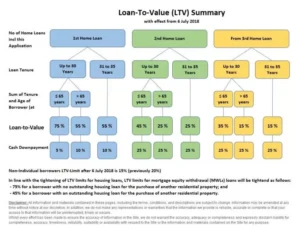
Every purchase price splits into two parts: the bank loan and your downpayment.
In Singapore, the maximum LTV for a first home loan (tenure under 30 years, borrower under 65) is 75%. That leaves a minimum downpayment of 25%, split between 5% cash and the rest from cash or CPF.
Push the loan tenure past 65, or stretch it beyond 30 years, and LTV drops to 55%. Already servicing another mortgage? Same 55% cap applies.
Formula: Downpayment = Purchase Price − Loan Amount
2. Total Upfront Cash Outlay
Downpayment is just the start. BSD, ABSD, legal fees, and (occasionally) agent commission all stack on top, and together they’re what you actually need in the bank before collecting your keys.
Purchase Price | BSD Rate |
First $180,000 | 1% |
Next $180,000 | 2% |
Next $640,000 | 3% |
Remaining amount | 4% |
Rough shortcut: under $1 million, BSD is about (Price × 3%) − $5,400. Above $1 million, it’s about (Price × 4%) − $15,400.
ABSD depends on residency and how many properties you already hold.
Buyer Profile | 1st Property | 2nd Property | 3rd+ Property |
Singapore Citizen | 0% | 20% | 30% |
Singapore PR | 5% | 30% | 36% |
Foreigner | 60% | 60% | 60% |
If ABSD applies to you, look into the legal ways to reduce it before you commit. It’s often the single biggest line item in the entire budget, bigger than legal fees and agent commission combined.
3. TDSR and MSR: Will the Bank Even Say Yes?
This is the one most first-timers skip. It’s also the one that kills deals at the worst possible moment.
Total Debt Servicing Ratio caps all your monthly debt, including the new mortgage, at 55% of gross monthly income. Buying an HDB flat? Mortgage Servicing Ratio applies too, capping housing repayments at 30% of income.
Formula: TDSR = (Total Monthly Debt Repayments ÷ Gross Monthly Income) × 100
Run this before you fall for a unit, not after. There’s no point touring a $2 million condo if the bank will only lend against $1.4 million.
4. Net Rental Income
Net rental income is what’s actually left after collecting rent and paying every real expense tied to owning the unit.
Item | Amount |
Potential Rental Income (annual) | $42,000 |
Less: 1-Month Vacancy | ($3,500) |
Effective Rental Income | $38,500 |
Less: Property Tax | ($4,440) |
Less: Furnishing & Upkeep | ($3,500) |
Less: Condo Maintenance Fees | ($4,560) |
Less: Insurance | ($730) |
Less: Agent’s Commission | ($1,750) |
Net Rental Income | $23,520 |
Formula: Net Rental Income = Gross Rental Income − Operating Expenses
5. Gross Rental Yield
Gross rental yield is the fastest way to compare two condos, because it ignores financing and expenses and just looks at rent versus price.
Formula: Gross Rental Yield = (Annual Rental Income ÷ Purchase Price) × 100
A $1,000,000 condo renting at $3,500 a month works out to ($3,500 × 12) ÷ $1,000,000 × 100 = 4.2%.
It’s a blunt tool. Most decent luxury condos for sale in Singapore sit somewhere between 2.5% and 4% gross yield, so anything well above that range deserves a second look at why.
6. Net Rental Yield (Cap Rate)
Net rental yield, or cap rate if you want the technical name, takes gross yield and strips out the real running costs. Property tax, maintenance, insurance, commission, all of it.
Formula: Net Rental Yield = (Net Rental Income ÷ Purchase Price) × 100
This is the number serious buyers trust. Gross yield can make a property look great right up until the maintenance bill shows up.
7. The 1% Rule
Borrowed from US property investing, but still a decent quick screen here. Monthly rent should be at least 1% of the purchase price for a unit to earn a closer look as a rental play.
On a $1,000,000 condo, that’s $10,000 a month in rent.
Very few Singapore condos actually clear a full 1% today. Prices have run well ahead of rents in most prime areas. Treat it as a screening tool, not gospel. Anything near or above 1% deserves priority attention. Anything under 0.5% needs a much stronger appreciation story to justify the price tag.
8. Gross Rent Multiplier (GRM)
GRM tells you roughly how many years of rent it would take to “buy back” the property, purely based on rental income.
Formula: GRM = Purchase Price ÷ Annual Rental Income
On that same $1,000,000 condo earning $42,000 a year in rent, GRM = $1,000,000 ÷ $42,000 = 23.8.
Lower GRM generally means better rental value. It’s one of the simpler real estate investment calculations on this list, and a fast way to rank a shortlist before digging deeper.
9. Debt Service Coverage Ratio (DSCR)
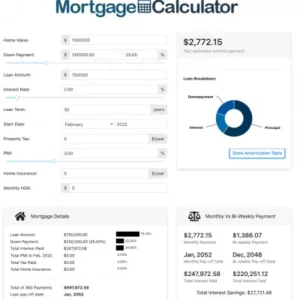
DSCR checks whether the rental income actually covers the mortgage repayment, which matters a lot more once interest rates move against you.
Formula: DSCR = Net Rental Income ÷ Annual Mortgage Repayment
A DSCR above 1.0 means rent covers the loan. Below 1.0, you’re topping up the shortfall from your own pocket every month. Most banks and seasoned investors like to see DSCR comfortably above 1.2, since that buffer absorbs a vacancy month or a rate hike without turning into a crisis. Of all the real estate investment calculations here, this is the one that quietly protects you when the market turns.
10. Cash-on-Cash Return
Cash-on-cash return measures cash flow against the actual cash you put in, not the full purchase price. Arguably more honest than gross yield, since it accounts for leverage.
Formula: Cash-on-Cash Return = (Annual Net Cash Flow ÷ Total Cash Invested) × 100
Take Peter and Jane. They buy a $1,000,000 condo with a $250,000 downpayment. Total cash outlay, downpayment plus closing costs, comes to $397,000. The unit rents for $3,500 a month, or $42,000 a year.
Cash-on-Cash Return = $23,520 ÷ $397,000 = 5.9%
If cash flow matters more to you than paper gains, this is the number to watch. It tells you how hard your money, not the bank’s, is actually working.
11. Payback Period
Payback period is how long it takes to recover your initial investment purely through rental income.
Formula: Payback Period = Purchase Price ÷ Annual Rental Income
Same $1,000,000 condo at $3,500 monthly rent: $1,000,000 ÷ $42,000 = 23.8 years.
Shorter is generally better, but a long payback period isn’t automatically a dealbreaker. Plenty of prime district units carry long payback periods because buyers are paying for appreciation and prestige over pure yield. Just know the number before you sign, not three years after.
12. Capital Appreciation
Nobody can predict this one with real precision, and anyone who tells you otherwise is selling something. Singapore private property has appreciated anywhere from 2% to over 16% in a given stretch, depending entirely on where you are in the cycle.
For planning purposes, model conservatively. Somewhere around 2.5% to 3% a year is a safer assumption than extrapolating off the best years the market has ever had.
Formula: Return on Equity = (Estimated Profit ÷ Downpayment) × 100
A $1,000,000 property appreciating 3% a year for 5 years generates roughly $100,000 in paper profit. Against a $250,000 downpayment, that’s a 40% return on equity over 5 years, around 8% annually once leverage is factored in. That’s a genuinely solid figure.
13. Price Per Square Foot
The simplest tool in the whole toolkit, and still one of the most misused. PSF lets you compare units of different sizes on equal footing, whether within one development or across projects in the same district.
Formula: Price Per Square Foot = Purchase Price ÷ Floor Area (sq ft)
Don’t use PSF alone though. A lower PSF sitting next to a higher one in the same project usually points to a worse layout, a lower floor, or an awkward facing, not a bargain. Pair it with layout efficiency before drawing any conclusions.
Putting the Numbers Together
None of these real estate investment calculations mean much on their own. A property with a fantastic gross yield but a 40-year payback period and negative cash-on-cash return isn’t a good investment. It’s a trap wearing one flattering number as a disguise.
Here’s roughly how we sequence it for buyers we work with:
- Check TDSR and MSR first, so your real budget is set before you view anything.
- Work out total upfront cash outlay, including ABSD, so nothing surprises you at OTP stage.
- Run gross and net rental yield to build a shortlist.
- Apply the 1% rule and GRM as quick screens if rental income matters to you.
- Check DSCR, cash-on-cash return, and payback period on your top two or three picks.
- Model capital appreciation conservatively as the final gut check.
Do this properly and you walk into a purchase with your eyes open, instead of discovering three years in that the “great deal” barely broke even.
Getting the Numbers Right Before You Buy
You can run these calculations yourself, no question. But cross-checking them against current cooling measures, TDSR limits, and the specific development you’re eyeing takes local, up-to-date knowledge, and that’s really where a second pair of eyes helps.
If you’d like someone to run these numbers against your actual budget before you view a single unit, our team offers a straightforward property consultation covering your TDSR, target yield, and holding strategy. For buyers thinking longer-term about entry timing, unit selection, and exit strategy, it’s worth a conversation with a dedicated Singapore property investment advisor before making an offer.
Still narrowing down where to put your money? Our guide on which condo is good for investment and our breakdown of how much a condo actually costs in Singapore are worth reading next.
At SG Luxury Condo, we’ve sat through enough of these conversations to know the buyers who do well aren’t the ones who moved fastest. They’re the ones who ran the real estate investment calculations first. If you’re browsing luxury condos for sale in Singapore and want someone to check your math before you commit, we’re happy to help.