TL;DR
- The most profitable Singapore properties share five traits: school proximity, MRT access, strong resale interest, larger unit sizes, and an attractive entry price.
- A unit within 1km of a top primary school taps into a steady pool of motivated buyers thanks to MOE’s priority admission rules.
- Entry price does most of the heavy lifting — even a 1 percent difference in your entry PSF compounds meaningfully over a 5–10 year hold.
- Macro factors like interest rates, cooling measures, and the future supply pipeline matter just as much as the property itself.
- Undervalued doesn’t automatically mean profitable — a cheap entry price on a weak location rarely appreciates the way people expect.
When you’re buying property in Singapore, whether as a home upgrader or a serious investor, one goal tends to sit above everything else: capital appreciation. The honest question is — how do you actually spot a unit that’s going to be worth meaningfully more in five or ten years?
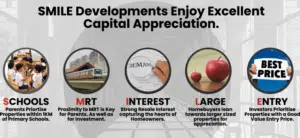
Nobody has a crystal ball, but the properties that appreciate the most almost always share the same DNA. I call it the S.M.I.L.E factors, and this guide walks through each one with real transaction data, plus a few things most articles on this topic skip.
What Is Property Capital Appreciation, Exactly?
Property Capital Appreciation is the increase in a property’s value between when you buy it and when you sell it. Buy a freehold condo for $800,000 and sell it five years later for $1,166,000, and your capital appreciation is $366,000.
It’s distinct from rental yield, which is the income a property generates while you hold it. A strong investment usually has both working in your favour — steady rental income covering your mortgage, and the asset climbing in value at the same time.
The S.M.I.L.E Framework at a Glance
Factor | What to look for | Why it drives appreciation |
School proximity | Within 1km of a popular primary school | MOE priority admission creates a steady, motivated buyer pool |
MRT access | 5–8 minute walk to a station | Widens your buyer and tenant pool significantly |
Interest / resale demand | Few listings, frequent transactions at higher PSF | Signals tight supply and strong buyer confidence |
Larger unit sizes | 1,000+ sqft for 3-bedders and up | Scarcity value as newer launches shrink in size |
Entry price | Below market average for comparable units | Appreciation starts with what you pay, not just what you sell for |
Factor 1: Within 1km of a Good Primary School
For parents, living near a reputable primary school isn’t a nice-to-have — it’s often the deciding factor in a purchase. Being within 1km of a sought-after school shifts buying decisions, and it’s policy driving that, not sentiment.
Why it matters: MOE’s priority admission rule gives an edge to families within this radius, creating a steady, motivated pool of buyers willing to pay a premium to secure that catchment.
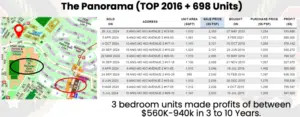
The Panorama is a good example — a 698-unit development that TOP’d in 2016. At launch in 2013, it struggled, landing right as new ABSD cooling measures kicked in. Despite that rough start, 3-bedroom units have since posted profits of between $560,000 and $940,000 over holds of 3 to 10 years.
Factor 2: Proximity to MRT
Whether it’s parents shuttling kids to school or tenants commuting into the CBD, MRT access is close to non-negotiable for a large slice of Singapore’s buyer pool. The rule of thumb holds up well: the closer, the better, ideally a 5 to 8 minute walk.
Why it matters: Easy MRT access widens your buyer and tenant pool considerably, especially for investors chasing rental yield, since tenants routinely rank commute time above almost everything else. Even in fringe estates, projects near upcoming lines like the Thomson-East Coast Line have seen resale prices tick up well before the station opens.
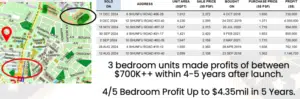
Jadescape is a solid case study — a 1,204-unit development that TOP’d in 2022, with 3-bedroom units posting profits around $700,000 or more within just 4 to 5 years, while larger 4–5 bedroom units have seen profits climb as high as $4.35 million over the same window. Jadescape checks nearly every S.M.I.L.E box at once: good schools nearby, MRT access, generous unit sizes, and a reasonable entry price at launch.
Factor 3: Strong Resale Interest and Tight Supply
Some developments have an “X-factor” — units barely list before they’re gone. That’s strong resale interest, one of the clearest signals of a property that will hold or grow in value, because scarcity keeps prices buoyant even in a slower market.
Developments with strong demand from HDB upgraders tend to create a durable engine for appreciation, since that demand pool refreshes constantly.
How to spot it:
- Very few or zero active listings on PropertyGuru or 99.co usually means existing owners aren’t keen to sell, and supply is genuinely tight.
- Frequent resale transactions at rising PSF on URA data signal liquidity and buyer confidence, not a stagnant market.
Real examples:
- Clementi Park often has fewer than three units listed at any time. With that little competing supply, sellers can command strong prices simply because buyers have nowhere else to go within the same development.
- High Park Residences in Sengkang sits surrounded by 1,498 BTO flats. Owners of nearby 4-room BTOs are enjoying profits above $400,000, while 5-room BTO owners are seeing gains past $500,000. High Park itself, despite being a mega development with 1,390 units, has still climbed 67.44 percent since its 2016 launch — proof that scale alone doesn’t kill demand if the fundamentals are right.
A quick caution here, because it trips people up constantly: undervalued does not automatically mean profitable, even when the entry price looks like a steal.
Factor 4: Larger Unit Sizes
Newer condos keep getting smaller, which quietly makes spacious layouts a genuine rarity. That scarcity works in your favour as an owner, especially as family sizes and lifestyle expectations shift back toward wanting more room.
Why it matters: Bigger units appeal to multi-generational families and affluent upgraders leaving HDBs, and both groups are consistently willing to pay for the extra space.
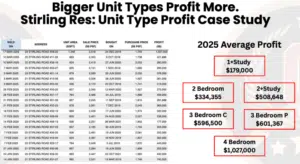
Older developments like Archipelago and Stirling Residences, offering 1,500+ sqft 3-bedders, have outpaced smaller units in price growth over the last decade — demand from families who simply want more room to breathe.
Factor 5: Attractive Entry Price
For investors, the money is largely made on entry, not exit. Buying below the market average for a location and quality tier leaves far more room for appreciation — and this is the one factor entirely within your control.
How to spot it:
- Compare PSF against nearby projects with similar facilities, age, and tenure.
- Look for undervalued launches in emerging growth zones, often available before an MRT line completes or a URA masterplan upgrade lands.
Early buyers of Parc Esta entered at around $1,600 PSF back in 2018. Within four years, prices had crossed $2,000 PSF, riding both a broader market recovery and the convenience of Eunos MRT nearby. That gap sounds small on paper, but shaving even 1 percent off your entry PSF compared to comparable units compounds meaningfully across a 5 to 10 year hold, especially once leverage from your loan is factored in.
Beyond S.M.I.L.E: Macro Factors That Move Every Property’s Price
The five factors above explain why one unit outperforms a similar one nearby. But they sit inside a bigger picture that affects every property in Singapore at once:
- Interest rates. Higher borrowing costs cool demand across the board; lower rates tend to reignite it.
- Cooling measures. ABSD, loan-to-value limits, and stamp duty adjustments are policy levers used deliberately to manage price growth.
- Land scarcity. Singapore’s limited land area makes new Government Land Sales sites structurally tight, not just cyclically tight.
- Economic strength and employment. Property prices track job security and wage growth closely.
You can’t control these, but tracking them tells you whether you’re buying into a rising tide or swimming against one.
Freehold vs Leasehold: Does Tenure Affect Property Capital Appreciation?
Tenure shapes long-term appreciation more than most first-time buyers realise. Freehold properties tend to command a premium and hold value better over long horizons, since there’s no lease decay eating into the asset. Leasehold properties, particularly 99-year leases past the 30-year mark, can see valuation and financing get noticeably harder as the remaining lease shrinks.
That doesn’t make leasehold a bad choice — plenty of leasehold projects in strong locations still appreciate well within a typical 10 to 15 year hold. It’s just one more line item worth checking, not an afterthought.
The Supply Pipeline Check Most Investors Skip
A great unit in a great location can still underperform if a wave of similar projects launches nearby in the following 1 to 3 years and floods the resale and rental market. Before committing, check:
- How many comparable projects (by price band and location) are under construction or recently launched nearby
- Whether unsold developer stock in the area is high or genuinely tight
- Whether recent Government Land Sales activity in the district signals more supply is coming
Heavy pipeline means you may need a sharper entry price or more conservative rental assumptions. Scarce supply means you can lean harder into that as part of your appreciation thesis.
How to Calculate Your Expected Property Capital Appreciation
Worth running the actual numbers rather than eyeballing it:
Capital Appreciation = Selling Price − Purchase Price
Buy an HDB 3-room flat for $500,000 and sell it five years later for $900,000, and your capital appreciation is $400,000. Buy a freehold condo at $800,000 and sell at $1,000,000, and your gain is $200,000.
Pair this with rental yield if you’re holding along the way: annual rental income divided by property value, times 100. An $800,000 unit renting for $5,000 a month generates $60,000 a year, a yield of 7.5 percent. Strong investments usually combine a healthy yield with steady appreciation, rather than leaning entirely on one or the other.
New Launch vs Resale: Which Appreciates Better?
This comes up in nearly every consultation, and honestly it depends on timing more than the launch type itself. New launches often let early buyers in at a promotional price before the developer raises prices in later phases, baking in appreciation before you’ve even collected the keys. Resale units come with visible transaction history, so any pricing inefficiency is easier to verify.
If pure capital growth is the goal, resale projects in strong owner-occupier locations near MRT lines, schools, and business corridors often present a cleaner risk-reward setup, since the buyer pool at exit is broader and less dependent on momentum.
Common Mistakes That Kill Capital Appreciation
- Chasing “undervalued” without checking why. A low price sometimes reflects genuine opportunity, sometimes a real problem with the unit or location.
- Ignoring the supply pipeline. A great location can flatten for years if competing launches hit the same street right after you buy.
- Overpaying for the “early bird” narrative. Not every early-bird discount is meaningfully below fair value.
- Treating tenure as an afterthought. A 99-year lease with 60 years left behaves very differently, financing-wise, from one with 30 years remaining.
- Skipping the maths. Going on a gut feeling instead of checking actual URA transaction data and PSF trends.