TL;DR: The URA Master Plan is Singapore’s statutory land use blueprint, updated every five years, showing how every plot of land will be used for the next 10 to 15 years. The current version is the Draft Master Plan 2025, exhibited from November 2024, which confirms Jurong Lake District as Singapore’s second CBD, expands Woodlands Regional Centre, and adds a green corridor along Orchard Road. Smart investors use the URA Master Plan to spot transformation zones before prices catch up, focusing on plot ratio increases, new MRT lines, and confirmed (not just proposed) infrastructure spend, then buy early and hold through the multi-year transformation window.
Every seasoned property investor in Singapore has one document permanently bookmarked, and it isn’t a listing site. It’s the URA Master Plan. If you’ve never actually opened it, you’re essentially investing with one eye closed, because this is the closest thing to a crystal ball the property market actually offers.
At SG Luxury Condo, this is the first thing we pull up with clients weighing where to invest next, before we even talk about specific projects. Here’s how to actually read it, and more importantly, how SG Luxury Condo uses it to spot opportunities before the rest of the market catches on.
What the URA Master Plan Actually Is
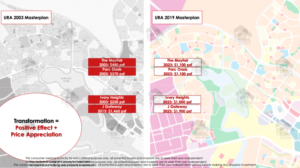
The URA Master Plan is a statutory land use plan prepared under the Planning Act, defining what can legally be built on every piece of land in Singapore for the next 10 to 15 years. It’s reviewed every five years, translating the broader, longer-term Long-Term Plan into the specific, ground-level detail that actually shapes what gets built where.
A few components matter most if you’re using it for property investment:
- Zoning colours – residential, commercial, business, and civic & community land uses are each colour-coded, so you can instantly see what’s planned around a specific plot
- Plot ratio (Gross Plot Ratio, or GPR) – the ratio of total floor area allowed against the land size. A plot ratio of 2.8 means a developer can build 2.8 times the land area in gross floor space. Higher plot ratios generally mean more units, and more value, for that piece of land
- White sites – flexible zoning that permits a mix of commercial, residential, hotel, and recreational use, often found in the Core Central Region and typically signalling a future integrated, higher-value development
- URA Space – the free, interactive online map tool where you can search any address and see its current zoning, plot ratio, and any confirmed or draft amendments layered on top
The Draft Master Plan 2025: What’s Actually New
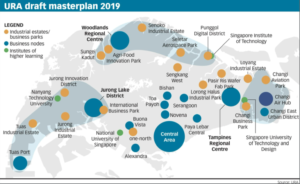
The current version, Draft Master Plan 2025, was exhibited to the public from November 2024, and it’s worth knowing the headline changes if you’re making an investment decision today.
Area | Key Change | Why It Matters for Investors |
Jurong Lake District | Confirmed as Singapore’s second CBD | Sustained mixed-use growth through the 2030s, boosted further by the Jurong Region Line |
Woodlands Regional Centre | Expanded as the largest northern hub | Long growth runway, better suited to patient, longer-horizon investors |
Orchard Road | New 2.4km green urban corridor, possible car-free sections | District 9 properties along this stretch gain a lasting amenity uplift |
Bishan | Slated as a sub-regional centre with added office space | More daytime footfall and commercial spillover for nearby residential units |
Holland Village | Rejuvenation with new residences and retail | A rare new supply injection into a historically undersupplied enclave |
We’ve broken this specific draft down in far more detail, area by area, in our dedicated guide on the URA Draft Master Plan 2025, which pairs well with the investment strategy covered here.
The Two Things We Always Check First
When SG Luxury Condo reviews the URA Master Plan for a client, two factors matter more than anything else on the page.
- Transformation – Identify nearby future growth areas that could lift property value. If the government is investing serious infrastructure money into a location, that’s usually a strong signal worth following.
- Rejuvenation – Look for older buildings with genuine en bloc potential, or vacant land earmarked for new residential development. Both tend to push surrounding property prices upward over time. If you’re specifically weighing a purchase for its redevelopment upside, our guide on the pitfalls of buying a property just for en bloc potential is worth reading first, since this strategy carries real risks of its own.
Five Filters for Spotting a Genuine Growth Opportunity
Not every highlighted zone on the Master Plan turns into a strong investment. Here’s how we separate the real opportunities from the ones that look good on paper but never quite materialise.
- Is the regeneration actually funded? Planning permission alone means little. Years, sometimes decades, can pass before a site with only planning approval sees a shovel in the ground.
- Is the scale large enough? A small, isolated project rarely moves the needle on surrounding property values or rents.
- Is the development broad-based? The strongest transformation zones combine residential, commercial, leisure, schools, and transport, not just another apartment block.
- Are you prepared to take a long view? To capture the full upside, you generally need to buy early and hold for a decade or more before, if no further investment follows, the area’s growth story plateaus.
- Is a proven developer involved? Large-scale transformation is rarely pulled off successfully by smaller, less-established developers.
No location checks every one of these boxes perfectly. The real skill is buying in when you have genuine conviction the area is changing, but before the property portals and “expert” columns start writing about it, a skill SG Luxury Condo has built up across countless transformation zones over the years.
Timing Your Entry: The Three Phases of Urban Transformation
Every transformation zone moves through roughly the same three phases, and where you enter matters enormously for your eventual return.
Phase | What’s Happening | Price Behaviour |
Pre-transformation | Confirmed plans exist, but visible construction hasn’t started | Prices still low, awareness limited, biggest upside available |
Mid-development | MRT lines, roads, and malls actively under construction | Prices climbing steadily as the story becomes visible |
Post-completion | Area is “hot,” infrastructure is live | Prices already reflect the future value; upside is mostly captured |
Buying in Phase 1, or early Phase 2, generally captures the most appreciation. Waiting until Phase 3 means you’re paying today for gains that already happened.
Regional Snapshot: Where the Growth Stories Sit Today
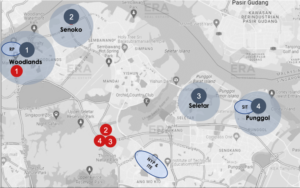
North – Woodlands Regional Centre remains a long-horizon play, likely needing 15 to 20 years for its full growth story to play out, though it’s well suited to patient investors. Punggol continues to offer a steadier, shorter-horizon growth path over the next decade.
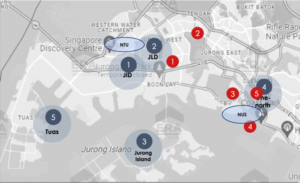
West – Jurong Lake District’s confirmation as a second CBD is the single biggest growth story on the current Master Plan. Watch land prices carefully though, some pockets close to the core have already run up significantly, so the outskirts, Jurong West, Boon Lay, and Lakeside, may offer better relative value today.
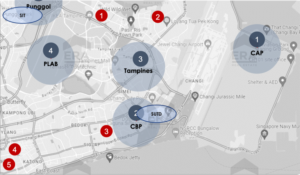
East – Changi Business Park, the Changi Aviation Hub, and the Cross Island Line’s eastern stretch are gradually knitting Pasir Ris, Tampines, and the Changi area more tightly into the rest of the island. These pockets still trade at relatively affordable levels for what’s coming.
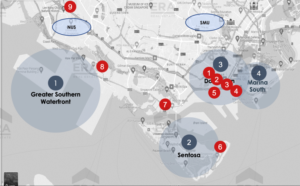
South – The Greater Southern Waterfront remains a genuinely long-term story, likely 15 to 20 years out, since the land itself, formerly Tanjong Pagar and Pasir Panjang port sites, is still being progressively cleared for redevelopment.
Crafting Your Exit Strategy
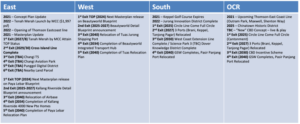
A clear exit strategy matters just as much as your entry timing. Coordinating your investment horizon with the Master Plan’s own milestones is how you actually capture the appreciation you were betting on in the first place.
A short 3 to 5 year hold works better in areas already mid-transformation, where infrastructure is visibly landing soon. A longer-horizon, patient hold suits areas still in the pre-transformation phase, where the full growth story may take a decade or more to unfold, but the entry price reflects that uncertainty.
A Word From SG Luxury Condo
The URA Master Plan is genuinely one of the most powerful, and most underused, tools available to Singapore property investors, precisely because it’s entirely public and free to access. The investors who consistently do well with it aren’t the ones with insider information, they’re the ones patient enough to buy early, hold through the noisy middle years, and exit once the transformation story has actually played out.
If you’re weighing a specific district against what the current Master Plan actually confirms, versus what’s still just proposed, SG Luxury Condo is happy to walk through it with you. Our property consultation sessions cover exactly this kind of location analysis, and our Property P.L.U.S System combines Master Plan research with the numbers side of due diligence so you’re not relying on either alone. You’re also welcome to browse our full range of luxury condos for sale in Singapore if you’re ready to start shortlisting against these growth corridors.