People ask me often how I got into property investment in the first place. Honestly, it started with a book, Rich Dad Poor Dad by Robert Kiyosaki. If you haven’t read it, the short version is this: it compares two father figures, one who worked hard for money his whole life, and one who made money work for him through assets like real estate. That idea, using other people’s money and time as leverage, genuinely reshaped how I thought about building wealth.
Over the years, watching how property has actually performed for clients at SG Luxury Condo, I keep coming back to the same three reasons why property is the best form of investment I recommend to almost everyone starting out. Let me walk you through them.
Reason 1: Property Offers the Best Form of Leverage
To understand why leverage matters so much, it helps to look at what’s sometimes called the Wealth Triangle, a simple framework built around three ways people generate wealth.
Wealth Triangle Component | What It Means | Examples |
High Income Skills | A skill valuable enough to trade for strong, consistent pay | Coding, consulting, sales |
Scalable Business | A business that grows without needing huge overheads | E-commerce, online services |
High Return Investments | Assets that build long-term wealth and passive income | Stocks, bonds, real estate |
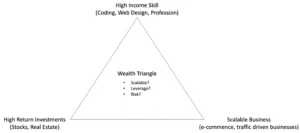
The Wealth Triangle: three paths to building long-term wealth
For this first reason, we have to take a look at what we call a Wealth Triangle, a conceptual framework made up of three fundamental components to generate wealth: High Income Skills, Scalable Business and High Return Investments.
Firstly, High Income Skills form the base of the pyramid. It is any valuable skill that can earn you a consistent and substantial amount of money each month. If you are able to develop a high income Skill, you can deliver value to the marketplace and trade your skill and expertise for very good money. Some examples of high income Skills include coding, web design, and consulting.
The second component of the Wealth Triangle is Scalable Business. Essentially, this refers to a business that you can grow and develop without the need of a lot of overheads or infrastructure. You do not need to spend large amounts of money to grow this business. Examples of scalable businesses are businesses that operate online, like e-commerce (Amazon, Drop-shipping) or traffic driven businesses. Scalable businesses are therefore systems that are in place that provide you with cash flow and makes you money, even while you are deep in sleep!
The final component of the Wealth Triangle is High Return Investments, which help to build your wealth, net worth and passive income. Some examples include stocks, bonds, mutual funds, and of course, real estate.
As mentioned earlier, Rich Dad Poor Dad got me into investing. While I am unable to tell you all the nitty gritty details of the book, I am proud to say that more than a decade later, I find that this one quote from the book still stands out to me.
It reads “People with leverage have dominance over people with less leverage. In other words, just as humans gained advantages over animals by creating leveraged tools, similarly, humans who use these tools of leverage have more power over humans who do not. Saying it more simply, leverage is power.”
So, you may be wondering “how does this quote relate to the Wealth Triangle?” While the Wealth Triangle seems simple, it is able to tell us a lot. Each time I look at it, I ask myself three questions:
- What is scalable?
- What can you leverage on?
- What are the risks involved for all three components?
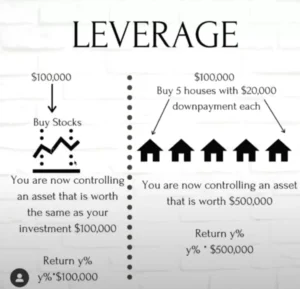
While brainstorming on the answers to these questions, I come to the conclusion that the third component—High Return Investments—has the best form of leverage, using other people’s money and time. The power of leverage in real estate therefore makes it the best form of investment that not only is scalable and also you can leverage on others yet having the lowest risk.
Reason 2: Singapore Property Is Genuinely Predictable
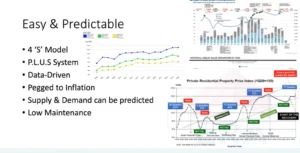
Singapore’s property market moves in patterns that are easier to read than most other asset classes
Singapore is a small, land-scarce country, which actually works in an investor’s favour. Government Land Sales, birth rates, and immigration numbers are all tracked and published, which means future supply and demand can be reasonably estimated well ahead of time, something you simply can’t do with a stock’s future price movement.
Property prices here have also tended to track inflation over the long run. When the general cost of living rises, property prices tend to rise with it, which makes property a genuine hedge against inflation eating into your savings. That doesn’t mean prices never fall, they absolutely can during an economic downturn, but a property that’s well chosen and doesn’t demand much upkeep is far easier to simply hold through a rough patch until the market recovers, compared to assets that require active, ongoing management.
Being able to actually use this predictability well comes down to having a proper system for reading the data. At SG Luxury Condo, this is exactly why we built our own Property P.L.U.S System, a structured way of screening properties using real transaction data rather than gut feeling. You don’t need decades of experience to use a system like this, you need the right framework and the discipline to follow it. Our guide on choosing the best selling condos in Singapore shows this kind of data-driven approach in action.
Reason 3: Property Is Far Safer to Enter Than Stocks
Property tends to carry far less entry risk than trading stocks
Stocks demand real skill to trade well, reading charts, timing entries and exits, understanding company fundamentals, managing emotional discipline under pressure. Get any of that wrong and it’s genuinely easy to lose a meaningful chunk of your capital quickly. We’ve all heard stories of people “burning their fingers” on a bad trade.
Property doesn’t ask nearly as much of a first-time investor. Beyond giving you a place to actually live in, it tends to deliver steadier, more predictable returns over time, even accounting for the occasional downturn. You don’t need to watch a screen daily or time your entry to the hour. A well-chosen property, held through a reasonable market cycle, has historically rewarded patience far more reliably than trying to actively trade in and out of stocks.
Why These Three Reasons Matter Together
None of these three reasons stand entirely on their own. Leverage without predictability is just a bigger bet. Predictability without safety doesn’t help if the entry itself is risky. It’s the combination, controlled leverage, a market you can reasonably forecast, and low entry risk, that makes property such a consistently recommended starting point for building wealth in Singapore.
A Real Example: How Leverage Plays Out in Practice
Numbers make this easier to picture than theory alone. Say you buy a $1,000,000 condo with a 25% downpayment, that’s $250,000 of your own money, with the remaining $750,000 financed through a bank loan.
If that property appreciates by 20% over five years, it’s now worth $1,200,000. Your gain is $200,000. But measured against your actual cash outlay of $250,000, that’s an 80% return on your own money, not 20%. That gap between the asset’s growth and your actual return is leverage doing exactly what it’s supposed to do. Try replicating that kind of amplified return with a stock purchase you paid for entirely in cash, and the math simply doesn’t stretch the same way.
Property vs Other Common Investments
It helps to see property lined up directly against the other assets people usually consider, rather than just taking the case for property at face value.
Asset | Typical Entry Barrier | Leverage Available | Skill Needed to Manage | Volatility |
Property | Moderate to high (downpayment + fees) | High (up to 75% LTV) | Low, mostly research upfront | Low to moderate |
Stocks | Low | Limited, unless margin trading | High, active monitoring helps | High |
Bonds | Low to moderate | Minimal | Low | Low |
Cryptocurrency | Very low | Varies widely | Very high | Very high |
This isn’t to say stocks or bonds don’t have their place in a balanced portfolio, they absolutely can. But if you’re weighing where to put your first serious chunk of investment capital, property’s combination of manageable skill requirements and strong available leverage is hard to match on this table.
Addressing the Common Doubts
A few objections come up constantly whenever this topic gets discussed, and they’re worth addressing honestly rather than glossing over.
- “Property isn’t liquid, I can’t sell it quickly.” True, and this is a genuine trade-off. Property suits patient capital, not money you might need back within months. If liquidity is your top priority, keep a separate emergency fund outside of property entirely.
- “The entry cost is too high for most people.” It’s higher than buying a single stock, certainly, but the 25% downpayment threshold is exactly what makes the leverage work in your favour once the property appreciates.
- “What if the market crashes right after I buy?” This is precisely why holding power matters so much, a property with low maintenance needs is far easier to simply hold through a downturn than a leveraged stock position facing a margin call.
- “Isn’t property investment risky if I don’t know the market well?” This is exactly the gap a structured system, rather than gut instinct, is meant to close, which is why having the right research framework matters more than raw experience.
A Word From SG Luxury Condo
I’ve shared these three reasons why property is the best form of investment with countless clients over the years, and the logic has held up consistently: strong leverage, genuine predictability, and far lower entry risk than most alternatives. None of this means every property purchase automatically succeeds, the right system and the right numbers still matter enormously.
If you’d like help applying this thinking to your own situation, SG Luxury Condo is happy to walk through it with you. Our property consultation sessions cover exactly this kind of planning, and you can check our track record to see how this approach has worked for past clients. You’re also welcome to browse our full range of luxury condos for sale in Singapore whenever you’re ready to start.