Buying Property in Singapore Using Search Analytics
Categoriesarticles

Buying Property in Singapore Using Search Analytics

TL;DR: Search analytics tracks what people are actually searching for and clicking on, not just what they eventually buy. PropertyGuru’s Popularity Index blends page views (40%) and enquiries (60%) into a single score, giving a quick read on genuine buyer interest. Layering this against keyword trends, top-searched condos, and top districts reveals patterns transaction data alone won’t show you, like which areas are quietly gaining momentum before prices catch up. A quick note: search rankings shift over time, so treat the specific rankings below as a snapshot of the data at the time this was pulled, and refresh the numbers periodically rather than treating them as permanently fixed.

Most people still shop for property the old-fashioned way, location, amenities, developer name, gut feeling. There’s nothing wrong with that, but it misses a genuinely useful signal hiding in plain sight: what people are actually searching for online, right now, before they’ve even spoken to an agent.

At SG Luxury Condo, we’ve started pulling data directly from PropertyGuru, Singapore’s largest property portal, to see what buyers and renters are genuinely typing into the search bar. It turns browsing behaviour into a real dataset, one that shows demand forming before it shows up in transaction numbers. Here’s how we use it, and what it’s currently telling us.

Understanding the Popularity Index

At the centre of this approach is the Popularity Index, a simple score that measures how much genuine interest a listing or area is getting. It combines two things:

  • Page views (40% weight), how many people are looking at a listing
  • Enquiries (60% weight), how many people are actually taking the next step and reaching out

Enquiries count for more because clicking a listing is passive, but sending an enquiry shows real intent. Here’s how the maths works in a simple example: a listing with 100 page views and 50 enquiries gets a Popularity Index of (100 × 0.4) + (50 × 0.6) = 70. The higher the score, the stronger the genuine buyer or renter interest behind that listing.

What Keyword Trends Actually Tell You

Beyond individual listings, it’s worth watching the keywords people search for overall, terms like “sea view condo,” “near MRT,” or “freehold property.” These searches reveal what buyers currently care about, sometimes months before that demand shows up in actual sales data.

Looking at the Top 20 and Top 40 most-searched terms lets you spot which districts and property types are pulling attention right now. If a specific district keeps climbing the rankings, that’s often an early signal of growing tenant or buyer interest, well before prices in that area start moving.

Top 20 Keywords People Search For
Top-20-Keywords

Top 20 Keywords People Search on PropertyGuru

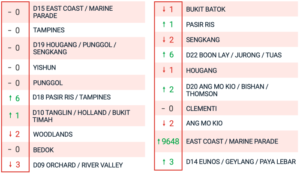
This ranking is based on how often each district or area name gets searched. It doesn’t break down whether someone’s looking for an HDB flat, a condo, or a landed home, just raw interest in the location itself.

A few patterns stand out. Areas like East Coast, Marine Parade, Tampines, District 19, and District 10 have stayed consistently popular over time, showing steady, reliable demand rather than a short-lived spike. Meanwhile, District 18 (Pasir Ris/Tampines) and District 22 (Boon Lay/Jurong/Tuas) both saw noticeable jumps in ranking, more than 6 positions each, suggesting growing interest in these two areas specifically.

Top 40 Keywords People Search For
Top 40 Keywords Search

Top 40 Keywords People Search on PropertyGuru

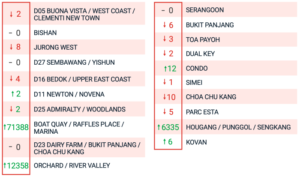
Moving further down the list, into ranks 21 through 40, District 1 (Boat Quay/Raffles Place/Marina) and District 9 (Orchard/River Valley) both show up with strong jumps in search interest. That’s not entirely surprising, the Core Central Region carries real long-term potential, something we’ve covered in our piece on undervalued vs profitable properties.

Most other rankings stayed fairly stable, aside from Jurong West and Bukit Panjang, which both slipped a handful of positions. One notable name worth flagging, Parc Esta was the only individual condo project to crack this Top 40 list, but its ranking had dropped compared to before, a signal worth watching if you’re holding a unit there and thinking about your exit timing.

Top 10 Condos People Search For (By Sale)
Top 10 Condo Search via Sales

Top 10 Most Searched Condos via Sales

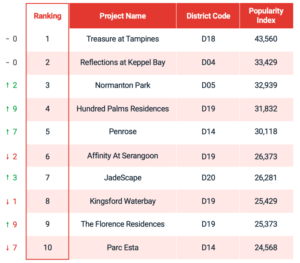
This chart shows the specific private condo projects generating the most sale-side search interest. Two clear patterns emerge here. First, aside from a couple of older exceptions, most of these projects were brand new, typically just 1 to 2 years post-TOP, suggesting buyers strongly favour newer stock when actively house-hunting.

Second, roughly half of these projects sit in Districts 18 and 19, both firmly in the Outside Central Region. Combined with the age pattern above, it points to two things mattering most to this group of searchers: how new the property is, and how affordable it is. If liquidity and a fast resale matter to you, this data suggests OCR new launches remain a genuinely strong strategy, a point we’ve explored further in our new launch versus resale comparison.

Worth noting too, most of these top-searched projects weren’t within comfortable walking distance of an MRT station, several even run their own shuttle bus service instead. Buyers searching for sale listings appear willing to trade MRT proximity for a lower psf, translating either into a cheaper unit or more space for the same budget. None of the top 10 in this category were freehold either, reinforcing that this particular buyer segment prioritises price and newness over tenure. For more on that trade-off, see our piece on freehold versus leasehold properties.

Top 10 Condos People Search For (By Rental)
Top 10 Most Search Condo via Rental

Top 10 Most Searched Condos via Rental

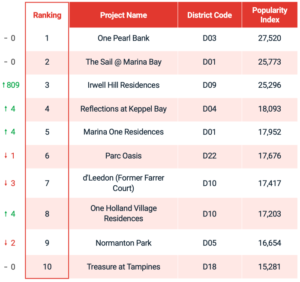
Rental searches tell a genuinely different story. Aside from a couple of outliers, most of the top-searched rental condos sit in the Core Central Region or nearby city fringe areas, and around six of the ten are close to an MRT station. If you’re buying specifically for rental income, this data suggests the priorities flip almost entirely compared to sale-side buyers, MRT proximity and closeness to the city centre matter far more to tenants than they do to owner-occupiers hunting for a home to buy.

Top 5 Condo Districts by Search Interest (Sale)
Top 5 Condo Districts (Sale)

Top 5 Condo Districts by Search Interest, Sale

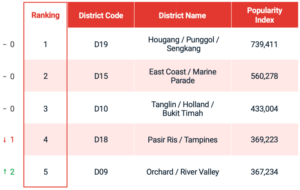
District-level data shows a genuine mix across all three regions. In the Core Central Region, Orchard and River Valley lead, followed by District 10 (Bukit Timah/Holland Road). In the Rest of Central Region, District 15 comes out on top. On the outskirts, Districts 18 and 19 dominate.

Districts 18 and 19 sit close to a large concentration of HDB estates, which suggests a lot of this search interest is coming from HDB upgraders shopping for their next home rather than pure investors. If that’s your situation, a 3-bedroom unit or larger tends to be the more sensible choice given this buyer profile.

Top 5 Condo Districts by Search Interest (Rental)
Top 5 Condo Districts (Rent)

Top 5 Condo Districts by Search Interest, Rental

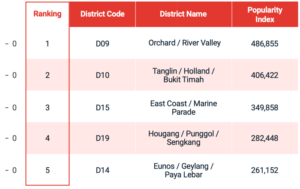
No real surprises here. Districts 9 and 10, right in the heart of the city near the CBD, dominate rental search interest. District 15, close to East Coast Park, also remains consistently popular, largely thanks to its long-standing appeal among expat tenants.

Top 5 HDB Districts by Search Interest (Sale)
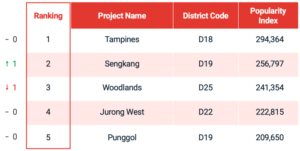
Top 5 HDB Districts (Sales)

Top 5 HDB Districts by Search Interest, Sale

Rounding things out, here’s the HDB side of the picture. Tampines, Sengkang, and Punggol lead the pack, matching closely with the top condo sale districts covered earlier. That overlap reinforces the same conclusion, a large share of buyer interest in these areas is coming from HDB owners actively looking to upgrade into a condo nearby, rather than starting their search from scratch elsewhere.

What This Means for Your Own Search

Search analytics won’t replace proper due diligence, checking a developer’s track record, running your own numbers, or reading a floor plan properly all still matter. But layering this kind of data on top of the fundamentals gives you an early read on where genuine demand is building, sometimes before it shows up in official transaction figures. If a district is climbing steadily in search interest quarter over quarter, that’s worth paying attention to, especially if you’re deciding between two similarly priced options.

A Word From SG Luxury Condo

Search behaviour is one of the more underused signals in Singapore property research, mostly because it takes real effort to pull and interpret properly. At SG Luxury Condo, we treat this kind of search analytics as one input among several, alongside URA transaction data, the URA Master Plan, and our own Property P.L.U.S System, rather than relying on any single source in isolation.

If you’d like a current read on what the search data is showing for a specific district or project you’re considering, SG Luxury Condo is happy to walk through it with you. Our property consultation sessions cover exactly this kind of research, and you’re welcome to browse our full range of luxury condos for sale in Singapore once you’ve got a clearer sense of where demand is heading.
Advanced Heading

Frequently Asked Questions

What is the PropertyGuru Popularity Index?

It’s a score combining page views (40% weight) and enquiries (60% weight) for a specific listing or area, giving a quick measure of genuine buyer or renter interest beyond just casual browsing.

Because sending an enquiry shows real intent to act, while a page view could just be casual browsing. Weighting enquiries higher makes the score a better reflection of genuine interest.

Transaction data shows what’s already happened. Search analytics shows what people are actively interested in right now, which can reveal demand building in an area before it shows up in completed sales.

Yes, quite differently. Sale-side searches tend to favour newer, more affordable OCR properties, even without MRT proximity, while rental searches skew heavily toward CCR and city-fringe locations near MRT stations.

Both districts contain a large concentration of HDB estates, and the strong search interest for nearby condos in these areas largely reflects HDB owners actively looking to upgrade rather than pure investors.

No, it’s best used alongside other research, developer track record, URA transaction data, and the Master Plan, rather than as a standalone decision-making tool.

It can shift meaningfully over months or quarters, so treat any specific ranking as a snapshot in time rather than a permanent fact, and check for updated data periodically.

Buyers searching for sale listings appear willing to trade MRT proximity for a lower price per square foot, which can mean a cheaper unit or more space for the same budget.

It can signal cooling interest in that specific project, which is worth watching closely if you’re an owner considering your exit timing, since search interest sometimes moves ahead of actual price trends.

It can offer useful early signals, a district climbing steadily in search rankings may be worth watching closely, but it should complement, not replace, fundamental checks like pricing, developer reputation, and future supply in the area.

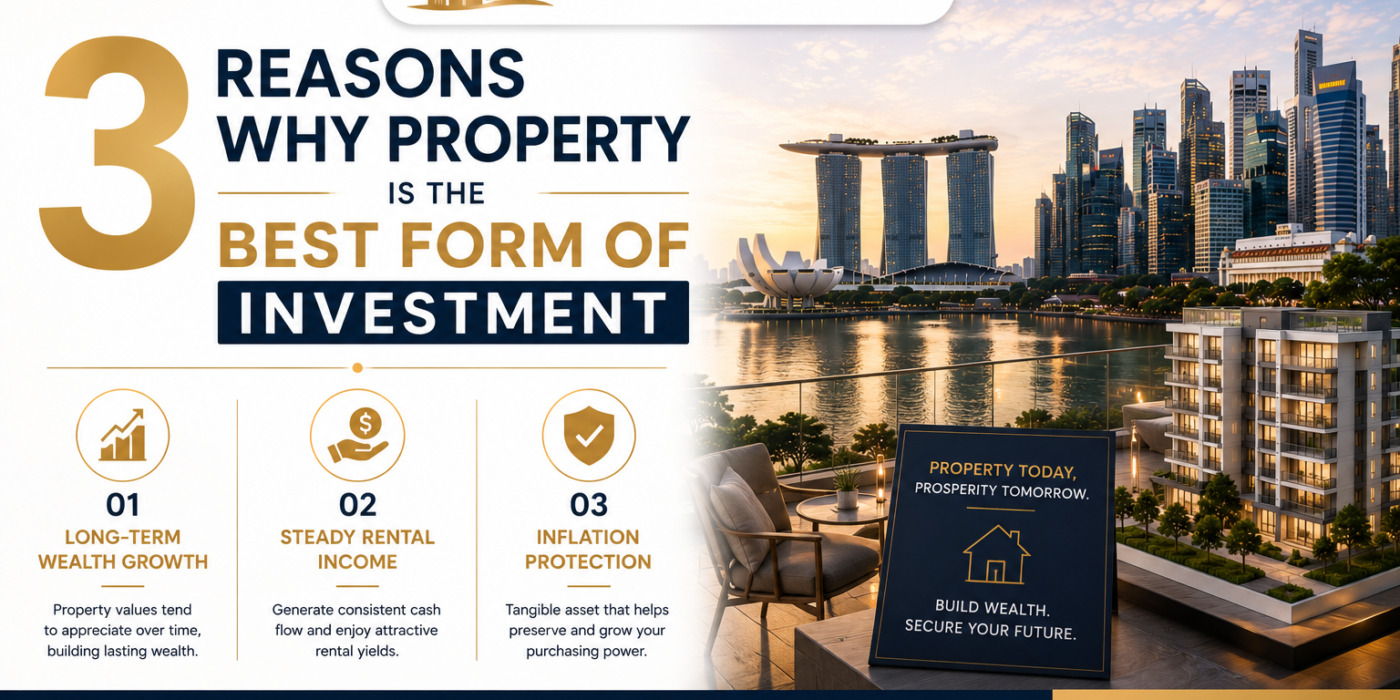
3 Reasons Why Property Is the Best Form of Investment
Categoriesarticles

3 Reasons Why Property Is the Best Form of Investment

People ask me often how I got into property investment in the first place. Honestly, it started with a book, Rich Dad Poor Dad by Robert Kiyosaki. If you haven’t read it, the short version is this: it compares two father figures, one who worked hard for money his whole life, and one who made money work for him through assets like real estate. That idea, using other people’s money and time as leverage, genuinely reshaped how I thought about building wealth.

Over the years, watching how property has actually performed for clients at SG Luxury Condo, I keep coming back to the same three reasons why property is the best form of investment I recommend to almost everyone starting out. Let me walk you through them.

Reason 1: Property Offers the Best Form of Leverage

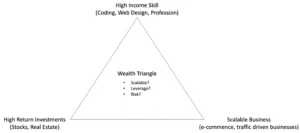
To understand why leverage matters so much, it helps to look at what’s sometimes called the Wealth Triangle, a simple framework built around three ways people generate wealth.

Wealth Triangle Component

What It Means

Examples

High Income Skills

A skill valuable enough to trade for strong, consistent pay

Coding, consulting, sales

Scalable Business

A business that grows without needing huge overheads

E-commerce, online services

High Return Investments

Assets that build long-term wealth and passive income

Stocks, bonds, real estate

best form of leverage

The Wealth Triangle: three paths to building long-term wealth

For this first reason, we have to take a look at what we call a Wealth Triangle, a conceptual framework made up of three fundamental components to generate wealth: High Income Skills, Scalable Business and High Return Investments. 

Firstly, High Income Skills form the base of the pyramid. It is any valuable skill that can earn you a consistent and substantial amount of money each month. If you are able to develop a high income Skill, you can deliver value to the marketplace and trade your skill and expertise for very good money. Some examples of high income Skills include coding, web design, and consulting.

The second component of the Wealth Triangle is Scalable Business. Essentially, this refers to a business that you can grow and develop without the need of a lot of overheads or infrastructure. You do not need to spend large amounts of money to grow this business. Examples of scalable businesses are businesses that operate online, like e-commerce (Amazon, Drop-shipping) or traffic driven businesses. Scalable businesses are therefore systems that are in place that provide you with cash flow and makes you money, even while you are deep in sleep!

The final component of the Wealth Triangle is High Return Investments, which help to build your wealth, net worth and passive income. Some examples include stocks, bonds, mutual funds, and of course, real estate.

As mentioned earlier, Rich Dad Poor Dad got me into investing. While I am unable to tell you all the nitty gritty details of the book, I am proud to say that more than a decade later, I find that this one quote from the book still stands out to me.

It reads “People with leverage have dominance over people with less leverage. In other words, just as humans gained advantages over animals by creating leveraged tools, similarly, humans who use these tools of leverage have more power over humans who do not. Saying it more simply, leverage is power.”

So, you may be wondering “how does this quote relate to the Wealth Triangle?” While the Wealth Triangle seems simple, it is able to tell us a lot. Each time I look at it, I ask myself three questions:

  • What is scalable?
  • What can you leverage on?
  • What are the risks involved for all three components?

While brainstorming on the answers to these questions, I come to the conclusion that the third component—High Return Investments—has the best form of leverage, using other people’s money and time. The power of leverage in real estate therefore makes it the best form of investment that not only is scalable and also you can leverage on others yet having the lowest risk.

Reason 2: Singapore Property Is Genuinely Predictable

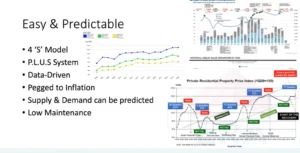
It is Easy and Predictable

Singapore’s property market moves in patterns that are easier to read than most other asset classes

Singapore is a small, land-scarce country, which actually works in an investor’s favour. Government Land Sales, birth rates, and immigration numbers are all tracked and published, which means future supply and demand can be reasonably estimated well ahead of time, something you simply can’t do with a stock’s future price movement.

Property prices here have also tended to track inflation over the long run. When the general cost of living rises, property prices tend to rise with it, which makes property a genuine hedge against inflation eating into your savings. That doesn’t mean prices never fall, they absolutely can during an economic downturn, but a property that’s well chosen and doesn’t demand much upkeep is far easier to simply hold through a rough patch until the market recovers, compared to assets that require active, ongoing management.

Being able to actually use this predictability well comes down to having a proper system for reading the data. At SG Luxury Condo, this is exactly why we built our own Property P.L.U.S System, a structured way of screening properties using real transaction data rather than gut feeling. You don’t need decades of experience to use a system like this, you need the right framework and the discipline to follow it. Our guide on choosing the best selling condos in Singapore shows this kind of data-driven approach in action.

Reason 3: Property Is Far Safer to Enter Than Stocks

Why Property Investment

Property tends to carry far less entry risk than trading stocks

Stocks demand real skill to trade well, reading charts, timing entries and exits, understanding company fundamentals, managing emotional discipline under pressure. Get any of that wrong and it’s genuinely easy to lose a meaningful chunk of your capital quickly. We’ve all heard stories of people “burning their fingers” on a bad trade.

Property doesn’t ask nearly as much of a first-time investor. Beyond giving you a place to actually live in, it tends to deliver steadier, more predictable returns over time, even accounting for the occasional downturn. You don’t need to watch a screen daily or time your entry to the hour. A well-chosen property, held through a reasonable market cycle, has historically rewarded patience far more reliably than trying to actively trade in and out of stocks.

Why These Three Reasons Matter Together

None of these three reasons stand entirely on their own. Leverage without predictability is just a bigger bet. Predictability without safety doesn’t help if the entry itself is risky. It’s the combination, controlled leverage, a market you can reasonably forecast, and low entry risk, that makes property such a consistently recommended starting point for building wealth in Singapore.

A Real Example: How Leverage Plays Out in Practice

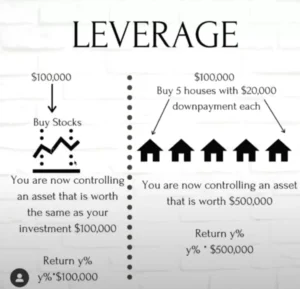
Numbers make this easier to picture than theory alone. Say you buy a $1,000,000 condo with a 25% downpayment, that’s $250,000 of your own money, with the remaining $750,000 financed through a bank loan.

If that property appreciates by 20% over five years, it’s now worth $1,200,000. Your gain is $200,000. But measured against your actual cash outlay of $250,000, that’s an 80% return on your own money, not 20%. That gap between the asset’s growth and your actual return is leverage doing exactly what it’s supposed to do. Try replicating that kind of amplified return with a stock purchase you paid for entirely in cash, and the math simply doesn’t stretch the same way.

Property vs Other Common Investments

It helps to see property lined up directly against the other assets people usually consider, rather than just taking the case for property at face value.

Asset

Typical Entry Barrier

Leverage Available

Skill Needed to Manage

Volatility

Property

Moderate to high (downpayment + fees)

High (up to 75% LTV)

Low, mostly research upfront

Low to moderate

Stocks

Low

Limited, unless margin trading

High, active monitoring helps

High

Bonds

Low to moderate

Minimal

Low

Low

Cryptocurrency

Very low

Varies widely

Very high

Very high

This isn’t to say stocks or bonds don’t have their place in a balanced portfolio, they absolutely can. But if you’re weighing where to put your first serious chunk of investment capital, property’s combination of manageable skill requirements and strong available leverage is hard to match on this table.

Addressing the Common Doubts

A few objections come up constantly whenever this topic gets discussed, and they’re worth addressing honestly rather than glossing over.

  • “Property isn’t liquid, I can’t sell it quickly.” True, and this is a genuine trade-off. Property suits patient capital, not money you might need back within months. If liquidity is your top priority, keep a separate emergency fund outside of property entirely.
  • “The entry cost is too high for most people.” It’s higher than buying a single stock, certainly, but the 25% downpayment threshold is exactly what makes the leverage work in your favour once the property appreciates.
  • “What if the market crashes right after I buy?” This is precisely why holding power matters so much, a property with low maintenance needs is far easier to simply hold through a downturn than a leveraged stock position facing a margin call.
  • “Isn’t property investment risky if I don’t know the market well?” This is exactly the gap a structured system, rather than gut instinct, is meant to close, which is why having the right research framework matters more than raw experience.

A Word From SG Luxury Condo

I’ve shared these three reasons why property is the best form of investment with countless clients over the years, and the logic has held up consistently: strong leverage, genuine predictability, and far lower entry risk than most alternatives. None of this means every property purchase automatically succeeds, the right system and the right numbers still matter enormously.

If you’d like help applying this thinking to your own situation, SG Luxury Condo is happy to walk through it with you. Our property consultation sessions cover exactly this kind of planning, and you can check our track record to see how this approach has worked for past clients. You’re also welcome to browse our full range of luxury condos for sale in Singapore whenever you’re ready to start.

Advanced Heading

Frequently Asked Questions

Why is property considered the best form of investment in Singapore?

Mainly because of three things working together: strong, accessible leverage through mortgage financing, a genuinely predictable market due to controlled land supply and tracked demand data, and far lower entry risk compared to actively trading stocks.

A downpayment, typically 25% for a first home loan, lets you control 100% of a property’s value using the bank’s money, meaning your potential returns are calculated against the full asset value rather than just your own cash outlay.

Relative to many other asset classes, yes. Land supply through Government Land Sales, birth rates, and immigration data are all tracked and published, giving investors a reasonable basis to estimate future demand and supply.

No investment is entirely risk-free. Property values can fall during an economic downturn, but a well-chosen property with low upkeep needs is generally easier to hold through a downturn than more actively managed investments like stocks.

Not in the same way stocks demand. Property investment benefits more from having a solid research system and patience than from active trading skill or constant market monitoring.

It’s a simple framework describing three paths to building wealth: developing high-income skills, building a scalable business, and making high-return investments, with property falling into that third category alongside stocks and bonds.

 Historically, yes. Property prices in Singapore have generally tracked or outpaced inflation over the long run, helping protect the real value of an investor’s money compared to holding cash alone.

Structured, data-driven systems that screen properties using real transaction history and demand indicators, rather than gut feeling, tend to produce more consistent results over time.

For many first-time investors, yes, mainly due to the lower skill barrier to entry and the ability to use leverage safely through a mortgage, though a diversified approach across multiple asset types is generally still wise.

Property investment generally rewards a longer holding period, often spanning a full market cycle of several years, since this allows leverage, predictability, and safety to work together as intended rather than being tested by short-term volatility.

Property AI

Here's a few ways we can help you
🤖
Would you like our AI Bot to help you find the perfect property? Our AI Bot can scrape through hundreds of property listings and provide you with a list of properties that matches your criteria.
Just now