Buying Property in Singapore Using Search Analytics
Categoriesarticles

James Lim’s Property Agent Track Record: Real Client Results

TLDR: Return on Investment (ROI) measures total profit against total cash invested. Return on Equity (ROE) measures that same profit specifically against the downpayment, which tends to look much larger since it isolates the effect of bank leverage. Both numbers matter, but ROE especially shows why leverage is such a powerful part of property investing in Singapore.

Looking to invest in property and wondering whether the numbers you’re being promised are actually real? Fair question. That’s exactly why this page exists, not as a sales pitch, but as an honest, detailed property agent track record showing the actual profit, or loss, our clients have made working with James Lim at SG Luxury Condo.

Every case study below is a genuine transaction, with real purchase prices, real sale or valuation figures, and real timelines. Nothing here is guaranteed to repeat for the next buyer, past performance never is, but it does show the kind of thinking behind each purchase, entry price, timing, unit selection, and how those decisions played out.

Summary of Results

Case

Property

Profit

Growth

ROI

Annualised ROI

1

Lake Grande (HDB upgrade)

$267,000

28%

2

Treasure @ Tampines

$290,000

23.5%

7.8%

3

Waterfront Isle

$178,475

20.4%

98%

24.5%

4

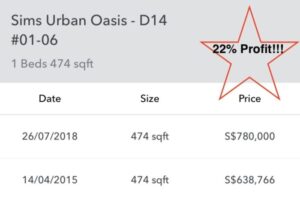
Sims Urban Oasis (1BR)

$141,234

22%

111%

36.8%

5

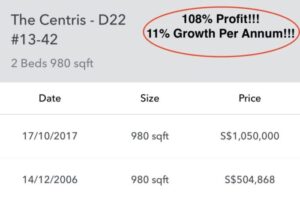
Centris

$1,050,000

108%

540%

54%

6

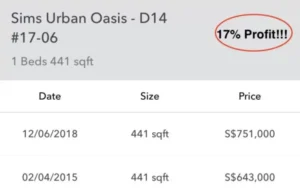
Sims Urban Oasis (Case A)

$108,000

17%

119%

40%

7

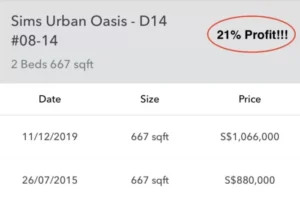
Sims Urban Oasis (Case B)

$186,000

21%

106%

26.5%

8

The Panorama (Client A)

$274,000

22.5%

113%

38%

9

Commonwealth Tower

$192,000

14.5%

137%

55%

10

The Panorama (Client B)

$218,000

17%

118%

39%

Case 1: Lake Grande, HDB to Condo Upgrade

TRACK RECORD 1

Lakge-Grande-HDB-Upgrader-Result

This client upgraded from an HDB flat to a 2-bedroom condo on my recommendation. Lake Grande TOP’d in 2020, so she waited roughly four years for the unit to complete. After living in it for two years, she decided to upgrade again to a bigger unit.

Applying our Property P.L.U.S System to guide the entry point and unit selection, she made an overall profit of $267,000 in six years, a 28% ROI. With a downpayment of $142,650, her ROE came in at 32% per annum.

Case 2: Treasure @ Tampines, Decoupling for a Second Investment Property

TRACK RECORD 2

This couple decoupled specifically to free up capacity for a second investment property. They bought a 3-bedroom unit at Treasure @ Tampines, not directly next to an MRT station, but selected using our Property P.L.U.S System framework rather than location alone.

They bought a low-floor, pool-facing 3-bedroom for $1,230,000 in 2020, and upon TOP decided to sell and roll the proceeds into another investment property. Their sale price of $1,520,000 meant a $290,000 profit in three years. On a $307,500 downpayment, that’s a 23.5% ROI, or 7.8% annualised. Measured by Return on Equity, the investment netted 31.4% per annum.

Case 3: Waterfront Isle, Bedok Reservoir

TRACK RECORD 3

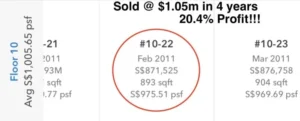
This client bought an investment property at Waterfront Isle in Bedok Reservoir and sold it four years later for $1,050,000, a $178,475 overall profit, or 20.4% growth. With a downpayment of just $174,305, leveraging through the bank produced a 98% return on investment over four years, working out to roughly 24.5% ROI per annum.

Case 4: Sims Urban Oasis, First Investment Property at 26

OTHER EXAMPLES

This client was 26 years old and looking for his first investment property. After going through his finances together, we settled on a 1-bedroom unit, giving him the flexibility to either rent it out or move in himself if his circumstances changed.

When the property TOP’d in early 2018, he rented it out for six months before deciding to sell, freeing up capital to purchase a second investment property. With a downpayment of $127,753, he made an overall profit of $141,234, a 22% growth in value, translating to a 111% return on investment in three years, or roughly 36.8% ROI per annum.

Case 5: Centris, Boon Lay, Upgrading After Starting a Family

Centris-2-Bedroom-Profit-Growth

A young couple bought a 2-bedroom, 2-bathroom unit at Centris, a mixed development in Boon Lay. After having a daughter, they decided to upgrade to a bigger condo. Selling for a profit of $1,050,000 in total, they achieved 108% growth on the property’s value, an 11% annualised gain. With a downpayment of only $101,000, leverage pushed their return on investment to a striking 540% over ten years, or 54% ROI per annum.

Case 6 & 7: Two More Sims Urban Oasis Results

Sims-Uran-Oasis-2-SG-Luxury-CondoSims-Uran-Oasis-1-SG-Luxury-Condo

Overall Profit: $108,000, 17% growth, 119% return on investment, 40% ROI per annum.

Overall Profit: $186,000, 21% growth, 106% return on investment, 26.5% ROI per annum.

Case 8 & 10: The Panorama, Two Friends, Same Recommendation

TRACK RECORD 4

This client bought his unit primarily for own stay, while a close friend of his (Case 10 below) purchased a unit in the same development after we discussed both their needs together. Both wanted a place that felt right to live in while still offering solid growth potential.

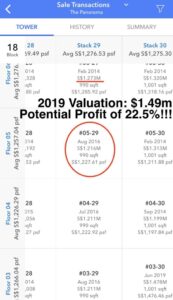
He bought his unit for $1.216 million in 2016. He hasn’t sold, but today’s valuation sits at $1.49 million, a 22.5% growth. If he chose to sell now, he’d realise a $274,000 profit. With leverage factored in, that’s a 113% return on investment over the holding period, roughly 38% ROI per annum.

TRACK RECORD 5

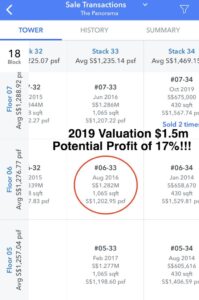
His friend, after our conversation, decided to buy in the same development. He purchased his unit for $1.282 million in 2016. Current valuation sits at $1.5 million, a 17% gain. If sold today, that would translate to a $218,000 profit, or a 118% return on investment with leverage, roughly 39% ROI per annum.

Case 9: Commonwealth Tower

TRACK RECORD 6

This client, a single woman, was searching for a 2-bedroom private condo with genuine growth potential. She was initially drawn to a different project purely for its proximity to her workplace, but after discussing the trade-offs, she bought a 2-bedroom unit at Commonwealth Tower in 2017 instead.

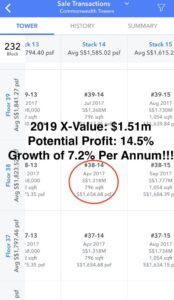
With a current valuation of $1.51 million, she stands to make an overall profit of $192,000 over 2.5 years, a 14.5% growth. With leverage, selling now would put her return on investment at 137%, roughly 55% ROI per annum.

A Freehold Case Study: Finding Value Even Against the Grain

TRACK RECORD 7

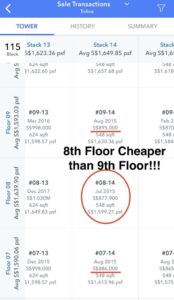
A close friend of mine wanted to invest in a freehold property. I advised against it at the time, given where the market cycle sat, but he had personal reasons for preferring freehold, so we worked within that constraint rather than against it. After scouting extensively across Singapore, we found a unit on the 8th floor priced $20,000 below the equivalent 9th floor unit in the same stack, and secured an auspicious unit number in the process.

What Actually Drives Results Like These

Across every case above, a few consistent principles show up again and again in how these purchases were approached:

  • Understanding where genuine demand is strong and supply is limited
  • Identifying undervalued properties relative to their actual location and fundamentals
  • Assessing a location’s future growth potential before the wider market catches on
  • Sticking to a disciplined entry price, rather than chasing whatever’s available
  • Favouring properties with low to minimal risk exposure
  • Weighing proven rental yield and rental demand alongside capital growth potential

If you’re curious how these principles apply to specific decisions, our guides on mixed developments, MRT proximity, new launch versus resale, en bloc potential, and freehold versus leasehold all go deeper into the reasoning behind these calls.

An Honest Note on Past Results

Every figure on this page reflects a real, individual transaction. None of it is a guarantee of what any future purchase will do, property markets move, and past growth in any specific project or district doesn’t predict future performance for a different buyer at a different entry price. What this property agent track record does show is a consistent, disciplined approach applied across very different situations, HDB upgraders, first-time investors, families, and long-term holders alike.

If you’d like to see how this approach applies to your own situation, you’re welcome to check our testimonials for what past clients have said directly, or reach out for a one-to-one consultation to talk through your own numbers.

A Word From SG Luxury Condo

Building this property agent track record over the years has really come down to the same discipline every time, entry price, timing, and matching the right property to each client’s actual goals, not a generic formula applied blindly. If you’re weighing your own property decision and want a second, honest opinion, SG Luxury Condo is happy to walk through it with you. Our property consultation sessions cover exactly this kind of planning, and you’re welcome to browse our full range of luxury condos for sale in Singapore whenever you’re ready.

Advanced Heading

Frequently Asked Questions

What is the PropertyGuru Popularity Index?

It’s a score combining page views (40% weight) and enquiries (60% weight) for a specific listing or area, giving a quick measure of genuine buyer or renter interest beyond just casual browsing.

Because sending an enquiry shows real intent to act, while a page view could just be casual browsing. Weighting enquiries higher makes the score a better reflection of genuine interest.

Transaction data shows what’s already happened. Search analytics shows what people are actively interested in right now, which can reveal demand building in an area before it shows up in completed sales.

Yes, quite differently. Sale-side searches tend to favour newer, more affordable OCR properties, even without MRT proximity, while rental searches skew heavily toward CCR and city-fringe locations near MRT stations.

Both districts contain a large concentration of HDB estates, and the strong search interest for nearby condos in these areas largely reflects HDB owners actively looking to upgrade rather than pure investors.

No, it’s best used alongside other research, developer track record, URA transaction data, and the Master Plan, rather than as a standalone decision-making tool.

It can shift meaningfully over months or quarters, so treat any specific ranking as a snapshot in time rather than a permanent fact, and check for updated data periodically.

Buyers searching for sale listings appear willing to trade MRT proximity for a lower price per square foot, which can mean a cheaper unit or more space for the same budget.

It can signal cooling interest in that specific project, which is worth watching closely if you’re an owner considering your exit timing, since search interest sometimes moves ahead of actual price trends.

It can offer useful early signals, a district climbing steadily in search rankings may be worth watching closely, but it should complement, not replace, fundamental checks like pricing, developer reputation, and future supply in the area.

Buying Property in Singapore Using Search Analytics
Categoriesarticles

Buying Property in Singapore Using Search Analytics

TL;DR: Search analytics tracks what people are actually searching for and clicking on, not just what they eventually buy. PropertyGuru’s Popularity Index blends page views (40%) and enquiries (60%) into a single score, giving a quick read on genuine buyer interest. Layering this against keyword trends, top-searched condos, and top districts reveals patterns transaction data alone won’t show you, like which areas are quietly gaining momentum before prices catch up. A quick note: search rankings shift over time, so treat the specific rankings below as a snapshot of the data at the time this was pulled, and refresh the numbers periodically rather than treating them as permanently fixed.

Most people still shop for property the old-fashioned way, location, amenities, developer name, gut feeling. There’s nothing wrong with that, but it misses a genuinely useful signal hiding in plain sight: what people are actually searching for online, right now, before they’ve even spoken to an agent.

At SG Luxury Condo, we’ve started pulling data directly from PropertyGuru, Singapore’s largest property portal, to see what buyers and renters are genuinely typing into the search bar. It turns browsing behaviour into a real dataset, one that shows demand forming before it shows up in transaction numbers. Here’s how we use it, and what it’s currently telling us.

Understanding the Popularity Index

At the centre of this approach is the Popularity Index, a simple score that measures how much genuine interest a listing or area is getting. It combines two things:

  • Page views (40% weight), how many people are looking at a listing
  • Enquiries (60% weight), how many people are actually taking the next step and reaching out

Enquiries count for more because clicking a listing is passive, but sending an enquiry shows real intent. Here’s how the maths works in a simple example: a listing with 100 page views and 50 enquiries gets a Popularity Index of (100 × 0.4) + (50 × 0.6) = 70. The higher the score, the stronger the genuine buyer or renter interest behind that listing.

What Keyword Trends Actually Tell You

Beyond individual listings, it’s worth watching the keywords people search for overall, terms like “sea view condo,” “near MRT,” or “freehold property.” These searches reveal what buyers currently care about, sometimes months before that demand shows up in actual sales data.

Looking at the Top 20 and Top 40 most-searched terms lets you spot which districts and property types are pulling attention right now. If a specific district keeps climbing the rankings, that’s often an early signal of growing tenant or buyer interest, well before prices in that area start moving.

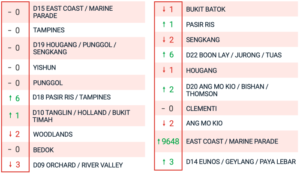
Top 20 Keywords People Search For

Top-20-Keywords

Top 20 Keywords People Search on PropertyGuru

This ranking is based on how often each district or area name gets searched. It doesn’t break down whether someone’s looking for an HDB flat, a condo, or a landed home, just raw interest in the location itself.

A few patterns stand out. Areas like East Coast, Marine Parade, Tampines, District 19, and District 10 have stayed consistently popular over time, showing steady, reliable demand rather than a short-lived spike. Meanwhile, District 18 (Pasir Ris/Tampines) and District 22 (Boon Lay/Jurong/Tuas) both saw noticeable jumps in ranking, more than 6 positions each, suggesting growing interest in these two areas specifically.

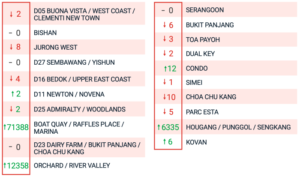
Top 40 Keywords People Search For

Top 40 Keywords Search

Top 40 Keywords People Search on PropertyGuru

Moving further down the list, into ranks 21 through 40, District 1 (Boat Quay/Raffles Place/Marina) and District 9 (Orchard/River Valley) both show up with strong jumps in search interest. That’s not entirely surprising, the Core Central Region carries real long-term potential, something we’ve covered in our piece on undervalued vs profitable properties.

Most other rankings stayed fairly stable, aside from Jurong West and Bukit Panjang, which both slipped a handful of positions. One notable name worth flagging, Parc Esta was the only individual condo project to crack this Top 40 list, but its ranking had dropped compared to before, a signal worth watching if you’re holding a unit there and thinking about your exit timing.

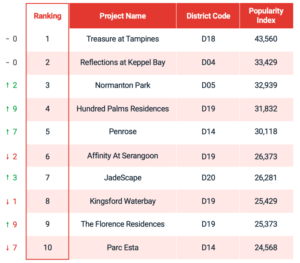
Top 10 Condos People Search For (By Sale)

Top 10 Condo Search via Sales

Top 10 Most Searched Condos via Sales

This chart shows the specific private condo projects generating the most sale-side search interest. Two clear patterns emerge here. First, aside from a couple of older exceptions, most of these projects were brand new, typically just 1 to 2 years post-TOP, suggesting buyers strongly favour newer stock when actively house-hunting.

Second, roughly half of these projects sit in Districts 18 and 19, both firmly in the Outside Central Region. Combined with the age pattern above, it points to two things mattering most to this group of searchers: how new the property is, and how affordable it is. If liquidity and a fast resale matter to you, this data suggests OCR new launches remain a genuinely strong strategy, a point we’ve explored further in our new launch versus resale comparison.

Worth noting too, most of these top-searched projects weren’t within comfortable walking distance of an MRT station, several even run their own shuttle bus service instead. Buyers searching for sale listings appear willing to trade MRT proximity for a lower psf, translating either into a cheaper unit or more space for the same budget. None of the top 10 in this category were freehold either, reinforcing that this particular buyer segment prioritises price and newness over tenure. For more on that trade-off, see our piece on freehold versus leasehold properties.

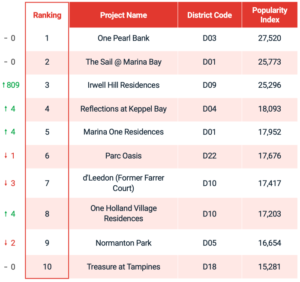
Top 10 Condos People Search For (By Rental)

Top 10 Most Search Condo via Rental

Top 10 Most Searched Condos via Rental

Rental searches tell a genuinely different story. Aside from a couple of outliers, most of the top-searched rental condos sit in the Core Central Region or nearby city fringe areas, and around six of the ten are close to an MRT station. If you’re buying specifically for rental income, this data suggests the priorities flip almost entirely compared to sale-side buyers, MRT proximity and closeness to the city centre matter far more to tenants than they do to owner-occupiers hunting for a home to buy.

Top 5 Condo Districts by Search Interest (Sale)

Top 5 Condo Districts (Sale)

Top 5 Condo Districts by Search Interest, Sale

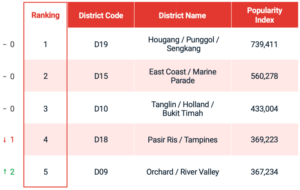
District-level data shows a genuine mix across all three regions. In the Core Central Region, Orchard and River Valley lead, followed by District 10 (Bukit Timah/Holland Road). In the Rest of Central Region, District 15 comes out on top. On the outskirts, Districts 18 and 19 dominate.

Districts 18 and 19 sit close to a large concentration of HDB estates, which suggests a lot of this search interest is coming from HDB upgraders shopping for their next home rather than pure investors. If that’s your situation, a 3-bedroom unit or larger tends to be the more sensible choice given this buyer profile.

Top 5 Condo Districts by Search Interest (Rental)

Top 5 Condo Districts (Rent)

Top 5 Condo Districts by Search Interest, Rental

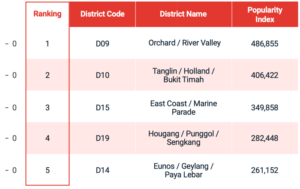
No real surprises here. Districts 9 and 10, right in the heart of the city near the CBD, dominate rental search interest. District 15, close to East Coast Park, also remains consistently popular, largely thanks to its long-standing appeal among expat tenants.

Top 5 HDB Districts by Search Interest (Sale)

Top 5 HDB Districts (Sales)

Top 5 HDB Districts by Search Interest, Sale

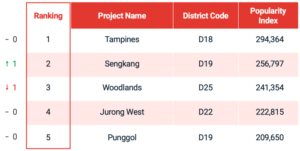
Rounding things out, here’s the HDB side of the picture. Tampines, Sengkang, and Punggol lead the pack, matching closely with the top condo sale districts covered earlier. That overlap reinforces the same conclusion, a large share of buyer interest in these areas is coming from HDB owners actively looking to upgrade into a condo nearby, rather than starting their search from scratch elsewhere.

What This Means for Your Own Search

Search analytics won’t replace proper due diligence, checking a developer’s track record, running your own numbers, or reading a floor plan properly all still matter. But layering this kind of data on top of the fundamentals gives you an early read on where genuine demand is building, sometimes before it shows up in official transaction figures. If a district is climbing steadily in search interest quarter over quarter, that’s worth paying attention to, especially if you’re deciding between two similarly priced options.

A Word From SG Luxury Condo

Search behaviour is one of the more underused signals in Singapore property research, mostly because it takes real effort to pull and interpret properly. At SG Luxury Condo, we treat this kind of search analytics as one input among several, alongside URA transaction data, the URA Master Plan, and our own Property P.L.U.S System, rather than relying on any single source in isolation.

If you’d like a current read on what the search data is showing for a specific district or project you’re considering, SG Luxury Condo is happy to walk through it with you. Our property consultation sessions cover exactly this kind of research, and you’re welcome to browse our full range of luxury condos for sale in Singapore once you’ve got a clearer sense of where demand is heading.

Advanced Heading

Frequently Asked Questions

What is the PropertyGuru Popularity Index?

It’s a score combining page views (40% weight) and enquiries (60% weight) for a specific listing or area, giving a quick measure of genuine buyer or renter interest beyond just casual browsing.

Because sending an enquiry shows real intent to act, while a page view could just be casual browsing. Weighting enquiries higher makes the score a better reflection of genuine interest.

Transaction data shows what’s already happened. Search analytics shows what people are actively interested in right now, which can reveal demand building in an area before it shows up in completed sales.

Yes, quite differently. Sale-side searches tend to favour newer, more affordable OCR properties, even without MRT proximity, while rental searches skew heavily toward CCR and city-fringe locations near MRT stations.

Both districts contain a large concentration of HDB estates, and the strong search interest for nearby condos in these areas largely reflects HDB owners actively looking to upgrade rather than pure investors.

No, it’s best used alongside other research, developer track record, URA transaction data, and the Master Plan, rather than as a standalone decision-making tool.

It can shift meaningfully over months or quarters, so treat any specific ranking as a snapshot in time rather than a permanent fact, and check for updated data periodically.

Buyers searching for sale listings appear willing to trade MRT proximity for a lower price per square foot, which can mean a cheaper unit or more space for the same budget.

It can signal cooling interest in that specific project, which is worth watching closely if you’re an owner considering your exit timing, since search interest sometimes moves ahead of actual price trends.

It can offer useful early signals, a district climbing steadily in search rankings may be worth watching closely, but it should complement, not replace, fundamental checks like pricing, developer reputation, and future supply in the area.

3 Reasons Why Property Is the Best Form of Investment
Categoriesarticles

3 Reasons Why Property Is the Best Form of Investment

People ask me often how I got into property investment in the first place. Honestly, it started with a book, Rich Dad Poor Dad by Robert Kiyosaki. If you haven’t read it, the short version is this: it compares two father figures, one who worked hard for money his whole life, and one who made money work for him through assets like real estate. That idea, using other people’s money and time as leverage, genuinely reshaped how I thought about building wealth.

Over the years, watching how property has actually performed for clients at SG Luxury Condo, I keep coming back to the same three reasons why property is the best form of investment I recommend to almost everyone starting out. Let me walk you through them.

Reason 1: Property Offers the Best Form of Leverage

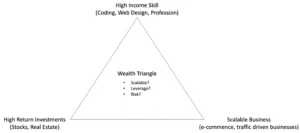
To understand why leverage matters so much, it helps to look at what’s sometimes called the Wealth Triangle, a simple framework built around three ways people generate wealth.

Wealth Triangle Component

What It Means

Examples

High Income Skills

A skill valuable enough to trade for strong, consistent pay

Coding, consulting, sales

Scalable Business

A business that grows without needing huge overheads

E-commerce, online services

High Return Investments

Assets that build long-term wealth and passive income

Stocks, bonds, real estate

best form of leverage

The Wealth Triangle: three paths to building long-term wealth

For this first reason, we have to take a look at what we call a Wealth Triangle, a conceptual framework made up of three fundamental components to generate wealth: High Income Skills, Scalable Business and High Return Investments. 

Firstly, High Income Skills form the base of the pyramid. It is any valuable skill that can earn you a consistent and substantial amount of money each month. If you are able to develop a high income Skill, you can deliver value to the marketplace and trade your skill and expertise for very good money. Some examples of high income Skills include coding, web design, and consulting.

The second component of the Wealth Triangle is Scalable Business. Essentially, this refers to a business that you can grow and develop without the need of a lot of overheads or infrastructure. You do not need to spend large amounts of money to grow this business. Examples of scalable businesses are businesses that operate online, like e-commerce (Amazon, Drop-shipping) or traffic driven businesses. Scalable businesses are therefore systems that are in place that provide you with cash flow and makes you money, even while you are deep in sleep!

The final component of the Wealth Triangle is High Return Investments, which help to build your wealth, net worth and passive income. Some examples include stocks, bonds, mutual funds, and of course, real estate.

As mentioned earlier, Rich Dad Poor Dad got me into investing. While I am unable to tell you all the nitty gritty details of the book, I am proud to say that more than a decade later, I find that this one quote from the book still stands out to me.

It reads “People with leverage have dominance over people with less leverage. In other words, just as humans gained advantages over animals by creating leveraged tools, similarly, humans who use these tools of leverage have more power over humans who do not. Saying it more simply, leverage is power.”

So, you may be wondering “how does this quote relate to the Wealth Triangle?” While the Wealth Triangle seems simple, it is able to tell us a lot. Each time I look at it, I ask myself three questions:

  • What is scalable?
  • What can you leverage on?
  • What are the risks involved for all three components?

While brainstorming on the answers to these questions, I come to the conclusion that the third component—High Return Investments—has the best form of leverage, using other people’s money and time. The power of leverage in real estate therefore makes it the best form of investment that not only is scalable and also you can leverage on others yet having the lowest risk.

Reason 2: Singapore Property Is Genuinely Predictable

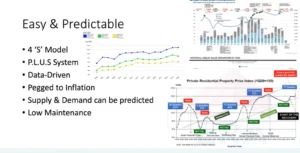
It is Easy and Predictable

Singapore’s property market moves in patterns that are easier to read than most other asset classes

Singapore is a small, land-scarce country, which actually works in an investor’s favour. Government Land Sales, birth rates, and immigration numbers are all tracked and published, which means future supply and demand can be reasonably estimated well ahead of time, something you simply can’t do with a stock’s future price movement.

Property prices here have also tended to track inflation over the long run. When the general cost of living rises, property prices tend to rise with it, which makes property a genuine hedge against inflation eating into your savings. That doesn’t mean prices never fall, they absolutely can during an economic downturn, but a property that’s well chosen and doesn’t demand much upkeep is far easier to simply hold through a rough patch until the market recovers, compared to assets that require active, ongoing management.

Being able to actually use this predictability well comes down to having a proper system for reading the data. At SG Luxury Condo, this is exactly why we built our own Property P.L.U.S System, a structured way of screening properties using real transaction data rather than gut feeling. You don’t need decades of experience to use a system like this, you need the right framework and the discipline to follow it. Our guide on choosing the best selling condos in Singapore shows this kind of data-driven approach in action.

Reason 3: Property Is Far Safer to Enter Than Stocks

Why Property Investment

Property tends to carry far less entry risk than trading stocks

Stocks demand real skill to trade well, reading charts, timing entries and exits, understanding company fundamentals, managing emotional discipline under pressure. Get any of that wrong and it’s genuinely easy to lose a meaningful chunk of your capital quickly. We’ve all heard stories of people “burning their fingers” on a bad trade.

Property doesn’t ask nearly as much of a first-time investor. Beyond giving you a place to actually live in, it tends to deliver steadier, more predictable returns over time, even accounting for the occasional downturn. You don’t need to watch a screen daily or time your entry to the hour. A well-chosen property, held through a reasonable market cycle, has historically rewarded patience far more reliably than trying to actively trade in and out of stocks.

Why These Three Reasons Matter Together

None of these three reasons stand entirely on their own. Leverage without predictability is just a bigger bet. Predictability without safety doesn’t help if the entry itself is risky. It’s the combination, controlled leverage, a market you can reasonably forecast, and low entry risk, that makes property such a consistently recommended starting point for building wealth in Singapore.

A Real Example: How Leverage Plays Out in Practice

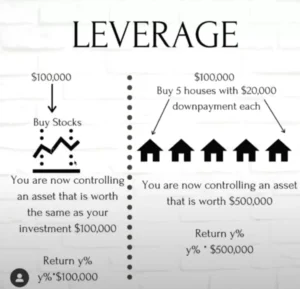
Numbers make this easier to picture than theory alone. Say you buy a $1,000,000 condo with a 25% downpayment, that’s $250,000 of your own money, with the remaining $750,000 financed through a bank loan.

If that property appreciates by 20% over five years, it’s now worth $1,200,000. Your gain is $200,000. But measured against your actual cash outlay of $250,000, that’s an 80% return on your own money, not 20%. That gap between the asset’s growth and your actual return is leverage doing exactly what it’s supposed to do. Try replicating that kind of amplified return with a stock purchase you paid for entirely in cash, and the math simply doesn’t stretch the same way.

Property vs Other Common Investments

It helps to see property lined up directly against the other assets people usually consider, rather than just taking the case for property at face value.

Asset

Typical Entry Barrier

Leverage Available

Skill Needed to Manage

Volatility

Property

Moderate to high (downpayment + fees)

High (up to 75% LTV)

Low, mostly research upfront

Low to moderate

Stocks

Low

Limited, unless margin trading

High, active monitoring helps

High

Bonds

Low to moderate

Minimal

Low

Low

Cryptocurrency

Very low

Varies widely

Very high

Very high

This isn’t to say stocks or bonds don’t have their place in a balanced portfolio, they absolutely can. But if you’re weighing where to put your first serious chunk of investment capital, property’s combination of manageable skill requirements and strong available leverage is hard to match on this table.

Addressing the Common Doubts

A few objections come up constantly whenever this topic gets discussed, and they’re worth addressing honestly rather than glossing over.

  • “Property isn’t liquid, I can’t sell it quickly.” True, and this is a genuine trade-off. Property suits patient capital, not money you might need back within months. If liquidity is your top priority, keep a separate emergency fund outside of property entirely.
  • “The entry cost is too high for most people.” It’s higher than buying a single stock, certainly, but the 25% downpayment threshold is exactly what makes the leverage work in your favour once the property appreciates.
  • “What if the market crashes right after I buy?” This is precisely why holding power matters so much, a property with low maintenance needs is far easier to simply hold through a downturn than a leveraged stock position facing a margin call.
  • “Isn’t property investment risky if I don’t know the market well?” This is exactly the gap a structured system, rather than gut instinct, is meant to close, which is why having the right research framework matters more than raw experience.

A Word From SG Luxury Condo

I’ve shared these three reasons why property is the best form of investment with countless clients over the years, and the logic has held up consistently: strong leverage, genuine predictability, and far lower entry risk than most alternatives. None of this means every property purchase automatically succeeds, the right system and the right numbers still matter enormously.

If you’d like help applying this thinking to your own situation, SG Luxury Condo is happy to walk through it with you. Our property consultation sessions cover exactly this kind of planning, and you can check our track record to see how this approach has worked for past clients. You’re also welcome to browse our full range of luxury condos for sale in Singapore whenever you’re ready to start.

Advanced Heading

Frequently Asked Questions

Why is property considered the best form of investment in Singapore?

Mainly because of three things working together: strong, accessible leverage through mortgage financing, a genuinely predictable market due to controlled land supply and tracked demand data, and far lower entry risk compared to actively trading stocks.

A downpayment, typically 25% for a first home loan, lets you control 100% of a property’s value using the bank’s money, meaning your potential returns are calculated against the full asset value rather than just your own cash outlay.

Relative to many other asset classes, yes. Land supply through Government Land Sales, birth rates, and immigration data are all tracked and published, giving investors a reasonable basis to estimate future demand and supply.

No investment is entirely risk-free. Property values can fall during an economic downturn, but a well-chosen property with low upkeep needs is generally easier to hold through a downturn than more actively managed investments like stocks.

Not in the same way stocks demand. Property investment benefits more from having a solid research system and patience than from active trading skill or constant market monitoring.

It’s a simple framework describing three paths to building wealth: developing high-income skills, building a scalable business, and making high-return investments, with property falling into that third category alongside stocks and bonds.

 Historically, yes. Property prices in Singapore have generally tracked or outpaced inflation over the long run, helping protect the real value of an investor’s money compared to holding cash alone.

Structured, data-driven systems that screen properties using real transaction history and demand indicators, rather than gut feeling, tend to produce more consistent results over time.

For many first-time investors, yes, mainly due to the lower skill barrier to entry and the ability to use leverage safely through a mortgage, though a diversified approach across multiple asset types is generally still wise.

Property investment generally rewards a longer holding period, often spanning a full market cycle of several years, since this allows leverage, predictability, and safety to work together as intended rather than being tested by short-term volatility.

Strong Property Investment Fundamentals
Categoriesarticles

Strong Property Investment Fundamentals: What Actually Makes a Property “Safe” in Singapore

TL;DR: Strong property investment fundamentals in Singapore come down to understanding who’s actually buying (investors chasing yield versus owner-occupiers chasing lifestyle fit), then checking eight specific traits: location, MRT and school accessibility, developer reputation, a sensible floor and stack, a development size that isn’t too small or too large, a maintenance fee that doesn’t scare buyers off, a fair entry price, and genuine first-mover advantage if you’re buying a new launch. None of these traits work alone, it’s the combination that actually protects your investment through a full market cycle.

Everyone wants a property that holds its value no matter what the market’s doing. The question is what actually makes a property fundamentally strong, versus one that just looks good in a showflat and struggles the moment the market cools. This is exactly the question we walk through with every client at SG Luxury Condo before any specific project comes up.

A fundamentally strong property, in simple terms, is one that keeps demand high and rarely loses money, regardless of where the broader market cycle happens to sit. These properties tend to have something genuinely unique or consistently sought-after about them, not just a nice paint job. Understanding the strong property investment fundamentals behind these properties is really the difference between buying something that happens to look nice, and buying something that actually protects your capital.

Step 1: Understand Who’s Actually Buying

Before diving into the eight traits, it helps to understand the two buyer types who ultimately determine whether your property holds its value.

Investors compare developments purely on numbers, they want the highest rental yield at the most reasonable price. If you’re holding a property this crowd wants, offering strong yield without an inflated price tag, that alone makes it fundamentally attractive to a genuine pool of buyers. Our breakdown of undervalued versus profitable properties goes deeper into how investors actually screen for this.

Own-stay buyers think differently. They’re willing to pay a premium, but only for something that genuinely fits their daily life, layout, location, and the specific features covered in the eight traits below.

The Eight Traits of a Fundamentally Strong Property

1. Location

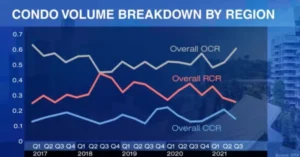
Condo-Volume-Breakdown-by-Region

Condo Volume Breakdown by Region

Location tops almost every buyer’s list, and for good reason. Properties in the Rest of Central Region (RCR) and Outside Central Region (OCR), Singapore’s city-fringe and suburban zones respectively, tend to be more affordable than the Core Central Region, while still holding genuine demand.

Unit size preference actually shifts by region too. In RCR developments, 2-bedroom units tend to see the strongest demand. In OCR, 3-bedroom units are generally the sweet spot, likely reflecting the larger, more family-oriented buyer pool typical of suburban Singapore.

2. Accessibility: MRT and Schools

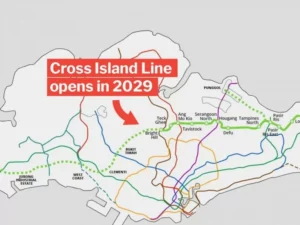
Cross-Island-MRT-Line

The Cross Island Line, one of the transit projects actively reshaping accessibility across the island

A simple test: would you rather live closer to an MRT station or further from one? Most buyers answer closer, and the generally accepted threshold is around 800m, roughly an 8-minute walk. Beyond that, a property starts feeling genuinely less accessible to most buyers. This factor becomes especially important for RCR developments specifically, since RCR buyers tend to rely on public transport more than car ownership. Our full breakdown on how MRT stations affect property prices goes much deeper into this exact mechanic.

That said, the 800m rule loosens for properties further from the city centre, since these buyers are more likely to already own a car, making MRT distance less of a priority.

School proximity matters just as much, arguably more so for OCR properties specifically. Being within 1km of a well-regarded primary school genuinely matters in Singapore, since it affects priority during the primary school registration exercise, something Singaporean parents take very seriously. More schools within reach means more choice for buyers, which in turn means stronger demand and better long-term value for your property.

3. Developer Reputation

Buyers consistently favour developments with better quality finishing and workmanship, and a reputable developer with a name to protect tends to deliver just that, not just inside the unit, but across the whole estate’s exterior and facilities too. CDL, for instance, has built a reputation for projects that still look genuinely fresh a decade after completion. Developments from less established or lower-quality developers can, by contrast, start looking noticeably rundown within just five years. That gap in long-term upkeep is a real, measurable part of what makes a property fundamentally strong or fundamentally weak.

4. The Right Floor and Stack

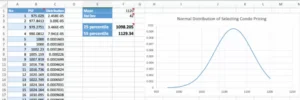
Based on analysis across hundreds of condo transactions, units sitting roughly in the 25th to 55th percentile of a building’s price range, typically floors 5 through 15 in a mid-rise development, tend to deliver the strongest profit margins. Extremely high floors carry a premium that’s harder to recoup, while very low floors often suffer from noise and privacy concerns that limit buyer interest.

5. Development Size

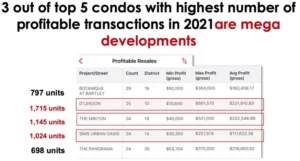
Top-5-Highest-Profitable-Transaction-for-2021

Historically strong-performing transactions have tended to cluster around mid-to-large developments with healthy transaction volume

Size matters more than people expect. Boutique developments under 200 units often struggle here, simply because there isn’t enough transaction volume for the market to establish a clear, reliable valuation over time. On the other end, truly massive developments of 1,000-plus units benefit from constant turnover, which keeps valuations current and liquidity strong. Our detailed study of mega developments in Singapore breaks down exactly how this plays out in real transaction data.

A regularly shaped, efficient layout matters here too, not just the building’s total unit count. HDB upgraders in particular tend to gravitate toward properties with a familiar, functional layout close to what they’re used to, rather than an oddly shaped unit with wasted space.

6. A Sensible Maintenance Fee

A maintenance fee that climbs much past $400 a month tends to noticeably cool buyer interest, and this often correlates with smaller developments, since fewer owners are splitting the same fixed costs. A useful mental comparison: a $200 fee spread across 200-plus units supporting a full range of facilities generally feels better value to buyers than a $450 fee funding just a single pool and a small gym. Developments in the 600 to 800-unit range often strike the best balance between facility variety and manageable fees.

7. Correctly Priced From the Start

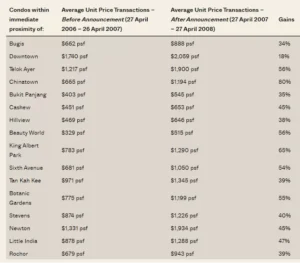
Prices-of-Condo-Near-Downtown-Line-MRT-Stations

Getting the price right isn’t guesswork, it comes down to three checks: compare the property against similar developments nearby and across the broader region, research the specific district’s current market conditions, and factor in any confirmed future growth catalysts for that area. Skipping any one of these steps is exactly how buyers end up overpaying for a unit that isn’t actually as strong a fundamental as it first appeared.

8. First-Mover Advantage

Stars-at-Kovan

Early-phase pricing tends to sit meaningfully below later-phase pricing on the same project

Buying into a new launch during its earliest sales phase generally means securing the lowest possible entry price, since developers typically raise prices in stages as units sell. Our breakdown of developer pricing strategy explains the mechanics behind why banks tend to support this upward pricing trajectory, and our new launch versus resale comparison shows the real return data behind buying early rather than waiting.

Putting the Eight Traits Together

None of these eight strong property investment fundamentals work in total isolation. A great location with a poorly reputed developer still risks looking tired within a few years. A perfectly sized development with an inflated entry price still leaves you overpaying. The properties that genuinely hold their value tend to score reasonably well across most, not necessarily all, of these traits simultaneously.

A Word From SG Luxury Condo

Now that you understand what actually goes into strong property investment fundamentals, the next step is applying this framework to your own numbers and your own financial situation before committing to anything. A checklist like this only works if you’re honest with yourself about your budget and your actual holding period.

If you’d like to know which current developments in Singapore genuinely check these boxes, SG Luxury Condo is happy to walk through it with you. Reach out through our property consultation page, or browse our best selling condos list for developments that have already demonstrated strong, consistent demand. You’re also welcome to explore our full range of luxury condos for sale in Singapore whenever you’re ready to start shortlisting.
Advanced Heading

Frequently Asked Questions

What does "fundamentally strong property" actually mean in Singapore?

 It refers to a property that maintains high demand and rarely loses value, regardless of where the broader property market cycle sits, usually due to a combination of location, accessibility, developer reputation, and sensible pricing.
Yes. Very small developments under 200 units often lack enough transaction volume to establish a reliable valuation, while very large developments of 1,000-plus units benefit from frequent turnover and stronger liquidity.

Fees climbing past roughly $400 a month tend to noticeably cool buyer interest, and high fees often signal a smaller development splitting costs across fewer owners, which can also affect long-term resale appeal.

Generally preferred, especially for RCR developments, but less critical for properties further from the city centre, where buyers are more likely to already own a car and prioritise other factors instead.

Yes, units in the roughly 25th to 55th percentile of a building’s price range, often floors 5 through 15 in mid-rise developments, have historically shown the strongest profit margins compared to extremely high or very low floors.

Very. Reputable developers tend to deliver consistent build quality across both the unit interior and the estate’s facilities, which directly affects how well a property ages and holds its appeal over a decade or more.

It refers to purchasing during a project’s earliest sales phase, when prices are typically lowest, before developers incrementally raise prices as more units sell in later phases.

Not entirely. Investors focus primarily on rental yield relative to price, while own-stay buyers are willing to pay more for a property that genuinely fits their lifestyle needs, location, layout, and accessibility included.

Being within 1km of a well-regarded primary school affects registration priority under Singapore’s primary school system, which matters intensely to many parents and directly supports sustained demand for nearby properties.

 It’s possible if the other traits, developer reputation, pricing, development size, and accessibility, compensate well enough, though location remains one of the most heavily weighted factors for most buyers.

Reasons to Invest in Property in Singapore
Categoriesarticles

8 Reasons to Invest in Property in Singapore (2026 Update)

Ask around and you’ll notice property comes up again and again as the investment people trust most in Singapore, more than stocks, more than crypto, more than just leaving cash in a savings account. There’s a reason for that, and it’s not just tradition. Property genuinely offers a specific combination of income, growth, and stability that’s hard to replicate elsewhere.

This is a full rewrite of our earlier piece, expanded with a few reasons to invest in property that got left out the first time, and updated numbers throughout since some of the old figures were a few years stale. SG Luxury Condo works through this exact list with new clients before any specific project gets discussed. Here’s the fuller picture.

TL;DR: The core reasons to invest in property in Singapore come down to eight things working together: steady rental income, long-term capital appreciation, the power of leverage through mortgage financing, risk diversification across asset classes, inflation hedging, forced savings through loan repayment, tax efficiency compared to other assets, and the ability to recycle profits into future purchases. None of these work in isolation, it’s the combination that makes property such a consistently recommended investment here.

1. Rental Income: Genuine Passive Cash Flow

Rental-Yield

Examples of Possible Rental Yields in Singapore

This is usually the first thing people think of, and for good reason. Renting out a unit, or even just a spare room, gives you a genuinely steady stream of income without demanding daily involvement once things are set up. Before you rent out a full unit, factor in your mortgage payments, stamp duty, and any renovation work needed to make it rentable, there’s real upfront cost before the income starts flowing.
Gross rental yields for private condos in Singapore currently sit roughly in the 3% to 4.8% range depending on district and unit size, with smaller units and OCR properties generally landing at the higher end. Our detailed breakdown of rental yield and other property investment facts goes deeper into how this varies by segment.
2. Capital Appreciation Over Time

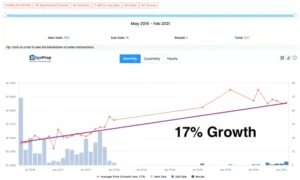
Singapore-Property-Price-Index-Trendline

Singapore Property Price Index Trendline

Capital appreciation is simply the gain you make when your property sells for more than you paid. Say you bought an executive condo for $1 million and sold it seven years later for $1.5 million, that’s $500,000 in capital appreciation, on top of any rental income collected along the way.

Singapore’s Property Price Index has climbed steadily over the decades, with the strongest jumps typically clustering around each 7 to 10 year property cycle. It’s not guaranteed every single year, and buyers on the wrong side of a cycle can genuinely see losses, but with proper research and reasonable holding periods, this remains one of the more consistent reasons to invest in property here.

3. The Power of Leverage

The-Importance-of-Leverage-

The Importance of Leverage

Property investment lets you control a much bigger asset than your actual cash outlay. A 25% downpayment, the current minimum for a first home loan, means you’re commanding 100% of the property’s value with only a quarter of it as your own money. That’s leverage, and it works because real estate is a tangible asset banks are comfortable lending against.

Your Cash Outlay

Property Value You Control

Effective Leverage

$250,000 (25%)

$1,000,000

4x

$360,000 (40%, 2nd property)

$900,000

2.5x

This leverage cuts both ways of course, it amplifies gains but also losses, which is exactly why the next few reasons on this list, diversification and inflation hedging, matter just as much as the leverage itself.

4. Risk Diversification Across Asset Types

Risk Diversification Across Asset Types

Property investment isn’t limited to one flavour of asset. Beyond residential units, you can diversify into industrial properties, commercial spaces like retail units or office space, or mixed-use developments, each responding differently to economic cycles than pure residential does. Spreading your exposure this way, rather than concentrating everything into a single unit or a single asset class, genuinely lowers overall portfolio volatility.

  • Residential: steady demand, most liquid segment, easiest entry point for most investors
  • Commercial: often longer leases with corporate tenants, different rent cycles than residential
  • Industrial: typically lower entry cost, different regulatory rules, appeals to a more specialised investor
  • Mixed-use developments: blend of residential stability with commercial upside in one package

5. A Genuine Hedge Against Inflation

Property Performs Well in Inflationary Environments

Cash sitting in a bank account quietly loses purchasing power every year inflation runs above your interest rate. Property, historically, has moved in the opposite direction, both rents and property values have tended to rise alongside or ahead of inflation over the long run, which is a big part of why property remains one of the more trusted reasons to invest in property during periods of rising prices elsewhere in the economy.

6. Forced Savings Through Loan Repayment

This one gets overlooked constantly. Every monthly mortgage instalment you pay is, in effect, a forced savings deposit, since a portion of it builds equity in an appreciating asset rather than disappearing the way rent or a car loan payment does. Many investors who’d otherwise struggle to save disciplined amounts each month find that a mortgage does that saving for them automatically.

7. Tax Efficiency Compared to Other Investments

Singapore doesn’t impose capital gains tax, which means the profit you make selling a property, unlike some other jurisdictions, isn’t taxed the way it might be elsewhere. You’ll still pay Buyer’s Stamp Duty going in, and potentially Seller’s Stamp Duty if you sell within four years, but the absence of a capital gains tax on the actual profit is a meaningful structural advantage property enjoys over some alternative investments.

8. Funding Your Next Property Purchase

Historical-Trend-

Singapore’s Property Price Index has never moved in a straight line, but zoom out far enough and the pattern is clear: each cycle of roughly 7 to 10 years tends to end higher than where it started. That steady climb is exactly what turns today’s property gain into tomorrow’s downpayment, profit from one purchase quietly funding the next, sometimes a bigger or better-located unit than you could’ve afforded the first time around.

A well-timed property sale doesn’t just bank a profit, it often provides the capital to fund your next purchase, sometimes a bigger or better-located one than your first. This compounding effect, using proceeds from one property to help finance the next, is exactly why many successful property investors describe their portfolio as a ladder rather than a single static asset. Our guide on undervalued versus profitable properties is worth a read if you’re weighing which type of property gives you the best shot at this kind of reinvestment cycle.

Putting It All Together

None of these eight reasons to invest in property work particularly well in isolation. Leverage without proper research can backfire. Rental income without accounting for real costs can look better on paper than it performs in practice. SG Luxury Condo has seen this play out enough times to know it firsthand. The investors who do well tend to weigh all eight factors together, income, growth, leverage, diversification, inflation protection, forced savings, tax efficiency, and reinvestment potential, rather than chasing just one.

A Word From SG Luxury Condo

With this many genuine reasons to invest in property, it’s easy to see why Singaporeans keep coming back to real estate as a core part of their wealth-building strategy. But none of these benefits show up automatically, they require proper research, the right entry price, and a realistic understanding of your own holding period and risk tolerance.

If you’re ready to explore what property investment could look like for you, SG Luxury Condo is happy to walk through the numbers and the paperwork together, so the process feels guided rather than overwhelming. Our property consultation sessions cover exactly this, and you’re welcome to browse our full range of luxury condos for sale in Singapore once you’re ready to start your search.

Advanced Heading

Frequently Asked Questions

What are the main reasons to invest in property in Singapore?

Steady rental income, long-term capital appreciation, the power of leverage through mortgage financing, risk diversification, inflation protection, forced savings through loan repayment, tax efficiency, and the ability to reinvest profits into future purchases.

Gross rental yields for private condos generally range from 3% to 4.8%, depending on district and unit size, with smaller units and OCR properties typically landing at the higher end.

A 25% downpayment lets you control 100% of a property’s value, meaning your potential returns are calculated against the full asset value, not just your initial cash outlay, though this also amplifies potential losses.

Historically, yes. Both rental income and property values have tended to rise alongside or ahead of inflation over the long term, unlike cash sitting idle in a low-interest account.

No, Singapore doesn’t impose capital gains tax, meaning the profit from a property sale generally isn’t taxed the way it might be in some other countries, though Buyer’s and potentially Seller’s Stamp Duty still apply.

It means spreading exposure across different property types, residential, commercial, industrial, or mixed-use, rather than concentrating your entire investment in a single asset type or unit.

Ask specifically how they plan to market the listing, which portals they’ll use, whether professional photography or video is included, and how they’ll qualify potential buyers.

Yes, this is a common strategy among experienced investors, using capital appreciation from an existing property to help finance the downpayment or full purchase of a subsequent one.

No investment is risk-free. Property cycles typically run 7 to 10 years, and buyers who purchase near a cycle peak can see genuine losses, which is why research and timing still matter significantly.

Most first-time investors start with residential property due to its liquidity and lower entry barriers, while commercial and industrial properties tend to suit more experienced investors comfortable with different lease structures and regulations.

Best Property Agent Singapore
Categoriesarticles

Best Property Agent Singapore: How to Actually Find and Choose One

Treasure-Tampines-Testimonial-

Search “best property agent Singapore” and you’ll get pages of agencies claiming the title, glossy headshots, big transaction numbers, five-star review widgets. None of it tells you much about whether that specific person is the right fit for your specific sale or purchase. So instead of another list of vague adjectives, here’s a practical way to actually evaluate and choose the best property agent Singapore has for your situation.

SG Luxury Condo sees buyers and sellers get burned by this exact confusion often enough that a clearer framework felt overdue. This version gives you an actual framework, what to compare, what to ask, and what should make you walk away.

Step 1: Confirm They’re Actually Licensed

Before anything else, this takes two minutes and rules out a real risk. Every property agent in Singapore must be registered with the Council for Estate Agencies (CEA). Search their name or registration number on the public CEA register to confirm they’re currently licensed and check for any disciplinary history on file. Skipping this step is more common than people realise, and it’s the single easiest filter available to you.

Step 2: Match the Agent to What You’re Actually Buying or Selling

Not every agent specialises in the same corner of the market, and the best property agent Singapore has for a luxury condo purchase isn’t necessarily the right fit for an HDB resale flat, or vice versa.

Segment

What a Specialist Agent Should Bring

HDB resale

Deep familiarity with MOP rules, HDB grants, and resale procedure timelines

Private resale condo

Strong grasp of SSD, CPF refund mechanics, and comparable psf data by district

New launch

Direct developer relationships, early access to VIP previews, balloting guidance

Luxury / high-value

Discretion, a network of high-net-worth buyers, and fluency in freehold vs leasehold trade-offs at the prime end of the market

Investment property

Comfort discussing ABSD, rental yield, and holding period strategy, not just closing a sale

If an agent’s background doesn’t actually match your segment, that’s worth asking about directly rather than assuming general experience transfers cleanly.

Step 3: Check Their Actual Track Record, Not Just Their Pitch

“Years of experience” tells you very little on its own. Ask for a genuine transaction history, closed deals, districts covered, deal sizes, and cross-check it where you can against public URA caveat data. A confident agent will hand this over without hesitation.

  • How many transactions have you closed in this specific district or segment in the last 12 months?
  • Can I speak to a past client directly, not just read a curated quote?
  • What’s your average time from listing to sale, or search to purchase, for clients like me?

Step 4: Assess Their Actual Market Knowledge

A good agent can recite a sales pitch. A great one can explain why a specific unit is priced the way it is, relative to recent URA transactions, and how ABSD or TDSR actually applies to your specific profile.

Weak Agent Signal

Strong Agent Signal

Quotes price without recent comparables

Pulls actual URA transaction data to justify pricing

Can’t explain your ABSD or TDSR exposure clearly

Walks you through your specific stamp duty and loan numbers

Vague about the district’s future

References specific URA Master Plan changes or upcoming MRT lines

Pushes a decision quickly

Encourages you to compare options and take the time you need

Step 5: Watch How They Communicate From the First Meeting

Poor communication is consistently one of the top complaints buyers and sellers report. You want an agent who updates you regularly, even when there’s nothing exciting to share, rather than one who goes quiet for weeks. Just as importantly, notice who does most of the talking. As the client, you should be doing the bulk of it early on, describing exactly what you need, while the agent asks good follow-up questions rather than pitching non-stop.

Step 6: Evaluate Their Negotiation Approach

Negotiation matters enormously in Singapore, where a single percentage point on a multi-million dollar property can mean tens of thousands of dollars. A skilled agent backs their position with actual comparable transactions, not just persistence, and they’re upfront when a request genuinely isn’t realistic instead of promising something they can’t deliver.

Step 7: Ask About Their Network Beyond the Deal Itself

Property transactions in Singapore rarely begin and end with matching a buyer to a unit. Ask whether they have working relationships with:

  • Conveyancing lawyers they can confidently refer you to
  • Mortgage bankers who can move quickly on In-Principle Approval
  • Renovation contractors, if you’re buying a resale unit that needs work
  • Property valuers, if you need an independent opinion before negotiating

An agent with no answer to any of these is likely handling transactions in isolation rather than guiding you through the full journey.

Step 8: If You’re Selling, Scrutinise Their Marketing Plan

Ask directly how they’ll market your listing: professional photography, a video walkthrough, which portals they’ll use, and how they plan to qualify buyers before booking viewings. Weak listings with dim photos and a one-line description sit unsold far longer than they should, and that’s squarely down to the agent’s execution, not the property itself.

Step 9: Confirm They’re Upfront About Conflicts of Interest

Dual representation, where the same agent represents both buyer and seller, is allowed in Singapore, but it should always be disclosed clearly and handled with genuine neutrality. A trustworthy agent tells you plainly when this applies rather than letting you discover it after the fact.

Step 10: Verify Testimonials Independently

Ask for reviews you can actually check, Google Business reviews or direct references you can contact yourself, rather than relying solely on curated quotes on the agent’s own website. The best agents also stay genuinely current on cooling measures and MAS lending rules rather than coasting on years-old knowledge, since clients today can look most of this up themselves.

Red Flags vs Green Flags at a Glance

Red Flag

Green Flag

Won’t share CEA registration or track record

Shares both without hesitation

Heavy pressure to decide quickly

Encourages comparison and patience

Vague on commission or conflicts of interest

Explains both clearly upfront

Inconsistent or slow communication before you’ve even engaged them

Responsive and proactive from the first contact

No clear marketing or search strategy

Lays out a concrete plan specific to your situation

A Word From SG Luxury Condo

Finding the best property agent Singapore has to offer isn’t about picking whoever answers the phone fastest. It’s about working through this checklist, licensing, track record, specialisation, communication, and honesty, before you commit to anyone. Buying and selling homes should feel like a guided process, not something you’re just trying to survive.

If you’d like to see how SG Luxury Condo measures up against this exact framework, our track record and testimonials are available to review directly, and you can learn more about us or browse our full range of luxury condos for sale in Singapore if you’re ready to start your search.

Advanced Heading

Frequently Asked Questions

How do I check if a property agent in Singapore is actually licensed?

Search their name or registration number on the CEA public register. This confirms whether they’re currently licensed and shows any disciplinary history on record.

Reluctance to share a verifiable track record or CEA registration, combined with pressure to decide quickly, are two of the clearest warning signs worth taking seriously.

Not necessarily. A genuine, checkable transaction track record in your specific segment matters far more than years alone.

Ideally, yes. Each segment involves different rules and buyer profiles, HDB resale procedure and MOP rules differ significantly from luxury freehold transactions, so specialisation genuinely matters.

Yes, but it must be disclosed clearly and handled with genuine neutrality. An agent who doesn’t disclose this upfront is a warning sign, not a technicality to overlook.

Very. The best property agent Singapore buyers trust can explain pricing using real URA transaction data and walk you through your specific ABSD or TDSR exposure clearly.

Ask specifically how they plan to market the listing, which portals they’ll use, whether professional photography or video is included, and how they’ll qualify potential buyers.

A well-connected agent can refer you to trusted conveyancing lawyers and mortgage bankers, saving you the time and risk of finding these professionals blind on your own.

Look for reviews on independent platforms like Google Business, or ask for direct references you can actually contact, rather than relying solely on curated quotes on the agent’s own website.

Regular updates on your buying or selling position, even when there’s no major development to report, using your preferred communication method, whether that’s text, call, or email.

How to Sell Your Home Fast in Singapore
Categoriesarticles

How to Sell Your Home Fast in Singapore (2026 Update)

TL;DR: Selling a home fast in Singapore comes down to eight things: timing your sale against the market cycle, pricing it competitively from day one, presenting the unit well, choosing a properly CEA-registered agent, knowing your real numbers before you list (SSD, CPF refund, outstanding loan), marketing it with strong photos and honest listings, managing viewings so buyers feel comfortable, and being mentally prepared for negotiation. Miss the numbers step and you can end up “selling fast” for less than you actually needed to walk away with.

Singapore-Luxury-Property

Selling a home should feel like a milestone, but for a lot of owners it turns into weeks of stress, low-ball offers, and second-guessing the asking price. The difference between a smooth sale and a stressful one usually comes down to preparation, not luck. If you want to sell your home fast in Singapore without leaving money on the table, there’s a fairly predictable set of things that actually move the needle, and most of them have nothing to do with luck or timing the market perfectly.

Time Your Sale Against the Market Cycle

Selling into a rising market genuinely nets you more than selling into a flat or declining one, and it’s worth checking the property price index for your specific segment before committing to a listing date. If your current home still suits your needs and the market’s soft, sometimes the better move is simply waiting it out rather than rushing to sell your home fast in Singapore at a discount you didn’t need to accept.

Get the Price Right From Day One

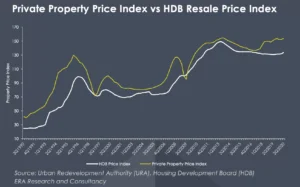
Private-Property-Price-Index-vs-HDB-Resale-Price-Index

Overpricing is the single most common reason listings sit unsold for months, and it’s the opposite of what you want if the goal is to sell your home fast in Singapore without losing money in the process. Buyers today check recent transacted prices on portals before they even book a viewing, so an inflated asking price gets noticed immediately, and every extra week on the market quietly signals to buyers that something might be wrong with the unit. Pull recent comparable transactions in your building or neighbourhood, price competitively against them, and resist the urge to test the market with a number nobody else is asking.

Know Your Real Numbers Before You List

This is the step that gets skipped most often, and it’s the one that actually determines whether you can afford to sell fast or need more room to negotiate. Before listing, work out:

What to Check

Why It Matters

Seller’s Stamp Duty (SSD)

Applies if you sell within 4 years of purchase (for properties bought on or after 4 July 2025); rates step down each year you hold

CPF refund with accrued interest

Any CPF used to buy the property, principal plus 2.5% interest, must be refunded to your CPF Ordinary Account on sale

Outstanding home loan

Settled first from your sale proceeds before anything else is disbursed

MOP (HDB only)

Must be fulfilled, generally 5 years, before you can sell on the open market

Agent commission

Typically 1% to 2% of sale price, always confirm the rate in writing before engaging

Legal and administrative fees

Roughly $2,000 to $3,500 for conveyancing

If your sale proceeds, after settling the loan, aren’t enough to cover your full CPF refund, you generally don’t need to top up the shortfall in cash, provided you sold at market value. It’s a common misconception that trips people up mid-sale, so it’s worth confirming with your lawyer early rather than assuming the worst.

Present the Home the Way a Showflat Would

Study your competition

Buyers respond to feeling, not just square footage. Declutter, deep clean, and fix small cosmetic issues, chipped paint, a squeaky door, that pile of shoes by the entrance, before your first viewing. A fresh coat of paint on the front door and a tidy walkway genuinely change a buyer’s first impression before they’ve even stepped inside. If your furniture is dated or the space feels cramped, professional home staging can be worth the cost for higher-value units, since buyers are ultimately deciding both emotionally and logically.

Choose a Properly Registered Agent, and Verify It

Your agent’s marketing reach and negotiation skill directly affect how fast your home sells and for how much. Before engaging anyone, check their CEA registration number on the CEA public register, this takes two minutes and confirms they’re actually licensed to transact in Singapore. Ask directly how they plan to market your listing, which portals they’ll use, whether professional photography or a video walkthrough is included, and how they’ll qualify buyers before scheduling viewings. A good agent should be able to answer all of this clearly, not vaguely.

Market It Properly, Photos Included

Do up your house

Your listing’s first photo determines whether a buyer clicks through at all. Bright, wide-angle, well-lit photos consistently outperform dim, cluttered ones, and a short video walkthrough has become close to standard expectation on major portals like PropertyGuru and 99.co. Include floor plans if you have them, buyers increasingly want to see the actual layout before booking a viewing rather than relying on photos alone.

Manage Viewings So Buyers Feel Comfortable

Let your house do the inviting

Buyers tend to open up more, ask honest questions, voice real objections, when the seller isn’t standing right there. Let your agent run the viewing rather than hovering yourself. It sounds counterintuitive, but a buyer who feels free to linger and picture themselves living there is more likely to make an offer than one who felt watched the whole time.

Negotiate With a Clear Head and a Real Walk-Away Number

Go into negotiations knowing your floor price and your ideal price, and don’t let a single lowball offer rattle you into either accepting too little or losing your composure. Buyers pick up on desperation quickly, so avoid vacating the home early or dropping your price dramatically after just one quiet week. Once you’ve agreed on terms, the actual completion process for a resale property typically runs 8 to 12 weeks from the buyer exercising the Option to Purchase to keys changing hands, with your CPF refund and net proceeds landing on completion day itself.

A Word From SG Luxury Condo

Selling your home fast in Singapore isn’t about tricks, it’s about doing the unglamorous prep work properly: knowing your real numbers, pricing honestly, presenting well, and choosing the right person to represent you. Sellers who skip the numbers step in particular tend to get unpleasant surprises exactly when they can least afford them, right before completion.

If you’re getting ready to list and want a clear read on your actual numbers, SSD, CPF refund, and net proceeds, before you commit to a price, SG Luxury Condo is happy to walk through it with you. Our property consultation sessions cover exactly this kind of pre-sale planning, and you’re welcome to check our track record and testimonials if you’d like to see how we’ve helped past clients sell their home fast in Singapore, or browse our full range of luxury condos for sale in Singapore if you’re upgrading right after your sale.

Advanced Heading

Frequently Asked Questions

What's the fastest way to sell a home in Singapore without losing money?

Pricing competitively from day one based on recent comparable transactions, rather than testing an inflated asking price and dropping it later, is consistently the biggest factor in selling both fast and profitably.

Only if you’re selling within 4 years of purchase for properties bought on or after 4 July 2025. Outside that holding period, no SSD applies regardless of how quickly you sell.

Any CPF used toward your original purchase, principal plus accrued interest at 2.5% per annum, must be refunded to your CPF Ordinary Account from your sale proceeds, typically within about two weeks of completion.

You generally don’t need to top up the shortfall in cash, provided the property was sold at fair market value. This is a common point of confusion worth clarifying with your lawyer before you list.

Search their name or registration number on the CEA public register, which confirms whether they’re currently licensed to transact property in Singapore.

Typically 4 to 6 months total, with marketing and viewings taking 1 to 3 months and legal completion taking another 8 to 12 weeks after the buyer exercises the Option to Purchase.

Generally, no. Buyers tend to feel more comfortable asking honest questions and picturing themselves in the space when the seller isn’t present, letting your agent manage the viewing instead.

For HDB flats, MOP is generally 5 years before you can sell on the open market. Executive Condominiums also carry a 5-year MOP starting from TOP, before you can sell to Singaporeans and PRs.

For higher-value units especially, yes. A well-presented, decluttered space creates a stronger first impression, and buyers are making both an emotional and logical decision when viewing a home.

Beyond any applicable SSD, budget for agent commission (typically 1% to 2%), legal and conveyancing fees (roughly $2,000 to $3,500), and your CPF refund, which reduces your net cash proceeds even though it’s technically your own money returning to your account.

ABSD Rate Singapore
Categoriesarticles

ABSD Rate Singapore: The Complete 2026 Breakdown

TL;DR

  • The ABSD rate Singapore charges depends on your residency status and how many properties you already own.
  • Singapore Citizens pay 0% on a first property, 20% on a second, and 30% on a third or beyond.
  • Permanent Residents pay 5%, 30%, and 35% respectively.
  • Foreigners pay a flat 60% regardless of property count — except nationals of the US, Switzerland, Norway, Iceland, and Liechtenstein, who pay Singapore Citizen rates under free trade agreements.
  • Trust purchases carry a flat 65% ABSD.
  • ABSD is payable in cash or CPF within 14 days of exercising your Option to Purchase.
  • Legal remission is available in specific situations, most notably for married couples selling their first home within 6 months of buying a second.

Additional Buyer’s Stamp Duty (ABSD) Rates

Correct as of 15/02/2023 (Latest)

Additional Buyer’s Stamp Duty

1st Property Purchase

2nd Property Purchase

3rd Property Purchase

Singapore Citizens

Nil

20% (Former 17%)

30% (Former 25%)

Permanent Residents

5%

30% (Former 25%)

35% (Former 30%)

Foreigners

60% (Former 30%)

60% (30%)

60% (30%)

Misc: Trustees 65% (can claim back)

Buyer Stamp Duty

  • Purchase Price $360,000 to $ 1 million: (3% X Purchase Price – $5,4002
  • Purchase Price $1 million to $1.5 million: (4% X Purchase Price – $15,400)
  • Purchase Price $1.5 million to $3 million: (5% X Purchase Price – $30,400)4
  • Purchase Price above $3 million: (6% X Purchase Price – $60,400)

What ABSD Actually Is

Additional Buyer’s Stamp Duty sits on top of the standard Buyer’s Stamp Duty every property buyer pays. It was introduced in December 2011, initially just 10% for foreigners and corporate entities, as one of Singapore’s cooling measures aimed at moderating demand and keeping the market from overheating. The ABSD rate Singapore charges has been raised repeatedly since then, most recently in April 2023, and shows no sign of being a temporary measure at this point.

Working Out Your Total Stamp Duty: A Real Example

Numbers land better with an actual scenario. Say a Singapore Citizen is buying a $1.8 million condo as their second property.

  • BSD: roughly $50,600 based on the tiered calculation above
  • ABSD at 20%: $360,000
  • Total stamp duty: approximately $410,600, payable within 14 days of exercising the OTP

That’s before legal fees, agent commission, or the downpayment itself. This is exactly why running the full ABSD rate Singapore applies to your specific profile matters before you fall in love with a specific unit, not after. Rather than doing this by hand every time, our calculator tools let you plug in your purchase price and buyer profile and get the same breakdown instantly.

ABSD Remission for Married Couples

There’s one commonly used exception worth knowing well. If a foreigner or PR is married to a Singapore Citizen and doesn’t currently own any residential property, ABSD isn’t payable on their matrimonial home.

And if a married couple — Singapore Citizen and PR, or Singapore Citizen and foreigner — buys a second property while still owning their first, they can apply for ABSD remission provided they sell the first property within 6 months of completing the second purchase.

This remission has genuinely saved clients tens of thousands of dollars when timed correctly, but it does require careful planning around the sale of the first property. Missing that 6-month window forfeits the remission entirely.

Free Trade Agreement Exemptions

Nationals and Permanent Residents of Iceland, Liechtenstein, Norway, and Switzerland, along with nationals of the United States, are treated the same as Singapore Citizens under their respective free trade agreements with Singapore. That means 0% ABSD on a first property, rather than the standard 60% foreigner rate.

Worth checking your specific nationality against this list before assuming the full foreigner rate applies to you — it’s a detail that’s easy to miss and expensive to get wrong.

ABSD on Trusts: The 65% Rate

Since May 2022, transferring residential property into a living trust triggers a flat, non-remittable 65% ABSD, payable upfront at the point of transfer. This was introduced specifically to close a planning loophole where property was being placed in trust for minor children to effectively reset a family’s property count.

A refund is possible only if all beneficial owners are identifiable individuals with beneficial ownership vested at the time of transfer, and that ownership can’t later be varied or revoked. Our detailed guide on buying property under trust in Singapore covers the full mechanics if you’re considering this route.

Can You Pay ABSD Using CPF?

Yes, CPF savings can go toward ABSD and related survey fees. The catch is timing. For resale property purchases, ABSD must be paid within 14 days of exercising the OTP, well before CPF reimbursement typically processes, so most buyers pay cash upfront and apply for CPF reimbursement afterward rather than relying on CPF to cover it directly at the point of payment.

stamp-duties-01-768x463-1

Legal Ways to Reduce Your ABSD Exposure

Tax evasion is illegal, but Singapore does offer a handful of legitimate, well-established strategies to legally reduce ABSD exposure:

  • Decoupling — restructuring ownership between spouses so one becomes a first-time buyer again for a subsequent purchase
  • Buying under a child’s name via trust — though this now carries the 65% trust ABSD unless specific remission conditions are met
  • Choosing a dual-key unit — some buyers use this to functionally separate living and rental space within a single purchase
  • Timing a sale within the 6-month remission window — relevant if you’re a married couple upgrading

Our full breakdown on how to legally avoid ABSD in Singapore walks through each of these strategies with the actual numbers and trade-offs involved.

The Full History of ABSD and Property Cooling Measures

ABSD hasn’t stood still since 2011, and it doesn’t exist in isolation either — it’s one piece of a much longer chain of cooling measures Singapore has layered on since the mid-90s. Worth understanding the full trajectory, since it tells you the direction rates have consistently moved, and how ABSD fits into the bigger picture of loan limits, seller’s stamp duty, and TDSR rules.

URA-private-home-price-index-private-home-sales-volume

May 1996

  • Gains from selling properties within three years of purchase taxed as income — 100% of gains if sold within one year, two-thirds in the second year, one-third in the third year.
  • Payment of stamp duty by the buyer brought forward to the time of signing the sale and purchase agreement, closing a loophole that let speculators buy and sell uncompleted properties without paying stamp duty.
  • Seller’s Stamp Duty (SSD) introduced on residential properties sold within three years of purchase.
  • Loan-to-Value (LTV) limit set at 80% for housing loans.
  • Foreigners who are not PRs, and non-Singapore companies, no longer allowed Singapore-dollar housing loans. (These measures were rolled back between November 1997 and July 2005.)

September 2009

  • Removal of the Interest Absorption Scheme (IAS) and Interest-Only Housing Loans (IOL), effective 14 September 2009.
  • Property-related Budget 2009 assistance measures for developers allowed to expire as scheduled.

February 2010

  • SSD reintroduced at up to 3% on residential properties bought on or after 20 February 2010 and sold within one year.
  • LTV limit lowered from 90% to 80% for all housing loans.

August 2010

  • SSD holding period extended from one year to three years for properties bought on or after 30 August 2010.
  • For buyers with an existing outstanding housing loan, minimum cash downpayment raised from 5% to 10%, and LTV limit lowered from 80% to 70%.

January 2011

  • SSD holding period extended further to four years, with rates set at 16%, 12%, 8%, and 4% for properties sold in the first through fourth year of purchase.
  • LTV limit lowered to 60% for individuals with one or more outstanding housing loans, and to 50% for non-individual buyers.

December 2011

  • Additional Buyer’s Stamp Duty (ABSD) introduced for the first time, on top of BSD, for certain categories of residential purchases.
  • Highest ABSD rate of 10% imposed on foreigners and corporate entities buying any residential property.
  • Singapore Citizens owning two properties and buying a third pay 3% ABSD. PRs owning one property and buying a second pay 3% ABSD. (Reliefs provided for qualifying developers and purchases under Singapore’s free trade agreements.)

October 2012

  • Maximum loan tenure of 35 years introduced for all new residential property loans.
  • LTV limit lowered to 40% (or 60% with no outstanding loan) where loan tenure exceeds 30 years or extends past age 65.
  • LTV limit for non-individual borrowers cut from 50% to 40%.

January 2013

  • ABSD raised by 5 to 7 percentage points across the board.
  • ABSD extended to PRs buying their first property and Singapore Citizens buying their second.
  • Foreigners and corporate entities charged 15% ABSD on any residential purchase.
  • LTV limits tightened further for buyers with existing loans; minimum cash downpayment for a second housing loan raised from 10% to 25%.

June 2013

  • MAS introduced the Total Debt Servicing Ratio (TDSR) framework, capping total monthly debt obligations at 60% of gross monthly income.
  • Existing LTV rules refined to prevent buyers circumventing tighter limits on second and subsequent loans.

July 2018

  • ABSD for Singaporeans and PRs buying a second or subsequent property raised by 5 percentage points.
  • ABSD for foreigners raised to 20% (from 15%); for corporate entities, raised to 25% (from 15%).
  • Developers buying residential property for development now pay an additional non-remittable 5% ABSD upfront.
  • LTV limits tightened by 5 percentage points across the board.

16 December 2021

  • ABSD for Singaporeans buying a second property raised by 5 percentage points; third or more, by 10 percentage points.
  • ABSD for PRs buying a second property raised by 10 percentage points; third or more, by 15 percentage points.
  • ABSD for foreigners raised by 10 percentage points; for corporate entities, raised to 35% (from 25%), with the additional 5% developer ABSD retained.
  • TDSR threshold lowered from 60% to 55% of monthly income.
  • LTV limit for HDB housing loans cut from 90% to 85%.

8 May 2022

  • ABSD (Trust) of 35% introduced on any transfer of residential property into a living trust from 9 May 2022 onward, payable upfront at transfer.
  • A refund is possible only if all beneficial owners are identifiable individuals, ownership has fully vested in them at the point of transfer, and that ownership can’t later be varied or revoked.
  • Read more in our guide on purchasing a property via trust.

30 September 2022

  • MSR/TDSR computations now use the higher of a 4% p.a. floor or the prevailing interest rate.
  • HDB loan applications from this date use a 3% interest rate floor for loan eligibility; LTV limit for HDB loans cut from 85% to 80%. HDB’s concessionary rate remains unchanged at 2.6% p.a.
  • A 15-month wait-out period imposed on private property owners and ex-owners before they can buy a non-subsidised HDB resale flat (waived for seniors aged 55+ downgrading from private property).

26 April 2023

  • ABSD raised from 17% to 20% for Singapore Citizens buying a second property.
  • ABSD raised from 25% to 30% for Singapore Citizens buying a third-plus property, and for PRs buying a second property.
  • ABSD raised from 30% to 35% for PRs buying a third-plus property.
  • ABSD raised from 30% to 60% for foreigners buying any residential property.
  • ABSD raised from 35% to 65% for entities and trusts, except housing developers.

3 July 2025

  • SSD holding period extended from 3 years back to 4 years.

Every adjustment across this timeline has moved in essentially one direction — tighter — which is worth keeping in mind if you’re weighing whether to buy now or wait for measures to ease. (Sources: MAS, MOF, URA, and Ministry of National Development press releases.)

How ABSD Actually Shapes Buyer Behaviour

The 60% foreigner rate in particular has visibly cooled foreign demand for Core Central Region property since 2023, part of why CCR price growth has moderated relative to OCR and RCR in recent years.

For local buyers, the jump from 0% to 20% ABSD on a second property is often the single biggest factor determining whether someone upgrades by selling first, or holds two properties simultaneously and absorbs the ABSD cost. It’s rarely a decision people make lightly once they see the actual dollar figure involved.

What to Do Before You Commit to a Second Purchase

Before signing anything, run the actual ABSD rate Singapore applies to your specific citizenship and property count, factor in BSD on top, and confirm whether any remission or FTA exemption genuinely applies to you. Our ABSD calculator and mortgage affordability calculator work together to give you both the tax exposure and your realistic loan ceiling before you commit to a second property.

A Word From SG Luxury Condo

ABSD is genuinely the single biggest line item most buyers underestimate, and it’s not going anywhere given how consistently rates have climbed since 2011. Understanding exactly where you fall on the current table, and whether any remission or exemption applies to you, is worth doing properly before you start viewing units, not after you’ve already found one you love.

If you want a clear read on your own ABSD exposure before committing to a purchase, SG Luxury Condo is happy to run the numbers with you. Our property consultation sessions cover exactly this kind of planning, and you’re welcome to browse our full range of luxury condos for sale in Singapore once your numbers are clear.

Advanced Heading

Frequently Asked Questions

What is the current ABSD rate in Singapore for a second property?

For Singapore Citizens, 20%. For Permanent Residents, 30%. For foreigners, a flat 60% regardless of whether it’s their first, second, or subsequent property.

Almost always, except for nationals and PRs of Iceland, Liechtenstein, Norway, and Switzerland, and nationals of the United States, who are treated the same as Singapore Citizens under free trade agreements.

Yes — if you’re a married couple (Singapore Citizen with PR or foreigner spouse) and you sell your first property within 6 months of completing the second purchase, you can apply for ABSD remission.

Yes, but for resale purchases, ABSD must be paid within 14 days of exercising the OTP, which is typically faster than CPF reimbursement processes, so most buyers pay cash first and reclaim via CPF afterward.

A flat, non-remittable 65%, payable upfront when the property transfers into the trust, unless specific remission conditions around identifiable, vested beneficial ownership are met.

No. It started at 10% in 2011, before being raised in stages to 15%, 20%, 30%, and finally 60% as of April 2023.

BSD is a tiered tax every buyer pays regardless of citizenship or property count. ABSD is an additional tax layered on top, depending specifically on your residency status and how many properties you already own.

Yes — decoupling between spouses, timing a sale within the married couple remission window, and certain trust structures are all legitimate strategies, though each comes with its own costs and trade-offs worth weighing carefully.

Yes, ABSD applies to both HDB and private residential property purchases, based on the same buyer profile and property count rules.

Each increase has been introduced as a cooling measure to moderate demand during periods of rapid price growth. Since 2011, every adjustment has moved rates upward, part of a broader pattern of tightening rather than easing.

Property AI

Here's a few ways we can help you
🤖
Would you like our AI Bot to help you find the perfect property? Our AI Bot can scrape through hundreds of property listings and provide you with a list of properties that matches your criteria.
Just now