
Ever walked into a showflat, looked up at a soaring double-height ceiling, and thought “wow, this feels so much bigger”? That feeling is real. What’s not always obvious is that a chunk of the square footage creating that feeling might be a void area, and you could be paying full price for space you can’t actually stand in.
This trips up more buyers than you’d expect, including some who’ve bought multiple properties before. At SG Luxury Condo, we walk every client through their floor plan line by line before they sign anything, specifically because void area is one of the easiest things to miss and one of the most annoying things to discover after the fact. It’s a small detail with a real dollar impact, and it’s exactly the kind of thing SG Luxury Condo flags early rather than letting a client find out during their first week moving in.
TL;DR: A void area is empty space above the floor in a strata unit, usually created by a high ceiling, that still counts toward the unit’s total saleable floor area even though you can’t walk on it or furnish it like normal living space. It’s common in penthouses, strata landed homes, and loft-style units. The key thing to know is that void area typically sells at only 30% to 50% of the psf price of regular floor area, which means the unit’s average psf on paper can look artificially low. Always check the Sale and Purchase Agreement, or the Subsidiary Strata Certificate of Title for resale units, before assuming your quoted floor area is all usable space.
What Exactly Is a Void Area?
A void area is empty space that sits above the floor within a strata unit, but which the developer still counts as part of the unit’s total saleable floor area. It typically shows up in units with a ceiling height of around 3.2m or more, noticeably taller than the standard 2.75m to 2.9m ceiling in a typical condo unit.
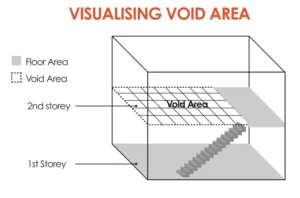
Think of a double-volume living room, or the open space above a staircase leading up to a loft. Visually, it’s dramatic. Functionally, you can’t put a bed in it, you can’t stand in it, and depending on the specific layout, you might not even be able to walk through the upper portion of it at all.
The exact breakdown of a unit’s floor area, including whether it contains void area and how much, is stated in the Sale and Purchase Agreement (S&P) for new launches, or the Subsidiary Strata Certificate of Title (SSCT) for completed resale units issued on or after 1 August 2012.
Where You’ll Typically Find Void Area
Void area isn’t unique to any one property type, but it does show up more often in certain layouts:
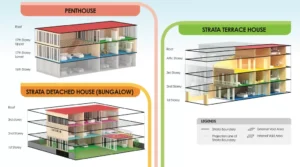
- High-rise penthouses, especially those marketed around a dramatic double-volume living or dining space
- Strata detached houses and bungalows, where high ceilings are part of the architectural draw
- Strata terrace houses, particularly newer designs with loft-style upper floors
- Loft-style apartments, where the “loft” portion above a staircase may or may not be usable, standing headroom depends entirely on the specific design
It’s worth noting that not every loft unit has void area. Generally, if the loft deck’s ceiling isn’t tall enough for an adult to stand comfortably, developers often don’t count that portion as void area at all. Practices differ from developer to developer and project to project, which is exactly why you shouldn’t assume anything without checking the paperwork.
The Part Most Buyers Miss: You’re Paying for Air
Here’s the bit that actually matters for your wallet. Void area typically transacts at roughly 30% to 50% of the psf price of normal, walkable floor area. Developers and sellers know this, and it shows up in how units get priced and marketed.
Here’s a simple side-by-side to show why this matters.
Unit A (with void area) | Unit B (no void area) | |
Total Floor Area | 2,000 sq ft (includes 500 sq ft void area) | 1,500 sq ft (fully usable) |
Average PSF | $1,300 | $1,600 |
Total Price | $2,600,000 | $2,400,000 |
At first glance, Unit A looks like the better deal, bigger space, lower psf. But strip out the void area and Unit A actually only has 1,500 sq ft of genuinely usable floor space, exactly the same as Unit B, and it costs $200,000 more. The lower headline psf on Unit A isn’t really a discount. It’s just the void area quietly dragging the average down.
This is exactly why comparing two units purely on advertised psf can be misleading if one of them carries void area and the other doesn’t. Always ask specifically how much of the quoted floor area is void before comparing prices across units, it’s one of the first checks SG Luxury Condo runs whenever a client is torn between two similarly priced options.
A Real Example of Why This Matters
This isn’t just a theoretical concern. In one case from 2014, a couple who’d paid an option fee on an executive condominium penthouse later argued the unit felt smaller than they’d expected and took the developer to court. The developer’s position was that the Option to Purchase had clearly stated the total saleable floor area included the air-conditioner ledge, roof terrace, and void area of the unit, all spelled out in the paperwork the couple had signed. The case didn’t proceed to a full ruling, but it’s a useful reminder that once you’ve signed, the law generally expects you to have read and understood what you were buying.
How to Check Before You Buy
Whether you’re buying a new launch or a resale unit, here’s exactly what to do before you sign anything.
- For new launches, developers are required to give buyers a description and estimated area breakdown of every space, including any void area, before accepting a booking fee. You’ll need to sign written confirmation that you received this. Read it properly before handing over that fee.
- For sub-sale (uncompleted resale) units, ask the seller for their Certificate of Strata Area before you pay the option fee. It states the unit’s floor area and whether any void area is included.
- For completed resale units, buy a copy of the Subsidiary Strata Certificate of Title (SSCT) from SLA. For SSCTs issued on or after 1 August 2012, void areas are shown explicitly. You can also purchase the Strata Certified Plan (CPST) through SLA’s Integrated Land Information Service (INLIS) for extra confirmation.
- If you’re still unsure, don’t be afraid to just walk away from the deal. If a unit’s void area classification feels unclear or the agent can’t explain it properly, that ambiguity alone is a reasonable reason to look elsewhere.
Can You Deck Over a Void Area to Get More Usable Space?
Some owners look at a double-volume void space and think, why not just build a floor across it and gain an extra room? Technically possible, but not something you can just decide to do on your own.
You’ll need two separate approvals before any decking work happens:
- Consent from the Management Corporation Strata Title (MCST), which requires at least 90% of share value in favour of the proposal at a general meeting. Getting there isn’t always easy, especially in larger developments with more owners to convince.
- Approval from the Urban Redevelopment Authority (URA), since decking over a void area effectively adds floor space, which can push a development’s Gross Floor Area (GFA) beyond what’s approved. Void areas are specifically excluded from GFA calculations as they stand, so converting one into usable floor space changes that equation.
Skipping either approval isn’t just a formality issue. Unauthorised structural changes can create real problems if you ever try to sell the unit or if the MCST later requires you to reverse the work. SG Luxury Condo always advises clients to get both approvals in writing before any contractor touches the space.
Is Buying a Unit With Void Area a Good Idea?
It depends entirely on what you value. If the dramatic ceiling height and sense of space genuinely matter to you, and you go in understanding exactly how much of the quoted area is void, there’s nothing wrong with it. Some buyers love the architectural drama enough that the trade-off is worth it.
Where it becomes a problem is when a buyer doesn’t realize the void area exists at all, and ends up disappointed that their “2,000 sq ft home” feels a lot smaller once they move in. Understanding your actual usable floor area, not just the number printed on the listing, is the difference between a happy purchase and a frustrating one. Our guide on how to read a floor plan properly goes deeper into spotting these details before you commit, and it pairs well with this topic since void area is exactly the kind of thing a poorly read floor plan can hide.
A Word From SG Luxury Condo
We’ve sat with clients staring at a floor plan trying to figure out why a unit felt smaller in person than the numbers suggested, and nine times out of ten, void area was the answer. It’s not a scam, and it’s fully disclosed if you know where to look, but it’s exactly the kind of detail that’s easy to gloss over when you’re excited about a showflat.
If you’re comparing a few units and want a second pair of eyes checking for void area, strata quirks, or anything else hiding in the fine print, SG Luxury Condo is happy to walk through the paperwork with you before you commit. Our property consultation sessions cover exactly this kind of due diligence, and if you’re specifically eyeing a penthouse or loft-style unit, our luxury condo real estate agents can pull the SSCT and floor plan details for you before you even schedule a viewing.
You can also browse our full range of luxury condos for sale in Singapore if you’re still shortlisting where to start. For more tips on what to check before falling for a showflat, our guide on picking your dream condo unit is worth a read alongside this one.