Ask any property agent in Singapore what the first thing they check on a listing is, and a good chunk will say the same thing: how far is it from an MRT station? It’s become such a reflex that buyers sometimes forget to ask the more useful question, which is exactly how much that distance is worth, and when in a station’s life cycle it’s worth the most.
That’s really what the MRT Effect on Property Prices is about. It’s not just “closer is better.” The actual pattern is more interesting, and more useful, once you understand the different stages a station goes through, from announcement to construction to opening, and how each stage moves prices differently.
At SG Luxury Condo, we walk clients through this pattern constantly, especially with the Cross Island Line and Jurong Region Line both actively reshaping parts of the island right now. Understanding the MRT effect properly, rather than just assuming “near MRT is always good,” is one of the first things SG Luxury Condo covers with new investors.
TL;DR: The MRT effect on property prices in Singapore plays out in four distinct stages. Prices tend to rise right after a new line is announced, dip during the noisy construction phase, and then rise again once the station actually opens, typically by 3% to 8% within 12 to 24 months of opening. Properties within 400m to 500m of a station generally command a 10% to 20% premium over similar units further away. The catch is that a lot of this premium gets priced in early, sometimes years before a station even opens, so timing matters just as much as location.
A Quick Recap: Singapore’s MRT Network Today
Singapore’s MRT system started small. The first five stations, Yio Chu Kang, Ang Mo Kio, Bishan, Braddell, and Toa Payoh, opened on 7 November 1987 along a 6km stretch of the North South Line. Today the network has grown to roughly 200 stations across the island, carrying millions of commuters daily, with two more lines actively under construction and reshaping how the MRT Effect on Property Prices plays out in previously underserved neighbourhoods.
Two upcoming lines matter most for anyone studying the MRT effect right now:
- Jurong Region Line (JRL) – opening in phases from 2027, serving Tengah, Choa Chu Kang, Boon Lay, NTU, and the Jurong Innovation District
- Cross Island Line (CRL) – Singapore’s longest MRT line at over 50km, cutting across the island from Changi to Tuas. Phase 1 opens in 2030, Phase 2 (including the Punggol Extension) in 2032, and Phase 3 construction is slated to begin in 2027 with completion in the late 2030s
The government’s long-standing target, first set in 2013, is for 8 in 10 households to live within a 10-minute walk of an MRT station by 2030. That goal is a big part of why the MRT effect keeps mattering so much to Singapore property values, more stations are always on the way.
Stage 1: The Announcement Effect
The first, and often largest, price movement happens the moment a new MRT line or station is officially announced, well before a single piece of track gets laid. This is the earliest and arguably most important stage of the MRT effect.
Interestingly, the size of this bump depends heavily on the age and prior accessibility of the area. In older estates that previously had poor MRT access, the announcement effect tends to hit hardest, since these units usually start from a lower psf base, and even a modest percentage jump adds up to a meaningful dollar amount once you factor in typically larger unit sizes in older developments.
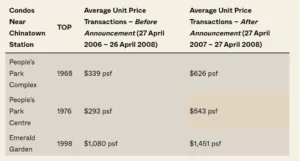
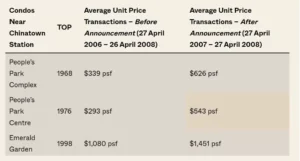
Chinatown offers a clear real-world example, being an older estate with a lower starting psf, the announcement of a nearby MRT line pushed prices up noticeably more than it did in newer, already well-connected areas.
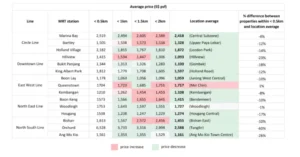
Across 15 MRT stations, properties within 0.5km commanded roughly a 15% premium over similar units in the surrounding neighbourhood, with the gap narrowing (though staying real) as distance increased to 1km and beyond
A 2017 study found buyers were willing to pay roughly 13% more for units within 400m of a station. More recent research from URA and SRX puts the typical premium in the 10% to 15% range, with newer analyses of projects within 400m of a launch station showing premiums stretching up to 20% in some cases.
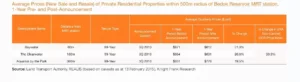
A concrete example from Bedok Reservoir: Baywater, just 60m from the station, saw prices jump 21% in the year following the MRT announcement. The Clearwater (180m away) gained 20.6%, and Aquarius by the Park (380m away) gained 19.5%, a clear, if gentle, decline in the announcement bump as distance from the station increases, exactly the pattern this stage of the MRT effect predicts.
Developments with direct MRT integration, where residents can access the station from the building’s basement without stepping outdoors, tend to command the strongest and most defensible premiums of all, since that convenience simply can’t be replicated by any nearby but non-integrated project.
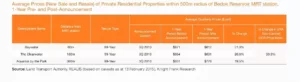
A direct comparison near Bedok Reservoir MRT makes the pattern concrete: Baywater, less than 100m from the station, saw a 21% increase within two years of the MRT announcement, while Aquarius by the Park, roughly 400m away, saw a noticeably smaller gain.
Stage 2: Proximity’s Ongoing Effect
Once the initial announcement bump settles, proximity to the station becomes the dominant factor in ongoing pricing. This part of the MRT effect is the most consistent and well-documented across multiple independent studies.
Distance to MRT Station | Typical Price Premium |
Within 400m (direct walkable catchment) | Full premium, 10% to 20% |
400m to 800m | Partial premium |
Beyond 800m | Premium largely disappears |
Direct basement/podium integration (e.g. Lentor Modern, J’Den) | Strongest and most durable premium |
A 2017 study found buyers were willing to pay roughly 13% more for units within 400m of a station. More recent research from URA and SRX puts the typical premium in the 10% to 15% range, with newer analyses of projects within 400m of a launch station showing premiums stretching up to 20% in some cases.
Developments with direct MRT integration, where residents can access the station from the building’s basement without stepping outdoors, tend to command the strongest and most defensible premiums of all, since that convenience simply can’t be replicated by any nearby but non-integrated project.
Stage 3: The Construction Dip
Here’s the part of the MRT Effect on Property Prices that catches a lot of buyers off guard, because it runs counter to what you’d assume. Once construction actually begins, prices near the future station often soften, sometimes noticeably.
The reason is straightforward. Noise, dust, and traffic disruption from years of tunnelling and station works are a real, daily inconvenience, and buyers price that discomfort in. Data from developments near Bedok Reservoir MRT showed prices declining nearly 10% once construction infrastructure works began, reversing a chunk of the earlier announcement gains.
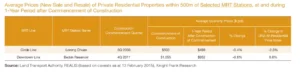
The numbers back this up precisely. Bedok Reservoir saw a 9.8% price decline in the year after construction began. Interestingly, Lorong Chuan barely moved (-0.4%) during its own construction phase, showing the construction dip isn’t universal, it depends on how disruptive the specific works are and how exposed nearby units are to the noise and dust.
Developments near Bedok Reservoir saw prices dip 9.8% once construction and infrastructure works actually began, a real, measurable reversal of the earlier announcement-phase gains.
This dip is actually one of the more useful things to understand about the MRT effect, because it often creates a genuine buying window. Analysts have found that once a line is completed, nearby properties can enjoy a premium of 10% to 30% depending on proximity and market conditions, meaning the temporary construction-phase softness can be an opportunity rather than a warning sign, provided you’re prepared to hold through the disruption.
Stage 4: The Opening Effect, and Why It Doesn’t Play Out the Same Everywhere
Once a station finally opens, prices generally rise again, reversing the construction dip and then some. Historical studies of past line openings show nearby property values appreciating roughly 3% to 8% in the 12 to 24 months surrounding a station’s opening.
But this is the stage where the MRT effect gets genuinely nuanced, and it’s worth slowing down here. The size of the opening-day bump depends heavily on three things:
- How much the area relied on the MRT beforehand. Suburban estates that previously had poor access see the largest gains, since residents there depend on the new line far more for daily commuting. Well-connected central areas see comparatively little uplift, since residents there weren’t lacking transport options to begin with.
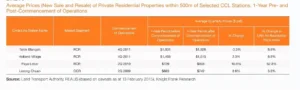
Real Circle Line data backs this up clearly. Lorong Chuan (OCR) saw an 8.6% price increase in the year after operations began, while Holland Village (RCR), already well-connected, saw just 3.3%. Paya Lebar stood out even more, jumping 10.6% locally against a broader URA index gain of 52.3% in the same period, suggesting the area was catching up fast to the wider market.
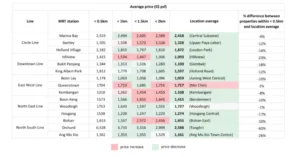
Circle Line data illustrates this well. Lorong Chuan, a suburban station where residents relied heavily on the new line, saw a noticeably bigger price bump after opening than Holland Village, an already well-connected, more central area
- Whether the station is an interchange. Interchange stations, like Clementi (EWL to future CRL) or King Albert Park (DTL to future CRL), multiply the number of destinations reachable without transferring, and tend to command a larger, more durable premium than a standalone station on a single line.
- Whether exclusivity was already priced in. Upscale central districts that were already well-connected before a new line arrived often see minimal additional gains, since the area’s prices already reflected strong accessibility long before the new station showed up.
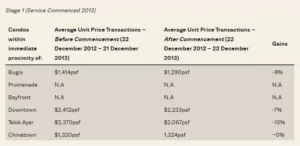
- Downtown Line Stage 1, which opened in 2013, actually showed a downward trend in nearby prices rather than a gain, since many of these developments already sat in well-connected, exclusive central districts
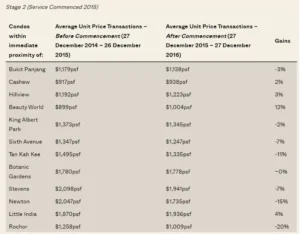
Stage 2 of the Downtown Line showed the same pattern, developments right next to the new stations saw weak gains, reinforcing that pre-existing exclusivity and connectivity blunt the opening-day effect
Where the MRT Effect Is Playing Out Right Now
If you’re trying to apply the MRT effect to today’s market rather than a historical case study, here’s where the action currently sits.
- Cross Island Line corridor – Ang Mo Kio, Bishan, Hougang, Serangoon North, and Pasir Ris in the east; King Albert Park, Clementi, and the Jurong Lake District in the west. Clementi and King Albert Park are particularly notable since both become interchanges, and the western stretch is delivering first-time MRT access to areas like Sunset Way and West Coast that have never had a station before, which is exactly where the announcement effect tends to hit hardest.
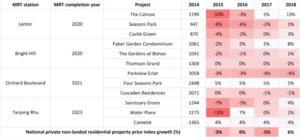
- Jurong Region Line corridor – Tengah, Choa Chu Kang, Boon Lay, and the Jurong Innovation District. Properties here are still, at least partially, priced without the full transit premium factored in, since JRL Stage 1 only opens from 2027.
- A word of caution – much of the CRL’s connectivity premium is already priced in years ahead of opening. Buyers entering the market for confirmed Phase 1 stations today may be paying for gains the market has already anticipated, rather than gains still waiting to happen. The MRT effect rewards early entry, not entry after everyone else has already noticed.
What the MRT Effect Doesn’t Tell You
It’s worth being honest about the limits here. Buying near an MRT station is not a guaranteed path to appreciation. The MRT effect is one input among many, not a standalone investment strategy. Tenure, unit layout, surrounding supply, school proximity, and broader market cycles all matter just as much, sometimes more, than distance to a station.
There’s also a longer-term consideration worth flagging. As more and more of Singapore ends up within walking distance of some MRT line, the scarcity that drives premium pricing today could gradually erode. A station within 400m might not command the same 15% to 20% premium in fifteen years that it does now, simply because far fewer properties will lack that access by then.
Getting the Timing Right
If there’s one takeaway from studying the MRT effect across multiple line openings, it’s that timing matters as much as location. Buying right after an announcement, before construction disruption sets in, tends to capture the earliest and often largest gains. Buying during the construction dip can work well for patient investors who can tolerate a few years of noise in exchange for a lower entry price. Buying only after a station opens usually means you’re paying for gains that have already materialised.
At SG Luxury Condo, this is exactly the kind of timing question our Property P.L.U.S System is built to help clients think through, weighing the MRT effect alongside tenure, unit mix, and where a project sits in its own price cycle. If you’re studying a specific corridor, our breakdown on which MRT lines add the most value to your property purchase goes deeper into line-by-line comparisons, and our guide on using the URA Master Plan to navigate property investment shows you how to spot these announcements before they become common knowledge.
A Word From SG Luxury Condo
The MRT effect is real, well documented, and worth paying attention to, but it’s not a substitute for proper due diligence. We’ve seen clients get excited about a station announcement and overpay for a project that was never going to perform as well as a slightly further, better-built alternative nearby. Understanding which stage of the MRT effect a station is currently in- announcement, construction, or post-opening- tells you far more about whether now is a good time to buy than distance alone ever will.
If you’d like a second opinion on how the MRT effect applies to a specific project or corridor you’re considering, SG Luxury Condo is happy to walk through the numbers with you. You’re also welcome to browse our full range of luxury condos for sale in Singapore if you’d rather explore projects already benefiting from strong MRT connectivity today. For a more structured look at how SG Luxury Condo weighs timing against these transit catalysts, our property consultation sessions are a good place to start.