Over the years, one question comes up again and again from clients at SG Luxury Condo: “Should I buy a unit in a mega development?” It’s a fair question. Big condos come with big trade-offs, more facilities, but also more neighbours, more competition when it’s time to sell, and a very different living experience than a boutique building.
So let’s actually dig into the numbers. This is an update to our earlier study of mega developments in Singapore, now with fresh data from 2025 transactions and a clearer picture of how the market has actually behaved, not just how it’s expected to behave. SG Luxury Condo tracks this segment closely, since it’s one of the most common cross-roads buyers hit when comparing two otherwise similar shortlists.
TL;DR: A mega development in Singapore is a condo with 1,000 or more units. As of early 2025, there were 24 of these across the island, holding over 30,000 units combined, and every single one is 99-year leasehold. Data from EdgeProp and Stacked shows study mega developments tend to outperform smaller condos on price growth and transaction volume, especially for smaller units bought early. But results vary a lot by project, and location still matters more than size alone. The trade-off is real too: lower maintenance fees and more facilities, against less privacy and tougher competition when you eventually sell.
What Exactly Is a Study of Mega Development?
A Stuudy mega development is simply a condo with more than 1,000 units. Some analysts stretch the definition to include projects with 900-plus units too, since the experience is largely the same. Units typically range from compact one-bedders to five-bedroom and penthouse layouts, and the sheer land area usually means an unusually large spread of facilities, multiple pools, tennis courts, function rooms, sometimes even childcare centres.
As of the most recent count, Singapore has 24 mega condo developments, with a combined total of over 30,000 units. Twenty-three are completed, with Grand Dunman still under construction. Every single one of them sits on 99-year leasehold land, and interestingly, D’Leedon is the only mega development located in a prime Central Region district. Treasure at Tampines remains the only project to cross the 2,000-unit mark, with over 2,200 units in total.
Well-known examples include Parc Clematis, Treasure at Tampines, Affinity at Serangoon, Normanton Park, The Minton, D’Leedon, Sims Urban Oasis, and Kingsford Waterbay, alongside newer large-scale launches like ParkTown Residences in Tampines North.
Why Consider a Mega Development?
1. Rental Yield Tends to Run Higher
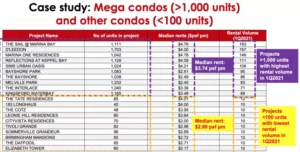
Rental Comparison: Mega Developments vs Smaller Condos
In addition, because more families are sharing the overall cost of the maintenance fees that condominium buyers need to pay, the maintenance fee that each family pays in mega developments will be lower, as seen in the table below. In District 5 and District 15, newer and smaller projects like One-North Eden, Kent Ridge Hill Residences, and Nyon have higher maintenance fees as compared to mega project Normanton Park. Here, One Meyer is the outlier as it lacks facilities. Even so, its maintenance fees are higher than Normanton Park.
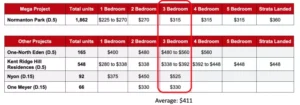
Maintenance Fee Comparison: Mega Development vs Smaller Project (District 5 & 15)
2. Lower Maintenance Fees Through Economies of Scale
With more families sharing the cost of upkeep, individual maintenance fees in mega developments tend to run noticeably lower than in smaller projects, even when the mega development actually offers far more facilities. ERA’s own comparison found similar patterns: Treasure at Tampines, for example, packs in 128 facilities, more than four times what a comparable mid-sized project in the same district offers, while still keeping fees competitive.
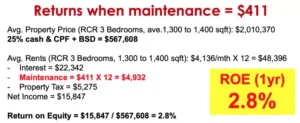
Based on 2021 analysis factoring in maintenance, interest, and property tax, smaller developments returned roughly 2.8% annually.
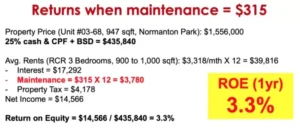
Return of Investment: Mega Development (3.3% annual return, 2021 analysis)
3. Stronger Historical Price Growth for Some Projects
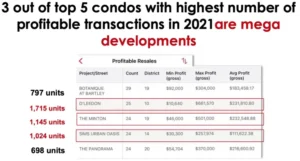
This is where the data gets genuinely interesting. Treasure at Tampines has posted a 33.3% price increase since its 2019 launch, reaching around $1,785 psf, with 487 profitable resale transactions against just a single unprofitable one. Melville Park, an older mega development in the same district, has grown 30.5% since 2019 despite being nearly three decades old. Independent analysis from Stacked has found that, on average, mega developments do tend to outperform regular-sized condos, particularly for smaller units and buyers who got in during early sales phases.
That said, this isn’t universal. The Sail @ Marina Bay has recorded the highest number of unprofitable transactions among all mega developments, and Reflections at Keppel Bay, heavily marketed as a status investment, has actually lost value since launch. Location and timing still matter enormously, size alone doesn’t guarantee a good outcome.
4. A Genuinely Different Lifestyle Offering
Many mega developments include retail, dining, and childcare within the compound itself, effectively creating a self-contained neighbourhood. Families with young children, in particular, tend to get outsized value from this, since there’s rarely a reason to leave the compound for daily errands or weekend entertainment.
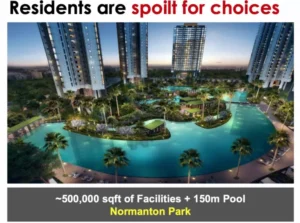
Every unit at Normanton Park sits elevated above ground, meaning there’s no such thing as a true low-floor unit. The development also packs in roughly 500,000 sq ft of facilities, including four to five separate pools
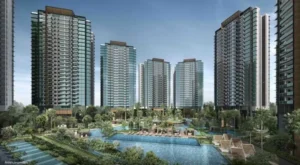
Normanton Park’s Facility-First Design Philosophy
Mega Development vs Boutique Development: A Quick Comparison
Factor | Mega Development (1,000+ units) | Boutique Development (under 100 units) |
Facilities | Extensive, often 100+ | Limited to essentials |
Maintenance fees | Generally lower, shared across more owners | Generally higher per unit |
Privacy and community | Larger, more diverse resident base | Tighter, more intimate community |
Transaction volume | High, frequent resale activity | Lower, fewer comparable transactions |
Resale liquidity | Generally easier to sell, more buyer pool | Can take longer due to niche appeal |
Best suited for | Families, investors, downgraders wanting activity | Singles, professionals, those valuing exclusivity |
Neither option is objectively better. It genuinely comes down to what you and your future tenant or buyer will actually value.
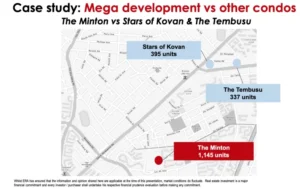
The Minton vs Stars of Kovan vs The Tembusu: Size Comparison.
Historical Case Study: The Minton
The Minton in Upper Paya Lebar remains a useful illustration of what a well-performing mega development can look like over time. In one particularly strong month of transactions, all nine recorded sales showed a 100% profit rate. Comparing average profit per transaction against two nearby, smaller developments, Stars of Kovan and The Tembusu, The Minton’s average profit came in noticeably higher, despite sitting further from the nearest MRT station.
This is a good reminder that MRT proximity, while important, isn’t the only factor driving resale performance. For more on how MRT distance actually affects pricing, our guide on the MRT effect on property prices breaks this down further.
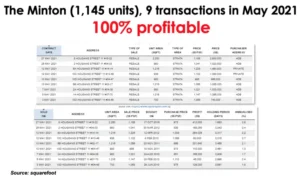
The Minton, May 2021: All 9 Transactions Recorded a Profit
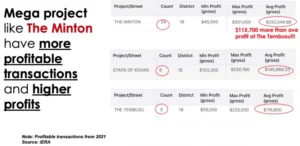
Average Profit: The Minton Outperformed Both Smaller Nearby Developments
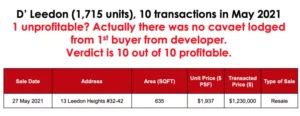
One D’Leedon unit initially looked unprofitable in the data, but that’s because no bank loan caveat was lodged, the buyer paid cash. Once accounted for, all 10 D’Leedon transactions that month were actually profitable.
Case Study
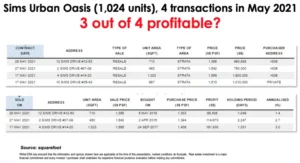
One investor in this batch actually walked away with a $264,751 profit, a 30% return over 3 years, and since he’d taken an 80% loan, his real return on his own cash was closer to 67%
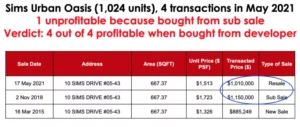
Common Concerns About Mega Developments
“Won’t it be harder to sell with so many competing units?”
This is the most common worry, and it’s a fair one. SG Luxury Condo uses what we call the 1km Formula to check this properly: count how many comparable one-bedroom (or similar) units exist within a 1km radius of the development, then compare that figure across the mega development you’re considering and any smaller alternatives nearby. A lower count of directly competing units is generally a good sign.
A second useful check is dividing total annual transaction volume by total unit count. This tells you how actively a specific mega development is trading, and helps you spot which projects are genuinely well-received by the market versus which ones are simply large.
“Is it harder to rent out a unit in a mega development?”
Not necessarily, but it depends heavily on your target tenant pool. If the development sits near office clusters or is popular with expatriates and white-collar professionals, rental demand tends to be strong. Always research the surrounding tenant demographic before assuming either way.
“Is a mega development harder to en bloc?”
Generally, yes. Buying en bloc potential in a mega development is riskier than the same bet on a smaller, older project, since developers need significantly more capital to buy out a thousand-plus units and pay every owner their share. If en bloc upside is genuinely part of your investment thesis, our detailed guide on the pitfalls of buying for en bloc potential is worth reading first, since mega developments make this already-uncertain strategy even less likely to pay off.
Should You Buy in a Mega Development?
Based on the data, mega developments in Singapore have generally held their own, and often outperformed, comparable smaller condos, particularly for smaller unit types and buyers who entered during early sales phases. But “generally” isn’t “always.” The Sail @ Marina Bay and Reflections at Keppel Bay both show that size alone doesn’t guarantee strong returns, location, timing, and entry price still do the heavy lifting.
If you’re deciding between a mega development and a smaller boutique alternative, weighing the actual numbers matters far more than a general rule of thumb. Our breakdown of undervalued versus profitable properties covers exactly this kind of comparison in more depth.
A Word From SG Luxury Condo
We’ve walked plenty of clients through this exact decision, and the honest answer is that mega developments deserve a fair look rather than automatic dismissal or automatic preference. The data genuinely supports them as solid, often outperforming options, but the project-by-project variation means due diligence still matters as much as it would for any other purchase.
If you’ve got your eye on a specific mega development in Singapore and want a proper look at the numbers before committing, SG Luxury Condo is happy to walk through it with you. Our luxury condo real estate agents track these large-scale projects closely, and our property consultation sessions can help you compare a mega development against smaller alternatives side by side. You’re also welcome to browse our full range of luxury condos for sale in Singapore if you’re ready to start comparing options.