TL;DR: Comparing four real freehold vs mixed development pairings across Beach Road, Redhill, Potong Pasir, and Hillview, freehold properties posted stronger long-term annual price growth in three out of four cases, sometimes dramatically so. But mixed developments consistently saw far higher transaction volumes, meaning better liquidity if you need to sell quickly. Broader 2026 market data adds an important twist: the average freehold premium across Singapore has shrunk to just 4.7%, down sharply from 20% in 2013, and well-connected leasehold developments near MRT stations increasingly outperform quieter freehold properties. Location and connectivity now matter more than tenure alone
“Should I go freehold, or would a mixed development actually serve me better?” We get this question constantly at SG Luxury Condo, and it’s a genuinely harder call than most people expect. It’s not simply freehold good, leasehold bad. The real answer depends on your holding period, your entry price, and honestly, how much you value convenience over land ownership.
This is an update to our original freehold vs mixed development study. We’re keeping the four real case studies that made the original piece useful, but adding fresh context, because the broader market picture has actually shifted since SG Luxury Condo first ran these numbers.
Freehold vs Mixed Development: The Basic Difference
A freehold condominium means you own both the unit and the land it sits on, indefinitely, with no expiry date. It passes to your heirs, or whoever you name in your will, without any lease countdown running in the background.
A mixed development, almost always built on 99-year leasehold land, bundles residential units together with commercial elements, malls, F&B outlets, offices, sometimes even a bus interchange. These projects are usually built directly above or beside an MRT station, which is exactly why they command such strong day-to-day convenience.
Four Real Case Studies: Freehold vs Mixed Development Head to Head
To keep this comparison fair, we picked four location-matched pairs: a mixed development and a nearby freehold development, similar in size, age, and unit count, so tenure was really the main variable at play.
Beach Road: City Gate vs Kallang Riverside
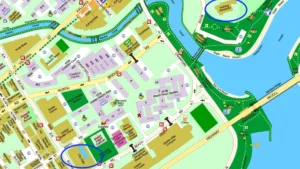 City Gate, a mixed development with direct access to Nicoll Highway MRT and a retail mall downstairs, went up against Kallang Riverside, a freehold project nearby.

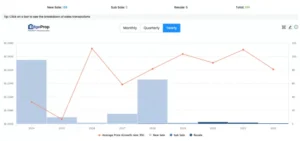
City Gate (Mixed Development) | Kallang Riverside (Freehold) | |
2014 Price | $1,845 psf | $2,129 psf |
2022 Price | $1,971 psf | $2,323 psf |
Annual Growth Rate | 7% | 9% |
2-Year Transaction Volume | 19 | 5 |
Redhill: Artra vs One Jervois
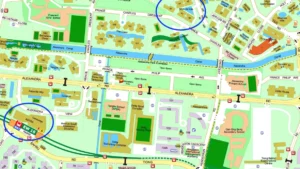
Artra, a newer 99-year leasehold mixed development, went up against One Jervois, a freehold project in the same neighbourhood.

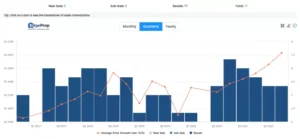
Artra (Mixed Development) | One Jervois (Freehold) | |
2017 Price | $1,653 psf | $1,525 psf |
2022 Price | $2,013 psf | $2,014 psf |
Annual Growth Rate | 3% | 32% |
2-Year Transaction Volume | 12 | 31 |
One Jervois is genuinely an outlier here, and worth explaining. Its location close to the Core Central Region attracts a more affluent buyer pool, people less sensitive to entry price and more focused on status and legacy planning. That demand pushed both its growth rate and its transaction volume unusually high for a freehold property.
Potong Pasir: Poiz Residences vs Euro-Asia Park
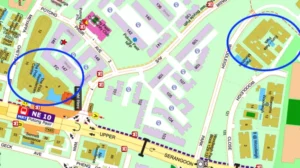
Poiz Residences sits right next to the MRT station and includes a mixed-use retail component. Euro-Asia Park, a freehold development, sits further away.
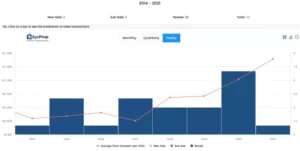
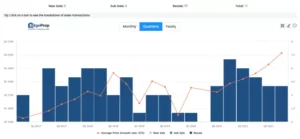
Poiz Residences (Mixed Development) | Euro-Asia Park (Freehold) | |
2015 Price | $1,423 psf | $1,036 psf |
2022 Price | $1,770 psf | $1,456 psf |
Annual Growth Rate | 24% | 43% |
2-Year Transaction Volume | 78 | 8 |
Hillview: Hillier vs Hillvista
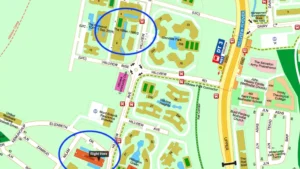
Hillier sits closer to the MRT and is a mixed development, while Hillvista, a freehold project, sits further away.
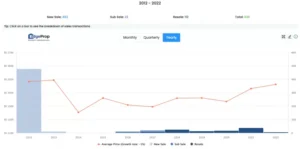
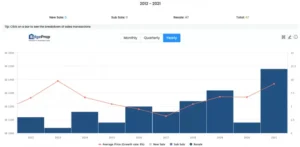
Hillier (Mixed Development) | Hillvista (Freehold) | |
2012 Price | $1,483 psf | $1,263 psf |
2022 Price | $1,462 psf | $1,368 psf |
Annual Growth Rate | -1% | 8% |
2-Year Transaction Volume | 56 | 20 |
Notably, Hillier actually lost value over that decade, while the freehold Hillvista, further from the MRT, still posted solid growth.
What the Four Case Studies Tell Us
Line all four up together and a few patterns become clear.
Beach Road | Redhill | Potong Pasir | Hillview | |
Mixed Development Growth | 7% | 3% | 24% | -1% |
Freehold Growth | 9% | 32% | 43% | 8% |
Mixed Development Volume | 19 | 12 | 78 | 56 |
Freehold Volume | 5 | 31 | 8 | 20 |
- Freehold developments outperformed on price growth in three of the four pairings, and by a wide margin in Redhill and Potong Pasir specifically
- Mixed developments consistently traded more often, meaning easier resale and better liquidity if you need to exit quickly
- The longer the holding period, the wider the gap tends to grow between freehold and leasehold pricing, based on this data
- MRT distance didn’t determine the outcome in these four cases. Freehold properties further from the station still often posted lower entry prices and stronger percentage growth from that lower base
The 2026 Update: Why This Is Getting More Nuanced
Here’s where we need to update our original conclusion. Broader market data from 2026 tells a more complicated story than these four case studies alone suggest. Across the market as a whole, the freehold premium, meaning how much extra buyers pay for freehold tenure compared to a similar leasehold unit, has shrunk to just 4.7%, down sharply from around 20% back in 2013.
That’s a meaningful shift. It suggests the broad, structural advantage freehold once carried has been narrowing for years, even as individual pairings like One Jervois or Euro-Asia Park still show freehold winning decisively on their own merits. Increasingly, well-connected leasehold developments near MRT stations or integrated with malls and offices are matching or even beating quieter freehold properties on long-term returns, simply because connectivity and daily convenience now weigh more heavily on buyer demand than tenure alone.
The honest takeaway is this: freehold vs mixed development isn’t a rule that applies uniformly across Singapore. Location and connectivity are doing more of the heavy lifting than they used to, and treating “freehold always wins long term” as a blanket rule risks missing genuinely strong leasehold opportunities in the process, which is exactly why SG Luxury Condo runs case-by-case comparisons rather than leaning on a single rule of thumb.
Freehold or Mixed Development, Which Should You Choose?
Our general take is this: if you’re working with a shorter horizon, comfortable exiting within five to seven years, a mixed development’s stronger liquidity and rental demand usually serves you better. If you’re planning to hold for twelve years or more, and you’re not overly reliant on being able to sell quickly, freehold has historically delivered the stronger long-term price growth, at least based on these case studies and the broader premium data.
But don’t stop at that generic answer. A few honest questions are worth asking yourself before deciding:
- What’s your actual entry strategy, and does the current psf gap between the freehold and leasehold option in your target area make sense?
- If both options offered similar profit in three to five years, which genuinely suits your lifestyle better?
- Who is your likely future buyer, and what would make them pay a premium for your unit specifically?
- Can you comfortably afford the bank mortgage on the pricier option without stretching your finances thin?
- Does the cost of the freehold premium actually justify the connectivity and convenience you’d be giving up?
For a deeper look at how tenure specifically, freehold versus 99-year leasehold, plays out on its own, our companion piece on freehold vs leasehold properties is worth reading next. And if MRT proximity is a major factor in your decision, our breakdown of how MRT stations affect property prices explains why that connectivity premium has grown more significant in recent years.
A Word From SG Luxury Condo
Every client’s situation is different, and the honest truth is that neither freehold nor mixed development is objectively “better” in every case. What matters is matching the choice to your actual holding period, your budget, and what you genuinely want out of the property, capital growth, rental income, or simply somewhere convenient to call home.
If you’re weighing a specific freehold and mixed development pairing and want the real numbers run for you before deciding, SG Luxury Condo is happy to walk through it. Our property consultation sessions cover exactly this kind of comparison, and our mortgage affordability calculator can help you check whether the pricier freehold option actually fits your budget before you commit. You’re also welcome to browse our full range of luxury condos for sale in Singapore if you’re ready to start shortlisting between the two.