Ask anyone who’s bought and sold a few properties in Singapore what they’d do differently, and most of them land on the same answer. They wish they’d paid more attention to the importance of location layout before they got swept up in a nice showflat or a flashy facade. It’s an easy trap. A unit can look stunning on the day you view it and still turn out to be a headache five years later, either because the location doesn’t hold its value the way you assumed, or because the layout wastes half the space you paid for.
At SG Luxury Condo, this is genuinely one of the first things we sit down and go through with clients, before pricing, before facilities, before any of the shiny stuff. Get the importance of location layout right and almost everything else about the purchase gets easier to judge.
What People Usually Get Wrong About Location Layout
Most first-time buyers treat location and layout as two separate boxes to tick. Good area, check. Nice floor plan, check. Done. But the importance of location layout only really shows up when you look at both together. A three-bedroom unit with a genuinely efficient layout in a mediocre location might still underperform a smaller, slightly pricier unit in a location with real long-term demand behind it. And the reverse is just as true. A dream location with a badly designed unit, awkward bedroom shapes, wasted corridor, a kitchen that eats into the living room, can leave you sitting on a property that’s genuinely hard to sell, even in a good district.
Location Factor 1: School Proximity
For a lot of families, this is the single biggest driver behind the importance of location layout in their decision. Properties within about 1km to 2km of a well-regarded primary school tend to hold a steady premium, and just as importantly, they tend to sell faster than similar units further away, since there’s always a fresh wave of parents hunting for that specific catchment area every year.
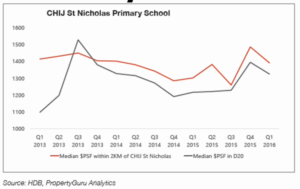
Take St. Nicholas Girls’ School as a real example. Properties within a two-kilometre radius have consistently traded at a premium in District 20 since 2014. Price growth has largely tracked the broader market, but these units have sold faster and more reliably the whole way through, that’s the real value school proximity adds, not necessarily a bigger price jump, but a steadier, more dependable one.
Location Factor 2: MRT Proximity
This one barely needs explaining these days, everyone knows MRT access matters. What people miss is the timing of it. Buying right after a new line gets announced, or during the noisy construction phase, usually captures more upside than waiting until the station has already opened and the premium’s already baked into the price. We’ve gone deep into this exact pattern in our guide on how MRT stations affect property prices, worth a read if MRT access is a big part of your decision.
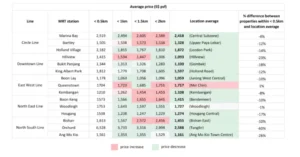
Real Transacted Prices by Distance Band: Selected MRT Stations Across Singapore’s Lines
Real transaction data across Singapore’s MRT lines tells a more nuanced story than the headline premium numbers suggest. Interestingly, properties within 0.5km of a station often trade below their wider location average, Orchard shows a striking 60% gap. This likely reflects older, smaller stock sitting right at the station versus newer, larger units just a bit further out. The lesson: MRT distance alone doesn’t set the price, age, unit size, and specific stack matter just as much, sometimes more.
Location Factor 3: Developer Track Record
The name behind the project says more than people give it credit for, and it’s a piece of the importance of location layout that’s easy to overlook. A developer with a strong history tends to deliver better build quality, smarter use of space, and property management that actually keeps the estate looking good ten or fifteen years down the road. That last part matters more than most buyers realize, a poorly managed estate can drag down even a good location over time.
Developer | Generally Known For |
CDL | Practical, efficient layouts and strong estate management |
UOL | Premium finishes, more generous common facilities |
GuocoLand | Large-scale, transformative projects that lift the whole precinct |
Layout Factor 1: Usable Space vs Quoted Floor Area
Here’s where the importance of location layout tips more toward the “layout” half. Two units advertised at the exact same square footage can feel completely different once you actually walk them. One might dedicate a chunk of that footage to corridor, bay window, or void space you genuinely can’t use day to day. The other might use nearly all of it. This is exactly why comparing psf alone is a mistake, you need to compare usable space. Our detailed breakdown on how to read a floor plan walks you through spotting this before you even book a viewing.
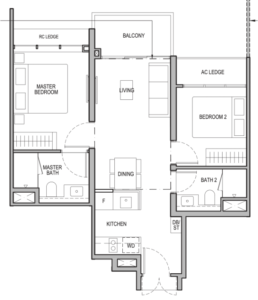
A dumbbell or butterfly layout, bedrooms on either end, living and dining space in the middle, cuts out wasted corridor almost entirely. That’s the kind of design worth actively looking for on a floor plan, not just a nice-sounding term in a brochure.
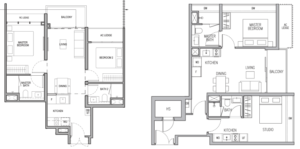
Compare that against a dual-key layout, same total square footage, but split across two kitchens and extra circulation space purely for rental flexibility. Great if renting out both halves separately is genuinely your plan, but for most owner-occupiers, it’s simply less usable space for the same price
Layout Factor 2: Orientation and Sun Path
Layout isn’t only about the floor plan on paper, and this is another part of the importance of location layout that’s easy to skip past. Which way a unit faces changes how it feels every single afternoon. North-south facing units generally dodge the harshest sun Singapore throws at east-west facing ones. It’s a small thing on a spec sheet and a genuinely big thing once you’re living with it.
Layout Factor 3: Bedroom and Living Space Proportions
A well laid out unit puts bedrooms where they should be, quiet corners, away from the main traffic path, with a living and dining area that doesn’t feel like a hallway you’re forced to walk through to get anywhere. This is one of the quieter pieces of the importance of location layout equation, since it rarely shows up in a listing photo. Cheaper-feeling layouts often compress the living room to squeeze in an extra bedroom, which looks good on a floor plan listing but feels cramped the moment you move in furniture.
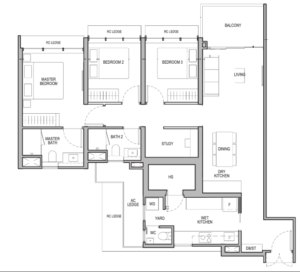
A well-planned 3-bedroom unit still finds room for a dining area that comfortably seats six to eight, a living room big enough for an L-shaped sofa, and bedrooms sized properly rather than shrunk to fit. If a 3-bedroom layout feels tight everywhere at once, that’s usually a sign space was sacrificed somewhere it shouldn’t have been.
Combining the Two: A Simple Way to Score a Shortlist
When we’re helping a client weigh a shortlist, we don’t treat location and layout as separate scores. We look at them together, because the importance of location layout really is about how they interact.
Strong Location | Weak Location | |
Strong Layout | Ideal, worth paying up for | Still workable, good for owner-occupiers |
Weak Layout | Risky, resale may struggle despite the address | Avoid unless the price reflects both weaknesses |
Location Layout and Resale Value
This is really the whole point of paying attention to any of this. Buyers ten years from now will judge your unit on the exact same two factors you should be judging it on today. A good location with a poor layout still sells, just slower and at a discount against comparable units nearby with better space planning. A poor location with a great layout tends to hit a ceiling on price no matter how clever the design is. The importance of location layout, when you’re thinking years ahead rather than just today, is really a resale conversation in disguise.
Price: The Factor That Ties Everything Together
None of this means chase the priciest option available. It means don’t let price alone decide for you, since price without context tells you nothing about the importance of location layout underneath it. A cheaper unit that skimps on layout efficiency or sits in a location with no real growth story isn’t automatically a bargain. Our piece on undervalued versus profitable properties goes further into telling a genuine deal apart from a property that’s just cheap for a reason.
Layout Factor 4: Facilities and Estate Upkeep
This one gets overlooked a lot, mostly because it’s not really about your unit at all, it’s about everything around it. A gorgeous unit inside a poorly maintained estate still drags on resale value, and it’s worth checking a few things before you commit.
- How the pool, gym, and function rooms actually look on a weekday, not just during a staged viewing
- Whether the lift lobbies and corridors feel cared for, chipped paint and grimy carpets are a quiet red flag
- How many facilities the development actually has versus how crowded they get, more isn’t always better if everyone’s fighting for one BBQ pit
- Whether the management corporation has a healthy sinking fund, ask for the latest AGM minutes if you can
- How landscaping and common areas have aged since the development’s TOP, older estates with neglected greenery tend to feel tired fast
Layout Factor 5: Noise, Privacy, and Unit Placement
Two units on the same floor plan can live completely different lives depending on where they sit within the block. This part rarely gets discussed, but it shapes daily comfort just as much as square footage does.
- Corner units usually get better cross-ventilation and more natural light, but sometimes at the cost of extra sun exposure on two sides instead of one
- Units directly above a function room, gym, or driveway tend to pick up more noise than a unit tucked away on a quieter stack
- Ground floor and low-floor units near the main entrance or drop-off point often deal with more foot traffic and less privacy
- Units facing directly into another block’s windows lose a layer of privacy that a floor plan alone won’t show you
- Lift lobby distance matters too, too close and you’ll hear every ping, too far and you’re doing a longer walk every single day
A Word From SG Luxury Condo
We’ve sat with enough clients staring at a beautiful showflat to know how easy it is to forget the fundamentals underneath the staging. A dramatic ceiling or a nicely dressed model unit doesn’t tell you whether the real layout works, and a good postcode doesn’t guarantee the unit inside will hold its value. Weighing the importance of location layout properly, together rather than separately, is genuinely one of the best habits a buyer can build.
If you’re comparing a shortlist right now and want a second opinion on how the location and layout actually stack up, SG Luxury Condo is happy to run through it with you. Our property consultation sessions cover exactly this, and you’re welcome to browse our full range of luxury condos for sale in Singapore once you’ve got a clearer picture of what you’re after.