Property Investment SingaporeProperty Investment Singapore
Categoriesarticles

Property Investment Singapore: Why Serious Investors Work With James Lim

TL;DR: What makes property investment Singapore actually work

  • Every purchase gets screened through our Property P.L.U.S System, price, location, URA Masterplan, sellability, not gut feeling
  • We specialise in condos that genuinely perform, not just condos that show well
  • Full end-to-end support, financing, timeline planning, portfolio structuring, not just viewings
  • We flag overpriced launches and risky resale picks honestly, even when it costs us a sale
  • Real client outcomes are documented and checkable, not just claimed
  • Rental yield and capital appreciation demand different unit types and districts, we help you pick the right one for your actual goal
  • ABSD is the single biggest factor most investors underestimate before buying a second property

Property investment Singapore style comes with its own rulebook. ABSD, TDSR, lease decay, a government that actively steps in to manage the market rather than letting it run wild. Get the fundamentals wrong here and the mistake can quietly cost you tens of thousands of dollars before you’ve even collected your first month’s rent. That’s exactly why serious investors don’t go it alone, they work with someone who’s actually run the numbers on hundreds of transactions before them.

At SG Luxury Condo, led by James Lim, we don’t just sell condos, we help clients build genuine property portfolios with a clear strategy behind every purchase. Here’s what that actually looks like, and why it matters.

Why Property Investment Singapore Needs a Real Strategy, Not Just a Good Unit

Most agents sell units. What actually moves the needle for property investment Singapore-style is a data-backed strategy behind the purchase. At SG Luxury Condo, every recommendation runs through our Property P.L.U.S System:

Letter

What It Checks

Price

Is this unit genuinely undervalued relative to its location and project quality?

Location

Are there upcoming MRT stations, schools, or growth catalysts nearby?

URA Masterplan

What does the current Master Plan tell us about the next 8 to 10 years for this area?

Sellability

Will this unit be genuinely easy to exit profitably within 5 to 8 years?

James Lim personally reviews every listing through this lens before it ever reaches a client, so whether you’re buying your first condo or your fourth, you’re not relying on a sales pitch to tell you whether a unit is genuinely sound.

Rental Yield vs Capital Appreciation: Two Different Games

This is the first thing worth sorting out before anything else. Property investment Singapore strategies generally fall into one of two camps, and trying to optimise for both at once usually means doing neither particularly well.


Rental Yield Focus

Capital Appreciation Focus

Best unit type

1-bedroom, smaller footprint

2 to 3-bedroom

Best region

OCR (Outside Central Region)

RCR and select CCR pockets

Typical gross yield

3.5% to 4.6%

2.5% to 3.8%

Best suited for

Investors prioritising monthly cash flow

Investors with a longer hold, chasing profit on exit

We shortlist across both categories depending on the client’s actual goal:

  • 1-bedroom resale units with 3.5% to 4.6% yield in the RCR and OCR
  • CCR luxury units in Orchard, Newton, and Paterson with genuine long-term upside
  • Emerging resale picks near upcoming MRT lines, Jurong, Paya Lebar Air Base, the future Tengah MRT line
  • Low entry-price strategies for upgraders looking to maximise capital efficiency

ABSD: The Number Most Investors Underestimate

If there’s one factor that reshapes the entire calculus of a second property purchase, it’s Additional Buyer’s Stamp Duty. A Singapore Citizen buying a second property pays 20% ABSD, payable entirely in cash, not CPF. On an $1.8 million purchase, that’s $360,000 locked up before a single dollar of rental income comes in. This is exactly why we walk through TDSR, MSR, ABSD impact, and CPF drawdown with every client before a purchase, not after.

It’s Not Just the District, It’s the Layout, Block, and Stack

Not every property is investment-grade, even within a genuinely good district. James Lim works closely with each client to identify the right layout, block, and stack, not just the right postcode. In property investment, the margin often sits in these details: which floor, which facing, which specific stack within the same development, our guide on finding the most profitable unit in an entire condo development goes deeper into exactly how we screen for this.

Full End-to-End Support, Not Just Viewings

Buying an investment property in Singapore involves more moving parts than most first-time investors expect. We handle:

  • Financial calculations, TDSR, MSR, ABSD impact, CPF drawdown
  • Timeline planning for HDB upgraders navigating MOP and exit windows
  • Portfolio structuring to avoid over-leverage or poor sequencing across multiple properties
  • Sale of your existing unit, when applicable, so both transactions align
  • Legal, tax, and rental advisory after the purchase completes

Clients often describe this as having a genuine “property CFO” in their corner, not just an agent chasing a single transaction.

We Tell You What’s Not Worth Holding, Too

The market is genuinely flooded with overpriced new launches and risky resale picks. Part of our job is filtering through that noise to flag:

  • Overlooked resale opportunities where supply is genuinely tightening
  • Developer incentives that still make financial sense once you run the actual numbers
  • Locations tagged for future URA redevelopment over the next 5 to 10 years

Whether you’re weighing an OCR fringe condo or a Core Central unit, we’ll give you a straight, fact-based answer, even when that means telling you a specific unit isn’t worth it.

Who We Actually Work With

Property investment Singapore clients come in genuinely different shapes, not a single profile:

  • HDB upgraders with strong household income looking to move into a condo for a better lifestyle
  • First-time condo buyers focused on long-term capital growth
  • Higher-net-worth investors focused on Orchard and River Valley
  • Families planning their next generational asset purchase

Each client gets a full property analysis, honest numbers, and access to private viewing slots before the wider market sees them.

Real, Checkable Client Outcomes

We don’t lean on hype, we lean on documented results. Our track record page walks through real client transactions, including cases where clients achieved strong annualised returns on equity, secured positive cash flow from day one, and successfully structured a second property purchase while minimising their ABSD exposure. Every figure there reflects an actual transaction, not a projection.

Ready to Make Your Next Property Investment Move?

Whether you’re buying your forever home or your next income-generating asset, who you buy with genuinely matters. With SG Luxury Condo and James Lim, you get a documented strategy, honest numbers, and full support from the first conversation through to key collection and beyond.

Schedule a strategy call with James Lim on WhatsApp to talk through your budget, target yield, and exit timeline before you commit to anything.

WhatsApp

Advanced Heading

Frequently Asked Questions

What makes property investment Singapore different from other markets?

Singapore’s market is actively managed through cooling measures like ABSD, TDSR, and LTV limits, alongside a land-scarce environment where Government Land Sales and the URA Master Plan shape future supply years in advance. Understanding these mechanics matters as much as picking a good location.

 It’s SG Luxury Condo’s screening framework, checking Price, Location, URA Masterplan alignment, and Sellability before any unit is recommended to a client, replacing gut instinct with a documented process.

It depends on your goal. Rental yield generally favours smaller units in the OCR, while capital appreciation tends to favour 2 to 3-bedroom units in the RCR or select CCR pockets. We help clients match the right unit type to their actual objective.

Significantly. A Singapore Citizen buying a second property pays 20% ABSD in cash upfront, which on an $1.8 million purchase is $360,000, a cost that needs to be factored in well before you start viewing units.

No, our clients range from HDB upgraders and first-time condo buyers to high-net-worth investors and families planning generational asset purchases. The strategy is tailored to each client’s actual budget and goals.

We look beyond the district to the specific layout, block, and stack, since these details often determine the real difference in resale performance between two units in the exact same project.

Full end-to-end support, including TDSR/MSR/ABSD calculations, CPF drawdown planning, timeline coordination for HDB upgraders, portfolio structuring, sale of an existing property if needed, and legal, tax, and rental advisory after purchase.

Yes, our track record page documents real, individual client transactions with actual figures, not projections or hypothetical scenarios.

Both, depending on the client’s goals and timing. We shortlist across new launches, resale units, and emerging areas near upcoming MRT lines, based on which best fits the client’s specific yield or appreciation objective.

Reach out for a short strategy call with James Lim to discuss your budget, target yield, and exit timeline, the same starting point every client goes through before any specific property gets discussed.

Maximising Your Home Value with Affordable Upgrading Hacks
Categoriesarticles

Maximising Your Home Value with Affordable Upgrading Hacks

TL;DR

  • Fresh paint in neutral tones is still one of the best-paying upgrades out there
  • Get rid of rust and mould, it instantly ages a place
  • Swap out tired cabinet handles, cheap and it works
  • A proper deep clean matters more than people think
  • Better lighting genuinely changes how a room feels
  • Decluttering makes small units feel a lot bigger than they are
  • Staging can push your final price up more than it costs
  • A good smell during viewings sticks with buyers
  • Skip the expensive stuff, big renovations rarely pay for themselves
  • Start early, don’t scramble the night before your first viewing

Everyone wants the same thing when they sell a home, the highest price someone’s actually willing to pay. A lot of sellers figure a good agent handles all of that. But honestly, your home does most of the talking before your agent even opens the door. Maximising your home value doesn’t mean gutting the place and spending a fortune either. Most of the stuff that actually changes a buyer’s mind costs next to nothing, sometimes literally nothing.

Here are 12 hacks we walk clients through all the time before a listing goes live. Same ones we’d use ourselves.

Why Even Bother Before You Sell?

Buyers make up their minds fast, sometimes in the first couple minutes walking through the door. If a home looks cared for, buyers assume the plumbing and wiring have probably been cared for too, even if that’s not really how it works. A tired-looking place does the opposite, plants doubt, even when nothing’s actually wrong. Small, cheap fixes close that gap.

1. Repaint the Walls

Repaint-the-Walls

Fresh paint is still one of the cheapest ways to make a place look looked-after. Buyers read it as “someone cared for this,” even if literally nothing else has changed. Depending on what the paint job costs versus what it adds to your final price, you’re often looking at a return of 50% to 500%.

Stick with neutral tones, white, soft grey, warm beige, so more buyers can picture their own stuff in there. And you don’t need to redo the whole unit. Just the living room and kitchen, the two spots people actually linger in, is usually enough.

2. Get Rid of Rust and Mould

Rust and mould age a home fast, even one that’s structurally fine. Rust shows up on doorknobs, hinges, pipes, that kind of thing. Skip replacing the whole fixture, a rust converter brushed on works fine, or soak the metal in white vinegar for a few hours then scrub it off. Baking soda mixed with water into a paste and left to sit does the job too.

Mould’s worth taking seriously, not just for looks. A mould remover or fresh sealant around the bathroom and kitchen edges makes the whole space read newer instantly. And people really will pay more for something that feels new.

3. Swap the Cabinet Hardware

Spring-Clean

Replacing whole cabinets is expensive, and honestly, you rarely need to. Old, tired doorknobs and handles are one of the cheapest swaps around, most hardware stores sell simple options you can screw in yourself in an afternoon. Small change, but it makes the whole kitchen or wardrobe look updated even though the boxes underneath are the same ones from years ago.

While you’re at it, clear out bulky furniture you don’t need, an extra coffee table, an old desk, whatever’s crowding the room. Fewer things almost always makes a space feel bigger, not smaller.

4. Actually Deep Clean the Place

This is the one sellers underestimate most. Before any viewing, the kitchen, floors, and bathrooms need a real clean, not a quick tidy. Oxygen bleach works well on grout, or mix baking soda, vinegar, and lemon juice, leave it 15 minutes, then scrub.

Vinyl floors do well with hot water and white vinegar. Marble or granite countertops need their own specific cleaner, then a microfibre wipe and a spray sealer. Not glamorous work, but it’s genuinely one of the cheapest, highest-impact things you can do before someone walks through.

5. Fix the Lighting

Living-Room-Lights-1


Lighting changes how a buyer feels about a place more than people realize. Put in fresh bulbs for the bathroom and kitchen, and avoid overly warm, dim lighting, it can make rooms feel smaller and more closed off than they actually are. Got any art on the walls? A small spotlight on one or two pieces adds a nice touch.

Wiring and switches matter too, buyers do notice these small things during a viewing, so it’s worth double-checking everything actually works before people show up.

6. Clear Out the Clutter

Storage is a real concern for buyers here, Singapore units run small to begin with. Clutter doesn’t just look messy, it makes a place feel smaller than it actually is. Go through your stuff properly. Keep what you need, tuck the rest away neatly.

If you own a lot, a short-term storage rental just for the viewing period is worth the small cost. One tip worth planning for: line up your laundry days with your agent’s viewing schedule so you’re not hanging wet clothes out when buyers walk through.

7. Consider Home Staging

Staging, arranging furniture and decor to show the place at its best, tends to actually lift your final price. Costs more than the other stuff here, but usually pays for itself, staged homes have sold for as much as 23% above their original listing price. If your unit’s empty right now, or your furniture’s looking dated, this is genuinely worth it, especially for pricier units.

8. Make It Smell Good

Freshen-Your-Home

Smell hits people immediately, buyers notice it the second they walk in. A musty or off smell, often from pets or hidden mould in carpets or damp corners, creates an instant bad impression, even if everything else looks great.

Got a garbage disposal? Run ice, lemon slices, and a bit of bleach through it to clear built-up odour. Light a candle 30 to 60 minutes before a viewing, put diffusers in the bathroom and living room, maybe some soft music in the background. Switch the aircon on ahead of time too, and if you’ve got pets, take them out for a walk while people are looking around.

9. Know What to Skip

Not every upgrade actually pays off. Full kitchen or bathroom renovations rarely earn back their cost, especially on a place you’re about to sell, not live in. Bold, personal choices, an accent wall, unusual fixtures, weird finishes, can actually shrink your buyer pool instead of growing it. The rule of thumb: spend on things that help first impressions broadly, paint, cleanliness, lighting, decluttering, and skip anything pricey and overly personal that a buyer would probably just rip out anyway.

10. Time It Right

Start a few weeks before your first viewing, not the night before. Paint needs time to dry and lose that fresh smell. Deep cleaning holds up better with a week or two of buffer before back-to-back viewings. Staging needs setup time too, or it just looks rushed. Give yourself room so you’re not juggling contractors, cleaners, and your agent’s schedule all at once.

A Word From SG Luxury Condo

Maximising your home value doesn’t take a big renovation budget. It takes knowing which small, cheap changes actually shift what a buyer thinks, and which ones aren’t worth your money. Fresh paint, a real clean, better lighting, less clutter, these cost relatively little and genuinely make a difference at viewing.

If you’re getting ready to list and want a second opinion on which upgrades are actually worth your time, SG Luxury Condo is happy to walk through it with you. Our property consultation sessions cover this kind of pre-sale planning, and our guide on selling your home fast in Singapore is worth reading too. You’re also welcome to browse our full range of luxury condos for sale in Singapore if you’re upgrading right after your sale.

Advanced Heading

Frequently Asked Questions

What's the cheapest way to boost home value before selling?

Repainting in neutral tones, usually returning 50% to 500% of what it costs, plus a proper deep clean and decluttering, both of which cost little to nothing.

For a lot of sellers, yes. Staged homes have sold for up to 23% above their original listing price, which usually covers the cost, especially for higher-value units.

Probably not a full renovation. That rarely earns back what you spend. Smaller stuff, swapping cabinet handles, a fresh coat of paint, tends to give a better return for less money.

A few weeks. Gives paint time to dry, leaves room for a proper clean, and enough time to arrange staging if you want it, instead of rushing everything the day before.

Yes, it hits people fast. A musty smell can undo a home that otherwise looks great, while a pleasant one leaves buyers with a genuinely good impression.

A rust converter brushed on works, or soak it in white vinegar and scrub with a microfibre cloth. Baking soda paste is another cheap option.

Yes, noticeably. Clutter can make a unit feel much smaller than its actual size, which matters even more given how compact Singapore units usually run.

Neutral, white, soft grey, warm beige. Easier for buyers to picture their own furniture, and it appeals to more people overall.

Yes. Lighting genuinely changes how spacious and warm a place feels. Fresh bulbs, avoiding dim warm light, and a spotlight on any art are all cheap, effective fixes.

Bold, personal design choices and big renovations. Both usually cost more than they return. Put your budget toward cleanliness, paint, lighting, and decluttering instead, stuff that appeals broadly.

Property Capital Appreciation Singapore
Categoriesarticles

Property Capital Appreciation Singapore: The 5 Factors That Actually Move Prices

TL;DR

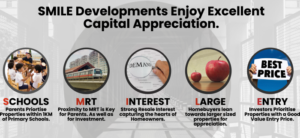
  • The most profitable Singapore properties share five traits: school proximity, MRT access, strong resale interest, larger unit sizes, and an attractive entry price.
  • A unit within 1km of a top primary school taps into a steady pool of motivated buyers thanks to MOE’s priority admission rules.
  • Entry price does most of the heavy lifting — even a 1 percent difference in your entry PSF compounds meaningfully over a 5–10 year hold.
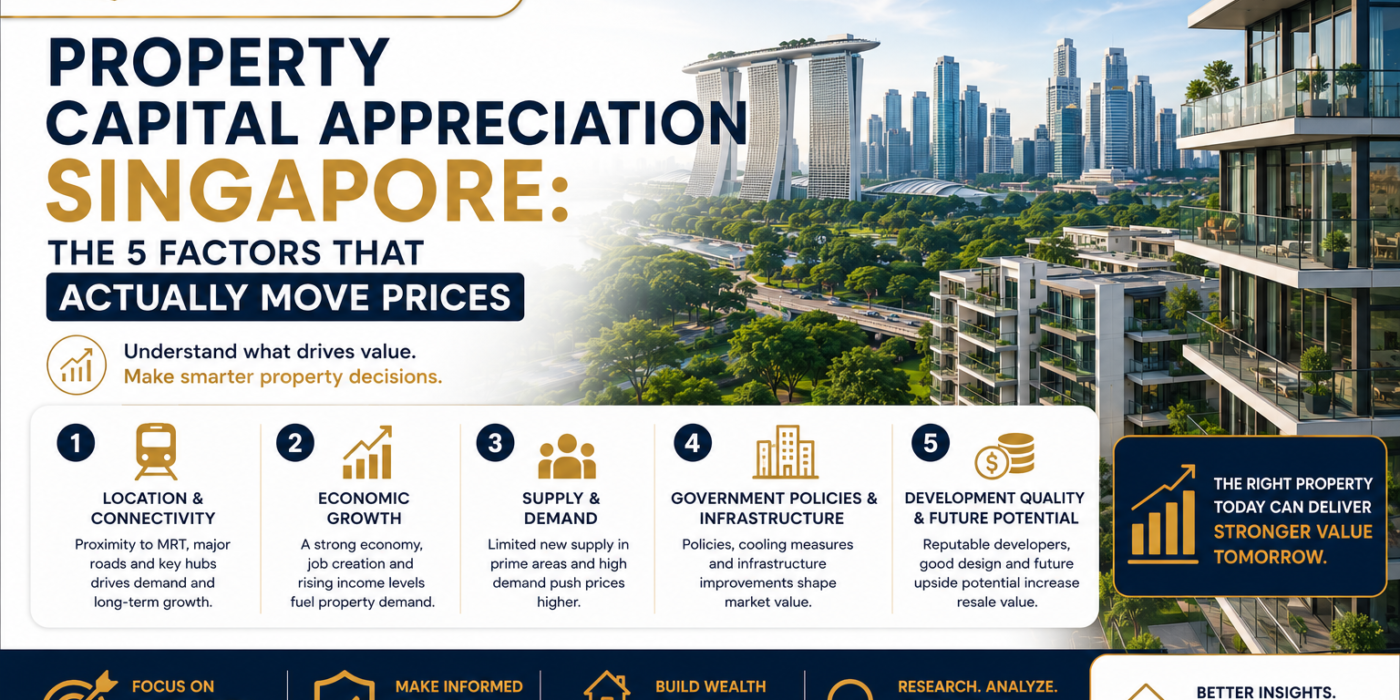
  • Macro factors like interest rates, cooling measures, and the future supply pipeline matter just as much as the property itself.
  • Undervalued doesn’t automatically mean profitable — a cheap entry price on a weak location rarely appreciates the way people expect.

When you’re buying property in Singapore, whether as a home upgrader or a serious investor, one goal tends to sit above everything else: capital appreciation. The honest question is — how do you actually spot a unit that’s going to be worth meaningfully more in five or ten years?

Nobody has a crystal ball, but the properties that appreciate the most almost always share the same DNA. I call it the S.M.I.L.E factors, and this guide walks through each one with real transaction data, plus a few things most articles on this topic skip.

What Is Property Capital Appreciation, Exactly?

Property Capital Appreciation is the increase in a property’s value between when you buy it and when you sell it. Buy a freehold condo for $800,000 and sell it five years later for $1,166,000, and your capital appreciation is $366,000.

It’s distinct from rental yield, which is the income a property generates while you hold it. A strong investment usually has both working in your favour — steady rental income covering your mortgage, and the asset climbing in value at the same time.

smile-strategy

The S.M.I.L.E Framework at a Glance

Factor

What to look for

Why it drives appreciation

School proximity

Within 1km of a popular primary school

MOE priority admission creates a steady, motivated buyer pool

MRT access

5–8 minute walk to a station

Widens your buyer and tenant pool significantly

Interest / resale demand

Few listings, frequent transactions at higher PSF

Signals tight supply and strong buyer confidence

Larger unit sizes

1,000+ sqft for 3-bedders and up

Scarcity value as newer launches shrink in size

Entry price

Below market average for comparable units

Appreciation starts with what you pay, not just what you sell for

Factor 1: Within 1km of a Good Primary School

For parents, living near a reputable primary school isn’t a nice-to-have — it’s often the deciding factor in a purchase. Being within 1km of a sought-after school shifts buying decisions, and it’s policy driving that, not sentiment.

Why it matters: MOE’s priority admission rule gives an edge to families within this radius, creating a steady, motivated pool of buyers willing to pay a premium to secure that catchment.

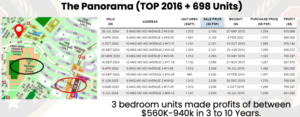
The Panorama is a good example — a 698-unit development that TOP’d in 2016. At launch in 2013, it struggled, landing right as new ABSD cooling measures kicked in. Despite that rough start, 3-bedroom units have since posted profits of between $560,000 and $940,000 over holds of 3 to 10 years.

The Panorama Capital Appreciation

Factor 2: Proximity to MRT

Whether it’s parents shuttling kids to school or tenants commuting into the CBD, MRT access is close to non-negotiable for a large slice of Singapore’s buyer pool. The rule of thumb holds up well: the closer, the better, ideally a 5 to 8 minute walk.

Why it matters: Easy MRT access widens your buyer and tenant pool considerably, especially for investors chasing rental yield, since tenants routinely rank commute time above almost everything else. Even in fringe estates, projects near upcoming lines like the Thomson-East Coast Line have seen resale prices tick up well before the station opens.

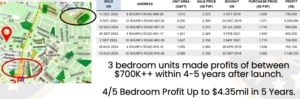
Jadescape is a solid case study — a 1,204-unit development that TOP’d in 2022, with 3-bedroom units posting profits around $700,000 or more within just 4 to 5 years, while larger 4–5 bedroom units have seen profits climb as high as $4.35 million over the same window. Jadescape checks nearly every S.M.I.L.E box at once: good schools nearby, MRT access, generous unit sizes, and a reasonable entry price at launch.

Jadescape Profit

Factor 3: Strong Resale Interest and Tight Supply

Some developments have an “X-factor” — units barely list before they’re gone. That’s strong resale interest, one of the clearest signals of a property that will hold or grow in value, because scarcity keeps prices buoyant even in a slower market.

Developments with strong demand from HDB upgraders tend to create a durable engine for appreciation, since that demand pool refreshes constantly.

How to spot it:

  • Very few or zero active listings on PropertyGuru or 99.co usually means existing owners aren’t keen to sell, and supply is genuinely tight.
  • Frequent resale transactions at rising PSF on URA data signal liquidity and buyer confidence, not a stagnant market.

Real examples:

  • Clementi Park often has fewer than three units listed at any time. With that little competing supply, sellers can command strong prices simply because buyers have nowhere else to go within the same development.
  • High Park Residences in Sengkang sits surrounded by 1,498 BTO flats. Owners of nearby 4-room BTOs are enjoying profits above $400,000, while 5-room BTO owners are seeing gains past $500,000. High Park itself, despite being a mega development with 1,390 units, has still climbed 67.44 percent since its 2016 launch — proof that scale alone doesn’t kill demand if the fundamentals are right.

A quick caution here, because it trips people up constantly: undervalued does not automatically mean profitable, even when the entry price looks like a steal.

Factor 4: Larger Unit Sizes

Newer condos keep getting smaller, which quietly makes spacious layouts a genuine rarity. That scarcity works in your favour as an owner, especially as family sizes and lifestyle expectations shift back toward wanting more room.

Why it matters: Bigger units appeal to multi-generational families and affluent upgraders leaving HDBs, and both groups are consistently willing to pay for the extra space.

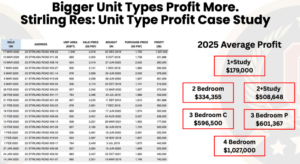
Older developments like Archipelago and Stirling Residences, offering 1,500+ sqft 3-bedders, have outpaced smaller units in price growth over the last decade — demand from families who simply want more room to breathe.

Stirling Residence Profit Margin Growth

Factor 5: Attractive Entry Price

For investors, the money is largely made on entry, not exit. Buying below the market average for a location and quality tier leaves far more room for appreciation — and this is the one factor entirely within your control.

How to spot it:

  • Compare PSF against nearby projects with similar facilities, age, and tenure.
  • Look for undervalued launches in emerging growth zones, often available before an MRT line completes or a URA masterplan upgrade lands.

Early buyers of Parc Esta entered at around $1,600 PSF back in 2018. Within four years, prices had crossed $2,000 PSF, riding both a broader market recovery and the convenience of Eunos MRT nearby. That gap sounds small on paper, but shaving even 1 percent off your entry PSF compared to comparable units compounds meaningfully across a 5 to 10 year hold, especially once leverage from your loan is factored in.

Beyond S.M.I.L.E: Macro Factors That Move Every Property’s Price

The five factors above explain why one unit outperforms a similar one nearby. But they sit inside a bigger picture that affects every property in Singapore at once:

  • Interest rates. Higher borrowing costs cool demand across the board; lower rates tend to reignite it.
  • Cooling measures. ABSD, loan-to-value limits, and stamp duty adjustments are policy levers used deliberately to manage price growth.
  • Land scarcity. Singapore’s limited land area makes new Government Land Sales sites structurally tight, not just cyclically tight.
  • Economic strength and employment. Property prices track job security and wage growth closely.

You can’t control these, but tracking them tells you whether you’re buying into a rising tide or swimming against one.

Freehold vs Leasehold: Does Tenure Affect Property Capital Appreciation?

Tenure shapes long-term appreciation more than most first-time buyers realise. Freehold properties tend to command a premium and hold value better over long horizons, since there’s no lease decay eating into the asset. Leasehold properties, particularly 99-year leases past the 30-year mark, can see valuation and financing get noticeably harder as the remaining lease shrinks.

That doesn’t make leasehold a bad choice — plenty of leasehold projects in strong locations still appreciate well within a typical 10 to 15 year hold. It’s just one more line item worth checking, not an afterthought.

The Supply Pipeline Check Most Investors Skip

A great unit in a great location can still underperform if a wave of similar projects launches nearby in the following 1 to 3 years and floods the resale and rental market. Before committing, check:

  • How many comparable projects (by price band and location) are under construction or recently launched nearby
  • Whether unsold developer stock in the area is high or genuinely tight
  • Whether recent Government Land Sales activity in the district signals more supply is coming

Heavy pipeline means you may need a sharper entry price or more conservative rental assumptions. Scarce supply means you can lean harder into that as part of your appreciation thesis.

How to Calculate Your Expected Property Capital Appreciation

Worth running the actual numbers rather than eyeballing it:

Capital Appreciation = Selling Price − Purchase Price

Buy an HDB 3-room flat for $500,000 and sell it five years later for $900,000, and your capital appreciation is $400,000. Buy a freehold condo at $800,000 and sell at $1,000,000, and your gain is $200,000.

Pair this with rental yield if you’re holding along the way: annual rental income divided by property value, times 100. An $800,000 unit renting for $5,000 a month generates $60,000 a year, a yield of 7.5 percent. Strong investments usually combine a healthy yield with steady appreciation, rather than leaning entirely on one or the other.

New Launch vs Resale: Which Appreciates Better?

This comes up in nearly every consultation, and honestly it depends on timing more than the launch type itself. New launches often let early buyers in at a promotional price before the developer raises prices in later phases, baking in appreciation before you’ve even collected the keys. Resale units come with visible transaction history, so any pricing inefficiency is easier to verify.

If pure capital growth is the goal, resale projects in strong owner-occupier locations near MRT lines, schools, and business corridors often present a cleaner risk-reward setup, since the buyer pool at exit is broader and less dependent on momentum.

Common Mistakes That Kill Capital Appreciation

  • Chasing “undervalued” without checking why. A low price sometimes reflects genuine opportunity, sometimes a real problem with the unit or location.
  • Ignoring the supply pipeline. A great location can flatten for years if competing launches hit the same street right after you buy.
  • Overpaying for the “early bird” narrative. Not every early-bird discount is meaningfully below fair value.
  • Treating tenure as an afterthought. A 99-year lease with 60 years left behaves very differently, financing-wise, from one with 30 years remaining.
  • Skipping the maths. Going on a gut feeling instead of checking actual URA transaction data and PSF trends.
Advanced Heading

Frequently Asked Questions

What is a good rate of capital appreciation for property in Singapore?

There’s no fixed benchmark, but well-located private properties have historically appreciated somewhere around 3 to 6 percent annually over a full market cycle, though individual projects can far exceed or fall short of that.

Yes. Studies on lines like the Circle Line have found measurable price uplifts for nearby non-landed private homes, often showing up even before a station physically opens.

Larger units tend to appreciate more strongly as new launches trend smaller, but they need more capital upfront, so it comes down to your budget and holding horizon.

Both can work. New launches offer promotional entry pricing with appreciation potential baked in, while resale gives you visible transaction history to verify the price is genuinely fair.

Meaningfully, particularly for family-sized units. Properties within 1km of sought-after primary schools consistently attract a steady, motivated buyer pool thanks to MOE’s priority admission framework.

It’s harder, but not impossible, particularly if other S.M.I.L.E factors are strong. Still, entry price is the one variable fully within your control, so it’s worth prioritising.

They typically slow price growth by reducing speculative demand, though well-located properties with genuine owner-occupier demand tend to weather them better than speculative purchases.

Capital appreciation is the increase in resale value over time. Rental yield is the income it generates while you hold it. Strong investments usually deliver both.

Before you buy, and periodically afterward — new Government Land Sales and developer launches nearby can shift how much competing supply hits the market during your hold.

No, and this trips up a lot of buyers. A property priced below market can still underperform if the underlying location, unit size, or building condition doesn’t support genuine long-term demand.

Property Consultation Singapore
Categoriesarticles

Property Consultation Singapore: The Smarter Way to Buy or Invest

TL;DR

  • A property consultation is a 1-on-1 session covering your cash flow, loan eligibility, timing, and shortlist — not just a list of condos to view.
  • It matters most for three groups: first-time buyers, HDB/condo upgraders, and investors growing a portfolio.
  • Skipping it usually costs more than the consultation itself — a rate or entry-price miscalculation of even 1 percent on a $1.5M unit is a $15,000 mistake.
  • Online listings tell you what’s for sale. A consultation tells you what’s actually worth buying, and when.
  • Most sessions run free for 30 minutes, with a fuller paid plan if you want a complete strategy.

I still remember a client telling me, almost sheepishly, that his friend bought a resale unit in Queenstown back in 2021 for $1.4M. By the time he finally worked up the nerve to ask me about it, that same unit was trading at $1.9M. He wasn’t slow because he lacked money. He was slow because nobody had ever sat him down and walked through the actual numbers.

That’s the gap a proper property consultation closes. Singapore’s market moves fast, land is genuinely scarce, and guessing your way through a purchase can cost you hundreds of thousands of dollars — or leave you holding an asset that never really performs. Most buyers still treat the biggest purchase of their life the way they’d treat picking a phone plan: a bit of comparison shopping, a gut decision, and hope. We do it differently, and this guide walks through exactly what that looks like.

What Is a Property Consultation, Really?

It’s not a showroom tour dressed up with a fancy name. A real property consultation is a 1-on-1 session where we look at your finances, your family’s needs, and how much risk you’re actually comfortable carrying — then build decisions around numbers instead of noise. In practice, that means:

  • Working out your real monthly cash flow after CPF and loan repayments
  • Comparing freehold versus 99-year leasehold against your actual goals, not general advice
  • Reviewing which projects in your shortlist are overpriced and which are quietly undervalued
  • Timing your purchase to sidestep ABSD or other costs that catch people off guard

Think of it like hiring a personal trainer instead of winging it at the gym. You could do it alone. A good coach just gets you there faster, with fewer injuries along the way.

Who Actually Needs a Property Consultation

Three groups get the most value out of sitting down properly before they buy.

First-Time Homebuyers

Jumping from an HDB flat straight into private property, or buying your very first home, opens up a dizzying number of choices — and just as many ways to get it wrong. A consultation helps you:

  • Weigh new launch against resale with real numbers, not showroom energy
  • Work out your actual budget, which is rarely the same figure the bank approves you for
  • Spot early signals of future growth, like an incoming MRT line, school catchment changes, or rezoning

HDB and Condo Upgraders

This is the group we work with most. Typically 35 to 50 years old, earning somewhere in the $15k–$30k monthly range, wanting to move up without wrecking their finances. Here’s what we focus on:

  • Keeping your existing HDB while legally securing a condo purchase
  • Sequencing your sale and purchase so you avoid ABSD or an awkward stretch of temporary homelessness
  • Choosing units with better layouts, views, or resale potential rather than whatever’s available first

One client, Marcus, assumed he could only stretch to a 2-bedder at Lentor. After we restructured his finances properly, he walked away with a high-floor 3-bedder at Stirling Residences — a unit that has since appreciated 18 percent in under two years.

Investors

If you already own your home and want to grow wealth through property, a consultation shifts the conversation toward:

  • Finding undervalued units near genuine growth nodes, like One-North or Bayshore
  • Planning an exit strategy for rental income or resale on a 5–10 year horizon
  • Using decoupling, trust structures, or part-sale arrangements to optimise your tax position

What You Get in a Property Consultation With Us

What you get

Why it matters

Cash flow breakdown

Know exactly what you can afford, based on real-world expenses, not a bank’s optimistic estimate

Loan eligibility check

Clarity on your loan quantum, CPF usage, and realistic timeline

ABSD and tax planning

Avoid the 20 percent-plus tax traps that catch most upgraders off guard

Property shortlisting

Data-backed picks, not just whatever’s trending on social media

Exit strategy

Every good purchase should also be an easy sell when the time comes

The Real Cost of Skipping a Property Consultation

Here’s the number that tends to change people’s minds. On a $1.5M purchase, a rate or entry-price miscalculation of just 1 percent works out to $15,000 — often more once you factor in ABSD timing, a mismatched loan structure, or a unit bought at the wrong point in its price cycle. A 30-minute consultation costs you nothing or close to it. Getting the entry price wrong by even a sliver can cost you five figures, sometimes six, and you usually don’t find out until you try to sell.

This is exactly why buyers who skip proper advice and rely purely on listings tend to overpay, underprepare for ABSD, or miss financing structures that could have saved them real money.

Property Consultation vs. Just Searching Online

A lot of prospective clients tell me, “I already check PropertyGuru every day.” Fair enough — but that’s a bit like trying to diagnose a health issue through search results instead of seeing an actual doctor. Listing platforms are useful for browsing, not for judgment calls.

Here’s what browsing alone won’t tell you:

  • Why a unit has been sitting on the market far longer than it should
  • How to read URA caveats and transaction histories against a specific project’s price trend
  • Which developer pricing tactics are inflating a launch price
  • How to sequence a sale and purchase so you’re not scrambling — sell in August, buy in November, for example

A consultation gives you clarity. A listing page just gives you options.

How We Compare to the Bigger Advisory Firms

Search around and you’ll find plenty of large consultancies — global names offering broad real estate advisory, valuation, and investment services across commercial and residential sectors. They’re solid for institutional clients and large portfolios. What we do is different in scope: we work specifically with individual homebuyers, upgraders, and investors on the Singapore residential market, and we intentionally keep our client load small each month. That means more time per client, sharper focus on your specific numbers, and advice that isn’t diluted across a dozen unrelated deals.

How We Use Data, Not Guesswork, to Back Every Recommendation

“Data-driven” gets thrown around a lot in property marketing, so it’s worth being specific about what that actually means in a session. Every recommendation we make is checked against real transaction records, not gut feel or whatever’s trending on Instagram that week. In practice, that looks like:

  • URA caveats and transaction history for the specific project and its closest comparables, not just the district average
  • PSF trends over the last 12 to 24 months, so you can see whether a project is still climbing, plateauing, or quietly softening
  • Rental yield benchmarks pulled from actual tenanted units nearby, not a developer’s projected figure
  • Supply pipeline checks — how many similar units are launching nearby in the next 1 to 3 years, since oversupply quietly erodes both rental and resale value
  • Loan and CPF simulations run against your real income, not a generic affordability rule of thumb

None of this replaces judgment. But it means when we tell you a unit is fairly priced or overpriced, there’s a transaction history behind that claim, not just an opinion.

Signs You Need a Property Consultation Right Now

Not everyone needs to book immediately, but a few situations are strong signals that guessing is about to get expensive:

  • You’ve been “just browsing” listings for over six months without making a decision
  • You’re not sure whether you’d qualify for a loan, or how much you’d actually be approved for
  • You own an HDB flat and keep hearing about upgrading but have never run the actual numbers
  • You’re eyeing a new launch and the showroom pressure is starting to feel like a countdown clock
  • You already own one property and aren’t sure if buying a second makes financial sense right now
  • You’re facing a decision with a hard deadline — a lease expiring, an ABSD timing window, or a family situation forcing a move

If more than one of these sounds familiar, that’s usually the point where a proper consultation saves more money than it costs.

Common Mistakes People Make Without a Consultation

  • Buying on emotion at a showroom. Show units are designed to sell a feeling, not to show you the real entry PSF against comparable resale prices nearby.
  • Ignoring ABSD timing. Selling and buying out of sequence can trigger tax you never needed to pay.
  • Assuming bank approval equals affordability. A bank’s maximum loan offer and your actual comfortable monthly cash flow are rarely the same number.
  • Skipping tenure comparison. Freehold versus 99-year leasehold changes your financing options and long-term exit value — most buyers never run this comparison properly.
  • Treating every “growth area” claim at face value. Not every rezoning or MRT rumour translates into real appreciation. This deserves actual verification, not marketing copy.

What Happens After Your Consultation

Once we’ve gone through your numbers, you don’t just walk away with a verbal opinion. You get a written game plan covering your realistic budget, a shortlist of specific projects or units worth considering, and a rough timeline for when to act. If it makes sense to move forward together, we handle the shortlisting, negotiation, and paperwork from there. If it doesn’t, you still leave with a clearer picture than you walked in with.

What Clients Say

“James didn’t just show me condos. He helped me understand my own numbers, my options, and even planned the entire sell-and-buy process. We felt zero stress.” — Cheryl & Adrian, upgraded from HDB in Clementi to a 3BR condo at Normanton Park

“I almost bought a new launch on emotion. But James showed me the actual entry PSF and exit numbers. That saved me from a potential $100k mistake.” — Henry, investor who bought at The M

How to Book a Property Consultation

Booking is simple, and the first session is free.

  1. Share your numbers. Your income, CPF balances, and any existing property or loan commitments.
  2. Tell us your goal. Own stay, upgrade, or investment — each changes the whole approach.
  3. Give us a timeline. ASAP, within 6 months, or sometime next year all lead to different strategies.

From there, you’ll walk away with a tailored property game plan and a shortlist of units or projects worth considering. If you’d rather explore listings first, you can also browse luxury condos for sale in Singapore before booking, and bring specific units to discuss during your session.

Final Thoughts: Property Isn’t Just a Purchase, It’s a Plan

Buying property in Singapore shouldn’t feel like guesswork, and it definitely shouldn’t come down to whichever showroom had the better lighting that weekend. Whether it’s your first condo or your fifth investment unit, the goal is the same: buy with actual confidence, and exit with a profit rather than regret.

So before you scroll through another listing or wander into another showroom, take 30 minutes, talk it through properly, and plan it right. You can also start with our free consultation booking if you’re ready to get specific numbers on the table.

Luxury is not a price, it is an experience.

Advanced Heading

Frequently Asked Questions

How much does a property consultation cost?

Our initial 30-minute session is free. If you’d like a full, structured plan afterward, that moves to a paid engagement, which we’ll outline clearly before anything is charged.

Both. We work with buyers, upgraders, and sellers, and often coordinate a sell-and-buy sequence so you avoid unnecessary ABSD or a gap in housing.

No. Many clients come in with no shortlist at all — that’s exactly what the session is for.

A standard viewing appointment is transactional. A proper consultation starts with your finances and goals, and only gets to specific units once those are clear.

 It can help you plan around it — through timing, decoupling, or other legal structures — though ABSD itself depends on your specific ownership situation. We’ll walk through what applies to you specifically, and you can check current ABSD rates beforehand if you want a head start.

That’s still useful. Early planning gives you more room to structure your finances, CPF, and timing correctly, rather than rushing decisions later.

No. Our shortlist is based on your numbers and goals, not on which project pays the highest commission. If nothing on the market fits, we’ll say so.

Yes — this is actually one of the most common questions we get. A full walkthrough of the HDB-to-condo upgrade process covers this in more depth if you want to read ahead of your session.

 It varies with your situation, but most upgraders and buyers move from initial consultation to completed purchase within 3 to 9 months, depending on financing and whether a sale is involved.

Yes — our mortgage calculator is a good starting point to get a rough sense of affordability before we go through the fuller picture together.

Property AI

Here's a few ways we can help you
🤖
Would you like our AI Bot to help you find the perfect property? Our AI Bot can scrape through hundreds of property listings and provide you with a list of properties that matches your criteria.
Just now