TL;DR: Buying property in Singapore follows a fairly fixed sequence: check your eligibility, work out your affordability, shortlist and view units, secure an Option to Purchase (OTP), exercise it and sign the Sale and Purchase Agreement, pay your stamp duties within 14 days, then complete the purchase and collect your keys. Budget for at least 25% to 30% of the price in cash or CPF for a bank-financed purchase, plus Buyer’s Stamp Duty (up to 6% depending on price) and Additional Buyer’s Stamp Duty if it applies to your profile. The whole process, from OTP to completion, typically takes 8 to 12 weeks for a resale purchase.
Buying property is probably the biggest financial decision most people in Singapore will ever make. It’s not like upgrading your phone or trading in a car. Get it wrong and the mistake can follow you for years. That’s exactly why we sit down with every client at SG Luxury Condo and walk through the entire process before they sign anything, not just the exciting parts like viewings and showflats, but the paperwork, the deadlines, and the numbers that actually decide whether a purchase makes sense.
This is a full rewrite of our original property purchase guide for Singapore. The old version had a lot of general encouragement and not quite enough of the actual mechanics, so we’ve rebuilt it from the ground up with current figures, a clearer structure, and the specific numbers you’ll actually need at each stage.
Step 1: Check Your Eligibility First
Before you even start browsing listings, confirm you’re actually allowed to buy what you’re looking at. Singapore’s property rules vary quite a bit depending on your residency status and the property type.
- You need to be at least 21 years old to purchase property in your own name. Under 21, a purchase can only go through a trust structure
- Foreigners and Permanent Residents cannot buy landed property on the mainland without approval from the Singapore Land Authority, though freehold and leasehold condominiums are open to them without restriction
- PRs can only buy an HDB resale flat after holding PR status for at least 3 years, and only with an eligible family nucleus
- Foreigners cannot buy HDB flats at all, new or resale
If any of this applies to you, our guide on foreigners buying property in Singapore goes into the eligibility rules and ABSD implications in far more depth.
Step 2: Understand New Launch vs Resale
Every property purchase in Singapore falls into one of two categories, and the payment structure for each is genuinely different.
New Launch (Building Under Construction) | Resale Property | |
Payment structure | Progressive, tied to construction milestones | Front-loaded, mostly due within weeks |
Typical timeline to move in | 2 to 4 years | 8 to 12 weeks after OTP |
Ability to negotiate price | Limited, developer sets pricing | Room to negotiate directly with seller |
Condition | Brand new, under warranty | As-is, may need renovation |
New launch payment schedule typically looks like this: 5% booking fee in cash, 15% on exercising the OTP (cash or CPF), then progressive payments as construction milestones are hit, roughly 10% for foundation work, 10% for structural completion, 20% across various completion stages, 25% at TOP, and the final 15% at legal completion.
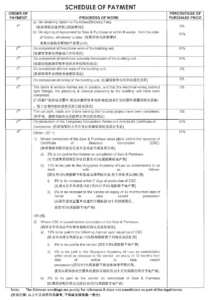
This is the standard 9-stage payment schedule developers follow under a typical Sale & Purchase Agreement, from the Option to Purchase all the way through to final completion. Each stage ties directly to actual construction progress, foundation work, structural framework, walls, ceiling, electrical and plumbing, car park and roads, TOP, and final completion, so your payments only increase as the building genuinely moves forward
Resale payment schedule is far more front-loaded: 1% option fee in cash to secure the OTP, 4% more within 14 to 21 days when you exercise it, and the remaining 95% due at completion, typically 8 to 10 weeks later, funded through cash, CPF, and your bank loan.
If you’re still weighing which route suits you better, our detailed comparison of new launch versus resale performance breaks down real case study data on how each has actually performed over time.
Step 3: Work Out Your Affordability
This is the step people most often skip, or do too casually, and it’s the one that saves you the most heartache later. Two numbers matter here: how much the bank will lend you, and how much cash or CPF you’ll need to bridge the rest.
- Banks in Singapore typically lend up to 75% of a property’s value on a first home loan, meaning you’ll need at least 25% in cash or CPF
- Of that 25%, a minimum of 5% must be paid in cash, the remainder can come from CPF
- Your loan eligibility is capped by the Total Debt Servicing Ratio (TDSR), which limits all your monthly debt obligations to 55% of gross income, stress-tested at a fixed rate regardless of your actual mortgage rate
- Beyond the downpayment, budget separately for stamp duties, legal fees, and if you’re financing, loan-related insurance
Running these numbers properly before you start viewing units saves you from falling for a property you can’t actually secure financing for. Our mortgage affordability calculator applies the current TDSR framework directly to your income and existing debt.
Step 4: Search, Shortlist, and Inspect
Once you know your budget, the actual hunting begins. Most buyers start online, comparing listings against their target area and price range, though working with a registered property agent can save considerable time, particularly for narrowing down units that genuinely match your criteria rather than just what’s heavily advertised.
When you do book a viewing, go beyond how the unit looks. Check the walls, ceiling, and flooring for signs of water damage or cracking. Test the plumbing and electrical fittings. For resale units specifically, ask about the age of major fixtures like the water heater and air-conditioning system, since replacing these isn’t cheap. A thorough inspection at this stage gives you real leverage during price negotiation if you spot genuine issues.
Step 5: Get Your In-Principle Approval (IPA)
If you’re financing your purchase, secure an In-Principle Approval from a bank before you commit to any OTP. An IPA tells you, and the seller, roughly how much you’re actually able to borrow, based on a preliminary review of your income and debt.
It’s generally worth applying to two or three banks at once, since each bank calculates lending capacity slightly differently, and comparing offers ensures you’re not settling for the first number you’re given. Getting this sorted early avoids the genuinely painful scenario of committing to an OTP only to discover your actual loan eligibility falls short of what you need.
Step 6: Secure the Option to Purchase (OTP)
Once you’ve settled on a price with the seller, you’ll pay an Option Fee, typically 1% of the purchase price, in exchange for the OTP. This document gives you the exclusive right to buy the property at the agreed price within a set option period, usually 14 days, during which the seller cannot sell to anyone else.
A properly drafted OTP includes the buyer and seller’s details, the agreed price and property specifics, the option period and expiry terms, and each party’s rights and responsibilities. Engage a conveyancing lawyer at this stage if you haven’t already, they’ll review the OTP before you sign anything and guide you through everything that follows.
Step 7: Exercise the OTP and Sign the S&P Agreement
Within the option period, you’ll need to exercise the OTP by paying a further deposit, typically 4% of the purchase price for resale, and signing the Sale and Purchase Agreement. This deposit must be paid entirely in cash or CPF, not through a bank loan. Once exercised, your lawyer lodges a caveat with the Singapore Land Authority, formally noting your interest in the property.
If you let the option period lapse without exercising, you lose the entire option fee, so this decision needs to be locked in well before the deadline, not at the last minute.
Step 8: Pay Your Stamp Duties
Once you’ve exercised the OTP, you have 14 days to pay your Buyer’s Stamp Duty, and Additional Buyer’s Stamp Duty if it applies to your profile, to IRAS. Your conveyancing lawyer typically handles this e-stamping process on your behalf, drawing from funds you’ve set aside.
Buyer’s Stamp Duty (BSD) applies to every buyer regardless of citizenship, calculated on a tiered basis:
Purchase Price Portion | BSD Rate |
First $180,000 | 1% |
Next $180,000 | 2% |
Next $640,000 | 3% |
Next $500,000 | 4% |
Next $1,500,000 | 5% |
Remaining amount above $3,000,000 | 6% |
Additional Buyer’s Stamp Duty (ABSD) applies on top of BSD depending on your citizenship and how many properties you already own:
Buyer Profile | 1st Property | 2nd Property | 3rd and Subsequent |
Singapore Citizens | 0% | 20% | 30% |
Permanent Residents | 5% | 30% | 35% |
Foreigners | 60% | 60% | 60% |
For a $1.5 million condo, BSD alone comes to roughly $44,600. If you’re a Singapore Citizen buying a second property, add another $300,000 in ABSD on top of that, a cost that catches a lot of upgraders off guard if they haven’t budgeted for it properly. Our ABSD rates calculator can work out your exact figure based on your specific buyer profile.
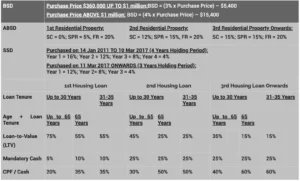
This table summarises Singapore’s core cooling measures in one place, Buyer’s Stamp Duty, Additional Buyer’s Stamp Duty, Seller’s Stamp Duty, and Loan-to-Value limits by loan count and tenure. Note that stamp duty rates are periodically revised by MAS and IRAS, so always confirm the current rates for your specific purchase before relying on any historical reference table.
Step 9: Final Inspection and Completion
Roughly 8 to 10 weeks after exercising the OTP, for resale purchases, you’ll reach completion. Before that date, do a final walkthrough to confirm the property has been left in the agreed condition and that the seller has vacated. If you flagged any defects during your earlier inspection, this is when you confirm they’ve actually been fixed.
On completion day, your lawyer handles the transfer of funds, settles any remaining loan disbursement with your bank, and formally registers you as the new owner. Legal fees for this process typically run between $2,500 and $4,000, and it’s worth budgeting for SLA registration fees on top of that.
Step 10: Collect Your Keys
Once completion is finalised, you’ll receive your keys, either directly from the seller or through your lawyer’s office if timing doesn’t align exactly on the day. From this point, you’re free to move in or begin renovations, and your journey shifts from buyer to homeowner.
A Word From SG Luxury Condo
Every step in this property purchase guide matters, but the two that trip up buyers most often are affordability planning and the stamp duty budget. Both are entirely avoidable if you run the numbers properly before you fall in love with a specific unit.
If you’re just starting out and want someone to walk through this entire process with you, from eligibility all the way to key collection, SG Luxury Condo is happy to guide you through it. Our property consultation sessions cover exactly this, and you’re welcome to browse our full range of luxury condos for sale in Singapore once you’re ready to start shortlisting.