Someone messaged me last week asking, almost apologetically, “Is it stupid to think I can afford a condo?” It wasn’t stupid at all. She just didn’t have the numbers in front of her. And that’s the real issue with property affordability in Singapore. It’s not that people can’t afford homes, it’s that most people are guessing instead of calculating.
So let’s calculate.
TL;DR
- Your borrowing power is capped by TDSR (55% for private property) or MSR (30% for HDB and new ECs), not by how much you’d like to spend.
- Banks will only lend up to 75% of a property’s value (LTV), so you need cash and CPF for the rest.
- A household earning $14,000 to $17,500 a month can typically afford up to $2.8 million, more than most people assume.
- Downpayment isn’t your only upfront cost. BSD, ABSD, legal fees, and renovation all add up.
- CPF, interest rates, and whether you buy new launch or resale all shift your real affordability, sometimes by a lot.
- Run your own numbers before deciding anything. A calculator takes two minutes; a bad decision takes 25 years to fix.
What “Property Affordability” Actually Means in Singapore
Affordability here isn’t a feeling. It’s math set by the Monetary Authority of Singapore, and the math doesn’t care how badly you want the corner unit with the pool view.
Three rules decide what you’re allowed to borrow:
- TDSR (Total Debt Servicing Ratio): All your monthly debts, including the new home loan, car payments, and credit card minimums, can’t exceed 55% of your gross income. Applies to private property and resale ECs past their MOP.
- MSR (Mortgage Servicing Ratio): For HDB flats and new ECs, the mortgage alone can’t go past 30% of income. Stricter than TDSR, because public housing is meant to stay within reach for more people.
- LTV (Loan-to-Value): Banks currently cap loans at 75% of the property’s value. The remaining 25% comes from your cash and CPF.
Once you know where you land on these three, the rest is just arithmetic.
How Much Income Do You Actually Need?
I get asked this constantly, so here’s a rough breakdown based on recent resale prices, a 25-year loan, and 75% LTV. No CPF housing grants factored in, since those vary by household.
Property Affordability Type | Typical Resale Price | Minimum Downpayment | Monthly Repayment | Income Needed (Monthly) |
HDB 3-Room | ~$445,000 | ~$111,000 | ~$1,600 | ~$5,900 |
HDB 4-Room | ~$630,000 | ~$157,000 | ~$1,900 | ~$8,300 |
HDB 5-Room | ~$736,000 | ~$184,000 | ~$2,200 | ~$9,700 |
Executive Condominium (EC) | ~$1,518,000 | ~$380,000 | ~$4,600 | ~$9,900 |
Condo (OCR) | ~$1,650,000 | ~$412,000 | ~$5,000 | ~$10,700 |
Condo (RCR) | ~$2,012,000 | ~$503,000 | ~$6,100 | ~$13,100 |
Condo (CCR) | ~$2,370,000 | ~$592,000 | ~$7,200 | ~$15,400 |
Landed (Terrace) | ~$3,300,000 | ~$825,000 | ~$10,000 | ~$21,500 |
Worth saying plainly: this table excludes BSD, legal fees, and renovation. It’s a starting point, not the full bill. If you want your actual numbers instead of a rough estimate, our mortgage affordability calculator will spit out a real figure in a couple of minutes based on your own income and debts.
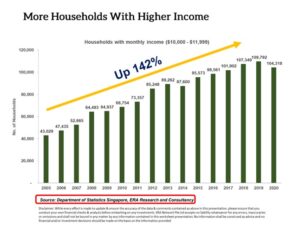
Households in this bracket have grown from roughly 43,000 to almost 110,000 over the past 15 years, a 142% increase.
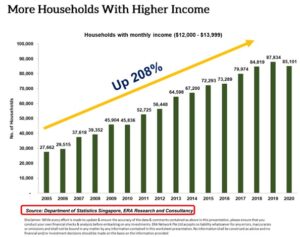
This bracket has more than tripled, growing over 200% in 15 years, from under 30,000 households to close to 90,000.
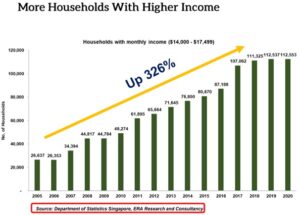
This is the fastest-growing middle bracket, up 326% in 15 years, from under 25,000 to over 110,000 households. It’s also the group that can typically stretch to a $2.8 million property, well above the $1.1M–$1.7M range of a typical 3-bedroom condo.
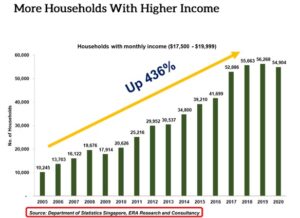
Growth here is even sharper, up 436% in 15 years, nearly a 5x jump from about 10,245 to over 55,000 households.
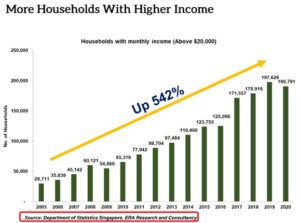
This top bracket has grown almost 550% over 15 years, from under 30,000 to close to 200,000 households, the clearest sign that a genuine, growing segment of Singapore can comfortably afford $3.5M+ properties.
Singaporeans Are Earning More Than the Headlines Suggest
Here’s a stat that surprised me the first time I saw it. Over the past 15 years, the number of households earning between $14,000 and $17,500 a month has grown by more than 300%. That’s not a small bump, that’s a whole segment of the population moving up a bracket.
What does that actually buy you? A household in that range can typically qualify for a loan of around $2.1 million, putting a property priced up to $2.8 million within reach. Meanwhile, the average 3-bedroom private condo sits somewhere between $1.1 million and $1.7 million. There’s real breathing room there for a lot of families who assume condos are out of their league.
Monthly Household Income | Approx. Maximum Loan | Approx. Property Affordability rates |
$10,000 – $12,000 | $1.44 million | $1.9 million |
$12,000 – $14,000 | $1.68 million | $2.2 million |
$14,000 – $17,500 | $2.1 million | $2.8 million |
$17,500 – $20,000 | $2.4 million | $3.2 million |
$20,000 and above | Higher, case by case | $3.5 million and up |
If you’re in one of the upper brackets and still telling yourself a condo isn’t realistic, it might be worth actually running the numbers before writing it off.
Costs People Forget to Budget For
The downpayment gets all the attention. It’s not the only cost that matters.
- Buyer’s Stamp Duty (BSD): A tiered tax on every property purchase, based on price.
- Additional Buyer’s Stamp Duty (ABSD): This one trips up a lot of buyers, especially on a second property or as a foreign buyer. Worth checking our ABSD rates guide before you sign anything, because it can add a shocking amount to your total.
- Legal fees: Usually a few thousand dollars, depending on the law firm.
- Renovation and furnishing: People underestimate this constantly. Even a light refresh on a resale unit can hit five figures fast.
- Agent fees: Typically covered by the seller in Singapore, but confirm this upfront so there’s no surprise.
None of these will sink you individually. Stack them together, though, and your cash reserves shrink faster than expected, especially if you’re also trying to keep an emergency fund intact.
How CPF Actually Changes Your Affordability
CPF is where a lot of people get their numbers wrong, in both directions. Some assume they can use CPF for everything. Others assume they can barely touch it. Neither is quite right.
Your CPF Ordinary Account can cover part of your downpayment and monthly instalments, up to certain withdrawal limits tied to the property’s valuation. For HDB purchases, CPF can go a long way. For private Property Affordability in singapore, especially higher-value condos, banks still require a minimum 5% cash component regardless of how much CPF you have sitting there. It’s a detail that catches CPF-rich, cash-poor buyers off guard more often than you’d think.
Interest Rates Move the Goalposts More Than People Realize
A one percentage point shift in your mortgage rate doesn’t sound like much until you see it on a $1.5 million loan over 25 years. That’s often a difference of several hundred dollars a month, which can be the gap between comfortably within your TDSR and uncomfortably close to the ceiling.
This is why banks stress-test loan applications at a minimum rate, regardless of what you’re actually being offered today. It protects you from a future where rates climb and your “affordable” mortgage suddenly isn’t.
New Launch vs Resale: Which Is Actually Easier on the Wallet
This gets debated a lot, and honestly, the answer depends on your cash flow more than the sticker price. New launches usually come with progressive payment schemes, so you’re not paying the full mortgage from day one, your payments scale up as construction progresses. Resale units require full payment structure from the start, but you skip the waiting period and often get more room to negotiate on price.
If you’re weighing this decision seriously, our guide on upgrading from HDB to a condo in 2026 breaks down the timing and cash flow side of things in more detail.
Foreign Buyers Face a Different Affordability Equation Entirely
If you’re not a Singapore citizen or PR, the math changes quite a bit. Foreigners face a 60% ABSD on most residential purchases, on top of the usual BSD. That alone can add hundreds of thousands of dollars to a purchase that would otherwise look affordable on paper. It doesn’t mean foreign buyers should avoid the market, but it does mean the “how much can I afford” question needs a completely different starting point.
Is Property in Singapore Actually Affordable Right Now?
Depends who you ask, honestly. Compare prices to five years ago and things feel tight. But compare income growth against loan capacity, and the picture is more balanced than the headlines make it sound. Household incomes have climbed steadily, and loan capacity for middle and upper-income families has, in several cases, kept pace with or outpaced Property Affordability prices.
But averages don’t buy houses, people do. Your affordability is personal. It depends on your income, your existing debts, your family’s needs, and how much financial risk you’re okay carrying for the next couple of decades. A household earning $12,000 a month might be perfectly set up for an OCR condo and stretched thin trying to reach for CCR. Neither is wrong. They’re just different starting points.
A Few Practical Tips If You’re Still On the Fence
- Know your TDSR or MSR limit before you fall in love with a unit. Saves a lot of heartbreak later.
- Don’t max out your loan just because the bank approves it. Leave room for rate hikes, job changes, or the unexpected.
- Budget for the full cost of ownership, not just the purchase. Maintenance fees, property tax, and insurance add up over the years, especially for condos with more facilities.
- Talk to someone who does this daily. A good Property Affordability consultant will tell you honestly if a unit is outside your comfort zone, instead of just pushing the sale through.
Final Thoughts
Property affordability in Singapore isn’t one fixed number sitting somewhere in a government report. It moves with your income, the lending rules in effect that year, and how much of your monthly paycheck you’re genuinely willing to commit for the next two and a half decades. What the data does show clearly is that a lot of Singaporean households can afford more than they think, particularly in the middle and upper income brackets. The real work isn’t affording the home. It’s figuring out where you actually stand, instead of guessing.
For a fuller walkthrough of the buying process, our guide on buying property in Singapore is a solid next stop. And if you’re already comparing units, browsing luxury condos for sale in Singapore is probably the most useful place to start looking.
At SG Luxury Condo, we work with buyers across every income bracket, not just the ones chasing penthouses. If you want a second opinion on what you can genuinely afford, reach out to our team for a free consultation. No pressure, just numbers laid out clearly.