TL;DR
- The ABSD rate Singapore charges depends on your residency status and how many properties you already own.
- Singapore Citizens pay 0% on a first property, 20% on a second, and 30% on a third or beyond.
- Permanent Residents pay 5%, 30%, and 35% respectively.
- Foreigners pay a flat 60% regardless of property count — except nationals of the US, Switzerland, Norway, Iceland, and Liechtenstein, who pay Singapore Citizen rates under free trade agreements.
- Trust purchases carry a flat 65% ABSD.
- ABSD is payable in cash or CPF within 14 days of exercising your Option to Purchase.
- Legal remission is available in specific situations, most notably for married couples selling their first home within 6 months of buying a second.
Additional Buyer’s Stamp Duty (ABSD) Rates
Correct as of 15/02/2023 (Latest)
Additional Buyer’s Stamp Duty | 1st Property Purchase | 2nd Property Purchase | 3rd Property Purchase |
Singapore Citizens | Nil | 20% (Former 17%) | 30% (Former 25%) |
Permanent Residents | 5% | 30% (Former 25%) | 35% (Former 30%) |
Foreigners | 60% (Former 30%) | 60% (30%) | 60% (30%) |
Misc: Trustees 65% (can claim back) | |||
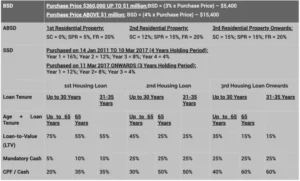
Buyer Stamp Duty
- Purchase Price $360,000 to $ 1 million: (3% X Purchase Price – $5,4002
- Purchase Price $1 million to $1.5 million: (4% X Purchase Price – $15,400)
- Purchase Price $1.5 million to $3 million: (5% X Purchase Price – $30,400)4
- Purchase Price above $3 million: (6% X Purchase Price – $60,400)
What ABSD Actually Is
Additional Buyer’s Stamp Duty sits on top of the standard Buyer’s Stamp Duty every property buyer pays. It was introduced in December 2011, initially just 10% for foreigners and corporate entities, as one of Singapore’s cooling measures aimed at moderating demand and keeping the market from overheating. The ABSD rate Singapore charges has been raised repeatedly since then, most recently in April 2023, and shows no sign of being a temporary measure at this point.
Working Out Your Total Stamp Duty: A Real Example
Numbers land better with an actual scenario. Say a Singapore Citizen is buying a $1.8 million condo as their second property.
- BSD: roughly $50,600 based on the tiered calculation above
- ABSD at 20%: $360,000
- Total stamp duty: approximately $410,600, payable within 14 days of exercising the OTP
That’s before legal fees, agent commission, or the downpayment itself. This is exactly why running the full ABSD rate Singapore applies to your specific profile matters before you fall in love with a specific unit, not after. Rather than doing this by hand every time, our calculator tools let you plug in your purchase price and buyer profile and get the same breakdown instantly.
ABSD Remission for Married Couples
There’s one commonly used exception worth knowing well. If a foreigner or PR is married to a Singapore Citizen and doesn’t currently own any residential property, ABSD isn’t payable on their matrimonial home.
And if a married couple — Singapore Citizen and PR, or Singapore Citizen and foreigner — buys a second property while still owning their first, they can apply for ABSD remission provided they sell the first property within 6 months of completing the second purchase.
This remission has genuinely saved clients tens of thousands of dollars when timed correctly, but it does require careful planning around the sale of the first property. Missing that 6-month window forfeits the remission entirely.
Free Trade Agreement Exemptions
Nationals and Permanent Residents of Iceland, Liechtenstein, Norway, and Switzerland, along with nationals of the United States, are treated the same as Singapore Citizens under their respective free trade agreements with Singapore. That means 0% ABSD on a first property, rather than the standard 60% foreigner rate.
Worth checking your specific nationality against this list before assuming the full foreigner rate applies to you — it’s a detail that’s easy to miss and expensive to get wrong.
ABSD on Trusts: The 65% Rate
Since May 2022, transferring residential property into a living trust triggers a flat, non-remittable 65% ABSD, payable upfront at the point of transfer. This was introduced specifically to close a planning loophole where property was being placed in trust for minor children to effectively reset a family’s property count.
A refund is possible only if all beneficial owners are identifiable individuals with beneficial ownership vested at the time of transfer, and that ownership can’t later be varied or revoked. Our detailed guide on buying property under trust in Singapore covers the full mechanics if you’re considering this route.
Can You Pay ABSD Using CPF?
Yes, CPF savings can go toward ABSD and related survey fees. The catch is timing. For resale property purchases, ABSD must be paid within 14 days of exercising the OTP, well before CPF reimbursement typically processes, so most buyers pay cash upfront and apply for CPF reimbursement afterward rather than relying on CPF to cover it directly at the point of payment.
Legal Ways to Reduce Your ABSD Exposure
Tax evasion is illegal, but Singapore does offer a handful of legitimate, well-established strategies to legally reduce ABSD exposure:
- Decoupling — restructuring ownership between spouses so one becomes a first-time buyer again for a subsequent purchase
- Buying under a child’s name via trust — though this now carries the 65% trust ABSD unless specific remission conditions are met
- Choosing a dual-key unit — some buyers use this to functionally separate living and rental space within a single purchase
- Timing a sale within the 6-month remission window — relevant if you’re a married couple upgrading
Our full breakdown on how to legally avoid ABSD in Singapore walks through each of these strategies with the actual numbers and trade-offs involved.
The Full History of ABSD and Property Cooling Measures
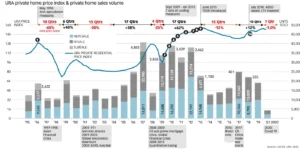
ABSD hasn’t stood still since 2011, and it doesn’t exist in isolation either — it’s one piece of a much longer chain of cooling measures Singapore has layered on since the mid-90s. Worth understanding the full trajectory, since it tells you the direction rates have consistently moved, and how ABSD fits into the bigger picture of loan limits, seller’s stamp duty, and TDSR rules.
May 1996
- Gains from selling properties within three years of purchase taxed as income — 100% of gains if sold within one year, two-thirds in the second year, one-third in the third year.
- Payment of stamp duty by the buyer brought forward to the time of signing the sale and purchase agreement, closing a loophole that let speculators buy and sell uncompleted properties without paying stamp duty.
- Seller’s Stamp Duty (SSD) introduced on residential properties sold within three years of purchase.
- Loan-to-Value (LTV) limit set at 80% for housing loans.
- Foreigners who are not PRs, and non-Singapore companies, no longer allowed Singapore-dollar housing loans. (These measures were rolled back between November 1997 and July 2005.)
September 2009
- Removal of the Interest Absorption Scheme (IAS) and Interest-Only Housing Loans (IOL), effective 14 September 2009.
- Property-related Budget 2009 assistance measures for developers allowed to expire as scheduled.
February 2010
- SSD reintroduced at up to 3% on residential properties bought on or after 20 February 2010 and sold within one year.
- LTV limit lowered from 90% to 80% for all housing loans.
August 2010
- SSD holding period extended from one year to three years for properties bought on or after 30 August 2010.
- For buyers with an existing outstanding housing loan, minimum cash downpayment raised from 5% to 10%, and LTV limit lowered from 80% to 70%.
January 2011
- SSD holding period extended further to four years, with rates set at 16%, 12%, 8%, and 4% for properties sold in the first through fourth year of purchase.
- LTV limit lowered to 60% for individuals with one or more outstanding housing loans, and to 50% for non-individual buyers.
December 2011
- Additional Buyer’s Stamp Duty (ABSD) introduced for the first time, on top of BSD, for certain categories of residential purchases.
- Highest ABSD rate of 10% imposed on foreigners and corporate entities buying any residential property.
- Singapore Citizens owning two properties and buying a third pay 3% ABSD. PRs owning one property and buying a second pay 3% ABSD. (Reliefs provided for qualifying developers and purchases under Singapore’s free trade agreements.)
October 2012
- Maximum loan tenure of 35 years introduced for all new residential property loans.
- LTV limit lowered to 40% (or 60% with no outstanding loan) where loan tenure exceeds 30 years or extends past age 65.
- LTV limit for non-individual borrowers cut from 50% to 40%.
January 2013
- ABSD raised by 5 to 7 percentage points across the board.
- ABSD extended to PRs buying their first property and Singapore Citizens buying their second.
- Foreigners and corporate entities charged 15% ABSD on any residential purchase.
- LTV limits tightened further for buyers with existing loans; minimum cash downpayment for a second housing loan raised from 10% to 25%.
June 2013
- MAS introduced the Total Debt Servicing Ratio (TDSR) framework, capping total monthly debt obligations at 60% of gross monthly income.
- Existing LTV rules refined to prevent buyers circumventing tighter limits on second and subsequent loans.
July 2018
- ABSD for Singaporeans and PRs buying a second or subsequent property raised by 5 percentage points.
- ABSD for foreigners raised to 20% (from 15%); for corporate entities, raised to 25% (from 15%).
- Developers buying residential property for development now pay an additional non-remittable 5% ABSD upfront.
- LTV limits tightened by 5 percentage points across the board.
16 December 2021
- ABSD for Singaporeans buying a second property raised by 5 percentage points; third or more, by 10 percentage points.
- ABSD for PRs buying a second property raised by 10 percentage points; third or more, by 15 percentage points.
- ABSD for foreigners raised by 10 percentage points; for corporate entities, raised to 35% (from 25%), with the additional 5% developer ABSD retained.
- TDSR threshold lowered from 60% to 55% of monthly income.
- LTV limit for HDB housing loans cut from 90% to 85%.
8 May 2022
- ABSD (Trust) of 35% introduced on any transfer of residential property into a living trust from 9 May 2022 onward, payable upfront at transfer.
- A refund is possible only if all beneficial owners are identifiable individuals, ownership has fully vested in them at the point of transfer, and that ownership can’t later be varied or revoked.
- Read more in our guide on purchasing a property via trust.
30 September 2022
- MSR/TDSR computations now use the higher of a 4% p.a. floor or the prevailing interest rate.
- HDB loan applications from this date use a 3% interest rate floor for loan eligibility; LTV limit for HDB loans cut from 85% to 80%. HDB’s concessionary rate remains unchanged at 2.6% p.a.
- A 15-month wait-out period imposed on private property owners and ex-owners before they can buy a non-subsidised HDB resale flat (waived for seniors aged 55+ downgrading from private property).
26 April 2023
- ABSD raised from 17% to 20% for Singapore Citizens buying a second property.
- ABSD raised from 25% to 30% for Singapore Citizens buying a third-plus property, and for PRs buying a second property.
- ABSD raised from 30% to 35% for PRs buying a third-plus property.
- ABSD raised from 30% to 60% for foreigners buying any residential property.
- ABSD raised from 35% to 65% for entities and trusts, except housing developers.
3 July 2025
- SSD holding period extended from 3 years back to 4 years.
Every adjustment across this timeline has moved in essentially one direction — tighter — which is worth keeping in mind if you’re weighing whether to buy now or wait for measures to ease. (Sources: MAS, MOF, URA, and Ministry of National Development press releases.)
How ABSD Actually Shapes Buyer Behaviour
The 60% foreigner rate in particular has visibly cooled foreign demand for Core Central Region property since 2023, part of why CCR price growth has moderated relative to OCR and RCR in recent years.
For local buyers, the jump from 0% to 20% ABSD on a second property is often the single biggest factor determining whether someone upgrades by selling first, or holds two properties simultaneously and absorbs the ABSD cost. It’s rarely a decision people make lightly once they see the actual dollar figure involved.
What to Do Before You Commit to a Second Purchase
Before signing anything, run the actual ABSD rate Singapore applies to your specific citizenship and property count, factor in BSD on top, and confirm whether any remission or FTA exemption genuinely applies to you. Our ABSD calculator and mortgage affordability calculator work together to give you both the tax exposure and your realistic loan ceiling before you commit to a second property.
A Word From SG Luxury Condo
ABSD is genuinely the single biggest line item most buyers underestimate, and it’s not going anywhere given how consistently rates have climbed since 2011. Understanding exactly where you fall on the current table, and whether any remission or exemption applies to you, is worth doing properly before you start viewing units, not after you’ve already found one you love.
If you want a clear read on your own ABSD exposure before committing to a purchase, SG Luxury Condo is happy to run the numbers with you. Our property consultation sessions cover exactly this kind of planning, and you’re welcome to browse our full range of luxury condos for sale in Singapore once your numbers are clear.