
Strong Property Investment Fundamentals: What Actually Makes a Property “Safe” in Singapore
TL;DR: Strong property investment fundamentals in Singapore come down to understanding who’s actually buying (investors chasing yield versus owner-occupiers chasing lifestyle fit), then checking eight specific traits: location, MRT and school accessibility, developer reputation, a sensible floor and stack, a development size that isn’t too small or too large, a maintenance fee that doesn’t scare buyers off, a fair entry price, and genuine first-mover advantage if you’re buying a new launch. None of these traits work alone, it’s the combination that actually protects your investment through a full market cycle.
Everyone wants a property that holds its value no matter what the market’s doing. The question is what actually makes a property fundamentally strong, versus one that just looks good in a showflat and struggles the moment the market cools. This is exactly the question we walk through with every client at SG Luxury Condo before any specific project comes up.
A fundamentally strong property, in simple terms, is one that keeps demand high and rarely loses money, regardless of where the broader market cycle happens to sit. These properties tend to have something genuinely unique or consistently sought-after about them, not just a nice paint job. Understanding the strong property investment fundamentals behind these properties is really the difference between buying something that happens to look nice, and buying something that actually protects your capital.
Understand Who’s Actually Buying
Before diving into the eight traits, it helps to understand the two buyer types who ultimately determine whether your property holds its value.
Investors compare developments purely on numbers, they want the highest rental yield at the most reasonable price. If you’re holding a property this crowd wants, offering strong yield without an inflated price tag, that alone makes it fundamentally attractive to a genuine pool of buyers. Our breakdown of undervalued versus profitable properties goes deeper into how investors actually screen for this.
Own-stay buyers think differently. They’re willing to pay a premium, but only for something that genuinely fits their daily life, layout, location, and the specific features covered in the eight traits below.
The Eight Traits of a Fundamentally Strong Property
1. Location
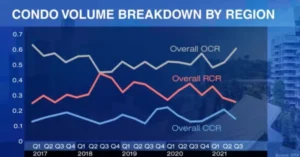
Condo Volume Breakdown by Region
Location tops almost every buyer’s list, and for good reason. Properties in the Rest of Central Region (RCR) and Outside Central Region (OCR), Singapore’s city-fringe and suburban zones respectively, tend to be more affordable than the Core Central Region, while still holding genuine demand.
Unit size preference actually shifts by region too. In RCR developments, 2-bedroom units tend to see the strongest demand. In OCR, 3-bedroom units are generally the sweet spot, likely reflecting the larger, more family-oriented buyer pool typical of suburban Singapore.
2. Accessibility: MRT and Schools

The Cross Island Line, one of the transit projects actively reshaping accessibility across the island
A simple test: would you rather live closer to an MRT station or further from one? Most buyers answer closer, and the generally accepted threshold is around 800m, roughly an 8-minute walk. Beyond that, a property starts feeling genuinely less accessible to most buyers. This factor becomes especially important for RCR developments specifically, since RCR buyers tend to rely on public transport more than car ownership. Our full breakdown on how MRT stations affect property prices goes much deeper into this exact mechanic.
That said, the 800m rule loosens for properties further from the city centre, since these buyers are more likely to already own a car, making MRT distance less of a priority.
School proximity matters just as much, arguably more so for OCR properties specifically. Being within 1km of a well-regarded primary school genuinely matters in Singapore, since it affects priority during the primary school registration exercise, something Singaporean parents take very seriously. More schools within reach means more choice for buyers, which in turn means stronger demand and better long-term value for your property.
3. Developer Reputation
Buyers consistently favour developments with better quality finishing and workmanship, and a reputable developer with a name to protect tends to deliver just that, not just inside the unit, but across the whole estate’s exterior and facilities too. CDL, for instance, has built a reputation for projects that still look genuinely fresh a decade after completion. Developments from less established or lower-quality developers can, by contrast, start looking noticeably rundown within just five years. That gap in long-term upkeep is a real, measurable part of what makes a property fundamentally strong or fundamentally weak.
4. The Right Floor and Stack
Based on analysis across hundreds of condo transactions, units sitting roughly in the 25th to 55th percentile of a building’s price range, typically floors 5 through 15 in a mid-rise development, tend to deliver the strongest profit margins. Extremely high floors carry a premium that’s harder to recoup, while very low floors often suffer from noise and privacy concerns that limit buyer interest.
5. Development Size
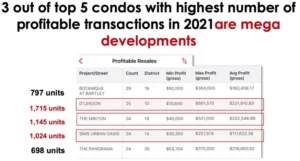
Historically strong-performing transactions have tended to cluster around mid-to-large developments with healthy transaction volume
Size matters more than people expect. Boutique developments under 200 units often struggle here, simply because there isn’t enough transaction volume for the market to establish a clear, reliable valuation over time. On the other end, truly massive developments of 1,000-plus units benefit from constant turnover, which keeps valuations current and liquidity strong. Our detailed study of mega developments in Singapore breaks down exactly how this plays out in real transaction data.
A regularly shaped, efficient layout matters here too, not just the building’s total unit count. HDB upgraders in particular tend to gravitate toward properties with a familiar, functional layout close to what they’re used to, rather than an oddly shaped unit with wasted space.
6. A Sensible Maintenance Fee
A maintenance fee that climbs much past $400 a month tends to noticeably cool buyer interest, and this often correlates with smaller developments, since fewer owners are splitting the same fixed costs. A useful mental comparison: a $200 fee spread across 200-plus units supporting a full range of facilities generally feels better value to buyers than a $450 fee funding just a single pool and a small gym. Developments in the 600 to 800-unit range often strike the best balance between facility variety and manageable fees.
7. Correctly Priced From the Start
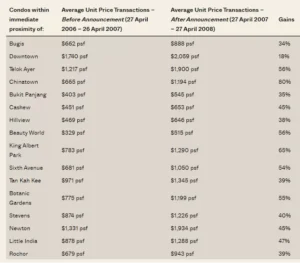
Getting the price right isn’t guesswork, it comes down to three checks: compare the property against similar developments nearby and across the broader region, research the specific district’s current market conditions, and factor in any confirmed future growth catalysts for that area. Skipping any one of these steps is exactly how buyers end up overpaying for a unit that isn’t actually as strong a fundamental as it first appeared.
8. First-Mover Advantage
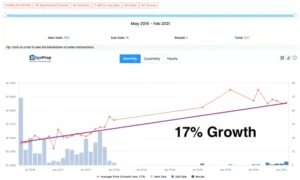
Early-phase pricing tends to sit meaningfully below later-phase pricing on the same project
Buying into a new launch during its earliest sales phase generally means securing the lowest possible entry price, since developers typically raise prices in stages as units sell. Our breakdown of developer pricing strategy explains the mechanics behind why banks tend to support this upward pricing trajectory, and our new launch versus resale comparison shows the real return data behind buying early rather than waiting.
Putting the Eight Traits Together
None of these eight strong property investment fundamentals work in total isolation. A great location with a poorly reputed developer still risks looking tired within a few years. A perfectly sized development with an inflated entry price still leaves you overpaying. The properties that genuinely hold their value tend to score reasonably well across most, not necessarily all, of these traits simultaneously.
A Word From SG Luxury Condo
Now that you understand what actually goes into strong property investment fundamentals, the next step is applying this framework to your own numbers and your own financial situation before committing to anything. A checklist like this only works if you’re honest with yourself about your budget and your actual holding period.
If you’d like to know which current developments in Singapore genuinely check these boxes, SG Luxury Condo is happy to walk through it with you. Reach out through our property consultation page, or browse our best selling condos list for developments that have already demonstrated strong, consistent demand. You’re also welcome to explore our full range of luxury condos for sale in Singapore whenever you’re ready to start shortlisting.