Categoriesarticles

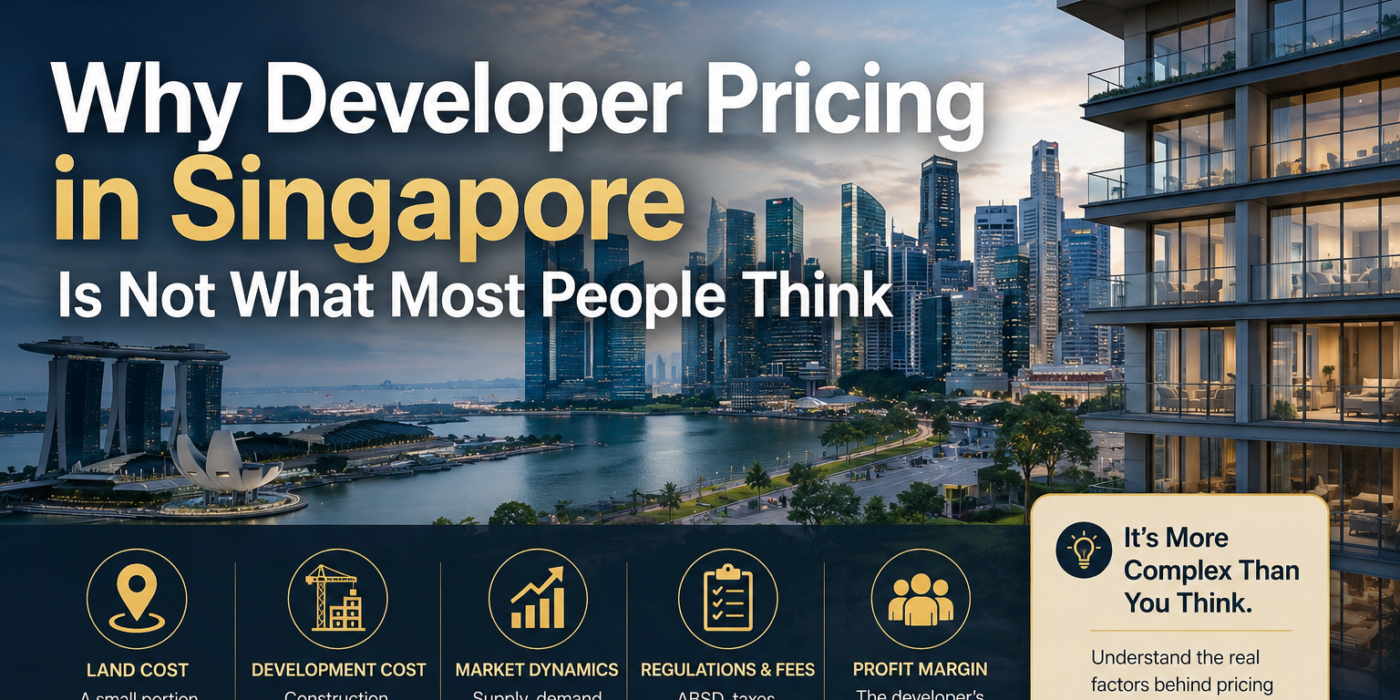
Why Developer Pricing in Singapore Is Not What Most People Think

TLDR

  • Developers don’t price based on cost. They price based on what the market will accept right now.
  • Phased releases are deliberate. Early phases are cheaper to build momentum. Later phases are priced higher as demand is proven.
  • VVIP or soft launch = best entry point — but only if the project sells well after. Sometimes later phases are cheaper if the launch flops.
  • Floor level, facing, and stack all affect price. A higher floor or unblocked view can cost $30,000–$80,000 more for the same unit type.
  • Bank loans work differently for new launches vs resale. A developer can push valuations upward as prices rise through phases. Resale is capped at past transaction prices.
  • Developers rarely cut prices publicly. If sales slow, they hold back units rather than drop the headline PSF — because a public cut damages the whole project’s valuation.
  • Early buyers get the best choice. Better stacks, lower floors are released first. Premium stacks sometimes get held back for later at higher prices.
  • Timing matters. If phase 1 sells 50%+ on launch weekend, prices in phase 2 are almost certainly going up.

Most buyers assume developers price new condos by working out their costs — land, construction, fees — and adding a profit margin on top.

That is not how it works.

Developer pricing strategy in Singapore is driven by one question: what will buyers accept right now? Land cost matters, but it only sets the floor. How far above that floor the developer goes depends on surrounding transactions, competing projects, and how confident they are in the market.

Two developers who paid the same price for neighbouring plots can launch at completely different PSF levels — and both can be right. Pricing is not a maths problem. It is a market read.

This matters to you as a buyer because it changes how you should interpret prices at a showflat. A high PSF does not necessarily mean overpriced. A low PSF does not necessarily mean a deal. You need to understand the strategy behind the number.

What Actually Goes Into the Launch Price
Final-Price-of-Development-Stage

When a developer sets the initial launch price, they look at several things:

Land cost — The biggest single input. The developer paid a specific price for the site (usually through a government land tender), and the launch price needs to make that viable. But viable does not mean launch price equals land cost plus margin. It means land cost sets a minimum.

Nearby transactions — Recent sales in surrounding developments, both new launches and resale, tell the developer what buyers in that area are already paying. Pricing too far above recent comparables risks a weak launch.

Competing supply — How many other new launches are happening in the same district or region at the same time? More competition gives buyers more options and pushes developers to be sharper on price.

Target buyer profile — A project aimed at HDB upgraders needs different pricing from one targeting investors or high-net-worth buyers. The quantum (total price of the unit) matters more to upgraders than the PSF.

Market sentiment — Are buyers confident right now? Interest rates, cooling measures, global economic noise — all of it feeds into how aggressively a developer can price.

Once all that is considered, the developer sets a price band that sits within what buyers will accept — not necessarily what is fair, and not necessarily what their costs dictate.

The Three Phases of a New Launch — and How Prices Move

Most new launch condos in Singapore do not release all units at once. They come out in phases. Understanding these phases is the foundation of understanding developer pricing strategy in Singapore.

Phase 1 — The Preview / Soft Launch

This is where prices are at their lowest. A limited number of units are released — often 20% to 30% of the total — at a price that creates momentum. Developers price these attractively on purpose. The goal is strong opening weekend sales, which create social proof and confidence for buyers in later phases.

Units sold here are sometimes called “loss leaders” — the margin is thinner, but the sales volume validates the project and justifies higher prices later.

Phase 2 — The Main Launch

If phase 1 sold well, prices in phase 2 go up. How much depends on take-up speed. A project that sold 50%+ on opening weekend can raise prices by 2% to 5% for the next release. Buyers at this stage are paying more, but the project is now proven.

If phase 1 sold slowly, the developer may hold prices flat or release a different unit mix rather than cut publicly.

Phase 3 and Beyond

By the time a project is 70% to 80% sold, remaining units often carry a premium — both because they are the last available and because the developer has full confidence the project is validated. Prices here can be meaningfully higher than the original launch.

The longest example in recent years was Luxus Hills — a landed development in Singapore where sales ran across 25 phases and 10 years. Prices moved significantly over that period.

Phase

Typical Pricing

Developer Goal

Preview / Soft Launch

Lowest — attract early buyers

Build momentum and prove demand

Main Launch

Moderate increase if Phase 1 sold well

Maximise take-up from broader buyer pool

Late Phases

Highest — scarcity premium

Extract full value from remaining units

VVIP and Soft Launches: Are They Really Worth It?

Almost every new launch in Singapore has a VVIP or soft launch before the official opening. This is supposed to be invite-only — reserved for major investors, past customers, and high-net-worth buyers.

In practice, it is not hard to get access. A registered property agent who has worked with the developer before can often get buyers into VVIP previews. Some developers will let you attend if you have simply registered on their website.

The pitch at a VVIP launch is always the same: buy now, get the best price, units will only go up from here.

Sometimes that is true. If the project launches strongly and phases sell out at higher prices, early buyers do come out ahead. But it is not guaranteed.

Sky Habitat in Bishan is a good example. When it launched in 2012, buyers at the preview paid premium prices. The project stalled. In 2014 it was relaunched at prices 10% to 15% lower. Early VVIP buyers did not get the best deal — later buyers did.

The lesson: a VVIP launch is a good entry point if the fundamentals are right. It is not automatically the right entry point just because the agent says so.

How Developers Price by Floor, Stack, and Facing

Developer pricing strategy in Singapore goes well beyond just the overall PSF. Within the same project, prices vary based on:

Floor level — Higher floors almost always cost more. The premium per floor varies, but a typical condo might add $3,000 to $10,000 per floor. A unit on the 25th floor can be $80,000 to $150,000 more expensive than the same layout on the 5th floor.

Facing and view — Units facing a park, reservoir, or open sky command a premium. Units facing an expressway or another building’s facade are priced lower.

Stack position — Corner stacks, which get more natural light and cross ventilation, often carry a small premium. Pool-facing stacks are priced higher if the pool is a feature.

Unit type and size — Within the same floor, larger units obviously cost more in absolute terms. But the PSF can sometimes be lower for larger units — a developer’s way of making the total quantum feel more accessible.

Sometimes developers use a “single price” tactic — applying the same price to all floors within a stack for a limited period. This is usually done to clear a batch of units faster. Buyers rush for the highest floor in the single-price range because they feel they are getting more for the same money. That logic is not always wrong, but it is worth checking whether the “single price” unit is actually cheaper than what was already available.

The Single-Price Tactic — What It Means for Buyers

You will sometimes see this at a showflat: “All units in this stack are the same price regardless of floor.”

It feels like a deal. You pay the same whether you are on floor 8 or floor 18 — so clearly floor 18 is the better buy, right?

Usually yes, but with caveats.

First, single-price promotions are typically temporary. Once a certain number of units sell, the developer removes the promotion and returns to floor-based pricing. Second, the single price might be set at mid-range — not a discount from the highest floors, but not much cheaper than what the project was already offering.

The promotion works because buyers feel urgency. A clock is ticking on the same-price offer. That urgency is manufactured, but it is effective.

If you see a single-price promotion, ask your agent to pull the transaction history and compare the single price to what similar units in the same project have actually sold for. That comparison tells you whether it is a real opportunity or just clever marketing.

Why Developers Rarely Cut Prices (Even When Sales Slow)

This is one of the things that most confuses buyers. You would think that if a project is selling slowly, the developer would drop the price to clear units.

They almost never do.

The reason is simple: a public price cut damages the entire project. Here is why:

Bank valuations for new launches follow actual transaction prices. If a developer cuts the price on remaining units, the bank may adjust valuations downward across the whole project. That affects buyers who already committed — their loan-to-value ratio changes. Some may face calls from the bank.

It also destroys trust. Buyers in later phases stop waiting and start expecting further cuts. The developer loses control of the narrative.

So instead of cutting prices, developers:

  • Hold back units and release them later under different conditions
  • Offer “star buy” promotions on specific stacks without changing the listed PSF
  • Repackage slow-moving units as a different product (e.g., combining two units into a larger one)
  • Wait out the market if they have enough cash runway

The one exception is when a developer is under serious ABSD deadline pressure — which we cover next.

How Developer Pricing Affects Your Bank Loan
Government-Land-Sales-

This is something most buyers do not realise, and it is one of the strongest arguments for buying new launch over resale in some situations.

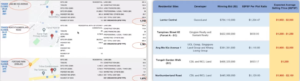
For a new launch condo, banks can base the loan on the developer’s current selling price — which rises with each phase. So if a 1,000 sqft unit is priced at $1,600 psf ($1.6 million) at launch and rises to $2 million by the time you get your keys, the bank’s valuation can follow those rising transaction prices. The maximum loan at $2 million (based on a 75% LTV) would be $1.5 million.

For a resale unit, the bank is capped by past transaction data. If past transactions show $1.6 million but the seller wants $2 million, the bank still values it at $1.6 million. That means you need $800,000 in cash to cover the gap — not $500,000.

Same price. Very different financing situation.

This is explained in more detail in the Understanding Developer Pricing Strategy piece, which covers how this plays out with real numbers.

For buyers looking at prime district condos where quantum is high, this difference in bank valuation can mean hundreds of thousands of dollars in additional cash outlay for a resale unit. It is a real practical consideration, not just theory.

ABSD Deadlines and How They Shape Developer Behaviour

Singapore’s Additional Buyer’s Stamp Duty rules for developers create strong selling pressure at specific points in a project’s timeline.

When a developer buys a residential site, they get a remission on ABSD — but only if they sell all units within 5 years of acquiring the land. If they miss that deadline, the ABSD becomes payable on the full land price. On a large site, that can run into tens of millions of dollars.

As that deadline approaches, developer behaviour changes. Projects that are 20% to 30% unsold with 12 months left tend to see:

  • Fire sale discounts on remaining units
  • “Star buy” pricing on specific stacks
  • More aggressive agent incentives to push sales

The 2020 fire sale at 38 Jervois is a well-cited example. With units still unsold close to the deadline, discounts ran from 13% to 24% off the original asking price. Buyers who waited long enough on that project did significantly better than VVIP buyers.

Watching developer ABSD deadlines is one of the smarter ways to identify genuine discount opportunities in the Singapore new launch market.

How to Read a Developer’s Pricing Strategy Before You Buy
You are at a showflat. The agent is telling you to buy now because prices are going up. How do you cut through that and actually understand what you are looking at?

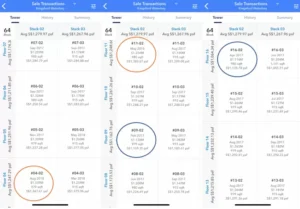
Check the price list against nearby comparables. Pull recent URA caveat data for the surrounding area. What are similar units selling for in nearby projects? Is this developer pricing within that range, above it, or below it?

Ask how many units were sold in phase 1. Strong phase 1 numbers mean phase 2 prices are likely going up. Weak phase 1 numbers may mean a correction is coming — or that the developer will hold back rather than cut.

Look at the unit mix. If a project has many small one-bedders priced at a low quantum, the developer is targeting a wide buyer pool to get momentum. If it is mostly large units, they are going after a specific buyer type and may be more patient on take-up.

Find out when the developer’s ABSD deadline is. If there is significant unsold inventory and the deadline is approaching, there is negotiating room. If the project just launched, not so much.

Talk to an experienced agent. Not one who only sells for that developer. An independent property agent in Singapore with experience across projects can give you an honest view of whether the pricing makes sense for the location.

New-Launch-vs-ResaleNew Launch vs Resale — The Pricing Difference Explained
Factor

New Launch

Resale

Pricing basis

Developer’s current selling price

Past transaction comparables

Bank valuation

Follows rising developer prices

Capped at past transaction data

Cash outlay

Lower (bank matches current launch price)

Potentially higher (gap between valuation and asking price)

Unit condition

Brand new, warranty period

Depends on age and upkeep

Choice of unit

Yes — you pick floor, facing, stack

Limited to what is available

Price certainty

Phase-based — may rise before completion

Fixed at time of purchase

Progressive payment

Yes — pay in stages as construction progresses

Full payment at completion

New launches come with progressive payment — you do not pay the full amount upfront. As construction hits milestones, you release portions of the purchase price. That eases cash flow compared to a resale purchase where the full payment is due at completion.

For buyers interested in how new launches compare to resale options in Singapore’s luxury segment, the new launch vs resale guide breaks this down further.

If you want to see what is currently available in Singapore’s prime condo market, browsing luxury condos for sale in Singapore gives a useful picture of what is on offer and at what price levels.

What This Means for You as a Buyer

Understanding developer pricing strategy in Singapore does not guarantee you get the cheapest unit. But it does mean you stop being surprised.

You know that prices go up in phases — so you stop wondering if waiting will get you a better deal on a project that just had a strong launch.

You know that developers hold prices rather than cut — so you stop expecting a discount that will never come on a healthy project.

You know that ABSD deadlines create rare but real opportunities — so you keep an eye on projects that have been sitting for a few years.

And you know that the bank loan situation for new launches can be more favourable than resale — so you factor that into your cash planning before you compare options.

The Singapore property market rewards buyers who understand the rules of the game. Developer pricing strategy is one of the most important rules to know.

If you want to understand how this applies to the specific projects you are looking at, or how an inherited or existing property affects your ability to buy a new launch, a property consultation is the right starting point.

And if you want to see what is available right now in Singapore’s luxury condo segment, check out the new launch condos for sale in Singapore page for current options.

Quick Reference Summary

Topic

What to Know

How developers set prices

Market-led, not cost-led

When prices are lowest

Phase 1 / soft launch

When prices are highest

Late phases, final units

Do developers cut prices?

Rarely — they hold back units instead

ABSD deadline effect

Can create genuine discounts near the 5-year mark

Bank loan difference

New launch valuations rise with phases; resale is capped at past data

Floor and facing

Both affect price significantly within the same project

VVIP launch

Usually best entry but not guaranteed if project sells poorly

Advanced Heading

Frequently Asked Questions

Is buying at a VVIP launch always the cheapest entry?

Usually yes — but not always. If phase 1 sales are weak and the developer cuts prices later, VVIP buyers can end up paying more. It depends on how the project performs after launch.

Because floor level, facing, and stack position all affect the price. A unit on floor 20 with a reservoir view costs more than the same layout on floor 5 facing another building, even if both are 3-bedders of the same size.

 Rarely on new launches. Developers protect listed prices closely. What you might be able to negotiate is the payment timeline, furniture packages, or legal fees — not the unit price itself. Discounts are usually structured as “star buys” on specific stacks rather than open negotiation.

 The developer feels real pressure to sell.That is when you see genuine discounts — not packaged promotions, but actual price reductions or significant star buy pricing. These moments are rare but they happen.

Strong first-weekend sales are the clearest signal. If more than half the released units sold on launch weekend, the next batch will almost certainly be priced higher. Your agent should be tracking this.

Typically yes in a rising market. But it depends on the project and location. A poorly located project that launched cheap can still underperform a well-located resale bought at a higher price.

Because they know those units will fetch more as the project builds its track record. Releasing them early at the initial price leaves money on the table. Releasing them in a later phase when the project is 60%+ sold lets the developer price them at a premium that the market will accept.

PSF stands for per square foot. It is the price divided by the unit’s size. It is how buyers and developers compare pricing across different unit sizes and projects. A $2,500 psf price on a 500 sqft unit means the unit costs $1.25 million. PSF lets you compare apples to apples across different unit sizes.

 Yes. In Singapore’s prime districts (9, 10, 11), developer pricing strategy is more about positioning than volume. Developers are targeting a smaller, wealthier buyer pool and are more comfortable holding unsold units than cutting prices. Discounts at the VVIP level in prime district projects are less common than in mass market launches.

 If a project just launched and phase 1 sold strongly, waiting means paying more in the next phase. If phase 1 sales were slow and the developer’s ABSD deadline is approaching, waiting can mean a better deal. There is no universal answer — it depends on the specific project and your timeline. Getting independent advice from a property investment advisor in Singapore who can read the signals on a specific project is worth it before committing.

Categoriesarticles

Property Inheritance Singapore: What Actually Happens When Someone Passes Away

Property-Inheritance-in-SingaporeTLDR

When someone dies in Singapore, their property goes to whoever is named in their will. No will? The law decides — and it may not match what the family expected. Singapore removed inheritance tax back in 2008, so you won’t pay tax just for inheriting. But you might face Seller’s Stamp Duty when you sell, and the inherited property will count toward your total when you buy another one later. If CPF was used to pay for the home, that money gets refunded separately and does not pass through the will. Joint tenancy properties skip all of this — they transfer automatically to the surviving owner. The single best thing any property owner in Singapore can do right now is write a valid will. Everything else flows from that.

Losing someone is hard enough. Then comes the question nobody prepared for — what happens to their property?

If you are the one dealing with this right now, or if you own property and want to avoid leaving your family in this situation, this guide is for you. No complicated legal terms. Just how property inheritance in Singapore actually works.

How Ownership Type Decides Everything

The very first thing to check is how the property was held. This single detail determines everything that follows.

Three ownership types exist in Singapore:

Ownership Type

What It Means

What Happens When Owner Dies

Sole Ownership

One person owns 100%

Goes through the will, or intestacy law if no will

Joint Tenancy

Two or more people own equal shares together

Goes straight to the surviving owner — no will, no court

Tenancy-in-Common

Two or more people own separate defined shares

Each share goes through the will or intestacy law independently

Joint tenancy is the clean one. Husband and wife hold a condo together as joint tenants. Husband passes away. The wife automatically owns everything — the property does not go through any court process at all.

Tenancy-in-common is messier. Each person controls their own slice. If the deceased held a 60% share and left no will, that 60% now goes through the intestacy process. The family might end up with co-owners they never expected.

Dying With a Will vs Without One

With a will

A will is a written document saying exactly who gets what. In Singapore, it needs to be signed by the person making it in front of at least two witnesses. Those witnesses cannot be getting anything from the will themselves.

The executor named in the will applies to the court for something called a Grant of Probate. Once that is approved, the executor can legally transfer the property to whoever is named.

Without a will

No will means the Intestate Succession Act takes over. The law then distributes the estate according to a fixed formula — not according to what the deceased wanted.

This catches families off guard more than anything else in property inheritance in Singapore. The assumption is always that the spouse or kids will just get everything. That is not always true. Unmarried partners get nothing under this law. Close friends get nothing. Even the distribution among children and spouse is fixed in percentages the deceased may never have intended.

Writing a will is not morbid. It is just practical.

Who Gets What Under Singapore’s Intestacy Law

The Intestate Succession Act distributes the estate based on who is still alive and their relationship to the deceased.

Who Survives

How the Estate Is Divided

Spouse only

Spouse gets 100%

Spouse and children

Spouse 50%, children split the other 50% equally

Children only

Children split everything equally

Spouse and parents (no children)

Spouse 50%, parents split 50%

Parents only

Parents split equally

Siblings only

Siblings split equally

No one

Goes to the government

If a child has already passed away but had children of their own, those grandchildren step in and take their parent’s share.

The law cannot factor in promises made, personal wishes, or complicated family dynamics. It just runs through the formula.

 Muslim Property Inheritance Rules (Faraid)

Muslim residents follow different rules. The Intestate Succession Act does not apply to them. Instead, the Syariah Court handles distribution under Faraid, which is the Islamic law of inheritance.

Faraid sets fixed shares for each beneficiary based on their relationship and gender. A standard will cannot override those shares.

What Muslims can do is write a wasiyyah — an Islamic will — covering up to one-third of the estate. That portion can go to people outside the fixed Faraid shares, like friends or charities.

If you are Muslim and own property in Singapore, speak with someone who specialises in Islamic estate planning. General property advisors may not know the Faraid rules well enough.

Is There a Property Inheritance Tax in Singapore?

No. Singapore scrapped inheritance tax in February 2008. It applies to everything — property, cash, investments. You do not pay any tax at the moment you inherit something.

But free to inherit does not mean free to own. Once you take on the property, property tax kicks in every year. And if you eventually sell it or buy something else, there are other costs to think about.

Stamp Duty — What You Pay and When

This is the part that confuses almost everyone dealing with property inheritance in Singapore.

At the point of inheritance — nothing

No Buyer’s Stamp Duty. No Additional Buyer’s Stamp Duty (ABSD). Even if you already own two properties and are inheriting a third, you pay zero stamp duty at the point of transfer — as long as the inheritance comes through a valid will, the Intestate Succession Act, or the Administration of Muslim Law Act.

Transfer the property through an informal family arrangement outside those legal channels and it may be treated as a gift. That triggers stamp duty.

When you sell

If the deceased bought the property after 20 February 2010, Seller’s Stamp Duty (SSD) could apply when you sell. The holding period is measured from when the deceased originally bought the property — not from when you inherited it.

SSD ranges from 4% to 12% depending on how long the property was held before sale.

When you buy another property

Once you inherit, that property counts toward your total. Buy another one after inheriting and you are treated as owning one more than you think.

ABSD rates for Singapore Citizens in 2024:

Which Property

ABSD Rate

First

0%

Second

20%

Third and beyond

30%

PRs and foreigners pay more. A lot of buyers get caught out by this. They inherit a flat, forget to account for it, and then face a 20% or 30% ABSD bill on their next purchase.

Annual property tax

Once it is yours, you pay property tax every year. Singapore uses a progressive system based on the Annual Value of the property. Non-owner-occupied properties are taxed at 12% to 36% from 2024 onwards.

CPF and the Property

CPF does not go through the will. It is handled separately through the CPF Board based on the deceased’s CPF nomination.

If CPF was used to fund the property purchase, the estate has to refund that money — the original amount plus accrued interest — when the property is sold or transferred. That refund goes back into the CPF account of the deceased and then gets paid out to whoever they nominated.

This can shrink the actual cash the family receives from the sale significantly. A property worth $1.2 million with $300,000 in CPF outstanding refunds means the net proceeds are closer to $900,000 before anything else.

Foreigners Inheriting Landed Property

Condos and apartments — no problem. Foreigners and Permanent Residents can inherit and hold them freely.

Landed property is different. Bungalows, semi-detached houses, terrace houses — foreigners and PRs generally need approval from the Singapore Land Authority to own these. That applies even when the property came through inheritance.

No approval means the beneficiary may be required to sell the property within a fixed period.

What to Do Right After Inheriting

Once you know you are inheriting a property, work through these steps:

Step 1 — Get legal authority first

If there is a will, apply for a Grant of Probate. No will means applying for Letters of Administration. Either way, you need this court order before you can legally do anything with the property.

Step 2 — Get a lawyer

A conveyancing lawyer handles the title transfer, checks for any outstanding loans or charges sitting on the property, and makes sure the stamp duty situation is clear.

Step 3 — Check what the property owes

Outstanding mortgage? Unpaid maintenance fees? These are the estate’s liabilities and need to be cleared. You cannot simply inherit the asset and ignore what comes with it.

Step 4 — Transfer the title

The Singapore Land Authority updates the property title to reflect the new owner. Your lawyer files this.

Step 5 — Decide what you are doing with it

Live in it. Rent it out. Sell it. Each option has different tax and financial implications — especially if you already own other property.

Selling an Inherited Property

Selling is allowed. A few things to sort out before you do:

SSD may apply if the deceased bought the property recently and the holding period has not passed.

Singapore has no capital gains tax. Any profit from the sale is yours to keep.

CPF refunds come out of the sale proceeds before the rest is split.

Multiple beneficiaries all need to agree to sell. If three siblings inherited together and one refuses, the others can go to court and apply for a Partition Action to force a sale. It works, but it takes time and usually damages the relationship.

If you want to understand what similar properties are trading for before deciding, looking through luxury condos for sale in Singapore gives a useful picture of current market prices.

11. How It Affects Your Next Property Purchase

This is the one that catches people off guard more than anything else.

The inherited property counts in your total. Full stop.

Own one condo. Inherit a flat. Now you own two. Try to buy a third — you are paying 30% ABSD. On a $1.5 million property that is $450,000 in stamp duty alone.

Some people sell the inherited property first before buying again. Others look at decoupling or other legal structures. There is no one-size answer. It depends on your income, your plans, and what the properties are worth.

If you are thinking about selling the inherited unit and upgrading to a new launch, it also helps to understand how developers price across different phases of a project. The Understanding Developer Pricing Strategy article explains how that works so you can time a purchase better.

For a proper look at your numbers and options, a property consultation with someone who knows Singapore well is worth the time.

Estate Planning Tools That Matter

If you own property here and want the handover to go smoothly:

Will — The most basic and most important. Tells everyone who gets what. Without it, the law decides.

Trust — Useful if the property is going to a minor, or if you want conditions on how it is used after you are gone.

Lasting Power of Attorney (LPA) — Not about death. About what happens if you lose mental capacity while still alive. Lets someone you trust manage your property and finances on your behalf.

CPF Nomination — Separate from your will. If you have not done this, your CPF savings and any refund from a CPF-funded property will take longer to distribute, and may not go where you intended.

Advance Medical Directive (AMD) — Lets doctors know your wishes about life-sustaining treatment if you are terminally ill. Not strictly a property document, but part of responsible end-of-life planning overall.

What This All Comes Down To

Property inheritance in Singapore is not impossible to navigate. The process has rules and those rules are fairly clear once you know them. The hard part is almost never the rules — it is the fact that most families have not planned for any of this.

No will. No CPF nomination. No conversation with family about what should happen. Then someone passes away and everyone is scrambling.

If you own property in Singapore, write a will. Update your CPF nomination. Tell your family where the documents are. That is most of the work done right there.

If you have just inherited a property and need to figure out what to do with it, take your time. Rushed decisions on high-value property are expensive. Read up on which condo is good for investment in Singapore if you are weighing whether to hold or sell, or go through the full guide on how to buy a condo in Singapore if buying another property is the next step.

Advanced Heading

Frequently Asked Questions

Do I pay ABSD when I inherit a property?

 Property tax is your property’s Annual Value multiplied by the applicable tax rate. The AV is based on estimated annual market rent, not the purchase price or current market value of the property.

It’s the estimated gross annual rent your property could earn if rented out unfurnished, excluding furniture and maintenance fees. IRAS sets this based on comparable rental transactions in your area.

The full amount is due by 31 January each year. If you pay via GIRO, you can opt for monthly instalments from January through December instead of a lump sum.

Owner-occupied rates are lower — starting at 0% on the first S$8,000 of AV. Non-owner-occupied rates start at 10% on the first S$30,000. If you rent your property out, you pay significantly more.

No. Property tax rates are the same for everyone regardless of nationality. What differs is the Additional Buyer’s Stamp Duty (ABSD) paid at purchase, not the ongoing annual property tax.

Yes. You have 30 days from the date of the AV revision notice to file an objection through the IRAS portal. Bring evidence of actual comparable rental transactions to support your case.

Notify IRAS through their digital services portal after you move into the property. It doesn’t apply automatically — you have to tell them. Once approved, overpaid tax from the current year gets refunded.

A 5% penalty applies to unpaid amounts after 31 January. After 30 more days, IRAS can add 2% per month on top. Don’t ignore the bill — the penalties compound quickly.

No. Stamp duty is a one-time cost paid when you buy a property. Property tax is an annual recurring cost you pay every year as long as you own it. Both need to be planned for separately.

If you live in the property, apply for the owner-occupier rate. If you think your AV is overestimated, file an objection. Beyond that, the rate structure is fixed — there are no further deductions or reliefs available for residential property tax in Singapore.

Categoriesarticles

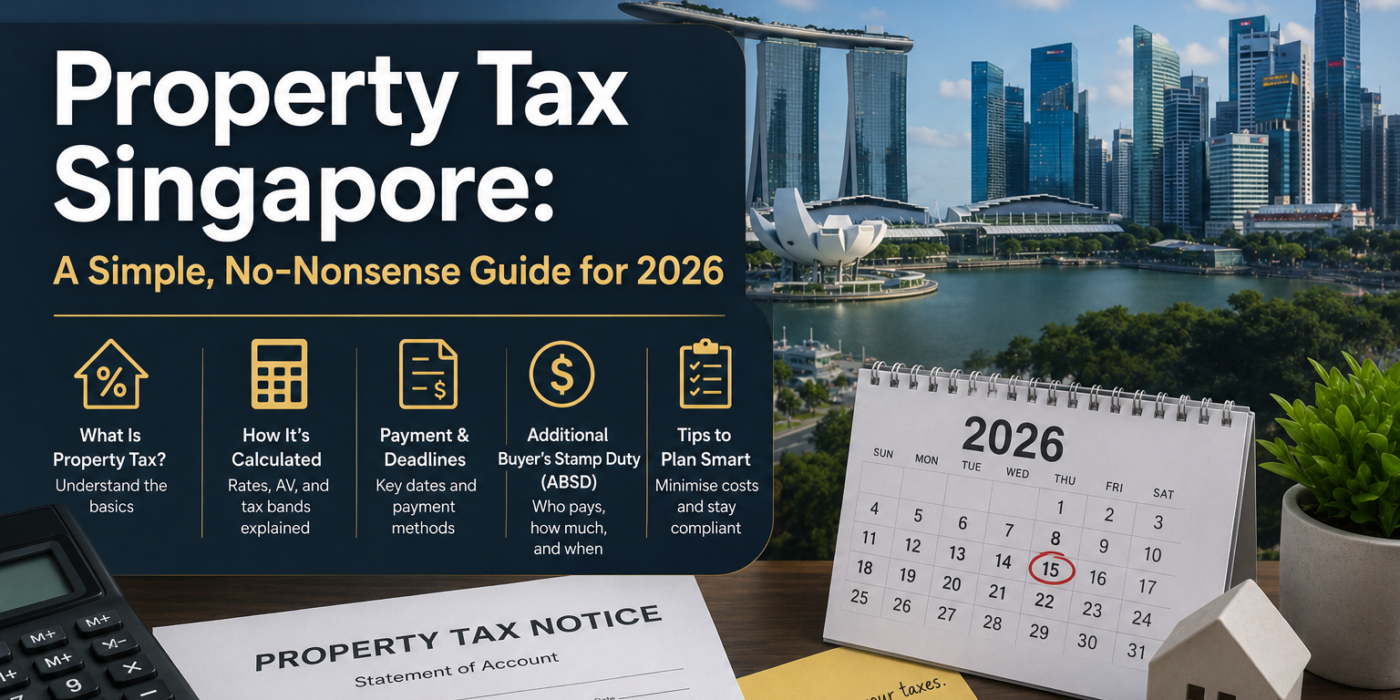
Property Tax Singapore: A Simple, No-Nonsense Guide for 2026

TLDR 

  • Property tax is annual, no exceptions. Own it, live in it, rent it, or leave it empty — IRAS bills you every year regardless.
  • It’s based on Annual Value, not market price. A $3M condo might have an AV of $60,000. That AV — not the market value — is what your tax is calculated on.
  • Two rate schedules exist. Owner-occupied rates are much lower. Renting out your property? You pay the non-owner-occupied rate, which starts at 10% from the first dollar.
  • Same property, very different bills. A condo with AV $60,000 costs $2,180/year in tax if you live there — and $6,900/year if you rent it out. That’s a $4,720 annual gap.
  • Luxury properties hurt more. Rates are progressive. The higher the AV, the steeper the rate — especially for rented-out units, where the top rate hits 20%.
  • Owner-occupier rate is not automatic. You have to apply for it through IRAS after moving in. Miss this and you overpay.
  • AV can be disputed. If IRAS revises your AV upward and it doesn’t match actual rents nearby, you have 30 days to object. Win the objection and you save money every year going forward.

If you own property in Singapore, property tax is one of those costs you pay every year without fail. Doesn’t matter if you live there, rent it out, or leave it empty — IRAS sends the bill regardless.

A lot of buyers only think about property tax after they’ve already bought. That’s a mistake. At the luxury end of the market especially, your annual tax bill can run into tens of thousands of dollars. Knowing how it works before you buy helps you plan properly and avoids any nasty surprises come January.

This guide breaks it down simply — how it’s calculated, what the current rates look like in 2026, worked examples for different property types, and what to do if you think your bill is wrong.

What Is Property Tax in Singapore?

Property tax in Singapore is an annual tax collected by the Inland Revenue Authority of Singapore (IRAS). Every property owner pays it — HDB flat owners, condo owners, landed homeowners, commercial property owners. No exceptions.

The key thing most people miss: property tax is not based on what you paid for your property or what it’s worth on the market today. It’s based on something called the Annual Value, or AV.

That distinction matters a lot. A condo worth S$3 million on the open market might have an AV of S$60,000. And it’s that S$60,000 figure, not the S$3 million, that determines your tax bill each year.

What Is Annual Value and How Is It Calculated?

Annual Value is the estimated amount your property could fetch in rent over one year if it were rented out unfurnished. IRAS works this out by looking at actual rental transactions for similar properties in the same area.

Furniture, fittings, and maintenance fees are excluded from the calculation. It’s strictly the bare rental value of the unit itself.

A few things to keep in mind about AV:

  • IRAS reviews and updates AVs periodically based on market rental movements
  • Your AV is not fixed permanently — it can go up if rents in your area have risen
  • If your AV is revised upward significantly and you think it’s wrong, you have the right to object within 30 days of receiving the notice

How to check your property’s Annual Value:

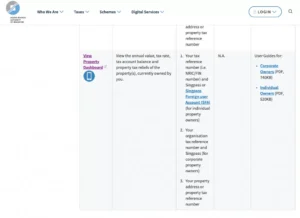
If you’re the owner, log in to the IRAS website at iras.gov.sg using Singpass and go to the View Property Dashboard. It’s all there.

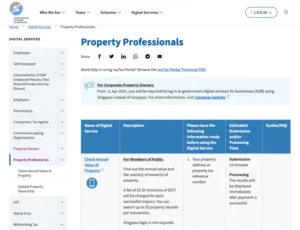
If you’re a buyer looking at a property before purchasing, you can use the IRAS portal for property professionals to check the AV. There’s a S$2.50 fee per enquiry but it gives you the actual figure, not an estimate.

You can also check estimated rental data on property portals like 99.co. This is free but less accurate — most units actually transact above the AV rental figure, so treat it as a rough guide only.

The Two Types of Property Tax Rates

Singapore uses two different rate schedules depending on how you use the property.

Owner-Occupied Rate

Owner-Occupied RateFor properties where the owner lives there as their primary residence, or where the property is left vacant.
Non-Owner-Occupied Rate

how-to-check-annual-value-of-a-propertyFor properties that are fully rented out to tenants. These rates are higher across all AV brackets.


This matters practically. If you buy a condo to rent out, you’ll pay the higher non-owner-occupied rates from the start. If you move in yourself, you apply for the owner-occupier rate and pay significantly less.

2026 Property Tax Rates: Owner-Occupied Residential Properties

These are the current rates for properties where the owner lives in the unit:

Annual Value (AV)

Tax Rate

Max Tax for This Band

First S$8,000

0%

S$0

Next S$47,000

4%

S$1,880

Next S$15,000

6%

S$900

Next S$15,000

8%

S$1,200

Next S$15,000

10%

S$1,500

Next S$15,000

12%

S$1,800

Next S$15,000

14%

S$2,100

Above S$130,000

16%

No limit

For the majority of owner-occupiers in Singapore, the effective tax rate stays well below 10% because most residential AVs don’t climb into the upper bands. A typical condo with an AV of around S$60,000 would pay a relatively modest annual tax bill under this schedule.

2026 Property Tax Rates: Non-Owner-Occupied Properties

If your property is rented out — or you own it but don’t live there — these are the rates that apply:

Annual Value (AV)

Tax Rate

Max Tax for This Band

First S$30,000

10%

S$3,000

Next S$15,000

12%

S$1,800

Next S$15,000

14%

S$2,100

Next S$15,000

16%

S$2,400

Next S$15,000

18%

S$2,700

Above S$90,000

20%

No limit

You’ll notice the starting rate here is already 10% on the first S$30,000. For investors with multiple properties, the non-owner-occupied schedule adds up quickly, especially when AVs are revised upward after a rental market uptick.

Real Examples: How Much Property Tax Will You Actually Pay?

Let’s make this concrete with a few real-world scenarios.

Example 1: HDB owner living in their flat, AV = S$12,000

Using owner-occupied rates:

  • First S$8,000 at 0% = S$0
  • Remaining S$4,000 at 4% = S$160
  • Total annual property tax = S$160

That’s S$13.30 a month. Not significant for most households.

Example 2: Condo owner living in unit, AV = S$60,000

  • First S$8,000 at 0% = S$0
  • Next S$47,000 at 4% = S$1,880
  • Remaining S$5,000 at 6% = S$300
  • Total annual property tax = S$2,180

Around S$182 a month. Still manageable.

Example 3: Condo fully rented out (investor), AV = S$60,000

Using non-owner-occupied rates:

  • First S$30,000 at 10% = S$3,000
  • Next S$15,000 at 12% = S$1,800
  • Remaining S$15,000 at 14% = S$2,100
  • Total annual property tax = S$6,900

See the difference? The same property with an AV of S$60,000 costs S$2,180 if you live in it and S$6,900 if you rent it out. That’s a gap of S$4,720 every year — which is a number worth knowing before you commit to an investment strategy.

Example 4: Luxury condo rented out, AV = S$120,000

  • First S$30,000 at 10% = S$3,000
  • Next S$15,000 at 12% = S$1,800
  • Next S$15,000 at 14% = S$2,100
  • Next S$15,000 at 16% = S$2,400
  • Next S$15,000 at 18% = S$2,700
  • Remaining S$30,000 at 20% = S$6,000
  • Total annual property tax = S$18,000

For luxury condo for sale investors renting out high-AV properties, property tax is a meaningful cost that needs to sit inside your return calculations from day one. If you’re working through investment numbers, our property investment advisory can help you model the full cost picture including property tax before you commit.

How to Pay Property Tax in Singapore

IRAS issues property tax bills once a year. The full amount is due by 31 January each year. You’ll receive a notice from IRAS in November or December for the following year.

Payment methods accepted:

  • GIRO (most common — set it up once and it’s automatic)
  • Internet banking
  • AXS stations
  • SAM (Self-service Automated Machines)
  • cheque (sent to IRAS)

GIRO is genuinely the easiest option. You can set up GIRO through the IRAS website, and IRAS will deduct in a single payment on 15 January or up to 12 monthly instalments from January to December. For most property owners, the monthly instalment option through GIRO makes the most sense for cash flow.

What happens if you pay late?

A 5% penalty is added to any unpaid amount after the due date. If it’s still unpaid after 30 days, IRAS can add another 2% per month. Don’t ignore property tax notices. The penalties add up quickly and IRAS takes this seriously.

Owner-Occupier Relief: How to Claim It

If you’ve just moved into your property and haven’t claimed the owner-occupier rate yet, you need to notify IRAS. It doesn’t apply automatically.

You can submit your owner-occupier claim through the IRAS website using Singpass. Once approved, IRAS will reassess your tax at the lower owner-occupied rates and refund any overpayment from the current tax year.

A few situations where this matters:

  • You bought a new property and moved in — apply for owner-occupier rate immediately
  • You had a tenant and they’ve moved out, and you’re moving in yourself — notify IRAS
  • You moved out and rented your place — notify IRAS and your rate will switch to non-owner-occupied

Don’t assume IRAS knows about changes in your occupancy status. You need to tell them. And if you’ve been paying non-owner-occupied rates when you should have been getting owner-occupier rates, you can claim a refund — but only for the current year and one year back.

Can You Dispute Your Annual Value?

Yes. If IRAS revises your AV upward and you believe it doesn’t reflect actual market rents in your area, you can object.

The process:

  1. You have 30 days from the date of the AV revision notice to file an objection
  2. Submit the objection through the IRAS digital services portal
  3. Gather evidence — actual rental transactions for comparable units in the same development or nearby buildings are the strongest support

IRAS will review your objection and either maintain the AV, revise it downward, or ask for more information. If you’re not satisfied with their decision, you can appeal to the Valuation Review Board.

This process is worth going through if the revision is significant, especially for investors where a higher AV directly means a higher annual tax bill. Winning an AV objection on a luxury rental property could save you thousands every year going forward.

Property Tax for Foreign Property Owners in Singapore

Foreigners who own private residential property in Singapore pay property tax at the same rates as citizens and PRs. The tax rates themselves don’t discriminate by nationality — your AV and occupancy status determine your rate, not your passport.

What does differ for foreigners is the buying cost upfront. The 60% Additional Buyer’s Stamp Duty for foreign buyers is a separate one-time charge at purchase. Property tax is the ongoing annual obligation after that. If you’re still working through whether buying in Singapore makes sense for your situation, our guide for foreigners buying property in Singapore covers the full picture including stamp duty, financing, and ownership rules.

Property Tax vs ABSD vs BSD — What’s the Difference?

A lot of buyers mix these up. They’re three completely separate taxes:

Tax

When You Pay

Who Pays

Buyer’s Stamp Duty (BSD)

Once, at purchase

All buyers

Additional Buyer’s Stamp Duty (ABSD)

Once, at purchase

Depends on buyer profile

Property Tax

Every year

All property owners

BSD and ABSD are one-off transaction costs. Property tax is your ongoing annual obligation as long as you own the property. All three need to be factored into your total cost of ownership calculation — especially when you’re buying at the S$5 million and above range. If you want a detailed breakdown of ABSD rates by buyer type, check our ABSD rate guide.

How Property Tax Affects Your Investment Returns

If you’re buying a condo as an investment to rent out, property tax is a real cost that eats into your net yield. Here’s a rough illustration of why it matters:

Say your condo generates S$72,000 in annual rental income. On paper, your gross yield looks decent. But if your property tax bill at non-owner-occupied rates is S$10,000 a year, that’s nearly 14% of your rental income going straight to IRAS before maintenance fees, mortgage servicing, or agent commissions even come into the picture.

Higher-AV properties — which are common in the luxury segment — pay proportionally more tax under the progressive rate structure. This is exactly why serious investors need to model net yield, not just gross yield, before committing to a purchase.

Our mortgage calculator can help you work through the monthly numbers, and our investment advisory team can help you stress-test the full return profile of any property you’re considering.

Key Dates and Admin Checklist for Property Owners

Here’s a quick reference for staying on top of property tax in Singapore:

  • November/December — IRAS sends your annual property tax notice
  • 31 January — Full payment due date (or GIRO deduction begins)
  • Within 30 days of AV revision notice — Deadline to file an AV objection
  • Anytime — Notify IRAS if your occupancy status changes (moving in, renting out, or vacating)
  • Immediately after purchase — Apply for owner-occupier rate if you’re moving in

If you’ve recently bought or are in the process of buying, it helps to go through all of this alongside your other financial planning. Our property consultation service covers the full cost-of-ownership picture including property tax — it’s a free 30-minute session and worth doing before you finalise anything.

Summary Table: Owner-Occupied vs Non-Owner-Occupied at a Glance

AV Level

Annual Tax (Owner-Occupied)

Annual Tax (Non-Owner-Occupied)

Difference

S$30,000

S$880

S$3,000

S$2,120

S$60,000

S$2,180

S$6,900

S$4,720

S$90,000

S$5,180

S$12,900

S$7,720

S$120,000

S$9,980

S$18,000

S$8,020

The gap between the two rate schedules only grows as AV increases. For investors buying high-value properties, this is a substantial annual cost difference worth factoring in from day one.

Advanced Heading

Frequently Asked Questions

How is property tax calculated in Singapore?

 Property tax is your property’s Annual Value multiplied by the applicable tax rate. The AV is based on estimated annual market rent, not the purchase price or current market value of the property.

It’s the estimated gross annual rent your property could earn if rented out unfurnished, excluding furniture and maintenance fees. IRAS sets this based on comparable rental transactions in your area.

The full amount is due by 31 January each year. If you pay via GIRO, you can opt for monthly instalments from January through December instead of a lump sum.

Owner-occupied rates are lower — starting at 0% on the first S$8,000 of AV. Non-owner-occupied rates start at 10% on the first S$30,000. If you rent your property out, you pay significantly more.

No. Property tax rates are the same for everyone regardless of nationality. What differs is the Additional Buyer’s Stamp Duty (ABSD) paid at purchase, not the ongoing annual property tax.

Yes. You have 30 days from the date of the AV revision notice to file an objection through the IRAS portal. Bring evidence of actual comparable rental transactions to support your case.

Notify IRAS through their digital services portal after you move into the property. It doesn’t apply automatically — you have to tell them. Once approved, overpaid tax from the current year gets refunded.

A 5% penalty applies to unpaid amounts after 31 January. After 30 more days, IRAS can add 2% per month on top. Don’t ignore the bill — the penalties compound quickly.

No. Stamp duty is a one-time cost paid when you buy a property. Property tax is an annual recurring cost you pay every year as long as you own it. Both need to be planned for separately.

If you live in the property, apply for the owner-occupier rate. If you think your AV is overestimated, file an objection. Beyond that, the rate structure is fixed — there are no further deductions or reliefs available for residential property tax in Singapore.

Categoriesarticles

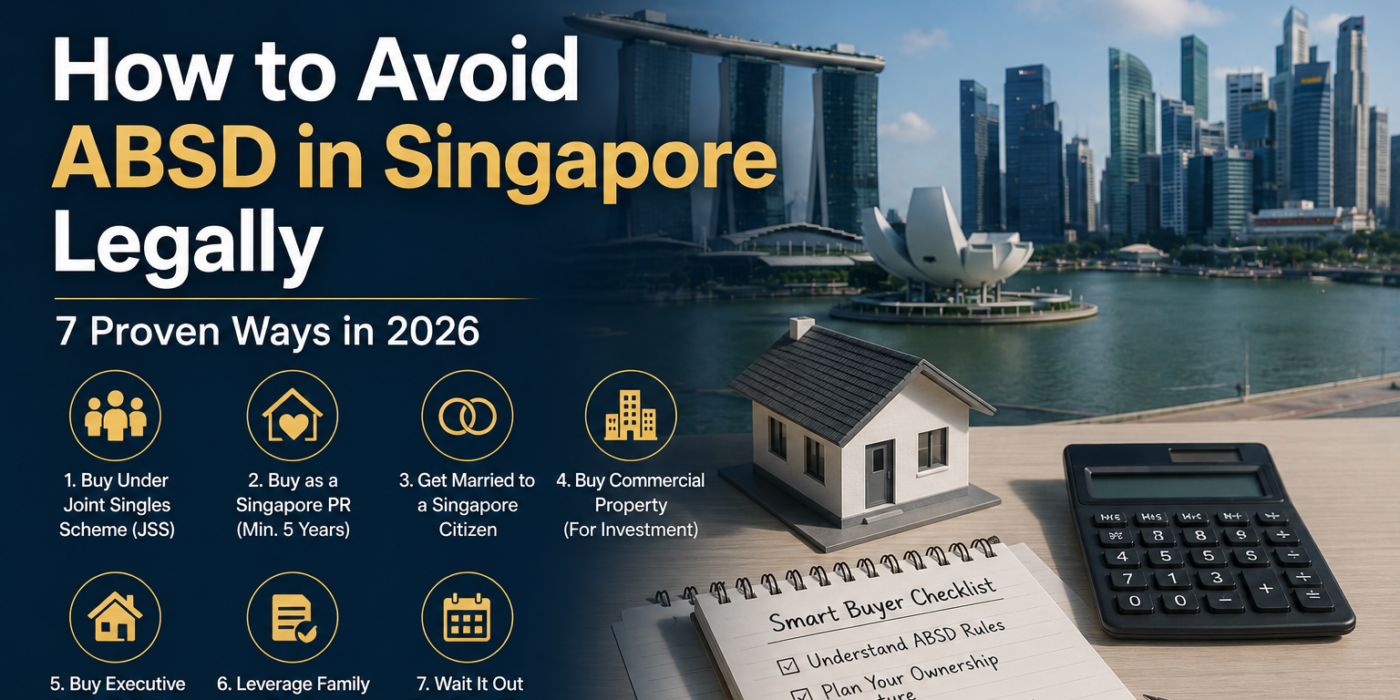
How to Avoid ABSD in Singapore Legally (7 Proven Ways in 2026)

TL;DR

ABSD can add a significant cost when buying additional residential properties in Singapore, but there are several legal ways to reduce or avoid it. Popular strategies include buying an Executive Condominium (EC), decoupling a jointly owned private property, selling your current property before purchasing new ones, buying under one spouse’s name, using a trust structure for children, purchasing a dual-key unit, or investing in commercial property. 

Each option has different eligibility requirements, costs, and risks, so the best approach depends on your property ownership status, finances, and long-term goals. Before making a decision, it’s important to calculate the actual savings and seek professional advice to ensure the strategy is suitable for your situation.

Let’s be real. The moment you start thinking about buying a second property in Singapore, ABSD becomes the elephant in the room. It’s not a small number. A Singapore Citizen pays 20% on a second property. A Permanent Resident pays 30% on their first investment purchase. And if you’re a foreigner — it’s 60%. On a S$2 million condo, that’s S$1.2 million just in stamp duty alone.

So yeah, people want to avoid ABSD in Singapore. That’s completely understandable.

The good news? There are legal ways to do it. Not loopholes, not shady arrangements — proper, government-recognized strategies that thousands of Singapore property buyers have used successfully. This guide walks you through all of them, clearly, so you can figure out which one actually fits your situation.

First, What Exactly Is ABSD?

ABSD stands for Additional Buyer’s Stamp Duty. The Singapore government introduced it in December 2011 as a cooling measure — basically a tax on top of the regular Buyer’s Stamp Duty (BSD) that applies when you buy any residential property.

The idea was to slow down property speculation. Before ABSD existed, investors in the 1990s would buy multiple properties using rental income from one to fund the next. It was a neat cycle that worked well — until it started pushing prices out of reach for ordinary buyers.

ABSD changed the math significantly. And in April 2023, the government raised the rates again — especially for foreigners, who jumped from 30% to 60% overnight.

Here are the current ABSD rates in Singapore for 2026:

Buyer Profile

1st Property

2nd Property

3rd & Beyond

Singapore Citizen

0%

20%

30%

Permanent Resident

5%

30%

35%

Foreigner

60%

60%

60%

Entity / Trust

65%

65%

65%

One thing most buyers don’t know — if a property is jointly purchased by two people with different profiles, the higher ABSD rate applies to the whole purchase. So if a Singapore Citizen and a foreigner buy together, the foreigner’s 60% rate kicks in on the full price. Plan joint purchases carefully.

7 Legal Ways to Avoid ABSD in Singapore

1. Buy an Executive Condominium (EC) Instead of a Private Condo

Buy an Executive Condominium (EC) Instead of a Private Condo

This one is specifically for HDB upgraders who want to move into a condo-style property without triggering a huge ABSD bill upfront.

Here’s the situation. If you own an HDB flat and want to buy a private condo, you’re technically a second-property buyer. That means 20% ABSD as a Singapore Citizen, payable upfront before you even move in.

Executive Condominiums are classified differently from private luxury condos for sale in Singapore. When you buy a new EC, the ABSD remission is granted upfront — meaning you don’t have to cough up the 20% first and claim it back later. You just need to sell your HDB within 6 months of collecting your EC keys.

EC household income ceiling in 2026 is S$16,000 per month. Prices typically run from S$1.1 million to S$1.5 million for a new launch. Not cheap, but the ABSD saving alone makes this a serious option for upgraders in the right income bracket.

One more thing — you can pay ABSD with CPF if needed, which helps with cash flow even when ABSD is payable.

Best for: HDB flat owners who want to upgrade without holding cash for ABSD upfront.

2. Decoupling — Transfer Your Share, Free Up a Name

Decoupling is one of the most talked-about strategies for avoiding ABSD in Singapore, and for good reason. But it doesn’t work for everyone, so understand it properly before assuming it’s your answer.

The basic idea: if you and your spouse jointly own a property, one of you transfers your share to the other. The person who transferred their share now legally owns zero properties. They can then buy a new property as a “first-time buyer” with no ABSD.

Sounds clean. But there are costs involved that you need to calculate first.

When you transfer your share, Buyer’s Stamp Duty (BSD) is payable on that portion — typically 3% to 4% depending on the value. If the property was bought within 3 years, Seller’s Stamp Duty (SSD) may also apply on the transferred portion. Legal fees for decoupling itself usually run around S$3,000 to S$5,000.

So the real question is: is the total cost of decoupling less than the ABSD you’d pay on the next purchase?

Let’s use a simple example. Your shared property is worth S$1.5 million. Your spouse transfers their 50% share (worth S$750,000) to you. BSD on S$750,000 works out to approximately S$18,600. Legal fees add roughly S$5,000. Total decoupling cost: around S$23,600.

Compare that to 20% ABSD on a S$1.2 million second property, which is S$240,000. The math clearly favours decoupling here.

But if the new property is smaller and the decoupling costs are proportionally higher, the numbers might not work. Always run the actual figures before committing.

One important note: you cannot decouple an HDB flat. This rule has been in place since 2016. If you’re in an HDB, you’d need to sell it first before using decoupling as part of your strategy.

Use our decoupling calculator to work out your specific numbers before you decide.

Best for: Married couples who jointly own a private property and want to expand their portfolio affordably.

3. Sell One, Buy Two Simultaneously

This strategy has been around for a while and it’s regaining popularity in 2026 as mortgage rates come down from their 2022-2024 peak.

The concept is simple. You sell your current property, then use the proceeds for two separate purchases — one under your name, one under your spouse’s name. Since neither of you owns any property at the point of buying, there’s no ABSD for either purchase.

Here’s a real-world example to make it concrete.

You and your spouse sell your 4-room HDB flat for S$700,000. You use S$400,000 as a downpayment on a S$1.3 million condo in your name. Your spouse uses S$250,000 toward a S$900,000 property in their name. Since neither of you owns property at time of purchase, zero ABSD applies.

For this to work, a few things need to be in place. Both of you need to qualify for your respective mortgages based on your individual incomes. You also need somewhere to live in between — either a temporary rental or staying with family during the gap period.

With rates now trending around 1.5% in 2025 compared to the 3.85% peak, the monthly servicing costs on two properties are far more manageable than they were two years ago. That’s why this strategy is back on the table for more buyers now.

Best for: Couples with dual incomes who can qualify for two separate mortgages and are comfortable with a transition period between selling and moving in.

4. Buy Under One Owner — Keep One Name Free

This is actually the simplest strategy of all, and a lot of couples overlook it because they assume joint ownership is always better.

If you and your spouse are planning to buy your first home, consider putting it entirely under one person’s name. The other person’s name stays clean — meaning when you’re ready to invest in a second property down the road, that person buys it as a first-time buyer with zero ABSD.

The tradeoff is that the person with the property carries the full financial and legal responsibility. The bank will assess the mortgage based solely on that individual’s income, which may limit how much you can borrow.

But if your incomes allow it and you’re planning for the long term, this is one of the cleanest and lowest-cost ways to build a two-property portfolio without ever paying ABSD. No lawyers, no transfers, no extra stamp duties. Just smart planning from day one.

Best for: Couples who haven’t bought their first property yet and have strong individual incomes.

5. Buy Under a Trust for Your Children

This one is more complex and comes with real trade-offs. But it’s a legitimate strategy used by high-net-worth families in Singapore.

You purchase a property and place it under a trust in your child’s name. Since it’s legally your child’s property, not yours, you don’t count as owning it for ABSD purposes. The property appreciates over time and eventually belongs to your child.

Before you get excited, here’s what you need to know.

You cannot get a bank loan for a trust property. It must be paid fully in cash — though you can take an equity loan against another property you own to partially finance it. So this strategy is really only available to buyers with significant liquid capital.

Once the property is in your child’s name, they’re considered a private property owner. That means if they want to buy an HDB flat or EC later, they’ll need to dispose of the trust property first — and face waiting periods and restrictions that could complicate their own housing plans.

The government is also watchful about trust structures created purely to avoid ABSD. If the motive is clearly tax evasion rather than genuine estate planning, IRAS can still impose the duty. A good property lawyer who has handled trust purchases before is non-negotiable here.

For a deeper look at how this works, read our full article on buying property under trust in Singapore.

Best for: High-net-worth individuals with significant cash who want to transfer wealth to children while building a property portfolio.

6. Get a Dual-Key Unit

A dual-key unit is one property with two separate living spaces — a shared foyer that splits into two distinct units. Some people use it for multi-generational living. Others rent out one unit while living in the other.

Because it’s legally classified as a single property, you don’t pay ABSD on a second purchase. You’re buying one unit, not two.

It’s worth being honest here though — dual-key units are not the most profitable investment option in Singapore. Compared to actually owning two separate properties (which you can achieve through decoupling or sell-one-buy-two), dual-key units tend to appreciate less and are harder to sell because the buyer pool is smaller.

But for people who want to generate rental income and avoid ABSD without the complexity of other strategies, dual-key works.

Best for: Buyers who want rental income from a single property purchase and don’t want to manage two separate properties.

7. Invest in Commercial Property Instead

No ABSD on commercial property. Full stop.

If your goal is investment income rather than a second home, commercial property — shophouses, office units, industrial spaces — is completely outside the ABSD framework. There’s GST of 9% applicable in most commercial transactions, which is a cost to factor in, but it’s a very different number from 20% or 30% ABSD.

Commercial property is a different game from residential. Tenant profiles, lease structures, and valuations work differently. You need to do proper homework before jumping in. But for buyers who’ve been wanting to expand beyond residential and were put off by ABSD, this is a genuine alternative worth exploring.

Best for: Investors who are comfortable with commercial real estate and want to bypass ABSD entirely on their next purchase.

ABSD Remission — Cases Where You Can Get It Back

There are specific situations where ABSD is paid upfront but can be refunded later. These aren’t strategies to avoid ABSD exactly — but they’re important to know.

Upgrader remission: Singapore Citizens who buy a second property while still owning their first can get the ABSD refunded if they sell the first property within 6 months of the new purchase. ABSD is still paid upfront — you get it back after IRAS verifies the sale. This is the standard “upgrade while selling” path for most Singaporean families.

Senior rightsizing remission: From March 2025, Singapore Citizen seniors aged 55 and above who sell a higher-value home and buy a lower-value replacement can apply for partial ABSD remission under specific conditions. This targets genuine downsizers rather than investors.

FTA exemption — for certain nationalities: Nationals or Permanent Residents of the USA, Iceland, Liechtenstein, Norway, and Switzerland are treated the same as Singapore Citizens for ABSD purposes. This comes from Singapore’s Free Trade Agreement obligations. If you hold one of these passports, your ABSD rate on a first purchase is zero — a significant advantage that most foreign buyers from other countries don’t have.

Which Strategy Is Right for You?

There’s no universal answer. It depends on your citizenship status, income, how many properties you already own, your family situation, and how much liquid cash you have available.

Your Situation

Strategy to Consider

HDB owner wanting to upgrade

EC purchase with remission

Couple with joint private property

Decoupling

Couple who hasn’t bought yet

Buy under one name only

Ready to sell current property

Sell one, buy two

High net worth, long-term planning

Trust purchase

Want income without two properties

Dual-key unit

Open to non-residential investment

Commercial property

US / Swiss / Norwegian national

FTA exemption — check with agent

Figuring out which one saves you the most money in your specific situation takes some actual number-crunching. Our property consultation service is built specifically for this — we’ll work through your situation, run the numbers, and tell you exactly which path makes the most financial sense.

Common Mistakes People Make When Trying to Avoid ABSD

Assuming decoupling always works. Sometimes the BSD plus SSD plus legal fees add up to more than the ABSD itself. Always calculate both sides before deciding.

Forgetting about the 6-month window. For upgrader remission to work, you must sell your existing property within 6 months of purchasing the new one. Miss that window and you lose the refund.

Putting a property under a child’s name without thinking through the consequences. The child is now a property owner with all the restrictions that come with it — BTO restrictions, HDB eligibility issues, future ABSD on their own purchases.

Buying jointly with a foreigner. If you’re a Singapore Citizen and your purchasing partner is a foreigner, the 60% foreign ABSD rate applies to the whole purchase. This catches couples off guard regularly.

Not getting proper legal advice before a trust structure. IRAS has broad powers to look through arrangements that exist purely to avoid stamp duty. A poorly structured trust could result in the full ABSD being imposed anyway.

The Bigger Picture — Is Avoiding ABSD Always the Right Goal?

Sometimes it is. If you’re a Singapore Citizen planning carefully and the numbers work, using one of these strategies can save you S$200,000 to S$400,000 or more on a single transaction. That’s money that stays in your pocket and goes toward your next purchase.

But sometimes buyers get so fixated on avoiding ABSD that they end up making a worse property decision overall. A property bought through a complicated structure in the wrong location at the wrong price can lose more in value than you saved in stamp duty.

The goal should always be a good property at a good price, bought with a smart structure. ABSD planning is one part of that — not the whole picture.

If you’re thinking about buying a second or third property in Singapore and want help working through the right strategy, have a look at our property investment advisory or get in touch directly for a free 30-minute session.

And if you haven’t already, use our ABSD calculator to check the current rates and what you’d be looking at for your specific buyer profile.

Advanced Heading

Frequently Asked Questions

What is ABSD and why does Singapore have it?

ABSD stands for Additional Buyer’s Stamp Duty. It’s a tax the Singapore government introduced in 2011 to cool down property speculation and keep housing affordable for first-time buyers.

Yes, in some cases. Strategies like decoupling, the sell-one-buy-two approach, or buying under one spouse’s name can legally eliminate or significantly reduce ABSD payable on a second purchase.

Foreigners pay 60% ABSD on all residential property purchases in Singapore regardless of how many properties they own, following the April 2023 increase.

 Yes. Singapore Citizens who buy a second property and sell their first within 6 months of the new purchase can apply for ABSD remission from IRAS. The duty is paid upfront and refunded after the sale is verified.

Yes, decoupling is still legal for private properties. However, it’s under closer scrutiny, and you cannot decouple an HDB flat. Always get proper legal and financial advice before proceeding.

It means selling your current property first so both you and your spouse are property-free, then each purchasing a new property simultaneously under your individual names with no ABSD applicable.

This is legal but comes with significant strings attached — your child becomes a property owner with restrictions on future HDB and EC purchases. It also requires full cash payment with no bank loan available.

Yes. Under Singapore’s Free Trade Agreements, nationals and PRs of the USA, Iceland, Liechtenstein, Norway, and Switzerland enjoy the same ABSD treatment as Singapore Citizens on their first property purchase.

 No. Commercial properties like shophouses, office units, and industrial spaces are not subject to ABSD. GST of 9% applies instead, but this is significantly lower than residential ABSD rates.

 It depends on your citizenship status, current property holdings, income, family situation, and available cash. Speaking with a specialist property consultant who can run the actual numbers for your situation is the most reliable way to decide.

Free 30 min Consultation Call
IT'S TIME TO DISCOVER
Your Dream Luxury Condo Home
CONTACT AGENT
Senior Realtor
JAMES LIM

Property Consultant & Analyst

Contact Us
FORM-ONE (footer and popup)

© 2025
SGLUXURYCONDO
ALL RIGHTS RESERVED.

USE OF THIS SITE CONSTITUTES ACCEPTANCE OF OUR TERMS OF USE AND PRIVACY POLICY