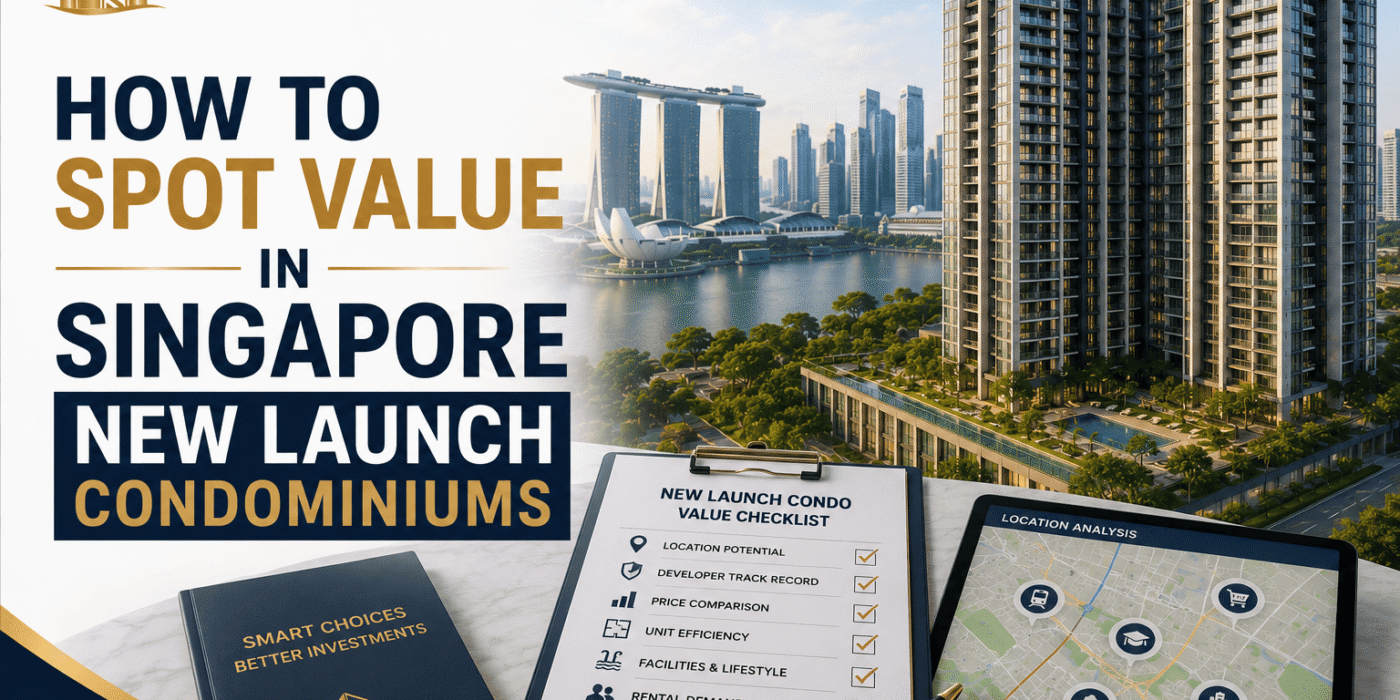
How to Spot Value in Singapore New Launch Condominiums
Executive Summary
Buying a first condominium is one of the largest financial decisions most Singapore households will make. Yet many buyers enter a sales gallery without a clear way to judge whether a new launch is reasonably priced. They may compare only the headline price, the monthly instalment, or the discount offered on launch weekend. A more useful starting point is the price paid for the land.
This report studies 40 major condominium launches from 2018 to 2025, using five projects for each year. For every project, the dataset records the land price in dollars per square foot per plot ratio, the average selling price in dollars per square foot, and the selling-price-to-land-price multiplier. The purpose is not to predict the exact price of every future launch. The purpose is to build a practical benchmark that helps a first-time buyer ask better questions.
The yearly results show a clear change. From 2018 to 2020, the average selling price was about 1.8 times the average land price. In 2021, the multiplier rose to about 2.0 times. In 2022, it fell to about 1.75 times because the sample contained projects with high land costs relative to their selling prices. From 2023 to 2025, the multiplier recovered from 1.91 times to 2.24 times.
This widening gap should not automatically be read as evidence that developers are earning much larger profits. Land is only one part of the total development cost. Developers also pay for construction, labour, professional fees, financing, marketing, regulatory compliance, taxes, contingencies and the risk of holding unsold units. Construction tender prices and imported material costs rose sharply after the pandemic, while interest rates increased from the unusually low levels seen before 2022. Global trade restrictions and tariffs can also raise the price of imported materials and equipment, although the exact effect varies by project.
For practical use, a buyer can multiply the land price by a broad benchmark. Before 2022, 1.8 times was a reasonable first estimate. For recent launches, 2.2 times is a more relevant starting point. A launch priced clearly below 2.2 times its land price may deserve closer study as a possible value opportunity. However, this is only a screen. A buyer must still consider location, tenure, transport, schools, site quality, unit efficiency, competition, maintenance fees and resale demand.
Important caution: This framework estimates relative pricing. It does not prove that a property is cheap, guarantee capital gains, or replace a full affordability and suitability check.
At a Glance
Core idea: A developer’s land price is a useful starting point for estimating a future launch price. In this dataset, the typical multiplier moved from about 1.8× before 2022 to about 2.2× by 2025.
Projects analysed | 40 |
Study period | 2018–2025 |
Projects per year | 5 |
Average multiplier in 2018 | 1.87× |
Average multiplier in 2025 | 2.24× |
Why Land Price Matters to a First-Time Condo Buyer
A new condominium price can feel mysterious. Buyers usually see the finished product: the show flat, the pool, the landscaping, the smart-home features and the promotional price list. The developer, however, started making decisions years earlier. One of the earliest and most important decisions was how much to pay for the site.

In Singapore, many new private housing sites are sold through the Government Land Sales programme. Developers submit bids for the land. The winning bid is commonly reported as dollars per square foot per plot ratio, or psf ppr. This measure adjusts the land price for the amount of floor area that can be built. A higher psf ppr usually means the developer starts with a higher land cost for every square foot of saleable space it hopes to create.
Land price is useful because it is public, measurable and fixed early. It gives buyers a base from which to estimate the likely launch price. If two sites are similar in location, tenure and planning conditions, the site bought at the higher psf ppr will usually need a higher selling price. The relationship is not exact, but it is meaningful.
The mistake is to assume that selling price equals land price plus a small mark-up. A condominium is not a piece of raw land sold directly to a buyer. The developer must turn that land into a completed and legally compliant residential project. This process takes years and includes design, approvals, construction, financing, sales, landscaping, infrastructure, taxes and risk. Therefore, the gap between land price and average selling price is not pure profit.
For a first-time buyer, land price is best treated as an anchor. It is similar to knowing the cost of ingredients before judging the price of a restaurant meal. The ingredients matter, but they are not the whole bill. When buyers understand this, they can avoid two common errors. The first is thinking that every project above its land price is overpriced. The second is accepting any high price simply because construction costs have increased. A disciplined buyer uses land price as a starting point, then checks whether the remaining premium is justified.
Research Method and Dataset
The analysis uses 40 project entries from 2018 to 2025, with five launches for each year. The workbook records the project name, total units, district, market region, tenure, developer, land price, average selling price and the ratio of average selling price to land price.
The intended screening approach was to focus mainly on larger projects with more than 400 units and to remove unusual cases such as boutique projects, en bloc redevelopments and mixed developments. Larger projects were preferred because they tend to have more transactions, a broader mix of buyers and more reliable average selling-price observations. Small boutique developments can produce misleading averages because a few premium units may heavily influence the result.
However, the final 40-row workbook still contains a small number of executive condominiums and mixed-use or integrated projects. Examples include Piermont Grand, Parc Central Residences, Tenet, CanningHill Piers, Lentor Modern and ParkTown Residence. These entries are reproduced faithfully because they remain in the supplied dataset. Readers should therefore view the results as an applied market sample rather than a perfectly controlled academic sample.
The average land price for each year is calculated by adding the five land prices and dividing by five. The average selling price is calculated in the same way. The main multiplier is then calculated as average selling price divided by average land price. This method is different from averaging the five individual project ratios, although the results are usually close.
The study also shows the inverse ratio, land price divided by average selling price. This tells us what share of the selling price is represented by the land-price benchmark. For example, an inverse ratio of 0.45 means the average land price is about 45 percent of the average selling price. It does not mean land is exactly 45 percent of the developer’s total cost, because psf ppr and saleable psf are not perfectly identical concepts and because project efficiency varies.
The dataset is designed as a practical decision tool. It is not a valuation report, and it does not estimate developer profit margins. Average selling prices may refer to launch-period averages, reported averages or broad project averages depending on the original source. Different unit sizes, floor levels, views and sales phases can also affect the reported psf.
The 40 New Launch Condominium Entries
The following table reproduces the dataset used in this report. The multiplier is calculated as average selling price divided by land price.
Year | Project | Units | Region | Tenure | Land price (S$ psf ppr) | Avg selling price (S$ psf) | Multiplier |
2018 | Riverfront Residences | 1,472 | OCR | 99-yr | 706 | 1,305 | 1.85× |
2018 | Stirling Residences | 1,259 | RCR | 99-yr | 1,051 | 1,800 | 1.71× |
2018 | Park Colonial | 805 | RCR | 99-yr | 1,100 | 1,700 | 1.55× |
2018 | The Tapestry | 861 | OCR | 99-yr | 565 | 1,310 | 2.32× |
2018 | Twin Vew | 520 | OCR | 99-yr | 592 | 1,399 | 2.36× |
2019 | Treasure at Tampines | 2,203 | OCR | 99-yr | 655 | 1,323 | 2.02× |
2019 | The Florence Residences | 1,410 | OCR | 99-yr | 842 | 1,447 | 1.72× |
2019 | Parc Esta | 1,399 | RCR | 99-yr | 909 | 1,680 | 1.85× |
2019 | Piermont Grand (EC) | 820 | OCR | 99-yr | 583 | 1,080 | 1.85× |
2019 | Avenue South Residence | 1,074 | RCR | 99-yr | 1,138 | 1,961 | 1.72× |
2020 | Clavon | 640 | RCR | 99-yr | 788 | 1,640 | 2.08× |
2020 | Parc Clematis | 1,468 | RCR | 99-yr | 850 | 1,580 | 1.86× |
2020 | Forett at Bukit Timah | 633 | RCR | Freehold | 1,068 | 1,880 | 1.76× |
2020 | Penrose | 566 | RCR | 99-yr | 732 | 1,580 | 2.16× |
2020 | The M | 522 | RCR | 99-yr | 1,458 | 2,450 | 1.68× |
2021 | Normanton Park | 1,862 | RCR | 99-yr | 969 | 1,750 | 1.81× |
2021 | Parc Central Residences (EC) | 700 | OCR | 99-yr | 578 | 1,171 | 2.03× |
2021 | CanningHill Piers | 696 | CCR | 99-yr | 1,171 | 3,000 | 2.56× |
2021 | Midtown Modern | 558 | CCR | 99-yr | 1,535 | 2,800 | 1.82× |
2021 | Irwell Hill Residences | 540 | CCR | 99-yr | 1,515 | 2,700 | 1.78× |
2022 | Lentor Modern | 605 | OCR | 99-yr | 1,204 | 2,107 | 1.75× |
2022 | Leedon Green | 638 | CCR | Freehold | 1,790 | 2,887 | 1.61× |
2022 | Riviere | 455 | RCR | 99-yr | 1,733 | 2,907 | 1.68× |
2022 | Tenet (EC) | 618 | OCR | 99-yr | 659 | 1,382 | 2.10× |
2022 | Piccadilly Grand | 407 | RCR | 99-yr | 1,129 | 2,150 | 1.90× |
2023 | Grand Dunman | 1,008 | RCR | 99-yr | 1,350 | 2,535 | 1.88× |
2023 | The Myst | 408 | OCR | 99-yr | 1,068 | 2,057 | 1.93× |
2023 | The Continuum | 818 | RCR | Freehold | 1,440 | 2,733 | 1.90× |
2023 | Tembusu Grand | 638 | RCR | 99-yr | 1,302 | 2,473 | 1.90× |
2023 | Lentor Hills Residences | 598 | OCR | 99-yr | 1,060 | 2,104 | 1.98× |
2024 | Chuan Park | 916 | RCR | 99-yr | 1,256 | 2,579 | 2.05× |
2024 | Emerald of Katong | 846 | RCR | 99-yr | 1,069 | 2,621 | 2.45× |
2024 | The Continuum | 818 | RCR | Freehold | 1,440 | 2,800 | 1.94× |
2024 | Lentor Mansion | 533 | OCR | 99-yr | 985 | 2,257 | 2.29× |
2024 | Hillock Green | 474 | OCR | 99-yr | 1,108 | 2,108 | 1.90× |
2025 | ParkTown Residence | 1,193 | OCR | 99-yr | 885 | 2,360 | 2.67× |
2025 | One Marina Gardens | 937 | CCR | 99-yr | 1,402 | 2,953 | 2.11× |
2025 | The Orie | 777 | RCR | 99-yr | 1,175 | 2,704 | 2.30× |
2025 | ELTA | 501 | RCR | 99-yr | 1,250 | 2,537 | 2.03× |
2025 | Lentor Central Residences | 477 | OCR | 99-yr | 982 | 2,200 | 2.24× |
Yearly Averages and the Main Trend
The yearly summary makes the change easier to see. Each year contains five projects, so every project has equal weight in the annual average.
Year | Average land price | Average PSF | Average PSF ÷ land price | Land price ÷ average PSF |
2018 | S$802.8 | S$1,502.8 | 1.87× | 0.53 |
2019 | S$825.4 | S$1,498.2 | 1.82× | 0.55 |
2020 | S$979.2 | S$1,826.0 | 1.86× | 0.54 |
2021 | S$1,153.6 | S$2,284.2 | 1.98× | 0.51 |
2022 | S$1,303.0 | S$2,286.6 | 1.75× | 0.57 |
2023 | S$1,244.0 | S$2,380.4 | 1.91× | 0.52 |
2024 | S$1,171.6 | S$2,473.0 | 2.11× | 0.47 |
2025 | S$1,138.8 | S$2,550.8 | 2.24× | 0.45 |
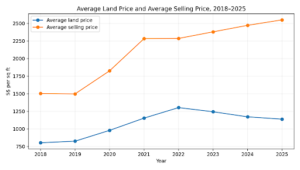
Figure 1. Average land price and average selling price for the five sampled projects in each year.
From 2018 to 2020, the multiplier stayed close to 1.8 times. It was 1.87 times in 2018, 1.82 times in 2019 and 1.86 times in 2020. This suggests that, across the sample, selling prices moved in a fairly stable relationship with land prices.
In 2021, the multiplier rose to 1.98 times. This was close to 2.0 times and marked a step up from the earlier period. The sample included several higher-priced central projects, which raised the average selling price.
In 2022, the multiplier dropped to 1.75 times, the lowest yearly figure in the study. The average land price reached S$1,303 psf ppr, the highest annual land-price average in the table, while the average selling price was S$2,286.60 psf. This combination compressed the multiplier. One possible interpretation is that developers had committed to expensive land before fully passing higher costs into selling prices. Another is that the mix of projects in the sample, including premium freehold and central sites, affected the result. It would be too strong to say that the entire market followed exactly the same pattern.
From 2023 to 2025, the multiplier rose steadily: 1.91 times in 2023, 2.11 times in 2024 and 2.24 times in 2025. At the same time, the average land price fell from S$1,244 psf ppr in 2023 to S$1,138.80 psf ppr in 2025, while the average selling price increased from S$2,380.40 psf to S$2,550.80 psf. In simple terms, developers achieved progressively higher selling prices relative to the sampled land costs.
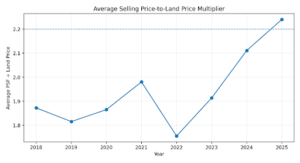
Figure 2. The average multiplier increased from around 1.8× in the earlier years to 2.24× in 2025.
Why the Gap Between Land Price and Selling Price Has Widened
The most important point is that land price is not the only cost. The developer’s final price must cover a full development cost stack. A wider gap between land price and selling price can therefore be caused by higher non-land costs even when the developer’s profit margin does not increase.
Construction cost is the most visible part of this gap. A condominium requires concrete, reinforcement steel, glass, aluminium, mechanical and electrical systems, lifts, waterproofing, finishes, landscaping and many other materials. It also requires skilled workers, supervisors, engineers, safety systems, testing and quality control. When material prices, wages or contractor bids rise, the developer’s breakeven price rises.
The pandemic created major disruption. Border restrictions reduced the availability of foreign workers. Worksites faced delays and additional safety measures. Shipping schedules became less reliable, and global supply chains were disrupted. Even after restrictions eased, contractors still had to rebuild capacity, clear project backlogs and manage higher input prices. These pressures did not disappear immediately.
Inflation also matters. Singapore imports many construction inputs and pieces of equipment. When international prices rise, when freight costs increase, or when the Singapore dollar does not fully offset foreign-currency price changes, imported costs can rise. General inflation also affects professional salaries, transport, energy, insurance, security, cleaning and administration.
Tariffs and trade restrictions can add another layer of cost. Singapore may not impose the relevant tariff itself, but global tariffs can change the price and routing of steel, aluminium, machinery, electrical equipment and other traded goods. Suppliers may pass these costs through the regional supply chain. The effect is indirect and differs by product, so tariffs should be treated as one possible contributor rather than the sole explanation.
Financing costs are another important reason. A developer pays for land before it receives most of the sales revenue. Construction also requires working capital over several years. When interest rates rise, the cost of holding land and financing construction increases. Higher rates also create sales risk because buyers face larger mortgage payments and may become more cautious. Developers may therefore need a wider buffer for financing and uncertainty.
Professional and regulatory costs have also grown in importance. Architects, engineers, quantity surveyors, legal advisers, project managers and marketing teams all contribute to the project. Newer developments may include more advanced building systems, sustainability features, digital controls and energy-efficiency requirements. These can improve long-term performance, but they can add upfront cost.
Taxes and policy-related costs should not be ignored. Developers face stamp duties, including Additional Buyer’s Stamp Duty obligations and deadlines, depending on the land acquisition structure and prevailing rules. There are also development charges or lease-related payments for some sites. A developer that fails to sell and complete within required periods may face significant financial consequences. This risk is reflected in bidding and pricing decisions.
Marketing and sales costs are smaller than land and construction but still material. Show flats, sales galleries, commissions, advertising, legal documentation and launch events all have a cost. Large projects may benefit from scale, yet they also require large sales teams and long marketing campaigns.
Finally, the developer must earn a return for taking risk. A project can take five years or more from land purchase to completion. During that period, the economy, interest rates, regulations, buyer demand and competing supply can change. The developer must also manage defects, delays and unsold inventory. Profit is therefore not simply an excessive add-on; it is the return required to undertake a complex, capital-intensive project. The correct question is not whether the selling price is above land cost. The correct question is whether the total premium above land cost is reasonable for the project and market conditions.
What the Correlation Does—and Does Not—Tell Us
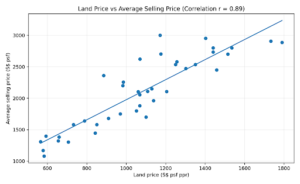
Figure 3. Across the 40 entries, land price and average selling price show a positive correlation of about 0.89.
Across the 40 entries, the correlation between land price and average selling price is approximately 0.89. This is a strong positive relationship. In general, projects built on more expensive land were sold at higher prices.
However, correlation is not the same as a pricing formula. The points do not lie on one perfect line. A project can sit above or below the trend because of location, tenure, views, unit sizes, design, timing, developer brand and competition. A freehold project may command a different premium from a 99-year leasehold project. A project beside an MRT station may command a higher price than a less connected project with the same land cost.
The sample also mixes CCR, RCR and OCR locations. A central project may have higher land and selling prices, while an OCR project may have a lower land cost but a large percentage premium because buyers compare it with nearby resale alternatives rather than central projects. Executive condominiums are governed by different eligibility and pricing conditions, which can also affect their multipliers.
For a first-time buyer, the correct use of correlation is simple: land price matters a lot, but it does not explain everything. It is the first checkpoint, not the final answer.
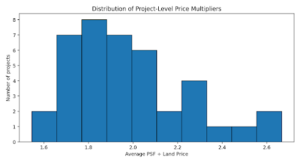
Figure 4. Most project-level multipliers in the sample fall roughly between 1.7× and 2.4×.
How to Estimate the Likely Selling Price of a New Launch

The most practical use of this study is to estimate a likely launch price before the official price list is released. The method is simple:
Estimated average selling price = land price × selected multiplier.
The multiplier should depend on the period and the nature of the project. Before 2022, a broad estimate of 1.8 times worked reasonably well for the sampled annual averages. By 2024 and 2025, a multiplier near 2.2 times was more consistent with the observed data.
Suppose a developer buys a residential site at S$1,000 psf ppr. Using the older 1.8-times rule, the estimated selling price would be about S$1,800 psf. Using a current 2.2-times benchmark, the estimate would be about S$2,200 psf.
Suppose the land price is S$1,300 psf ppr. Under the older rule, the estimate would be S$2,340 psf. Under the 2.2-times rule, the estimate would be S$2,860 psf.
Suppose the land price is S$1,500 psf ppr. The older estimate would be S$2,700 psf, while the newer estimate would be S$3,300 psf.
These numbers are not forecasts with guaranteed accuracy. They are quick screening estimates. A project with a complex integrated development, a costly underground connection, difficult soil conditions, premium architecture or a long construction programme may require a higher multiplier. A highly efficient site, a lower-cost construction contract or a developer seeking rapid sales may support a lower multiplier.
The average launch price also differs from the price of an individual unit. Small units often have a higher psf because fixed costs are spread over fewer square feet. High-floor units, premium stacks and better views usually cost more. A buyer should compare the selected unit with similar units in the same project, not only with the project-wide average.
A Practical Value-Screening Strategy: Look Below 2.2×
The central pricing strategy from this study is to compare a new launch’s expected or actual average selling price with 2.2 times its land price.
If the launch is meaningfully below 2.2 times, it may offer relative value against recent market norms. For example, if the land price is S$1,200 psf ppr, the 2.2-times benchmark is S$2,640 psf. If the project launches at an average near S$2,450 psf, the multiplier is about 2.04 times. That is below the recent benchmark and deserves closer examination.
The word “deserves” is important. A lower multiplier is not automatically a bargain. The project may have a weaker location, awkward site shape, less efficient layouts, high maintenance fees, poor views or heavy nearby supply. It may also be priced lower because the developer wants a fast launch rather than because the project is fundamentally undervalued.
The reverse is also true. A project above 2.2 times is not automatically overpriced. A premium may be justified by freehold tenure, direct MRT access, a rare central location, exceptional views, strong schools, an integrated transport hub or limited competing supply. Buyers should ask whether the extra premium is matched by real benefits that future resale buyers will also value.
A useful classification is:
- Below 2.0 times: potentially attractive relative pricing, but investigate why it is low.
- About 2.0 to 2.2 times: broadly within a reasonable recent range for many large launches.
- Above 2.2 times: requires stronger project-specific justification.
- Above 2.4 times: a high premium in this dataset; buyers should be especially careful to identify the source of value.
This classification is a guide, not a hard rule. It works best when comparing projects of similar tenure, location and development type.
First-Time Buyer Checklist
A first-time buyer should combine the land-price screen with a broader review. The following steps keep the process simple and disciplined.
- Find the land price in S$ psf ppr from the Government Land Sales result or a reliable property-news report.
- Multiply the land price by 2.2 to create a current benchmark.
- Compare the benchmark with the project’s reported average launch price, not only the cheapest advertised unit.
- Calculate the actual multiplier: average selling price divided by land price.
- Compare the project with nearby new launches and recent resale transactions.
- Check whether the project is 99-year leasehold, freehold or an executive condominium.
- Study the unit layout. Efficient usable space can matter more than a lower psf.
- Check MRT access, schools, shops, parks, noise, traffic and future construction around the site.
- Estimate monthly mortgage payments under a higher interest-rate scenario.
- Include buyer’s stamp duty, legal fees, renovation, maintenance fees and emergency savings.
- Ask whether the project will still appeal to resale buyers five to ten years later.
- Do not buy only because of a launch-day discount or fear of missing out.
Useful Discussion of the 2018–2025 Pattern

The data suggests that the new-launch market went through several phases.
The 2018–2020 period was relatively stable in multiplier terms. The annual figures stayed close to 1.8 times even though individual projects varied widely. This implies that a buyer using land price as a guide could obtain a fairly consistent first estimate.
The 2021 increase to about 2.0 times may reflect a combination of stronger private housing demand, a change in project mix and rising non-land costs. It also came during a period when the property market was recovering from the first pandemic shock.
The 2022 drop to 1.75 times is especially interesting. The average land price in the sample was the highest of the eight years. When developers buy land aggressively, they have less room between the land benchmark and the final selling price. They may accept a thinner buffer, phase price increases over time or depend on future market growth. The year also marked a sharp change in interest-rate conditions. Financing became more expensive, but developers could not always pass every cost increase to buyers immediately.
From 2023 onward, the multiplier recovered strongly. This could reflect several forces acting together. First, land bids became more disciplined in some tenders. Second, construction and financing costs remained high. Third, market selling prices had already moved upward. Fourth, developers may have needed larger risk buffers because of uncertain rates, taxes, cooling measures and future supply.
The inverse ratio helps explain the same trend from another angle. Land price divided by average selling price fell from about 0.53–0.55 in 2018–2020 to 0.45 in 2025. In other words, the land-price benchmark represented a smaller share of the sampled selling price over time. The missing share was not simply profit. It represented the larger total of construction, financing, professional, regulatory, marketing and risk costs.
It is also important to compare this sample with the wider market. URA reported that overall private residential prices rose strongly in 2022 and 2023 before the pace moderated in 2024 and 2025. This supports the broader observation that launch prices have reset upward, although the exact movement differs by region and project.
The data does not prove that construction cost alone caused the multiplier to rise. It shows an association over time. Construction inflation is a strong economic explanation, but project mix, land-bidding cycles, buyer demand and developer strategy also matter. A professional analysis should distinguish between what the data directly shows and what market evidence suggests.
Common Mistakes When Using the Multiplier
The first mistake is reversing the formula. For this report, the main multiplier is average selling price divided by land price. A S$2,200 psf selling price on S$1,000 psf ppr land gives 2.2 times. Land price divided by selling price gives 0.45, which is useful but answers a different question.
The second mistake is comparing unlike projects. A freehold city-fringe project should not be judged against a 99-year suburban project using only one multiplier. The number is most useful when projects are otherwise similar.
The third mistake is using the cheapest “from” price. Developers may advertise one or a few lower-priced units. The project average can be much higher. A buyer should use the average price or the price of the specific unit type under consideration.
The fourth mistake is treating 2.2 times as a valuation guarantee. It is a recent benchmark from this sample, not a law. Future construction costs, interest rates and market demand may change.
The fifth mistake is ignoring absolute affordability. A project can be good value relative to land price and still be unaffordable for a particular household. Buyers should maintain emergency savings and avoid stretching their monthly cash flow.
The sixth mistake is assuming a low multiplier guarantees profit. Resale performance depends on future supply, surrounding development, lease decay, economic conditions and the price paid for the specific unit.
Limitations of This Study

This report has several limitations. First, the sample contains only five projects per year and focuses on best-selling or prominent launches rather than every project launched in Singapore. It may therefore over-represent projects with strong demand.
Second, average selling prices can be measured at different points in a project’s sales cycle. Launch-weekend prices may differ from later prices after discounts are removed or premium stacks are released.
Third, land price in psf ppr is not identical to cost per saleable square foot. Developers lose some gross floor area to common areas, services and facilities. Efficiency varies by site and design.
Fourth, the final workbook still includes a few EC and mixed-use projects. Their economics and pricing rules can differ from standard private condominiums. The annual averages should therefore be treated as practical market indicators rather than a pure apples-to-apples sample.
Fifth, the study does not include exact construction contracts, financing arrangements, taxes, marketing expenses or developer profit margins. It cannot calculate the true breakeven price of each project.
Sixth, the relationship may change. If construction costs fall, interest rates decline, land bids rise sharply or buyer demand weakens, the appropriate multiplier may move away from 2.2 times.
Conclusion: How to Spot Value in a Singapore New Launch
The 40-project dataset provides a simple but useful lesson: land price is one of the best starting points for understanding a new condominium’s likely selling price.
From 2018 to 2020, the average selling price was about 1.8 times the average land price. In 2021, the ratio moved close to 2.0 times. It fell to 1.75 times in 2022, when the sample’s average land price was especially high. From 2023 to 2025, it rose from 1.91 times to 2.24 times.
The widening gap between land price and average selling price is consistent with higher construction costs, labour expenses, financing costs and inflation. Global tariffs and trade restrictions can also add pressure to imported material and equipment costs, although their impact is indirect and project-specific. The gap should therefore not be treated as pure developer profit.
For a quick estimate, buyers can multiply the land price by a benchmark. Before 2022, 1.8 times was a reasonable first estimate for this sample. For recent launches, 2.2 times is a more relevant starting point.
To spot possible value, look for projects priced below about 2.2 times their land price. Then investigate why. If the project also has a strong location, efficient layouts, acceptable maintenance fees, good transport and realistic resale demand, the lower multiplier may represent genuine value. If the project has major weaknesses, the lower price may simply reflect those weaknesses.
The best first-time buyers do not rely on one number. They use the multiplier to create a disciplined first screen, then combine it with affordability, location, unit quality and long-term demand. That approach is more reliable than buying because of a crowded show flat, a limited-time discount or a fear of missing out.
Worked Examples for First-Time Buyers
The following examples show how a buyer can use the land-price multiplier without treating it as a perfect valuation model. The numbers are simplified so that the method is easy to follow.
Example A: A suburban 99-year project
Assume a developer wins a suburban Government Land Sales site at S$900 psf ppr. Multiplying by 2.2 gives an estimated average selling price of about S$1,980 psf. If the developer later launches the project at an average of S$1,900 psf, the actual multiplier is about 2.11 times. On the surface, this is below the recent 2.2-times benchmark and may look attractive.
The buyer should then ask why the price is lower. The project may be launched early to build sales momentum. It may also face nearby competition, have less efficient layouts or be farther from an MRT station. If the project still has good transport, sensible maintenance fees and strong family demand, the lower multiplier could represent genuine relative value.
Example B: A city-fringe project with a higher land cost
Assume a city-fringe site is purchased at S$1,300 psf ppr. A 2.2-times estimate gives S$2,860 psf. If the project launches at S$2,750 psf, the multiplier is about 2.12 times. This is below the benchmark, but the absolute price is still high. A first-time buyer must separate value from affordability. A property can be attractively priced relative to land cost but still require a mortgage that is uncomfortable for the household.
The buyer should compare the total purchase price of a suitable two- or three-bedroom unit, not only the psf. A more efficient unit at S$2,800 psf may cost less overall than a larger but poorly planned unit at S$2,650 psf. Total quantum, usable space and monthly cash flow often matter more than a small difference in psf.
Example C: A premium project above 2.2 times
Assume a site is bought at S$1,400 psf ppr and launches at S$3,220 psf. The multiplier is 2.30 times. This is above the recent benchmark, but it is not automatically a bad purchase. The project may offer freehold tenure, direct MRT access, rare waterfront views or a highly desirable school location.
The buyer should test whether future buyers are likely to pay for the same advantages. A premium is safer when it is attached to a lasting feature such as tenure, transport or view. A premium based mainly on decorative finishes or launch excitement may be harder to recover during resale.
Example D: A very low multiplier
Assume the land price is S$1,100 psf ppr and the average selling price is S$1,950 psf. The multiplier is only 1.77 times. This looks unusually low compared with recent years. Rather than assuming it is a bargain, investigate carefully. The project may have been bought before a major increase in construction costs, or the developer may be accepting a lower margin. It may also have difficult surroundings, weak access or a large number of competing units.
A low multiplier is therefore a signal to investigate, not a signal to buy immediately. The aim of the method is to identify projects that deserve more attention, not to replace due diligence.
How to compare two launches
Suppose Project X has land at S$1,000 psf ppr and launches at S$2,150 psf, giving a multiplier of 2.15 times. Project Y has land at S$1,200 psf ppr and launches at S$2,520 psf, giving a multiplier of 2.10 times. Project Y has the lower multiplier, but it also has the higher absolute price.
A buyer should next compare location, tenure, total unit price, layout, maintenance fee and future supply. If Project Y is beside an MRT station and Project X requires a long bus ride, Project Y may offer better long-term value despite costing more. The multiplier helps organise the comparison, but it does not choose the home.
A simple three-step decision rule
Step one is to calculate the project multiplier. Step two is to compare it with the recent 2.2-times benchmark and with nearby projects. Step three is to decide whether the project’s strengths justify any premium. This keeps the process disciplined and reduces the chance of making a decision based only on sales-gallery pressure.
For first-time buyers, the strongest use of the multiplier is psychological as well as mathematical. It creates a neutral reference point before entering the show flat. When a salesperson says that a price is attractive, the buyer can ask, “Attractive compared with what?” Land price, nearby resale prices and competing launches provide a clearer answer than promotional language.
References and Data Notes
- Building and Construction Authority (BCA), Key Construction Information: Construction Demand, Tender Price Index and Construction Materials.
- Urban Redevelopment Authority (URA), Release of 4th Quarter 2024 Real Estate Statistics, 24 January 2025.
- Urban Redevelopment Authority (URA), Release of 4th Quarter 2025 Real Estate Statistics, 23 January 2026.
- Monetary Authority of Singapore (MAS), Measures to Promote Sustainable Conditions in the Property Market, 29 September 2022.
- Singapore Department of Statistics, Construction Material Market Prices and related construction statistics.
- Project-level land and selling-price figures: supplied 40-project workbook compiled from EdgeProp Singapore project-news coverage and related market reporting.
Disclaimer: This report is for general education and research. It is not financial, legal, tax or property-investment advice. Figures are approximate and should be independently checked before any purchase decision.