TL;DR: Before buying your first condominium, work through these ten questions: freehold or leasehold, EC or private condo, can you actually afford it once every cost is counted, what’s your exit strategy, how might the surrounding area change, is this for own stay or investment, what’s the developer’s track record, how much space do you genuinely need, are you actually eligible, and have you lined up a lawyer and financing. Skipping any one of these tends to be the thing people regret two or three years in, not the unit itself.
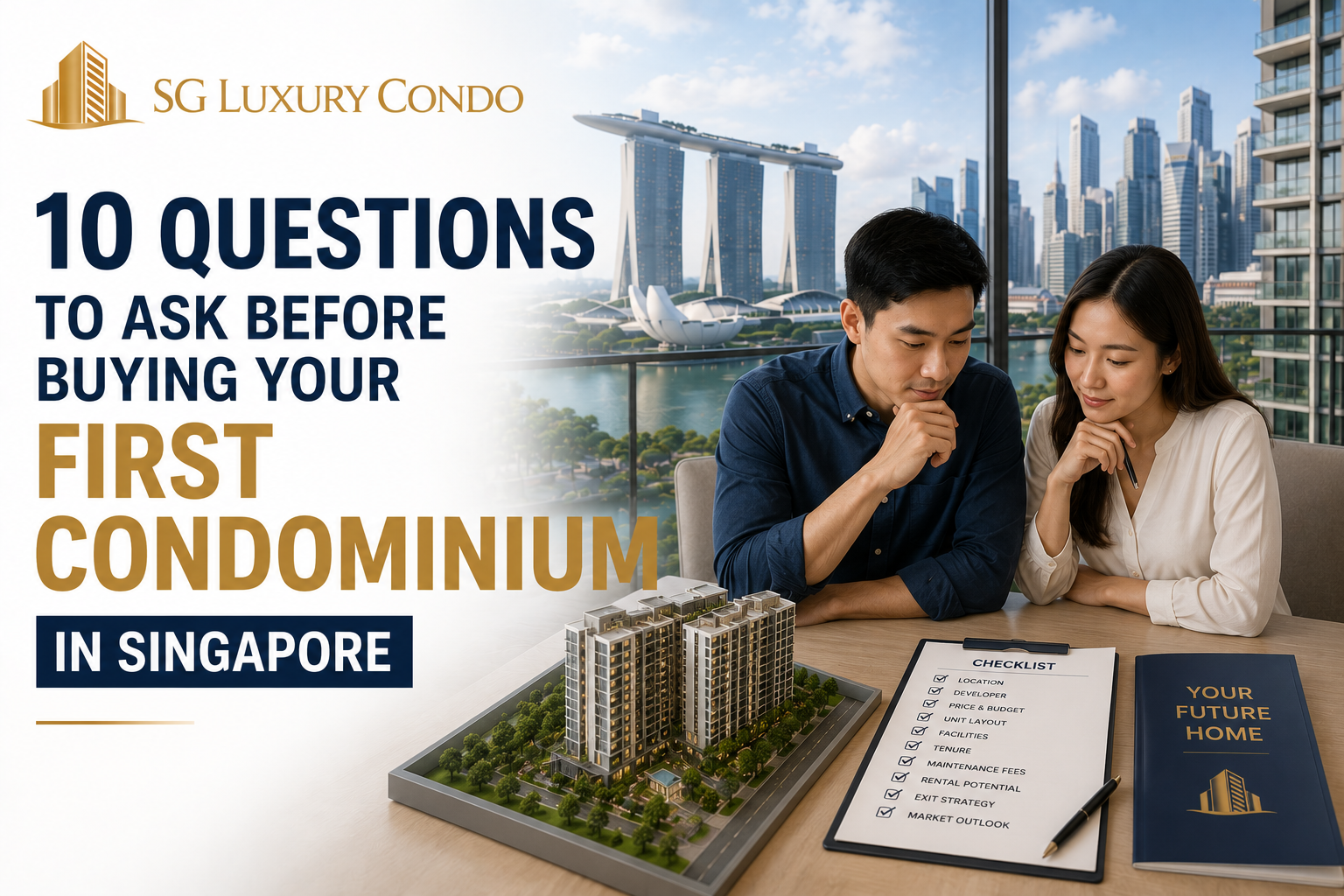
Excited to finally buy your first condominium? That’s genuinely one of the best feelings in this whole process, right up until the actual decisions start piling up. Freehold or leasehold. EC or private. New launch or resale. Before you rush off to the next showflat and put down a booking fee, it’s worth pausing on a proper set of questions to ask before buying your first condominium, because getting these right upfront saves you from a much more expensive lesson later.
This is an expanded update to our earlier piece, which covered three of these questions well but left out a fair bit that first-time buyers genuinely need to think through. Here’s the fuller set of questions to ask before buying your first condominium.
1. Freehold or 99-Year Leasehold?
Your preferred location often decides this one for you before you even get a choice. Some areas, Punggol, Sengkang, Tampines in the east, Jurong West, Jurong East, and Choa Chu Kang in the west, have no freehold condominiums at all. Anything built above an MRT station or on reclaimed land, like developments around Marina Bay or above Bukit Panjang MRT, is state land and only ever comes as 99-year leasehold.
Freehold stock, by contrast, clusters heavily in traditional prime districts 9, 10, and 11, Orchard Road, Holland Road, Draycott Park, and Nassim Road among them. Less than 50% of Singapore’s private housing is freehold overall, so if tenure matters a lot to you, your location options actually narrow fast.

2. Executive Condominium or Private Condominium?
Once location’s roughly sorted, this is usually the next fork. Private condos are fully privately owned, with common facilities co-owned by all unit holders. ECs sit somewhere between public and private housing, developed by private developers but with land costs subsidised by the government, which is why ECs typically run about 25% cheaper than comparable private condos.
Executive Condominium | Private Condominium | |
Price | Roughly 25% below comparable private condos | Full market price |
Minimum Occupation Period | 5 years before you can sell or rent out the whole unit | None |
Eligibility | Singaporean, income ceiling applies, first-timer priority | Open to citizens, PRs, and foreigners |
CPF Housing Grant | Up to $40,000 for eligible first-timers | Not applicable |
Long-term value | Privatises after 10 years, becomes fully private | Value doesn’t diminish due to MOP restrictions |
If you’re buying primarily as a family home and meet the income and eligibility criteria, ECs offer a genuinely attractive entry point. If you’re buying for investment flexibility, no MOP, no income ceiling, easier to sell or rent immediately, private condos usually make more sense.
3. Can You Actually Afford It, Once Everything’s Counted?
This is where a lot of first-time buyers underestimate the real number. Beyond the sticker price, budget for:
- Buyer’s Stamp Duty, tiered from 1% on the first $180,000 up to 6% on amounts above $3 million
- Additional Buyer’s Stamp Duty, if you already own property or fall outside the 0% first-property citizen rate
- Downpayment, minimum 5% cash if you’re under 65 with a loan tenure under 30 years, rising to 10% cash if you’re older or the tenure stretches longer
- Legal fees, typically $2,000 to $4,000
- Agent commission, not regulated by law, so always confirm the rate with your agent upfront, typically 1% to 2% if you’re the seller
Private condos can’t be paid for using CPF housing grants, and there’s no HDB subsidy involved, so your financing options are essentially cash plus a bank loan. ECs, on the other hand, may qualify eligible first-timers for up to $40,000 in CPF Housing Grants. Our mortgage affordability calculator works out your realistic loan ceiling based on your actual income and existing debt before you commit to anything.
4. What’s Your Exit Strategy?
This is one of the questions to ask before buying your first condominium that a lot of buyers skip entirely, mostly because it feels premature when you haven’t even bought yet. SG Luxury Condo brings this up early with every first-time client for exactly that reason. Knowing roughly whether you’re planning to hold for 3 years, 10 years, or indefinitely genuinely shapes which unit and tenure suits you best. A short hold makes Seller’s Stamp Duty a real risk if you sell within 4 years. A longer hold makes tenure and lease decay matter more, since a 99-year lease loses value more noticeably once you’re past the 60-year mark.
5. How Might the Surrounding Area Change?
A condo doesn’t exist in isolation from its neighbourhood. Check the URA Master Plan for any confirmed rezoning, upcoming MRT lines, or major developments planned nearby, these can meaningfully shift both your living experience and the property’s future resale value, for better or worse.
6. Is This for Own Stay or Investment?
Your answer here changes almost every other decision on this list. Buying to live in favours layout, school proximity, and personal lifestyle fit over pure yield numbers. Buying purely as an investment shifts the priority toward rental demand, unit size, and how quickly you could resell if your plans change. Trying to optimise for both at once, without acknowledging the trade-off, is one of the more common first-time buyer mistakes.
7. What’s the Developer’s Track Record?
Especially relevant if you’re eyeing a new launch. A developer’s history on past projects tells you a lot about build quality, how promptly defects get resolved after TOP, and how well the estate is likely to be managed for years afterward. Don’t rely on brand name alone, even reputable developers occasionally deliver a disappointing project through a subpar contractor.
8. How Much Space Do You Actually Need?
It’s tempting to buy for today’s needs alone, but a first condominium often needs to accommodate a few years of life changes, a growing family, a work-from-home setup, ageing parents visiting more often. Weigh this against your budget honestly, since overbuying on space you won’t use for years ties up capital that could otherwise go toward a better location or a stronger investment.
9. Are You Actually Eligible to Buy?
A basic but easy-to-overlook check. Confirm your citizenship or PR status against the specific property type you’re considering, EC eligibility comes with an income ceiling and first-timer requirements that private condos don’t have. If you’re a foreigner, confirm which property types are open to you without special approval.

10. Have You Lined Up a Lawyer and Financing?
Getting an In-Principle Approval from a bank before you start seriously viewing units tells you your real budget, not a hopeful estimate. Engaging a conveyancing lawyer early means you’re not scrambling to find one once you’ve already secured an Option to Purchase with a tight exercise deadline looming.
A Word From SG Luxury Condo
Buying your first condominium is genuinely one of the biggest financial decisions most people make, and it’s not something to rush through on excitement alone. SG Luxury Condo has walked enough first-time buyers through this exact list to know it works. Working through these ten questions to ask before buying your first condominium properly, tenure, property type, affordability, exit strategy, location, purpose, developer, space, eligibility, and financing, before you fall in love with a specific unit puts you in a far stronger position than most first-time buyers find themselves in.
If you’d like to go through this list with someone who does it every day, SG Luxury Condo is happy to walk you through it. Our property consultation sessions cover exactly this kind of first-time buyer groundwork, and our guide on how to avoid ABSD legally is worth a read if you already own property elsewhere. You’re also welcome to browse our full range of luxury condos for sale in Singapore once you’ve worked through your priorities.