Let’s talk about the number that stops a lot of Singaporean property dreams in their tracks.
You’ve found the condo you want. You’ve done the TDSR math. Your CPF is ready. And then someone drops the ABSD figure on the table — and suddenly you’re looking at an extra S$250,000 to S$400,000 on top of an already significant purchase price.
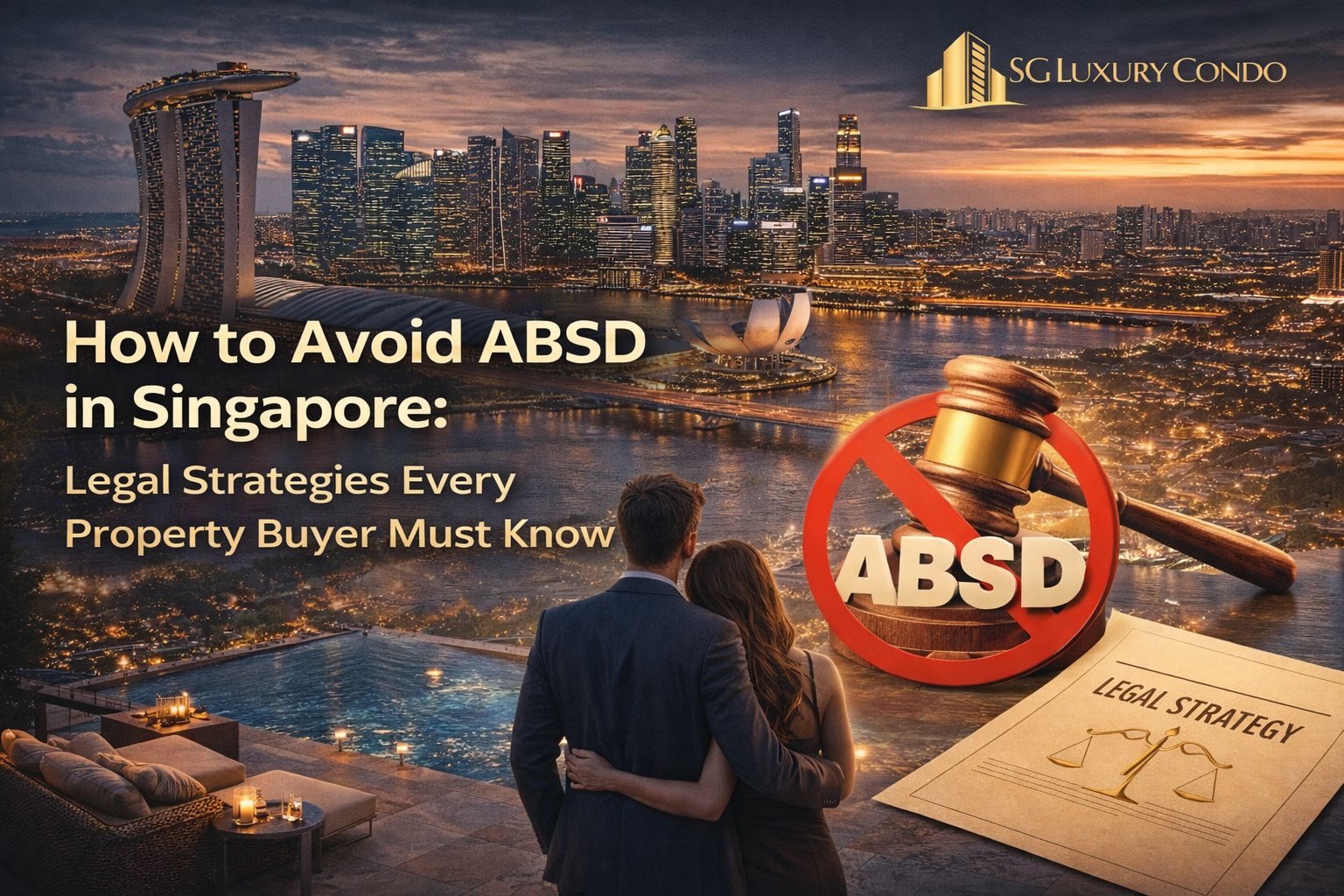
That’s the reality of Additional Buyer’s Stamp Duty Singapore buyers face in 2026. And if you’re reading this, you’re asking one very reasonable question: Is there? This is exactly how to avoid ABSD in Singapore legally. The answer is yes — but it requires planning, the right structure, and proper advice.
Understanding the guidelines set by the Inland Revenue Authority of Singapore (IRAS) is absolutely critical when exploring legal ways to avoid Additional Buyer’s Stamp Duty in Singapore. Get it wrong, and you’re not just paying ABSD — you’re facing a 50% surcharge penalty on top of it. Get it right and you could save hundreds of thousands of dollars, completely legally.
This guide breaks down every legitimate ABSD exemption Singapore strategy available in 2026.
What Is ABSD in Singapore?
Additional Buyer’s Stamp Duty (ABSD) is a property tax levied on top of the standard Buyer’s Stamp Duty on certain residential property purchases in Singapore. It was introduced in 2011 as one of Singapore’s property cooling measures, designed to moderate investment demand and keep housing affordable for genuine owner-occupiers.
Since its introduction, ABSD rates in Singapore have been revised upward multiple times — most significantly in April 2023, when rates were sharply increased across all buyer categories. These rates remain fully in force in 2026.
2025 ABSD Rates:
Buyer Profile | 1st Property | 2nd Property | 3rd & Beyond |
Singapore Citizen | 0% | 20% | 30% |
Singapore PR | 5% | 30% | 35% |
Foreigner | 60% | 60% | 60% |
Entities / Trusts | 65% | 65% | 65% |
Three things every buyer must know about ABSD rules Singapore:
ABSD is calculated on the higher of the purchase price or market value — not just your offer price. If you pay S$1.2 million but the valuation is S$1.25 million, ABSD applies on S$1.25 million.
ABSD must be paid within 14 days of signing the Sale and Purchase Agreement in Singapore, or within 30 days if signed overseas. No deferment. No instalments. Late payment attracts a penalty of 4 times the unpaid duty amount under the Stamp Duties Act.
ABSD applies to all residential properties — HDB flats, private condos, landed homes, and Executive Condominiums. It does not apply to purely commercial or industrial properties.
Do Singapore Citizens Pay ABSD on Their First Property?
No. Singapore Citizens pay 0% ABSD on their first residential property. This is one of the most important distinctions in Singapore property tax rules — the framework is specifically designed to support first-time Singaporean homeownership while managing investment demand.
Singapore PRs pay 5% ABSD on their first property. Foreigners pay 60% on their very first purchase — a rate that has significantly cooled foreign buying activity since 2023.
ABSD kicks in for Singapore Citizens from the second property onwards — at 20% for a second property and 30% for a third and beyond. This is where the second property tax Singapore planning becomes critical, and where the strategies below become most relevant.
6 Legal Ways to Avoid ABSD in Singapore
Strategy 1: Sell One, Buy Two — The Upgrader’s Clean Slate
This is the most commonly used method to avoid ABSD Singapore — and for good reason. It’s clean, fully legal, and highly effective.
The approach is simple: sell your existing property first, then use the proceeds to purchase two separate properties simultaneously — one for your own stay, one for investment. Since both you and your spouse enter each transaction with zero property count, both purchases are treated as first properties. Zero ABSD on both.
The inconvenience is real — you need temporary accommodation between selling and buying. Some couples stay with family; others rent short-term. But when you consider that 20% ABSD on a S$1.5 million property is S$300,000, a few weeks of inconvenience pays off enormously.
This is the strategy James Lim at SG Luxury Condo most frequently structures for upgrader clients, particularly those transitioning from HDB ownership into two private condos simultaneously.
Strategy 2: Decoupling — How to Reduce ABSD Without Selling
Decoupling property Singapore is one of the most discussed additional buyer’s stamp duty strategies in the market — and one that requires very careful calculation before proceeding.
Here’s how it works: if a couple jointly owns a property, one partner transfers their share to the other. The transferring partner now has zero property count and can purchase a new property as a first-time buyer — no ABSD.
The transfer is not free. It triggers Buyer’s Stamp Duty on the transferred share, legal fees, and decoupling administrative costs. For a S$2 million jointly owned property, transferring a 50% share triggers BSD on S$1 million — approximately S$24,600. Add legal fees of S$3,000 to S$5,000 and administrative costs of around S$5,000. Total decoupling cost: roughly S$32,000 to S$35,000.
Compare that to 20% ABSD on a S$1.5 million second property — that’s S$300,000.
The golden rule of decoupling: it only makes sense if the total decoupling cost is less than the ABSD you’d pay on the new purchase. In most cases, the math works overwhelmingly in the buyer’s favour.
Important: You cannot decouple an HDB flat. The government removed this option in April 2016. Decoupling only applies to private properties.
Strategy 3: Purchase an Executive Condominium
This strategy is specifically for HDB owners wanting to upgrade without paying ABSD upfront.
ABSD for the second property technically applies when you buy a private condo while still owning an HDB. However, Executive Condominiums are classified differently — you can purchase an EC without paying ABSD upfront, provided you sell your HDB within 6 months of the EC receiving its Temporary Occupation Permit.
This gives you a clear, legal runway: buy the EC, wait for TOP, then sell your HDB within the 6-month window. The ABSD remission conditions are met without needing to produce hundreds of thousands in upfront cash.
The EC household income ceiling in 2025 remains S$16,000 per month, and new EC prices typically range from S$1.1 million to S$1.5 million — making this one of the most accessible ABSD-free upgrade paths for middle-income Singaporean families.
Strategy 4: Buy Property Under Trust for Your Children
If your long-term goal includes passing property assets to your children, trust property purchase Singapore is a strategy worth understanding — though one that demands proper legal guidance.
Under this structure, you purchase a property and place it in a trust for your children as named beneficiaries. Since the property legally belongs to the trust and not to you personally, it does not add to your residential property count.
However, critical considerations apply. From 9 May 2022, transfers of residential property into a living trust are subject to ABSD at the entity rate of 65% — unless specific ABSD remission conditions are met, including identifiable individual beneficiaries and a remission application submitted within 6 months.
The IRAS ABSD guidelines specifically state that IRAS can impose a 50% surcharge on the additional duty if it determines a transaction was structured primarily to avoid stamp duty. Intent matters. Structuring this incorrectly is one of the most expensive property mistakes possible in Singapore.
Children placed under trust property also cannot subsequently apply for an HDB flat. And no bank loan is available for trust properties — full cash payment is required.
Trust structures are not a loophole. They are a legitimate property ownership structure strategy when implemented correctly, with proper legal drafting and genuine estate planning intent. Never attempt this without an experienced property lawyer. SG Luxury Condo can refer you to preferred lawyers who have successfully executed trust structures under IRAS compliance.
Strategy 5: Buy a Dual-Key Unit
A dual-key condo is a single property title containing two self-contained living spaces — typically a main unit and a smaller studio or one-bedroom unit, sharing a common main entrance but with separate internal access.
Why this matters for how to avoid ABSD in Singapore: both units sit under one property title, meaning it counts as one property in your IRAS record — regardless of how many people are living in or renting the two spaces.
You can live in the main unit and rent out the studio unit, effectively functioning as two households while paying ABSD in Singapore on just one property. This is a smart, fully legal approach to buying a second property in Singapore without triggering the second-property ABSD.
Dual-key units are particularly popular among families planning multi-generational living arrangements and investors who want rental income without additional stamp duty Singapore property exposure. Availability is limited to select private developments. James Lim at SG Luxury Condo can identify current opportunities in the market.
Strategy 6: Switch to Commercial Property
This is the cleanest way of how to avoid ABSD in Singapore in terms of structure: commercial and industrial properties are entirely exempt from Additional Buyer’s Stamp Duty — full stop.
No ABSD in Singapore regardless of how many residential properties you already own. No ABSD for foreigners either. No Seller’s Stamp Duty restrictions. And rental yields on Singapore commercial properties typically run higher than residential.
For investors whose primary goal is income generation rather than residential ownership, commercial property is a genuinely underutilised tool for property tax planning in Singapore. The trade-offs are real — no CPF usage, lower LTV ratios of around 55%, and no residential occupancy — but for the right investor profile, it eliminates ABSD from the equation.
ABSD Remission: When Can You Get It Back?
The Inland Revenue Authority of Singapore provides ABSD remission in specific circumstances. Knowing these ABSD remission conditions can save you significant amounts:
Married couple first matrimonial home: If a Singapore Citizen and a foreign spouse jointly purchase their first home as their matrimonial property, they pay ABSD upfront at the foreigner rate (60%) and then apply for full remission, bringing effective ABSD to 0%. Marital status documentation and joint ownership are required for IRAS verification.
Upgrader remission: Singapore Citizens who purchase a second property while still owning a first can receive ABSD remission if they sell the first property within 6 months of the new purchase. ABSD is paid upfront and refunded after the sale is completed and verified by IRAS.
Senior citizen rightsizing: From March 2025, Singapore Citizen seniors who sell a higher-value private home and purchase a lower-value one may qualify for partial ABSD remission under specific conditions — a new relief targeting genuine downsizers.
FTA nationals: Under Singapore’s Free Trade Agreements, nationals and PRs of the USA, Iceland, Liechtenstein, Norway, and Switzerland are treated the same as Singapore Citizens for ABSD purposes — a significant advantage for qualifying foreign buyers exploring ABSD for foreigners’ Singapore strategies.
Joint Ownership and Married Couple Property Strategies
Joint ownership ABSD rules follow the highest-count owner in any transaction. If one spouse owns two properties and the other owns zero, a joint purchase is treated as if both own two — meaning 20% ABSD applies to the entire transaction.
This is why married couple property strategies in Singapore almost always involve sole-name purchases rather than joint names when building a property portfolio. Each partner’s property count is tracked independently by IRAS — allowing couples to build two separate property portfolios while managing ABSD exposure through careful property ownership structure planning.
Getting this sequencing wrong is one of the most expensive mistakes Singaporean couples make in property. Getting it right is exactly the kind of property tax planning that the team at SG Luxury Condo specialises in.
Plan Your ABSD Strategy Before You Make Your Next Move
How to avoid ABSD is not a question you should answer alone — or after you’ve already signed an OTP.
The best time to plan your ABSD strategy is before you shortlist properties. Before you know which unit you want. Because the structure — whose name it goes in, whether you decouple first, whether you sell or hold — determines everything else that follows.
At SG Luxury Condo, James Lim and his team have helped hundreds of Singapore buyers, upgraders, and investors structure their purchases to legally minimise Additional Buyer’s Stamp Duty Singapore exposure — saving clients anywhere from tens of thousands to hundreds of thousands of dollars in the process.
His proprietary Property P.L.U.S. System incorporates full ABSD analysis, CPF optimisation, property sequencing strategy, and long-term portfolio planning into every client consultation — completely free of charge.