
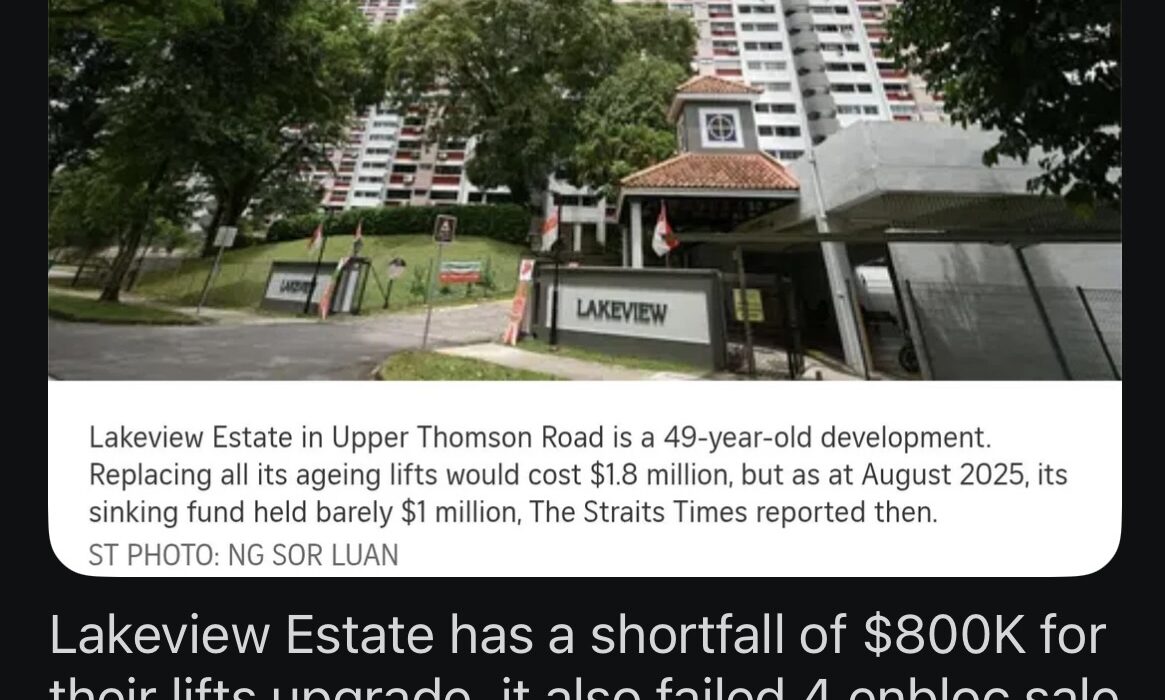
The Real Dangers of Buying an En Bloc Property in Singapore
By James Lim | SG Luxury Condo | Updated April 2026 | 10 min read
Buying a condo because it "might go en bloc" sounds like a shortcut to a windfall. For most HDB upgraders, it is one of the riskiest moves in Singapore property. In 2025, only two residential en blocs succeeded across the entire island. Here are the seven dangers you need to understand before committing.
- Most en bloc attempts fail. In 2025, only 2 out of the entire market succeeded.
- Rising GLS supply means developers have less reason to chase older condos.
- The process can trap your family in limbo for two to five years.
- You almost certainly overpay when buying an en bloc-rumoured condo.
- Corporate unit holders and dissenting owners can kill the deal.
- Living in an ageing building while you wait carries real hidden costs.
- When it succeeds, replacement costs and ABSD may eat your payout.

Every few years, Singapore's property market heats up and the word 'en bloc' starts spreading through WhatsApp groups. Stories of ordinary condo owners collecting million-dollar cheques make headlines. Friends of friends walk away with life-changing sums. The en bloc sale of the freehold Tulip Garden in 2018 netted some owners between $4.3 million and $7.6 million per unit. It is the kind of story that sticks.
So naturally, some buyers start looking for 'potential en bloc' condos to buy into — hoping to ride the same wave. Property agents sometimes encourage this. "Don't worry," they might say, "older properties mean more en bloc potential." That is how some buyers end up with 40-year-old properties they struggle to sell when the en bloc never comes.
Buying a property specifically because it might go en bloc carries serious risks that most people underestimate. Especially if you are an HDB upgrader stepping into private property for the first time. Let us walk through each risk honestly — using real data from Singapore's market in 2024 and 2025.
What Does 'Buying an En Bloc Property' Actually Mean?
An en bloc sale (formally called a collective sale) is when the majority of owners in a strata development agree to sell the entire development to a single buyer — usually a developer — at once. For private condominiums over ten years old, at least 80% of owners by share value and strata area must consent. Developers pay a premium over market rate because what they are really buying is the land, which they plan to redevelop into a higher-density project.
When a buyer targets a “potential en bloc” property, they are not buying for the home itself. They are betting that enough neighbours will agree to sell, that the Strata Titles Board will approve it, that a developer will bid above the reserve price, and that all of this will happen before their own finances need to move on. That is a lot of dominoes to fall in the right order.
Risk 1: The En Bloc May Never Happen — and 2025 Proves It
En bloc attempts fail far more often than they succeed. In the whole of 2025, only two residential en bloc sales went through in Singapore: Chiku Mansions and River Valley Apartments — both freehold developments over 40 years old. That is it. Out of hundreds of older condos in Singapore, two crossed the finish line.
The bigger structural problem is that developers now have a far easier option: Government Land Sales. The government has been deliberately ramping up GLS supply. As of the second half of 2025, the confirmed GLS list yielded around 4,725 private housing units, with the total annual pipeline exceeding 9,200 units. For developers, GLS tenders offer clearer planning parameters, transparent bidding, and a fixed launch timeline of about 15 months — versus the uncertainty of wrangling 80% owner consent in an en bloc. When GLS land is available, developers simply do not need to bother with the complexity of a collective sale.
Reaching the 80% consent threshold is itself a significant hurdle. Owners have different financial needs, ages, and life plans. Some have lived in the development for decades and do not want to leave. Others are investors with unrealistic price expectations. And then there are corporate unit owners — companies that purchased for investment — who are generally not interested in selling collectively at all. If a development has 50 units and corporations own just 12, hitting 80% can become nearly impossible.
Pine Grove attempted an en bloc sale five separate times starting from 2008 before eventually abandoning the effort. Some developments have been 'about to go en bloc' for over a decade. If the agent is pitching en bloc potential as a selling feature, ask: how many attempts have already failed?
Risk 2: You Could Be Stuck in Limbo for Years
Even a successful en bloc sale takes years to complete. From the first extraordinary general meeting to the day you receive your cheque, you are looking at a minimum of two years — often three to five. During that time, you cannot renovate meaningfully, you cannot make major financial decisions around the property, and your life plans are effectively on hold.
For HDB upgraders, this is especially painful. You have already committed your CPF savings and your borrowing capacity to this purchase. Your children’s school enrolment choices, your workplace proximity, your retirement planning — all of these depend on where and how you live. Years of uncertainty is not a minor inconvenience. It is a disruption to your whole family’s trajectory.
Industry observers note that many successful en bloc sales took three separate attempts to go through. The first two times usually failed because of owners’ unrealistic price expectations or unfavourable market conditions. That means some developments spent ten or more years in collective sale discussions before anything happened. During all that time, residents were living with uncertainty and watching their building’s maintenance and morale slowly decline.
If you are buying your first private property as an HDB upgrader, your priority should be a home that works for your family right now — not a bet on what might happen in three to five years. Stability of tenure matters more than speculative upside at this stage of your property journey.
Risk 3: The Building Deteriorates Around You While You Wait
Here is a risk most people overlook. When a condo is in active en bloc discussions, maintenance spending often stalls. Management committees hold off on major repairs, expecting the whole building to be torn down soon. But if the sale fails — or drags on for years — residents are left in a building that has been neglected, with a depleted sinking fund and no easy way to fund urgent repairs.
Take Loyang Valley as a real example. The development’s third collective sale attempt, which closed in September 2025, received expressions of interest but no firm bids. As reported by The Straits Times, the ageing swimming pool, landscaping, roofing and piping all now need refurbishment — with maintenance fees having been held flat for two years during the sale push. Residents now face a fee increase to be announced at the next AGM.
More than 1,000 of Singapore's approximately 3,750 private residential developments are now at least 30 years old — a number expected to rise to 1,160 by 2035 if none go en bloc (ERA Singapore data). As these buildings age, they face deteriorating infrastructure, insufficient sinking funds, and resistance from owners to pay special levies for major repairs. This is the building you may be buying into.
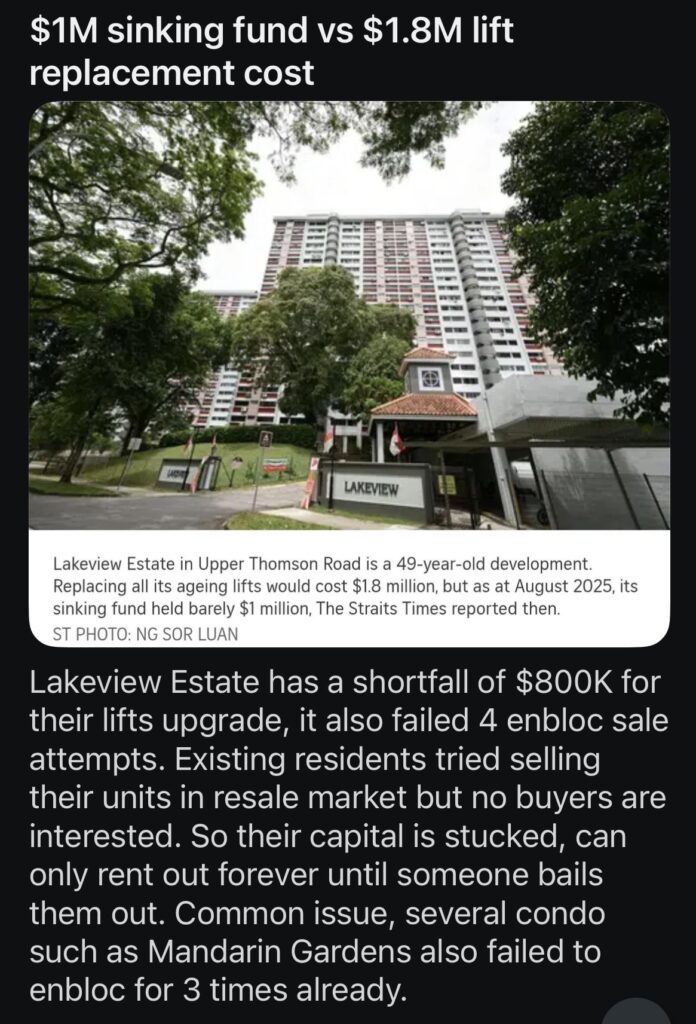
Older condos with 30-plus years of wear typically need electrical and plumbing system replacements, roof refurbishments, lift overhauls, and pool restorations — all expensive. Buyers of older condominiums should always check the MCST’s audited financial statements to understand the sinking fund balance and any history of special levies. A thin fund in an ageing building is a direct financial risk to you as the new owner — regardless of what happens with the en bloc.
Always request the MCST's audited financial statements before buying an older condo. A thin sinking fund in an ageing building means you could face a special levy bill — on top of your mortgage — not long after you move in.
Risk 4: You Are Probably Overpaying on Entry
The moment a development becomes known as a potential en bloc target, buyers start paying above its real market value. This 'en bloc premium' reflects the hope of a future payout. As property analysts note, the profit margin may be lower for every subsequent buyer as the development ages — because each new buyer enters at a higher en bloc-inflated price while the payout formula remains roughly fixed.
The psf price you pay on the secondary market may already reflect an en bloc premium of 15% to 30% above what the unit would otherwise fetch based on its age and condition. If the en bloc fails, you are left holding an overpriced, ageing condo with a limited pool of resale buyers — because most buyers in their right mind are not keen on a 35-year-old building with a cloudy en bloc history and stalled maintenance.
Ageing condos with strong en bloc potential sit on large freehold or 999-year leasehold land, have low plot ratios, and are in districts with strong redevelopment demand. These factors make the land genuinely valuable to a developer. But “valuable to a developer” and “good value for you as a buyer and occupant” are two entirely different things.
Risk 5: Minority Owners and Corporate Holders Can Block the Sale
Singapore’s collective sale legislation is designed to protect dissenting minority owners. Any owner who does not sign the Collective Sale Agreement can file an objection with the STB once the application is submitted. Common grounds include the sale proceeds being less than their unit’s estimated market value, an inequitable distribution method, or a lack of good faith in the process.
Beyond individual dissenters, corporate unit owners are a hidden risk that many buyers do not think about. Companies that purchase units for investment typically do not want the hassle of relocating or finding an alternative property. They did not buy for en bloc purposes, and they often vote against it. If a development has a significant number of corporately held units, the 80% threshold may simply never be reachable — regardless of how many individual residents want to sell.
Ask your agent to pull the development's ownership records. If a significant portion of units are registered under company names, treat this as a red flag. The STB's published decisions database also shows which past objections succeeded — and how long they dragged proceedings out. You can check STB decisions on the SLA website at sla.gov.sg.
Risk 6: Even If It Succeeds, Replacement Costs Have Surged
When your en bloc sale goes through and you collect your payout, you still need somewhere to live. URA data from January to July 2025 shows that the median price of newer leasehold condos under five years old was $2,479 psf — 122% higher than the $1,115 psf median for condos that are 40 or more years old. That is more than double. Your payout buys far less new home than it appears on paper.
Consider this scenario. You buy into a potential en bloc condo at $1.5 million. Three years later, the sale goes through and you receive $2 million. That sounds like a $500,000 gain. But to buy a comparable newer home in a similar location, you may now need $2.4 million or more — because the psf of newer condos has moved sharply higher. Your windfall has not kept pace with what it actually costs to replace your home.
This replacement-cost trap is especially acute because en bloc activity tends to cluster in property bull markets, which is precisely when new home prices are at their highest. The two cycles reinforce each other in the worst possible way for the homeowner who needs to buy again.
Some owners who received en bloc payouts in 2018 discovered that the proceeds were barely enough to buy a comparable unit in a new development nearby. After factoring in moving costs, interim rental, agent fees, and legal fees, some came out financially flat — after years of disruption. Always ask your agent to model the full replacement cost, not just the headline payout number.
Risk 7: ABSD Complications Can Turn a Profit into a Loss
If you buy a replacement private property before your en bloc sale is legally completed, you are purchasing a second property — which means ABSD applies. As of April 2023, Singapore Citizens pay 20% ABSD on a second residential property. For a $2 million replacement home, that is $400,000 in ABSD alone. The en bloc timeline is not in your control, and that timing mismatch can be extremely costly.
The government does offer an ABSD remission for married couples where one spouse is a Singapore Citizen, but the conditions are strict: you must sell your current home within six months of completing the replacement purchase. In a collective sale, completion dates are set by the developer, not you. STB hearings and court challenges can push your timeline off by months. Buyers who miscalculate this timing have paid hundreds of thousands of dollars in unexpected ABSD.
High property prices and elevated ABSD rates have been identified as one of the key reasons en bloc activity has slowed — because owners who receive payouts face very high re-entry costs into the market. Fewer owners want to sell, consent is harder to gather, and more attempts fail. For a full breakdown of ABSD rates and how they affect your upgrade calculations, read our complete ABSD guide.
| Scenario | Profile | ABSD Rate | Risk Level |
|---|---|---|---|
| Buy replacement BEFORE en bloc completes | SC, 2nd property | 20% | High |
| Buy replacement AFTER en bloc completes | SC, 1st property (sold) | 0% | Timing-dependent |
| Married couple, sell within 6 months | SC + SC, qualifying criteria | Partial remission | Medium |
| PR buyer seeking replacement | PR, 2nd property | 30% | Very High |
Who Should — and Should Not — Consider an En Bloc Property?
En bloc investing is not universally wrong. There are profiles for whom it can work.
It may suit you if: you already own multiple properties and are not dependent on this one as your primary home; your primary motivation is rental yield and en bloc is just a bonus if it happens; you are buying at a genuinely below-market price because the development is under the radar; you have a long investment horizon of five-plus years; and you have the financial resilience to carry the property through years of uncertainty and higher maintenance costs without stress.
It is likely wrong for you if: this is your first or only private property; you are an HDB upgrader who has stretched financially to make this purchase; you need housing stability for your children’s schooling or your own workplace; you have little buffer for special levies or unexpected maintenance costs; or your financial plan depends on a specific timeline for the payout.
Most HDB upgraders fall firmly into the second category. When you are making the biggest financial move of your life — stepping out of public housing into the private market — the goal should be a home that serves your family well right now, not a speculative bet on a process you cannot control. If you want to understand what a sound upgrade path looks like, read our guide on how HDB owners upgrade to private property in Singapore.
En bloc stories make great headlines. But for every owner who walked away with a windfall, there are dozens more who sat through years of failed attempts, lived in a deteriorating building, paid unexpected special levies, and eventually sold on the open market at a loss relative to what they paid. With only two successful residential en blocs in all of 2025 — and GLS competition reducing developer appetite further — pick your property based on fundamentals: location, lease, facilities, and your family's actual needs.
Frequently Asked Questions
The success rate is low and falling. In all of 2025, only two residential en bloc sales were completed across Singapore — Chiku Mansions and River Valley Apartments, both freehold and over 40 years old. The government's ramped-up GLS programme, with over 9,200 potential units in 2025, gives developers a far less complicated route to land, reducing their appetite for complex collective sales. Many attempts fail to reach 80% consent; those that do may still be blocked at the STB or fail to attract bids above the reserve price.
Yes. Dissenting owners can file formal objections with the Strata Titles Board on grounds including inequitable distribution, good faith failures, or sale proceeds being below market value. Corporate unit owners are also a significant hidden obstacle — companies that purchased for investment are generally not interested in collective sales, and if they hold enough share value, they can prevent the 80% threshold from ever being reached. Always check ownership records before buying into a potential en bloc development.
From the first EOGM to completion, the process typically takes two to five years. The Collective Sale Agreement is valid for twelve months, after which a new vote may be needed if the sale has not closed. STB hearings and potential High Court appeals can add further time. Industry professionals note that many successful en bloc sales required three separate attempts spanning a decade or more before going through.
ABSD liability depends entirely on your timing. If you purchase a replacement property before the collective sale is legally completed, ABSD applies — at 20% for Singapore Citizens on a second property as of 2023. If you wait until after the en bloc is finished and you no longer own any property, your replacement purchase is treated as a first property with no ABSD. A partial ABSD remission is available for qualifying married couples who sell within six months of buying the replacement, but the conditions are strict and the en bloc timeline is not in your control.
For most HDB upgraders, no. The strategy requires overpaying on entry due to the en bloc premium, living in an ageing building with rising maintenance costs, enduring years of uncertainty with no guaranteed outcome, and then competing in a hot replacement market where newer condos cost over 122% more per square foot than the ageing stock you are selling. With only two successful residential en blocs in 2025 and GLS supply reducing developer land appetite, the odds of a successful payout are lower than popular perception suggests.
Not Sure If That Condo Is Worth the Risk?
Get a frank, no-obligation assessment of any property you are considering. James will walk you through the real numbers — en bloc track record, sinking fund health, replacement costs, and ABSD exposure.
WhatsApp James at 9138 5008No hard sell. Honest advice from a licensed Singapore property consultant.