
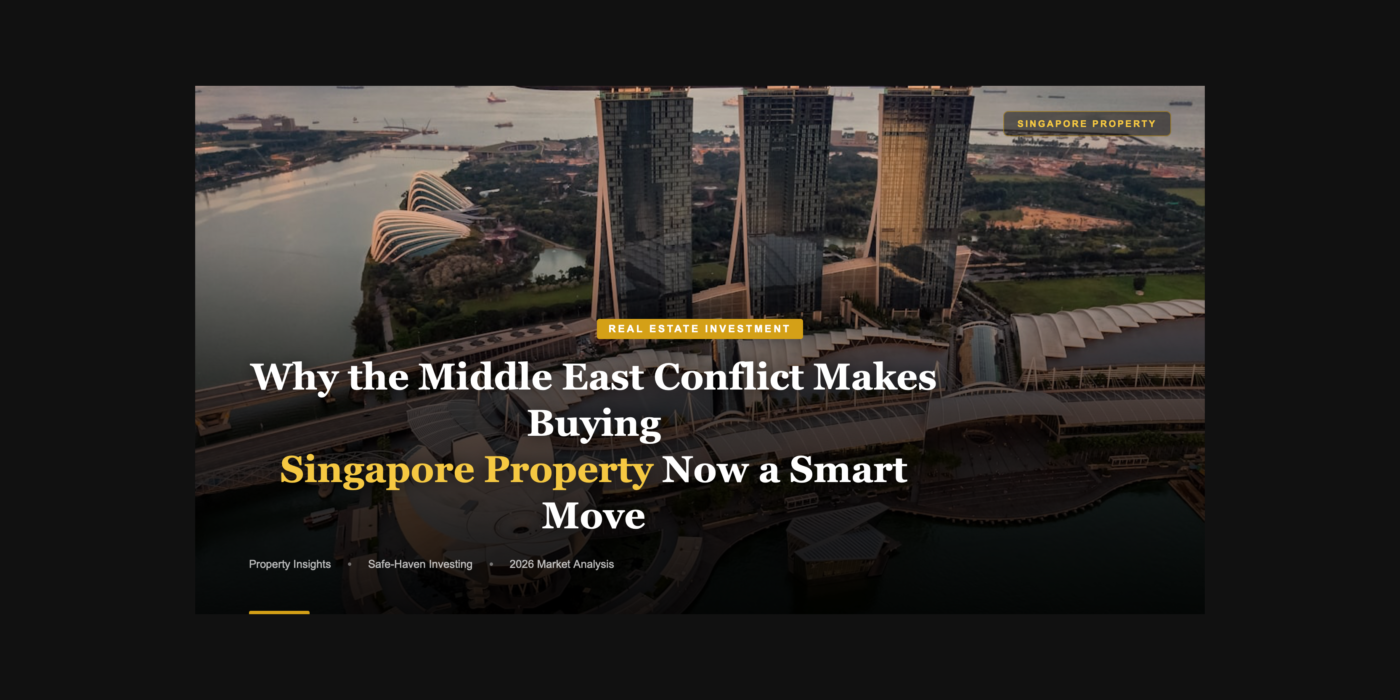
Why the Middle East Conflict Makes Buying Singapore Property Now a Smart Move
By SG Luxury Condo Team · March 2026 · 13 min read
📋 What You Will Learn
- How a Faraway Conflict Changes Your Property Decision
- Rising Construction Costs Will Drive Future Property Prices Higher
- Low Interest Rates Create a Rare Window for Buyers
- Singapore Is Asia's Ultimate Safe Haven for Capital and Families
- Supply Chain Disruption Is Tightening Future Housing Supply
- Singapore's Growing Population Means Demand Is Only Going Up
- The Bottom Line: Why Waiting May Cost You More Than Buying
How a Faraway Conflict Changes Your Property Decision
You might be asking: What does a conflict in the Middle East have to do with me buying a condo in Singapore? It is a fair question — and the answer is more direct than you might think.
In late February 2026, the United States and Israel launched joint air strikes against Iran, triggering a region-wide escalation that has effectively shut down the Strait of Hormuz — the narrow waterway through which roughly 20 million barrels of crude oil pass every single day. According to the World Economic Forum, Brent crude oil prices jumped about 15% in the opening days of the conflict, then surged to $120 a barrel as it deepened and the market began pricing in the risk of sustained disruption.
Oil and energy costs are embedded in almost everything used to build a home — steel, cement, aluminium, glass, transport, logistics. When oil prices spike and shipping routes shut down, building things gets more expensive. Developers pay more to construct your future condo. And eventually, they pass that cost to you. But the story does not stop at construction costs. The Middle East conflict is also reshaping where global capital flows, how Singapore is perceived as a home for both people and wealth, and whether the supply of new condos will keep up with the growing number of people who want to live here.
“Global uncertainty is not a reason to stop. For the right Singapore property buyer, it is a reason to think clearly — and act before the window closes.”
Chapter 1: Rising Construction Costs Will Drive Future Property Prices Higher
Construction is one of the most energy-hungry industries in the world. Steel requires enormous amounts of electricity. Cement kilns run on fuel. Aluminium smelters consume vast amounts of power. All of these are powered by the kind of energy that is now being priced with a war premium.
At the centre of the disruption is the Strait of Hormuz, the narrow waterway through which some 20 million barrels of crude oil pass daily. Escalation around the critical waterway has increased logistics risk, lifted war-risk insurance and bunker costs, and added a risk premium to crude oil and liquefied natural gas (LNG). These costs are now filtering through to construction input prices, as noted in a March 2026 report by global construction consultant Linesight.
In the first week of March 2026, crude futures jumped by nearly 22% as markets priced Gulf risk. Aluminium prices reached a four-year high on the London Metal Exchange. According to Baker McKenzie’s Global Disputes Forecast 2026, Asia’s dependency on Middle Eastern energy means disruptions pass through to power and transport costs, which in turn inflate material inputs such as steel, cement and fabricated components.
A condo that a developer prices at $1.8 million today was planned and costed before the current spike in material prices. The next wave of developments — those being designed, tendered, and launched over the next 12 to 24 months — will be costed with today’s elevated energy, steel, and aluminium prices baked in. That means higher launch prices for buyers who wait.
In Malaysia, housing contractors have already warned that the ongoing instability in global supply chains is making it difficult to provide accurate cost estimates during the early stages of a project, adding that this can lead to cost overruns, construction delays, and developers postponing or restructuring the launch of housing projects. What applies in Malaysia applies across the region — including Singapore.
Chapter 2: Low Interest Rates Create a Rare Window for Buyers
💡 What This Means for HDB Upgraders
If you are considering upgrading from your HDB flat to a private condo, the condos you are looking at today — especially new launches already under construction — were priced before the current energy cost spike. Waiting for "better deals" in 2027 may instead mean facing higher launch prices as developers reprice based on today's elevated construction costs. View our latest new launch listings to see current pricing before it changes.
SORA — Singapore’s benchmark home loan interest rate — has been falling steadily since its 2023 peak of over 3.5%. As of early 2026, SORA-linked home loan rates sit at approximately 1.1% to 1.5%. This gives you lower monthly mortgage repayments than at any point since 2021.
📊 What SORA Rate Movement Means for Your Monthly Payment
On a $1.35 million bank loan (75% LTV on a $1.8M condo) over 25 years:
At 3.5% (2023 peak): Monthly repayment ≈ $6,760
At 2.0% (stress test floor): Monthly repayment ≈ $5,720
At 1.3% (current SORA-linked rate, early 2026): Monthly repayment ≈ $5,150
*Illustrative figures only. Actual rates depend on bank package and individual credit profile. Bank stress tests use a floor rate of 4%.
Here is the nuance the Middle East conflict introduces: rising energy costs and potential supply disruptions will place upward pressure on inflation, either pushing it higher or preventing it from falling as quickly as expected. This means the current window of relatively low rates is not guaranteed to stay open indefinitely. If the conflict drives a sustained global inflation resurgence, central banks may have to pause or reverse rate cuts. The window of sub-2% SORA-linked mortgage rates may be shorter than it looks.
History shows that by the time it becomes obvious interest rates are rising, the window has already closed for most buyers. The time to lock in a loan at today’s rates is now, not after the inflation picture becomes clearer. Check out our complete HDB upgrade financing guide for a breakdown of how to structure your loan in today’s rate environment.
Chapter 3: Singapore Is Asia's Ultimate Safe Haven for Capital and Families
The Capital Inflow Is Already Happening
In 2025, Singapore’s three largest banks attracted a combined S$77 billion in net new wealth money. DBS reported S$39 billion in fresh inflows and OCBC added S$27 billion. The source is clear: ultra-high-net-worth individuals across Asia, particularly from China, India, and the Middle East, are moving assets out of perceived hotspots. The Iran-GCC conflict inflicted significant damage on the UAE’s infrastructure and civilian sites, directly undermining the Gulf’s reputation as a safe haven. Firms like JPMorgan and Partners Group have cancelled or relocated major investor gatherings from Dubai. When global wealth moves, it needs somewhere to land — and increasingly, a large portion of that capital is landing in Singapore real estate.
Huttons Asia CEO Mark Yip has said: “It would not be a surprise to see more wealth coming to Singapore and contributing to demand for properties.” This is because ultra-high-net-worth individuals want stability and low taxes.
Why Singapore Keeps Getting Chosen
| Singapore Advantage | What It Means for Property Owners |
|---|---|
| Political neutrality and stability | No risk of property confiscation or sudden policy reversal |
| Strong Singapore Dollar (SGD) | Your property value is denominated in a currency that holds its global value |
| English common law legal system | Transparent, enforceable property rights with no legal ambiguity |
| World-class financial infrastructure | Liquid market — you can sell when you need to |
| Low crime, excellent schools, healthcare | Consistent demand from locals and expats — supports rental yield |
| Consistent MAS regulatory framework | Cooling measures prevent speculative bubbles — no sudden market collapses |
ERA Singapore has documented the historical evidence: during the first Gulf War (1990–1991), Singapore’s Private Residential Property Price Index maintained its growth throughout the conflict and rose by roughly 160% over the following five years. During the Iraq War (2003–2011), the PPI rose by around 82.9% throughout the conflict. An upward trend in private property prices has been observed since the outbreak of the Russia–Ukraine conflict in 2022 as well.
The pattern is consistent: Singapore property does not crash during Middle East conflicts. It continues — and often accelerates — its long-term upward trend. Singapore’s stability makes it the natural beneficiary of the capital flight that follows every period of global uncertainty.
“Every major global conflict in the past 30 years has ended with Singapore property prices higher than when it started. That is not coincidence. That is structural advantage.”
💡 Explore Singapore's Top Condos
Browse our curated listings of Singapore's top private condos to see what your budget can unlock in today's market — from OCR family condos to CCR luxury residences that are seeing the strongest safe-haven interest from international buyers.
Chapter 4: Supply Chain Disruption Is Tightening Future Housing Supply
When construction costs rise sharply and supply chains become unpredictable, developers face a difficult choice: launch new projects at higher prices and risk slower sales, or delay launches until they have more cost certainty. Armed escalation across the Middle East has disrupted airspace and critical maritime corridors, notably the Strait of Hormuz and Red Sea/Suez, forcing costly rerouting of vessels and increasing war risk insurance and freight rates. According to Baker McKenzie, construction supply chains in the Gulf are already experiencing delivery delays, price volatility and repricing of non-energy cargo, with knock-on effects for Asia Pacific contractors dependent on these corridors.
Delayed New Launches
Developers who cannot accurately price steel, aluminium, and MEP components will delay project launches rather than risk selling at prices that do not cover their final construction cost. Fewer launches = fewer options for buyers = upward pressure on available units.
Extended Construction Timelines
When one stage slips — production, supply and delivery — the delay compounds on any project underway. The next wave of supply enters the market later than planned, stretching the gap between demand and available units.
Higher Replacement Cost of Existing Stock
When it becomes more expensive to build new properties, the replacement cost of existing ones rises. This puts a floor under resale prices — sellers of existing condos can justifiably ask for more, knowing that rebuilding today would cost significantly more than it did when the property was first constructed.
Singapore is a city-state with a total land area of just 733 square kilometres. There is no equivalent of suburban sprawl here. Every square metre of buildable land is finite, and the government tightly controls what gets released through the Government Land Sales (GLS) programme. Supply chain disruption slowing new completions, combined with tight land supply and rising construction costs that deter new launches, creates a perfect storm for constrained housing supply at exactly the moment when demand is rising.
You can explore currently available new launch condos on our listings page — properties priced and launched before the current cost spike, while supply is still relatively available.
Chapter 5: Singapore's Growing Population Means Demand Is Only Going Up
Population Growth: The Numbers from Singapore's Own Government
Singapore’s total population stood at 6.11 million as at June 2025, a 1.2% increase from June 2024. The annualised population growth rate of 1.5% over the past five years (2020–2025) was higher than the 0.5% over the preceding five-year period (2015–2020). The Non-Resident population stood at 1.91 million, an increase of 2.7% — this growing pool of employment pass holders and skilled professionals directly supports rental demand for private condos.
📌 Singapore's Population in Numbers (2025)
Total population: 6.11 million (record high)
5-year annualised growth rate: 1.5% per year
Non-resident population growth: +2.7% year-on-year
New PRs granted in 2024: ~35,264
New citizenships granted in 2024: ~22,766
Median household income: S$12,446/month — first time crossing $12,000 mark
Source: Singapore Department of Statistics (DOS), Population in Brief 2025; ERA Research, March 2026.
The Middle East Conflict Amplifies This Demand
When the Gulf becomes unstable — when Dubai’s reputation as a safe business hub is damaged by missile strikes on its infrastructure — Singapore is the natural destination for displaced wealth and displaced people. Multinational corporations often centralise operations in politically stable cities during uncertain times. Family offices, financial institutions, and regional headquarters that were based in Dubai are actively reviewing their presence and exploring Singapore as an alternative base. Every new high-income professional relocating from the Gulf to Singapore needs to live somewhere — and most will rent or eventually buy private property.
💡 What This Means for Your Rental Yield
The growing expat and non-resident population is a strong tailwind for rental demand. Current rental yields for OCR condos range from 3.5% to 4.5% per annum. See our guide on Singapore investment properties with strong rental yields to find the best-performing areas for income returns.
Chapter 6: The Bottom Line — Why Waiting May Cost You More Than Buying
| Factor | Current Situation | Implication for Buyers |
|---|---|---|
| 🏗️ Construction costs | Steel +22%; aluminium 4-yr high; tender inflation revised upward | Future condos will be launched at higher prices than today |
| 💰 Interest rates | SORA at ~1.1–1.5%, near multi-year lows | Monthly repayments cheaper now than in 12–18 months |
| 🏙️ Singapore safe haven | S$77B in new wealth inflows to SG banks in 2025 | More capital = more demand = sustained price floor + upward pressure |
| 🔗 Supply chain disruption | Strait of Hormuz effectively closed; shipping costs surging | Future supply tightening as demand rises |
| 👥 Population growth | 6.11M (+1.2%); 35K new PRs; $77B wealth migration to SG | More people need homes; rental yields and capital values supported |
Put these five forces together and a picture emerges: the cost of building a new condo will be higher in 2027 than in 2026. Supply may be tighter. And demand from both locals and arriving wealth is growing. The result of rising costs, tighter supply, and growing demand is higher prices.
History is the most convincing argument. Singapore property survived the Gulf War, the Asian Financial Crisis, SARS, the Iraq War, the Global Financial Crisis, COVID-19, and the Russia–Ukraine conflict. In every case, those who bought during the uncertainty and held for five or more years were rewarded. The Middle East conflict of 2026 will, in time, be another chapter in that same story.
⚠️ A Word of Balance
Not every scenario is positive. If the Middle East conflict leads to a prolonged global recession, Singapore's open, trade-dependent economy could face headwinds — and property market sentiment could cool in the short term. As always, buy within your means, maintain an emergency fund, and choose properties with strong fundamentals: good location, reputable developer, and the right size for your needs.
If you are ready to take the next step — whether exploring your upgrade options, understanding your CPF and financing position, or finding the right new launch for your budget — we would love to help. Browse our contact page to reach our team.
Find Out If Now Is the Right Time for You
Global market conditions are moving fast. Book a free, no-obligation consultation with our team and we will map out your personal upgrade timeline — your MOP, your finances, and the best options available right now.
Get My Free Property Consultation →