A lot of Singaporean buyers won’t even look at a 99-year leasehold unit. Freehold or nothing, full stop, like leasehold is some kind of consolation prize.
Here’s the thing though. We went and pulled the actual price data, and it tells a very different story than the one most people repeat at dinner parties.
TL;DR
- Freehold properties typically cost 15-20% more than comparable leasehold units, mostly because the government stopped selling freehold land ages ago.
- Higher price doesn’t mean higher returns. In several long-run comparisons, 99-year leasehold condos actually outgrew freehold ones.
- Rental yield tends to favour leasehold, since your rental income stays the same while your entry price is lower.
- Lease value barely erodes in the first 10-15 years. The steep decay only kicks in from around the 40-year mark onward.
- Freehold still wins for legacy planning and long holding periods past 15 years, plus certain foreign buyer segments lean freehold too.
- If you’re holding for under 12 years, the data leans leasehold. Past 15 years, freehold starts to make more sense.
The Six Things That Actually Separate Freehold and Leasehold
Buying a home comes with a dozen decisions stacked on top of each other, and tenure is one that gets debated way more than it probably should. So let’s actually break it down, properly, across the six areas that matter:
- Time limit on ownership
- Cost and long-term value
- Rental yield
- En bloc potential
- Loan and CPF restrictions
- Legacy planning
Freehold vs Leasehold: The Time Limit
Freehold means exactly what it sounds like. Free from hold. You own the unit and the land under it, with no expiry date attached.
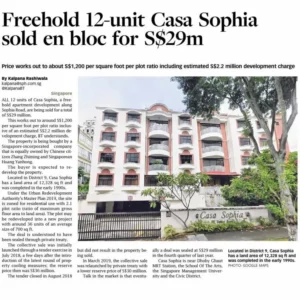
That said, “no expiry” doesn’t mean untouchable. The Singapore Land Acquisition Act, in place since 1966, lets the government reclaim your land for public projects like MRT lines, roads, or bridges. And if a developer wants your freehold building for a fresh redevelopment, an en bloc sale can still go through, provided enough of your neighbours agree to it. Casa Sophia, a freehold development, sold en bloc for $29 million, so freehold doesn’t put you outside that process at all.
Leasehold works differently. You own the unit for a set number of years, usually 99 in Singapore, occasionally 999 (a legacy structure that was more common decades ago and isn’t really used for new projects anymore).
Freehold vs Leasehold: Cost and Real Value
Freehold units generally run 15-20% pricier than equivalent leasehold ones. Simple supply issue really, the government stopped releasing freehold land a long time back, so what’s left is scarce, and scarce things cost more.
Here’s where most people get it wrong though: paying more doesn’t automatically mean the property is worth more, or that it’ll appreciate faster.
Location matters far more than tenure in most cases. An 80-year leasehold unit in a great district will usually out-value a freehold unit stuck in a quiet, out-of-the-way corner of Singapore. And when a freehold property happens to sit next to an MRT station with strong connectivity, good luck figuring out how much of that premium is actually the freehold status versus just the location.
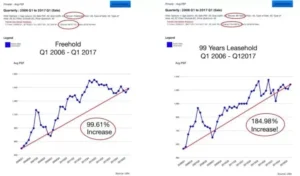
The data backs this up pretty clearly. Comparing average psf values of freehold versus 99-year leasehold properties from Q1 2006 to Q1 2017, both climbed, but leasehold rose 184.98% against freehold’s 99.61%. Roughly double.
Look at Scotts Square (freehold) next to The Orchard Residences (99-year leasehold) between 2007 and 2018. Orchard Residences gained 4%. Scotts Square actually dropped 17%.
Zoom out to a broader look at freehold versus leasehold private condos from 2010 to 2021, and leasehold appreciated 48.1% against freehold’s 29.74%.
Case Study: Stars at Kovan vs Tembusu
Two condos, launched around the same time, both a five-minute walk from Kovan MRT, similar unit counts. About as clean a comparison as you’ll find.
Stars @ Kovan (99-Year Leasehold) | Tembusu (Freehold) | |
2016 launch price | ~$1,400 psf | ~$1,500 psf |
Price growth (shorter holding period) | 17% | 3% |
That’s roughly a 5x difference in growth. If you’re holding over a shorter period, the data here is not subtle.
The same pattern shows up regionally too. Both the Rest of Central Region (RCR) and Outside Central Region (OCR) show leasehold outperforming freehold over comparable stretches.
But Freehold Does Win Sometimes
None of this means freehold never outperforms. Comparing freehold Leedon Residence against its leasehold neighbour D’Leedon (literally across the road from each other) from 2009 to 2020, Leedon Residence appreciated 12.86% versus D’Leedon’s 7.2%.
So tenure alone doesn’t decide the outcome. What actually seems to matter is timing, relative to how much lease decay has already happened.
Lease value barely moves in the first 10-15 years of ownership. A leasehold condo behaves almost identically to a freehold one during that window. The real drop-off starts showing up from around the 40-year mark, which is when the discount against freehold value widens sharply.
Put together: freehold costs more upfront, but that higher entry price doesn’t reliably translate into higher returns, particularly in the earlier decades of a lease.
Freehold vs Leasehold: Rental Yield
Rental yield is annual rent divided by what you paid. Lower entry cost, higher yield, assuming rent stays roughly the same.
And rent basically does stay the same. Tenants don’t pay less because your unit sits on a 99-year lease, and they won’t pay more just because yours happens to be freehold. Nobody asks about tenure before signing a lease.
So here’s the math. A $1,000,000 leasehold unit renting for $3,000 a month gives you a 3.6% yield. A freehold unit in the same area, priced 15% higher at $1,150,000, renting for the same $3,000, gives you 3.1%.
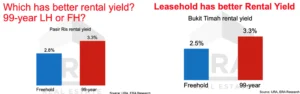
Real examples back this up. In Pasir Ris, freehold rental yield sits at 2.8% against 3.3% for 99-year leasehold. Bukit Timah shows the same pattern.
Makes sense once you think about it. Leasehold’s higher yield is basically compensation for owning a depreciating asset. You’re getting paid a bit more, in cash flow, for taking on the shorter runway.
Freehold vs Leasehold: En Bloc Potential
The common assumption is that freehold en bloc payouts should be bigger, since freehold owners are technically giving up more. Makes sense on paper.
Reality is messier. Zoning restrictions can cap what a developer’s allowed to rebuild, regardless of tenure, which drags the offer down even for freehold sites. Nearby infrastructure, upcoming MRT lines, new schools, retail, plays into a developer’s offer too. A freehold building surrounded by ageing, unimproved amenities can still get a mediocre bid.
Farrer Court, a 99-year leasehold development, sold en bloc in 2007 for $1.34 billion, still one of the largest collective sale prices on record, with residents walking away with over $2 million each.
Statistically, tenure doesn’t even show up as a significant predictor of en bloc success at the 5% level, though it does carry a large economic effect when a sale does go through. Translation: tenure influences the size of the payout somewhat, but it’s not the deciding factor in whether an en bloc succeeds at all.
Freehold vs Leasehold: Loan and CPF Restrictions
This is where leasehold quietly gets harder, and it’s easy to miss until you’re deep into financing.
If the remaining lease won’t outlast you until age 95, banks and HDB will cap your loan quantum below the usual maximum. Fall under a 20-year remaining lease, and CPF usage gets shut off entirely for that purchase.
CPF has its own rule on top: the buyer’s age plus the remaining lease needs to add up to at least 80 years. Leases sitting between 30 and 60 years remaining trigger a valuation limit on how much CPF you’re allowed to put toward the purchase.
Net effect, older leasehold units, particularly ones past the 40-year mark, end up with a smaller pool of financially qualified buyers, which drags resale prices down further. It’s part of why lease decay accelerates the way it does later in a lease’s life, fewer buyers can actually finance the purchase, not just that the asset is “worth less.”
What Happens When a 99-Year Lease Actually Runs Out?
This is the question that scares people the most, and honestly, most Singaporeans have never seen it play out because so few private leasehold developments have actually hit zero years yet.
Technically, when the lease expires, ownership reverts to the state and the land goes back to SLA (Singapore Land Authority) with no compensation owed to owners. That’s the textbook answer.
In practice, it rarely gets there. Most 99-year leasehold developments get identified for en bloc redevelopment or, in HDB’s case, are addressed through schemes like SERS long before the lease actually hits zero, precisely because an ageing, unsellable building with no CPF-eligible buyers left becomes a headache nobody wants to manage. That said, SERS is selective and not guaranteed, and plenty of older private leasehold estates simply ride out the decline in value with no redevelopment plan at all.
The realistic risk isn’t “the government seizes my flat overnight.” It’s a slower squeeze: shrinking loan eligibility, a thinner buyer pool, and declining resale value as the lease clock runs down, well before it ever reaches zero.
999-Year Leasehold vs Freehold: Is There Actually a Difference?
Barely, in practical terms. A 999-year lease is so long that no buyer, bank, or CPF rule treats it any differently from freehold. You won’t hit loan restrictions, CPF caps, or lease decay concerns within any realistic holding period.
The catch is supply. Very few 999-year leasehold developments exist today, since this tenure structure was mostly used decades ago and isn’t something the government issues for new land parcels anymore. If you do come across one, it behaves like freehold in every meaningful sense, just occasionally priced a touch below true freehold due to the label alone rather than any real legal difference.
Freehold vs Leasehold: Legacy Planning

If the plan is to hold a property for decades and eventually pass it to your kids or grandkids, freehold is the stronger pick, hands down. That’s precisely why older buyers tend to gravitate toward it, they’re thinking multi-generational, not just next decade.
Certain foreign buyer groups lean freehold too. Between January 2016 and August 2017, leasehold accounted for 71% of all transactions against 29% freehold overall. But that split shifts a lot depending on nationality: 40% of Indonesian buyers went freehold, 41% of American buyers, 50% of both British and Australian buyers, and 34% of Hong Kong buyers. Company purchases skewed freehold even harder, at 60%. Worth noting too that foreign buyers concentrate heavily in Districts 9, 10, and 11, which is exactly where I’d point buyers toward freehold over leasehold if that’s the profile you fit.
Freehold vs Leasehold: Quick Decision Table
Your Situation | Better Fit |
Holding under 12 years, chasing capital growth | Leasehold |
Prioritising rental yield | Leasehold |
Holding 15+ years, passing to family | Freehold |
Foreign buyer in D9, D10, or D11 | Freehold often preferred |
Tight loan/CPF budget, buying an older unit | Check remaining lease carefully either way |
So, Which One Should You Actually Buy?
If you’re chasing capital growth or rental yield over a holding period under 12 years, the numbers point pretty clearly toward leasehold. If you’re planning to hold past 15 years, especially with legacy planning in mind, freehold earns its premium.
Tenure is one input though, not the whole decision. Entry price, the specific development’s characteristics, remaining lease at time of purchase, and your own exit timeline all matter just as much, sometimes more.
If you’re weighing a specific freehold or leasehold unit and want the actual numbers run for your situation, our property consultation walks through entry price, expected holding period, and financing eligibility together. For a longer-term view, especially if legacy planning is part of your thinking, it’s worth speaking with a Singapore property investment advisor before you commit either way.
If you’re still comparing which type of unit suits your goals, our guide on which condo is good for investment and our look at Singapore’s luxury homes market both build on a lot of what’s covered here.
At SG Luxury Condo, we’ve watched enough of these comparisons play out in real transactions to know that “freehold is always better” is one of the more expensive myths a buyer can walk in believing. If you’re browsing luxury condos for sale in Singapore and want a clear-eyed read on tenure before you commit, we’re glad to run the numbers with you.