“Do you have any undervalued properties?” It’s probably the question we get asked most often at SG Luxury Condo, usually within the first five minutes of meeting a new client. It’s a fair question. Everyone wants to buy today’s price at yesterday’s discount, and honestly, who wouldn’t?
But here’s the thing most people get wrong. Cheap and profitable aren’t the same thing, and mixing the two up is exactly how buyers end up holding a property that ticked the “good deal” box but never actually made them money. Understanding the real difference between undervalued vs profitable properties is one of the most useful lessons a Singapore property investor can learn early, and it’s a conversation SG Luxury Condo has with nearly every client before they even start viewing units, so let’s break it down properly.
TL;DR: An undervalued property is priced below its actual market value or bank valuation, typically 5% to 15% lower. A profitable property is one that genuinely delivers strong returns over time, usually because it sits in a growth location with real demand behind it. These aren’t the same category. A property can be undervalued without being profitable, and a profitable property is sometimes not undervalued at all, it’s simply priced fairly for what it’s worth. When comparing undervalued vs profitable properties, the safer long-term bet is almost always the one with genuine growth drivers behind it, not just a lower sticker price.
What Is an Undervalued Property?
An undervalued property is one selling for less than its actual worth, meaning the asking or transacted price sits below its market value or bank valuation. Most industry practitioners consider a property meaningfully undervalued when it’s priced 5% to 15% below valuation. On a $2 million unit, that’s anywhere from $100,000 to $300,000 in potential savings, which explains why the phrase gets thrown around so much.
Undervalued properties tend to be older, and because of that, they often appeal to buyers chasing higher rental yield rather than capital growth, since the entry price is lower relative to the rent they can still command.
How to Spot an Undervalued Property
A few consistent signals show up again and again when a property is genuinely undervalued:
- It’s been sitting on the market a while. Difficulty selling is often the first clue, sellers lower their asking price to attract interest.
- Low transaction volume in the area. Thin transaction activity makes it harder for a property to find its “true” price, which can leave it undervalued relative to nearby comparables.
- A motivated or distressed seller. Someone who’s already committed to another property, is going through a divorce, or is facing financial pressure will often accept a below-valuation offer just to close quickly.
- Older age, typically 10 to 15 years plus. Older stock usually trades at a lower psf to begin with, which can compound into a genuine undervaluation if the surrounding area has improved since the building went up.
- A meaningful price gap versus a nearby new launch. If a resale unit nearby is priced 15% to 20% below a comparable new launch in the same postal district, that gap is worth investigating closely.
What Is a Profitable Property?
A profitable property is one that delivers a real return when you eventually sell it, or through rental income along the way. This is the metric that actually matters if wealth-building, not just a cheaper purchase price, is your goal.
How to Spot a Profitable Property
- Strong, consistent demand. When buyers are willing to pay at or above bank valuation, that pressure pushes future valuations up too, creating a positive cycle.
- A great or growth location. Central Region addresses, or fringe areas with a confirmed upcoming catalyst like a new MRT line or a URA rezoning, tend to outperform.
- Younger age, typically under 5 years. Newer projects usually see stronger initial demand, since buyers are willing to pay more for modern layouts, facilities, and specs.
- A real growth catalyst behind it, not just current sentiment. This could be a confirmed transport line, a masterplan rezoning, or a nearby transformation like a business district taking shape.
Undervalued vs Profitable Properties: Where People Get Confused
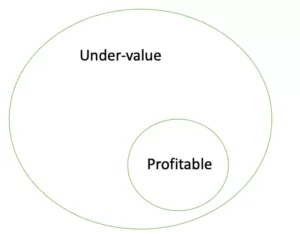
Here’s the misconception that trips up so many first-time investors. Buying something cheap feels like it should automatically be profitable. It isn’t, not necessarily. When you’re weighing undervalued vs profitable properties, remember this rule: an undervalued property is not always profitable, but a profitable property can sometimes also be undervalued, and that combination is the real jackpot when you can find it.
Undervalued Property | Profitable Property | |
Defining trait | Priced below market value or bank valuation | Delivers strong capital or rental returns over time |
Typical age | 10 to 15+ years | Usually under 5 years |
Typical location | Anywhere, including quieter or less popular pockets | Central Region or areas with a confirmed growth catalyst |
Why it’s priced that way | Distressed seller, low transaction volume, hard to sell | Strong demand, developer pricing strategy, first-mover advantage |
Main risk | Cheap for a genuine reason (poor condition, weak location, oversupply) | May already be priced close to full value, limiting further upside |
Best suited for | Rental yield seekers, patient renovators | Capital growth investors, those buying for long-term appreciation |
Just like you’d raise an eyebrow at a hawker stall selling food suspiciously cheap, it pays to dig into why a property is priced below valuation before assuming it’s a bargain. Sometimes it genuinely is undervalued. Sometimes it’s cheap because the area has stalled, the building is poorly maintained, or there’s simply no fresh catalyst in sight.
Two Real Case Studies
Numbers make this a lot easier to see clearly, so here are two comparisons worth studying.
Queenstown, 2015: The Queens vs Commonwealth Towers
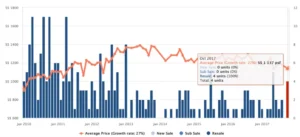
Back in 2015, resale project The Queens (completed 2002) was trading around $1,137 psf, comfortably below its 2014 peak of $1,400 psf, a textbook undervalued property on paper. Meanwhile, Commonwealth Towers, a Building Under Construction launch at the time, was selling at $1,600 to $1,700 psf, noticeably pricier.
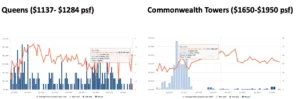
Fast forward to 2020: The Queens had crept up to roughly $1,284 psf, a 2.29% annualised return. Commonwealth Towers, despite its higher entry price, had climbed to around $1,950 psf, a 5.13% annualised return, more than double The Queens’ growth. The cheaper, undervalued option actually underperformed the pricier, profitable one.
Bartley, 2015-2020: Bartley Residences vs Botanique @ Bartley
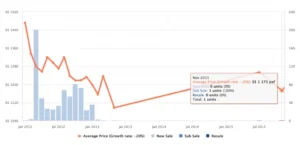
Bartley Residences, which had peaked at $1,480 psf, was trading around $1,173 psf by 2020, roughly 30% below its own past valuation. Across the road, Botanique @ Bartley by UOL sat at $1,300 to $1,400 psf, clearly the pricier option at the time.
Over that same window, Bartley Residences grew from $1,173 to $1,267 psf, a 1.48% annualised return. Botanique grew from $1,300 to $1,500 psf, a 3.07% annualised return, again, more than double.
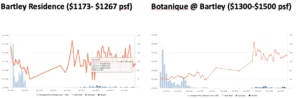
Both case studies land on the same lesson. The cheaper, more “undervalued” option looked like the smarter buy on paper, but the pricier, better-positioned option delivered the stronger actual return. That’s the undervalued vs profitable properties trade-off in its clearest form, and it’s a pattern SG Luxury Condo has seen repeat itself across dozens of similar comparisons since.
Where This Plays Out in Today’s Market
The same pattern shows up in current market discussions too. Analysts have pointed to areas like Jurong West, Woodlands, the Paya Lebar and Geylang fringe, Bayshore, and Tengah as pockets carrying genuine undervalued potential right now, each backed by a specific catalyst rather than just a lower price tag. Jurong West sits next to the Jurong Lake District’s ongoing transformation into a second CBD.
The Paya Lebar and Geylang fringe stands to benefit once the Paya Lebar Airbase relocation eventually lifts long-standing height restrictions nearby. Bayshore is riding the wave of a brand new estate taking shape around it.
The distinction matters here too. These aren’t cheap for no reason, they’re undervalued specifically because the market hasn’t fully priced in a confirmed future catalyst yet. That’s a very different situation from a property that’s cheap simply because nobody wants it. Our guide on using the URA Master Plan to navigate property investment goes deeper into how to spot these catalysts before the wider market catches on.
How to Actually Find Undervalued and Profitable Properties
For undervalued properties, a bank valuation is the traditional route, but it’s not the only option. EdgeProp Singapore lets you search specifically for undervalued listings and see exactly how far below valuation each one sits, which saves a trip to the bank. Comparing the price gap between a new launch and nearby resale stock in the same postal district is another reliable method, a gap of 15% to 20% or more is usually worth a closer look.
For profitable properties, the process is trickier, since you’re betting on future demand rather than reading a number off a valuation report. At SG Luxury Condo, we built our Property P.L.U.S System and 4 “P” framework specifically to help clients cut through this, weighing location, price trajectory, unit mix, and upcoming catalysts together rather than looking at any single factor in isolation.
So Which Should You Actually Buy?
It depends on your goal, and being honest with yourself about that goal matters more than the label on the property. If you’re chasing rental yield and you’re comfortable holding an older asset, a genuinely undervalued property can work well, provided you’ve confirmed why it’s cheap and you’re comfortable with that reason. If you’re building long-term wealth through capital appreciation, a profitable property with a real growth catalyst behind it, even at a fuller price, has historically outperformed the cheaper alternative in case after case.
The ideal outcome, of course, is finding a property that’s both undervalued and profitable, priced below its true worth today, with a confirmed catalyst that the wider market hasn’t fully appreciated yet. Those opportunities exist, but they take real digging to find, which is exactly why so many buyers end up settling for one half of the equation instead of both.
A Word From SG Luxury Condo
We’ve watched plenty of clients get tempted by a lower psf number, only to realise months later that the pricier alternative next door was actually the smarter buy. Understanding the real gap between undervalued vs profitable properties is one of the clearest ways to avoid that regret before you sign anything.
If you’re weighing a specific shortlist and want help figuring out which side of this equation a property actually falls on, SG Luxury Condo is happy to run the numbers with you. Our property consultation sessions cover exactly this kind of comparison, and if you’d rather avoid the common traps altogether, our guide on how to avoid unprofitable properties pairs well with this one.
You’re also welcome to browse our full range of luxury condos for sale in Singapore if you’re ready to start shortlisting.