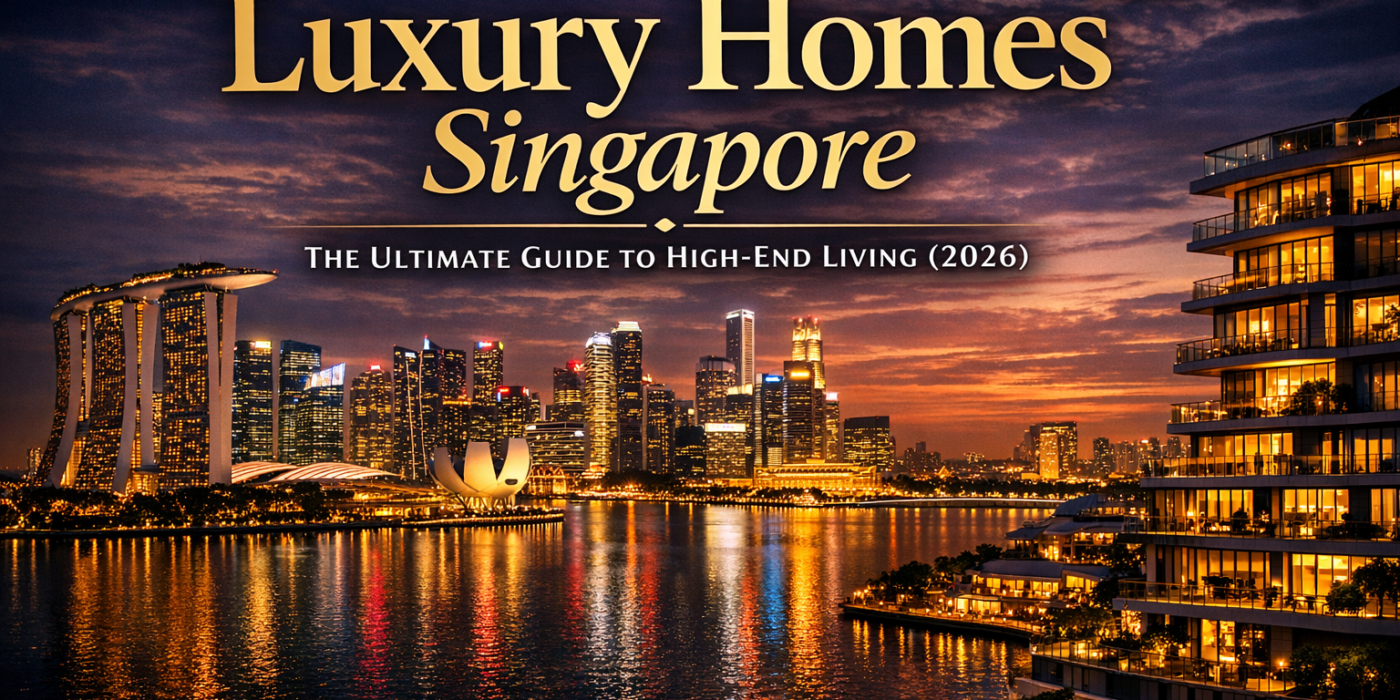
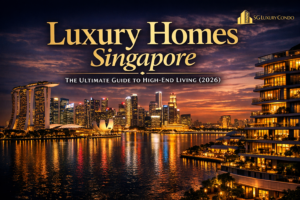
Luxury Homes Singapore.
CategoriesGuide tips & tricks

Luxury Homes Singapore: The Ultimate Guide to High-End Living (2026)

Luxury Homes Singapore: The Ultimate Guide to High-End Living (2026)

Explore luxury homes in Singapore — prime districts, property types, price ranges, foreign buying rules and 2026 market trends. Your complete guide by SG Luxury Condo.
Luxury Homes Singapore.

Table of Contents

Singapore stands in a league of its own when it comes to luxury living in Asia. From the gleaming towers of Marina Bay to the quiet, tree-lined boulevards of Nassim and Bukit Timah, luxury homes in Singapore represent the perfect convergence of architectural excellence, world-class lifestyle, and long-term investment strength.

At SG Luxury Condo, we have spent years helping discerning buyers navigate Singapore’s most exclusive residential developments. This guide is built on that expertise. We will walk you through what defines a luxury home in Singapore, where these homes are located, what types of luxury properties exist, how much they cost, who can buy them, and why Singapore continues to attract the world’s most sophisticated property buyers in 2026 and beyond.

What Defines a Luxury Home in Singapore?

The concept of luxury in Singapore’s real estate market has evolved far beyond expensive addresses and marble finishes. In 2026, a true luxury home in Singapore is defined by a combination of location prestige, architectural quality, lifestyle integration, technological sophistication, and long-term value preservation.

From a pricing perspective, properties transacting above SGD 5 million, or those priced at SGD 3,000 per square foot and above, are broadly considered to occupy the luxury bracket. Ultra-premium properties — super penthouses, full-floor apartments, Good Class Bungalows along Nassim Road — regularly trade at SGD 20 million, SGD 30 million, and beyond.

But price alone does not define luxury. The finest high-end real estate in Singapore is distinguished by the following characteristics:

Premium Architecture and Interiors: Luxury homes in Singapore are designed by internationally renowned architects and feature bespoke interiors with Italian marble, engineered timber flooring, floor-to-ceiling glazing, and designer kitchen systems from brands such as Miele, Gaggenau, and Sub-Zero. Every finish, every fitting, and every spatial proportion is the result of intentional design thinking rather than cost efficiency.

Smart Home Technology: The Singapore smart homes market is on a steep growth trajectory, projected to reach USD 7.90 billion by 2025, with smart home adoption having already surged to over 712,200 homes in 2024. In luxury developments, this translates to fully integrated living environments — automated climate control, biometric security systems, AI-powered energy management, and app-controlled home ecosystems that give residents seamless command over every aspect of their home.

Sustainability and Green Credentials: The conversation around luxury has evolved from a focus on opulence alone to a seamless integration of intuitive technology, personal well-being, verifiable sustainability, and impeccable service. Top luxury launches such as River Green — the first private residential development in Singapore to achieve BCA Green Mark Platinum Super Low Energy certification — demonstrate how sustainability has become a core marker of luxury status rather than merely a bonus feature.

Resort-Style Facilities and Services: Infinity pools, private wellness spas, sky terraces, concierge desks, private dining rooms, wine cellars, dedicated car parks, and 24-hour security are standard expectations at the luxury tier. The finest developments go further, offering hotel-style services including housekeeping arrangements, valet parking, and curated resident events.

Exclusivity and Privacy: Many of Singapore’s most coveted luxury developments are deliberately low-density — boutique projects of 30 to 100 units that prioritise privacy, personalised service, and a strong sense of community among like-minded residents.

Location in Prime Districts: Luxury homes in Singapore are almost always found within the Core Central Region, in postal districts that carry enduring prestige, strong connectivity, and proven capital appreciation track records.

Where Are Luxury Homes Located in Singapore?

Singapore’s luxury residential market is anchored within the Core Central Region (CCR) — the collection of prime postal districts that form the island’s most prestigious address zones. Understanding these districts is essential for any buyer seeking the finest high-end real estate Singapore has to offer.

District 9 — Orchard Road and River Valley

District 9 is Singapore’s most iconic luxury address. Orchard Road — the city’s world-famous shopping and lifestyle belt — runs through its centre, while River Valley offers a more intimate, village-like ambience lined with boutique restaurants, wellness studios, and the scenic Singapore River waterfront.

High-end condominiums in District 9 consistently command prices in the range of SGD 2,500 to SGD 3,500 per square foot, with notable luxury launches such as Klimt Cairnhill achieving an average of SGD 3,402 per square foot, and high-value resale transactions such as a unit at Hilltops in District 9 fetching SGD 13 million, demonstrating that buyers are willing to pay a premium for exclusivity and location.

Top luxury condo Singapore developments in District 9 include The Avenir, River Green, Cuscaden Reserve, Klimt Cairnhill, UpperHouse at Orchard Boulevard, and The Robertson Opus. The CCR recorded the strongest performance among all regions in 2026, with prices increasing 1.68% quarter-on-quarter and 8.28% year-on-year, driven in part by notable new launches such as The Robertson Opus, UpperHouse at Orchard Boulevard, and River Green.

District 10 — Bukit Timah, Nassim, Holland Village, and Tanglin

District 10 is the spiritual home of Singapore’s wealthiest families and most senior diplomats. This district carries a quieter, more private character than District 9, with lush greenery, generous land plots, and the highest concentration of Good Class Bungalows on the island.

Nassim Road and Cluny Road are among Singapore’s most coveted addresses, home to embassies, ultra-private residences, and some of the city’s largest remaining freehold land parcels. Luxury condos in District 10 — including The Nassim, Les Maisons Nassim, and Leedon Residence — regularly transact between SGD 2,800 and SGD 4,000 per square foot.

District 11 — Newton, Novena, and Bukit Timah

District 11 is a well-connected prime district that balances residential tranquility with easy access to Singapore’s medical hub, top international schools, and established lifestyle amenities. A notable recent GLS tender for a site near Newton MRT Interchange in prime District 10 attracted eight bids, with the top offer of SGD 566.29 million from HH Investment, reflecting the enduring competition for well-located land in Singapore’s prime residential corridor. Watten House by UOL Group is among the most discussed luxury launches here, offering a refined residential experience on Shelford Road. Prices in District 11 typically range from SGD 2,200 to SGD 3,200 per square foot.

District 1 — Marina Bay and Downtown Core

Marina Bay offers one of the most dramatic luxury living experiences in Asia. Positioned at the heart of Singapore’s financial district and overlooking the iconic Marina Bay Sands, Gardens by the Bay, and the open straits, condominiums here serve a globally mobile professional class who value CBD proximity and an unmistakable address. District 1 homes are ultra-scarce and ultra-expensive, with condo prices averaging over SGD 3,000 per square foot, reflecting the limited availability of skyline homes in developments such as Marina Bay Residences and The Sail.

District 4 — Sentosa Cove and Harbourfront

Sentosa Cove holds a unique and irreplaceable position in Singapore’s luxury property landscape. It is the only location in Singapore where foreign nationals may purchase landed residential property — subject to approval from the Singapore Land Authority. Sentosa Cove is unique as the only place where foreigners can own landed homes with approval, offering resort-style living with properties ranging from SGD 2,500 to SGD 3,500 per square foot. Large waterfront bungalows in Sentosa Cove regularly trade at SGD 10 million to SGD 20 million and above.

Types of Luxury Homes in Singapore

Luxury Condos Singapore

Luxury condominiums are the most accessible and widely available form of high-end real estate in Singapore. These full-facility private developments combine architectural prestige with comprehensive lifestyle amenities and a level of service that rivals the world’s finest hotels.

Singapore’s luxury condo market spans boutique developments of fewer than 50 units — where exclusivity and personalised service are paramount — to larger, full-scale developments offering every conceivable lifestyle facility. Units range from spacious one-bedroom apartments for the globally mobile professional to palatial four- and five-bedroom sky homes designed for multi-generational family living.

The defining characteristics of luxury condos Singapore are resort-quality facilities — infinity pools, sky gyms, spa suites, concierge desks, and private dining rooms — combined with premium branded interiors, smart home systems, and addresses in Singapore’s most prestigious districts. Top luxury condo developments include Klimt Cairnhill, The Robertson Opus, River Green, UpperHouse at Orchard Boulevard, The Avenir, and 21 Anderson in District 10. 21 Anderson, a freehold luxury condo of only 18 units in prime District 10, had four-bedroom units transacting at prices from SGD 20.97 million at SGD 4,672 per square foot to SGD 24 million at SGD 5,347 per square foot.

Landed Property Singapore

Landed homes represent the rarest and most coveted category of residential real estate in Singapore. The term covers a spectrum of property types: terrace houses, semi-detached houses, detached bungalows, and at the very apex, Good Class Bungalows. What unites them is that the owner possesses both the structure and the land it stands on — an extraordinarily scarce privilege in a city-state where land is one of the most tightly controlled resources in Asia.

Landed property Singapore is predominantly restricted to Singapore citizens. Singapore Permanent Residents and foreign nationals require approval from the Singapore Land Authority to purchase mainland landed property, which is rarely granted except in cases of exceptional economic contribution.

For those who desire a landed lifestyle with more shared maintenance responsibilities, strata landed options — cluster houses and townhouses within approved condominium developments — provide an intermediate solution accessible to a wider buyer profile.

Penthouses Singapore

Penthouses are the crown jewel of Singapore’s luxury condominium market. Occupying the highest floors of prime developments, these sky-high residences combine breathtaking panoramic views with expansive floor plans, double-volume ceilings, private rooftop terraces, and dedicated plunge pools.

In Singapore, penthouses are priced at a significant premium above standard units within the same development. A super penthouse in a prime District 9 or District 10 development may span 5,000 to 12,000 square feet, with asking prices ranging from SGD 10 million to SGD 30 million or more, depending on the development, floor level, and view orientation.

Notable penthouses in Singapore include sky suites at Skyline at Orchard Boulevard, duplex apartments at Marina Bay developments, and bespoke full-floor residences at The Nassim. For buyers seeking the ultimate expression of vertical luxury living, penthouses Singapore represent an irreplaceable asset class.

Good Class Bungalows (GCBs)

Good Class Bungalows sit at the absolute pinnacle of Singapore’s residential property hierarchy. There are approximately 2,800 GCBs across 39 gazetted GCB areas in Singapore, with each required to occupy a minimum land area of 1,400 square metres. This extreme scarcity — combined with the fact that GCBs are reserved exclusively for Singapore citizens — ensures they retain an enduring mystique and value that no other property class can match.

The most prestigious GCB areas include Nassim Road, Cluny Park, Dalvey Estate, Chatsworth Park, White House Park, and Victoria Park. These homes are typically owner-occupied by Singapore’s most prominent families and are infrequently traded, making each transaction a significant market event. GCBs regularly transact at SGD 20 million to SGD 80 million and beyond, depending on land size, location, and the quality of the existing or proposed structure.

What Is the Price Range for Luxury Condos in Singapore?

Price transparency is one of Singapore’s greatest strengths as a real estate market. The Urban Redevelopment Authority publishes comprehensive transaction data, allowing buyers to benchmark their purchase decisions with confidence. Here is a clear breakdown of what luxury property costs across Singapore’s prime residential landscape in 2026.

Luxury Condominiums — Core Central Region

For luxury condos in Districts 9, 10, 11, and the Marina Bay area, entry-level pricing begins at approximately SGD 2,000 to SGD 2,500 per square foot. CCR resale prices reached approximately SGD 2,228 per square foot in Q1 2025, while new launches in the region commanded significantly higher premiums.

A two-bedroom luxury condo unit in Districts 9 or 10 typically costs between SGD 3 million and SGD 5 million. Three-bedroom units in prime developments range from SGD 5 million to SGD 8 million. Four-bedroom sky homes, duplex apartments, and larger configurations routinely exceed SGD 10 million.

New Launch vs Resale Pricing

New sales in the CCR averaged SGD 3,208 per square foot in 2026 — the highest among all regions — followed by the Rest of Central Region at SGD 2,695 per square foot and the Outside Central Region at SGD 2,154 per square foot. Buyers willing to purchase resale units in established prime developments can often access properties at a modest discount to new launch pricing, while benefiting from immediate occupancy and proven building quality.

Landed Property Singapore — Price Overview

For landed property Singapore, the price spectrum is wide. A freehold terrace house in a prime district can begin at SGD 5 million to SGD 8 million. Semi-detached houses in Districts 10 and 11 typically range from SGD 8 million to SGD 15 million. Good Class Bungalow average prices moderated to SGD 2,122 per square foot in H1 2025, with 14 GCBs worth SGD 459.63 million transacted in that period. The most prestigious GCBs along Nassim Road and Dalvey Estate can command SGD 30 million to SGD 80 million or more.

Sentosa Cove Landed Homes

Landed properties in Sentosa Cove command premium prices starting from SGD 3 million for basic terrace houses, with luxury detached homes reaching SGD 10 million to SGD 50 million or more.

Stamp Duty Costs — What You Must Budget Beyond the Purchase Price

Every buyer must budget for Buyer’s Stamp Duty (BSD) in addition to the purchase price. BSD follows a tiered structure: 1% on the first SGD 180,000, 2% on the next SGD 180,000, 3% on the next SGD 640,000, and 4% on the next SGD 500,000, stepping up to higher rates for properties above SGD 1.5 million. For a SGD 5 million luxury condo purchase, BSD alone adds approximately SGD 189,600 before any ABSD applies.

Can Foreigners Buy Luxury Property in Singapore?

This is one of the most frequently asked questions from international buyers considering Singapore’s high-end real estate market, and the answer requires careful nuance.

Private Condominiums — Open to All Foreign Buyers

Foreigners can purchase private condominiums and apartments freely in Singapore, but cannot purchase landed property without special approval from the Singapore Land Authority. This makes luxury condos Singapore the primary and most practical entry point for international buyers.

However, foreign buyers must account for the Additional Buyer’s Stamp Duty (ABSD). Any residential property purchased by a foreigner is subject to a flat 60% ABSD, regardless of whether it is the first property, meaning a foreign buyer purchasing a SGD 1 million condominium will pay SGD 600,000 in ABSD alone.

In practical terms, a SGD 2 million condo purchase by a foreign buyer incurs SGD 64,600 in BSD and SGD 1.2 million in ABSD, bringing total tax obligations to over SGD 1.26 million on top of the purchase price.

ABSD Exemptions — FTA Countries

Citizens of countries that have signed Free Trade Agreements with Singapore may qualify for ABSD remission, allowing them to be treated equivalently to Singapore citizens for stamp duty purposes. These countries include the United States of America, Iceland, Liechtenstein, Norway, and Switzerland. Buyers from these countries should confirm their eligibility with a qualified conveyancing lawyer before proceeding.

Landed Property — Mainland Singapore

Foreign nationals generally cannot buy landed property in Singapore unless they have special approval from the Singapore Land Authority, and this approval is rarely granted except in cases of exceptional economic contribution to Singapore. For most foreign buyers, mainland landed property in Singapore remains out of reach regardless of financial capacity.

Sentosa Cove — The Exception for Foreigner Landed Purchases

Sentosa Cove is a gazetted exception to Singapore’s Residential Property Act rules on foreign ownership of landed property. It was specifically designed to attract high-net-worth foreign individuals, and the approval process for Sentosa Cove properties is significantly more streamlined than for mainland properties.

Foreigners buying landed properties at Sentosa Cove must still seek approval from the Land Dealings Approval Unit, and the property must be used solely for the owner’s own occupation and that of their family as a dwelling house, not for rental or any other purpose. Additionally, the land area of the property must not exceed 1,800 square metres, and foreigners can only own one restricted property at a time.

Permanent Residents

Singapore Permanent Residents occupy a middle ground. They may purchase private condominiums freely, and may apply to purchase mainland landed property — though approval is similarly rare and subject to evaluation of their economic contribution and long-term commitment to Singapore. PRs pay a 5% ABSD on their first residential property purchase and higher rates on subsequent purchases.

Singapore Luxury Property Market Trends 2026

Singapore’s luxury property market in 2026 is not merely resilient — it is performing with genuine momentum across multiple segments. Understanding the data behind this performance is essential for any buyer or investor making decisions in this space.

Private residential sales activity in Singapore strengthened considerably, with 7,404 residential units transacted in Q3 206, marking a robust 37.83% increase year-on-year. Total sales for the first three quarters of the year reached 19,793 units, up 36.34% from the same period in 2024.

At the luxury tier specifically, luxury apartment sales surged in H1 2025, with 45 units transacted for SGD 584.26 million — up 155.8% half-on-half and 53.9% year-on-year, with the average price rising 6.2% to SGD 3,736 per square foot.

The CCR Resurgence

2026 was a defining year for Singapore’s Core Central Region. Almost a quarter of all new launches were located in this prime residential zone, which comprises several prime residential districts catering to affluent locals and well-heeled foreign investors. Developers found renewed confidence from strong sales despite a relatively higher price per square foot.

The CCR recorded the strongest performance among all regions, with prices increasing 1.68% quarter-on-quarter and 8.28% year-on-year, driven by notable new launches such as The Robertson Opus, UpperHouse at Orchard Boulevard, and River Green.

Wealthy Singaporeans and PRs Lead Demand

In lieu of foreign buyers who have stayed away from the private home market due to the 60% ABSD rate, wealthy Singaporeans and Permanent Residents have been actively seeking investment opportunities in Singapore’s prime residential areas. This domestic demand from affluent local buyers has provided a stable and deep demand base for the CCR market, replacing some of the foreign buyer activity lost since the April 2023 ABSD revision.

Price Growth Outlook

Forecasts by CBRE, Knight Frank, OrangeTee, and PropNex place 2026 price growth in the range of 3% to 5%. Looking beyond 2026, OrangeTee has stated that as interest rates continue to moderate, high-net-worth individuals seeking capital preservation may continue to invest in luxury landed properties, and buying appetite for luxury apartments is expected to continue into 2026.

Mixed-Use Luxury Developments

Mixed-use developments are gaining traction by integrating condo units with commercial and retail space, enabling residents to take the lift directly from home to shopping and dining areas. Developments like One Holland Village and The Reserve Residences in Bukit Timah provide integrated residential, retail, and office spaces to meet the needs of contemporary buyers who are looking for holistic lifestyle choices.

Step-by-Step Guide to Buying a Luxury Home in Singapore

Step 1 — Establish Your Eligibility and Total Budget

Before beginning your property search, confirm what you are eligible to purchase based on your citizenship or residency status. Singapore citizens have the widest access, Permanent Residents have slightly more restricted access, and foreign nationals are limited to private condominiums and Sentosa Cove landed homes.

Step 2 — Engage a Specialist Property Consultant and Conveyancing Lawyer

In Singapore’s luxury market, working with an experienced specialist who knows the prime districts deeply is essential. The right consultant will give you access to listings before they reach the open market, provide accurate comparable data, and advise you on which developments offer the best long-term value for your specific needs.

Simultaneously, appoint a conveyancing lawyer early. A critical deadline arises at the stage of exercising the Option to Purchase: you must pay your BSD and any applicable ABSD to the Inland Revenue Authority of Singapore within 14 days of signing the Sale and Purchase Agreement. Failure to pay on time incurs penalties.

Step 3 — Secure the Option to Purchase

Once you identify the right property and agree on a price with the seller, you will be issued an Option to Purchase (OTP) upon payment of an option fee — typically 1% of the purchase price. This gives you the exclusive right to purchase within the option period, during which the seller cannot sell to any other buyer.

Exercise the OTP by paying a further 4% exercise fee within the option period. Your lawyer will simultaneously lodge a caveat with the Singapore Land Authority to protect your interest in the property.

Step 4 — Pay Stamp Duties

BSD and any applicable ABSD must be paid within 14 days of exercising the Option to Purchase. The final stage of the transaction is Completion Day, which is typically scheduled 8 to 12 weeks after the exercising of the OTP, when the bank disburses the loan, all funds are transferred, and legal ownership of the property is officially transferred to the buyer’s name and registered with the Singapore Land Authority.

Step 5 — Secure Financing

Singapore’s banks offer mortgage facilities of up to 75% of the property’s valuation for a first residential purchase, subject to the Monetary Authority of Singapore’s Loan-to-Value framework. Foreign buyers may face stricter LTV ratios and should obtain an In-Principle Approval from a bank before committing to a purchase. Rental yields for luxury condos in central locations such as Orchard, Marina Bay, and Sentosa average 3% to 4% gross, which many buyers factor into their financing calculations.

Step 6 — Final Inspection and Key Collection

Before completion, conduct a thorough inspection of the property. For resale luxury homes, verify all fixtures, fittings, and systems. For new launch developments, your developer will provide a Defects Liability Period during which they are obligated to rectify any defects identified at handover.

Why Singapore Is Asia’s Most Coveted Address for Luxury Living

Beyond the transaction mechanics and price data, there is a deeper story that explains why Singapore consistently attracts the world’s most discerning property buyers. This is ultimately the foundation on which the value of luxury homes in Singapore rests.

Political Stability and Property Rights

  • A True Global Hub
  • World-Class Education, Healthcare, and Lifestyle
  • Structural Land Scarcity
  • A Track Record of Resilience

Conclusion: Your Gateway to Luxury Homes Singapore

Singapore’s luxury property market in 2026 offers a rare combination: genuine lifestyle excellence, ironclad legal protections, structural supply scarcity, and a long-term track record of value creation that few property markets anywhere in the world can match.

Whether you are searching for a prestigious luxury condo Singapore in the heart of Orchard Road, a tranquil landed property Singapore on the leafy streets of Bukit Timah, a jaw-dropping penthouse Singapore overlooking Marina Bay, or an exclusive waterfront bungalow at Sentosa Cove — SG Luxury Condo is your trusted guide to Singapore’s finest residential real estate.

Contact SG Luxury Condo today for a private, no-obligation consultation. Your ideal luxury home in Singapore is closer than you think.

Frequently Asked Questions

Where are luxury homes located in Singapore?

Luxury homes in Singapore are primarily located in the Core Central Region, which encompasses Districts 9 (Orchard Road, River Valley), 10 (Bukit Timah, Nassim, Holland Village), 11 (Newton, Novena), 1 (Marina Bay, Downtown Core), and 4 (Sentosa Cove, Harbourfront). These prime districts offer the combination of prestigious addresses, excellent connectivity, lifestyle amenities, and proven capital appreciation that define Singapore’s finest residential real estate.

What is the price range for luxury condos in Singapore?

Luxury condos in prime locations such as District 9 consistently command prices in the range of SGD 2,500 to SGD 3,500 per square foot. A two-bedroom luxury condo typically starts from SGD 3 million, while three-bedroom units in prime developments range from SGD 5 million to SGD 8 million. Four-bedroom sky homes and penthouses frequently exceed SGD 10 million, with super penthouses and ultra-luxury full-floor apartments trading at SGD 20 million to SGD 50 million and beyond.

Can foreigners buy luxury property in Singapore?

Yes, foreigners can freely purchase private luxury condominiums in Singapore without any government approval requirement. However, foreigners are subject to a flat 60% Additional Buyer’s Stamp Duty on all residential property purchases, regardless of whether it is their first property. For landed property, foreigners are generally restricted from mainland purchases but Sentosa Cove is the only enclave where foreigners can purchase landed homes, subject to approval from the Singapore Land Authority.

What defines a luxury home in Singapore?

A luxury home in Singapore is defined by a combination of factors: a prestigious location in one of Singapore’s prime CCR districts, premium architectural design and branded interior finishes, smart home technology integration, resort-quality facilities and services, and a pricing threshold generally above SGD 5 million or SGD 3,000 per square foot. Beyond price, true luxury in Singapore’s 2026 market is characterised by sustainability credentials, wellness facilities, privacy, and the quality of service delivery within the development.

What is the difference between freehold and leasehold luxury condos in Singapore?

Freehold properties in Singapore are owned in perpetuity with no expiry of land tenure. Leasehold properties — the most common being 99-year leasehold — revert to the state at the end of the lease term. In Singapore’s prime districts, freehold luxury condos command a significant premium over comparable leasehold developments, and are particularly sought after by buyers focused on multi-generational wealth preservation. For investment buyers, the leasehold versus freehold decision requires careful analysis of holding period, exit strategy, and total return objectives.

What are the best luxury condo developments in Singapore in 2026?

Some of the most talked-about luxury condo developments in Singapore’s 2026 market include UpperHouse at Orchard Boulevard in District 9, River Green in River Valley, The Robertson Opus at Robertson Quay, Klimt Cairnhill in District 9, Watten House in District 11, and 21 Anderson in District 10. Each offers a distinct character, lifestyle proposition, and price point within Singapore’s prime residential landscape.

Is Singapore's luxury property a good investment in 2026?

Singapore’s private property market remains one of the most resilient and sought-after real estate sectors globally, with private property prices forecasted to rise 3% to 4% in 2026, supported by constrained supply, robust demand, and a recovering economy. For buyers with a medium- to long-term investment horizon, well-located luxury condos and landed homes in Singapore’s prime districts have a well-established track record of capital appreciation, strong rental demand, and value preservation through economic cycles.
Picture of JAMES LIM

JAMES LIM

Senior Realtor
Property Consultant & Analyst

Related Posts
How much salary to buy condo in Singapore
CategoriesGuide tips & tricks

How much salary to buy condo in Singapore? (complete 2026 guide)

How much salary to buy condo in Singapore? (complete 2026 guide)

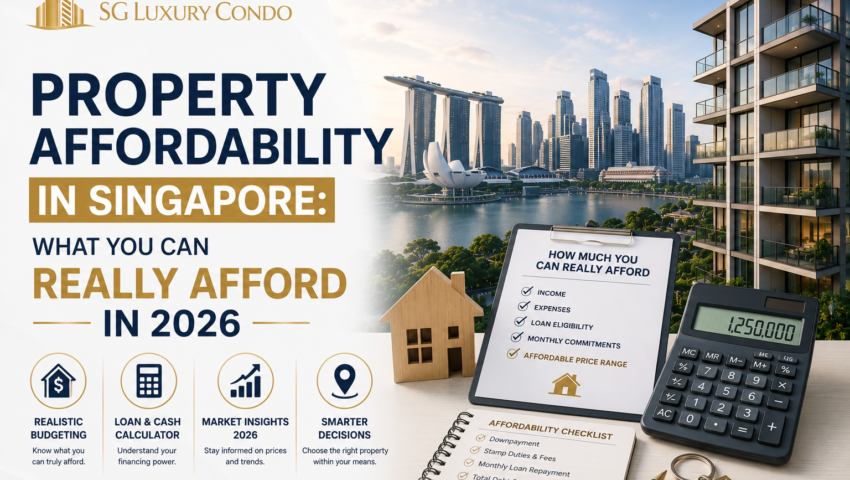
Wondering about condo affordability Singapore? This guide covers how much salary is needed to buy a condo in Singapore, TDSR rules Singapore, MSR limit, downpayment for condo, and home loan eligibility Singapore — all explained simply.

How much salary to buy condo in Singapore

Table of Contents

How much salary to buy condo in Singapore?

Wondering about condo affordability Singapore? This guide covers how much salary is needed to buy a condo in Singapore, TDSR rules Singapore, MSR limit, downpayment for condo, and home loan eligibility Singapore — all explained simply.

Let’s cut straight to it.

You’ve been thinking about buying a condo in Singapore. Maybe your HDB MOP is almost done. Maybe you’ve been renting and want to own something. Or maybe you’re just tired of watching property prices climb while you wait on the sidelines.

The question burning in your head: Do I actually earn enough?

This guide answers exactly that — in plain language, with real numbers, no jargon. We’ll walk you through condo affordability in Singapore, the TDSR rules Singapore banks apply, the MSR limit you need to know, how much downpayment for condo purchases you need to prepare, and your overall home loan eligibility in Singapore — so you walk into any property agent’s office fully prepared.

First — What Does a Condo in Singapore Actually Cost?

Condo prices in Singapore vary a lot depending on which region you’re buying in. The market is split into three zones:

Core Central Region (CCR) — Prime districts like Orchard, Marina Bay, and Bukit Timah. This is Singapore’s luxury belt. Here is what average prices look like by unit type:

Unit Type

Average Price

1 Bedroom

S$1.36M

2 Bedroom

S$2.28M

3 Bedroom

S$3.53M

4 Bedroom

S$5.75M

Prices can go well beyond these figures for anything with a skyline view or a premium address.

Rest of Central Region (RCR) — City fringe areas like Toa Payoh, Queenstown, Paya Lebar, and Geylang. A popular sweet spot for upgraders. Here is what average prices look like by unit type:

Unit Type

Average Price

1 Bedroom

S$1.00M

2 Bedroom

S$1.60M

3 Bedroom

S$2.35M

4 Bedroom

S$3.47M

Outside Central Region (OCR) — Heartland areas like Tampines, Jurong, Sengkang, and Woodlands. This is where most first-time condo buyers start. Here is what average prices look like by unit type:

Unit Type

Average Price

1 Bedroom

S$775,000

2 Bedroom

S$1.15M

3 Bedroom

S$1.60M

4 Bedroom

S$2.06M

If you’re a first-time buyer with a realistic budget, the OCR and RCR are your most likely entry points. Keep those price ranges in mind — everything else in this guide flows from them.

The 3-3-5 Rule: Start Here Before Anything Else

Before we get into official government rules, here’s a practical rule of thumb that CPF itself endorses — and that every seasoned property buyer in Singapore knows:

3 — Your monthly mortgage is up to 55% of your combined household income.

3 — You should have at least 25% of the property price ready in cash or CPF before buying.

So if your household earns $* per month combined, your comfortable condo price ceiling is roughly $* based on the 5x annual income rule.

This isn’t law — it’s a sanity check. If your numbers fail the 3-3-5 test, you’re not necessarily locked out. But you’re borrowing at the edge of your limits, and that’s a stressful place to be.

Most financially confident condo buyers in Singapore use 3-3-5 to set their comfortable ceiling, then use the TDSR rules Singapore provides to find their maximum ceiling. The ideal purchase sits somewhere between the two.

TDSR Rules Singapore: The Rule That Determines Your Loan

So if your household income is $10,000 per month, the maximum you can put toward all debt repayments is $5,500 per month. For most first time condo buyers with no other loans, that $5,500 is essentially your full home loan budget. But keep in mind — your actual loan eligibility depends on your age, income, existing debts, and how much cash or CPF you plan to contribute.

Want to know exactly how much you can borrow? Use this free affordability calculator based on TDSR: → Check Your Loan Eligibility Here

MSR Limit: Does It Apply to You?

Let’s clear up a common confusion around the MSR limit — because many buyers mix up MSR and TDSR.

The Mortgage Servicing Ratio (MSR) only applies to HDB flats and Executive Condominiums (ECs). It caps your home loan repayment at 30% of your gross monthly income — stricter than TDSR.

For private condos, the MSR limit does not apply. Only TDSR governs your borrowing.

However, if you’re considering an EC as a stepping stone into private property (a smart move for many Singaporeans), here’s what you need to know:

  • The household income ceiling for new EC purchases is $16,000 per month
  • The MSR limit of 30% applies to your EC loan repayment
  • You must take a bank loan for ECs (no HDB loan available)

How much salary to buy a condo in Singapore?

These figures are estimates based on a buyer below age 35, taking a 30-year mortgage, 75% LTV, 4% stress test rate, and no existing debts. Actual repayments will vary based on your age, income, loan amount, and how much cash you plan to use.

New Condo — Estimated Monthly Repayment (2025)

Region

2025 Median Price

Est. Monthly Repayment

CCR (Prime)

S$2,111,500

~S$7,590

RCR (City Fringe)

S$2,093,609

~S$7,530

OCR (Heartland)

S$1,892,000

~S$6,800

Resale Condo — Estimated Monthly Repayment (2025)

Region

2025 Avg. Price Range

Est. Monthly Repayment

CCR

S$2,200,000 – S$2,850,000

S$7,900 – S$9,600

RCR

S$1,600,000 – S$2,000,000

S$5,750 – S$7,200

OCR

S$1,300,000 – S$1,700,000

S$4,680 – S$6,100

Based on 2025 URA, PropNex, ERA Research and EdgeProp data. Estimates apply to buyers below age 35, 30 year tenure, 75% LTV, 4% stress test, no existing debts. Monthly repayment varies based on age, loan amount, and cash contribution.

What This Means in Real Life

For an OCR resale condo priced around S$1.4–1.5 million — the most common first condo purchase in Singapore — you need a combined household income of roughly S$9,200 to S$10,000/month. For a dual-income couple, that’s each earning around S$4,600 to S$5,000/month — well within reach for most professional couples in their 30s.

For RCR condos — where many HDB upgraders aspire to land — budget for S$10,500 to S$13,100/month household income.

For CCR luxury condos at S$2.1 million and above, you’re looking at S$13,800/month and beyond. High-net-worth buyers targeting S$3.5 million luxury condos need household incomes exceeding S$25,000/month.

One crucial distinction: TDSR allows up to 55% of income on debt. Most financial planners recommend keeping your mortgage closer to 30% of your income. The difference between “legally allowed” and “comfortably affordable” is what separates a good purchase from a stressful one.

Downpayment for Condo in Singapore: What You Need to Be Ready

The downpayment for condo purchases follows Singapore’s Loan-to-Value (LTV) rules precisely:

  • 75% → bank loan
  • 20% → cash or CPF Ordinary Account
  • 5% → mandatory cash (CPF not allowed)

For an OCR Condo at S$1.5 Million:

Item

Amount

Min. Cash Downpayment (5%)

S$75,000

Balance Downpayment — CPF/Cash (20%)

S$300,000

Bank Loan (75%)

S$1,125,000

Buyer’s Stamp Duty (BSD)

~S$44,600

Legal & Misc Fees

~S$5,000

Total Upfront Required

~S$424,600

For an RCR/CCR Condo at S$2.1 Million:

Item

Amount

Min. Cash Downpayment (5%)

S$105,000

Balance Downpayment — CPF/Cash (20%)

S$420,000

Bank Loan (75%)

S$1,575,000

Buyer’s Stamp Duty (BSD)

~S$69,600

Legal & Misc Fees

~S$5,000

Total Upfront Required

~S$599,600

The cash portion is what catches most buyers off guard. Many have sufficient CPF, but not enough liquid cash savings. Before you fall in love with any listing, make sure your cash is actually ready.

Buyer’s Stamp Duty (BSD): Don’t Forget This Cost

BSD is a tax every buyer pays when purchasing property in Singapore. It’s calculated on progressive rates:

Purchase Price

BSD Rate

First $180,000

1%

Next $180,000

2%

Next $640,000

3%

Next $500,000

4%

Next $1,500,000

5%

Remaining amount

6%

The good news: BSD can be paid using your CPF Ordinary Account on a reimbursement basis (you pay cash first, then CPF reimburses you).

ABSD: The Extra Cost You Must Plan For

If you already own a property — HDB or private — you’ll need to factor in Additional Buyer’s Stamp Duty (ABSD).

Buyer Profile

ABSD on 2nd Property

Singapore Citizen

20%

Singapore PR

30%

Foreigner

60%

Yes, foreigners pay 60% ABSD on any residential property in Singapore. This was raised sharply in 2023 as a cooling measure and remains in effect. Despite this, Singapore continues to attract high-net-worth foreign buyers due to its political stability and strong capital appreciation record.

For Singaporeans buying a second property as an investment while keeping their HDB, the 20% ABSD is a significant outlay that must be factored into their total acquisition cost.

Home Loan Eligibility Singapore: What Banks Actually Check

When assessing your home loan eligibility in Singapore, banks look beyond just your salary. Here’s what gets evaluated:

Credit Score — Your CBS (Credit Bureau Singapore) score matters. A score of 1825 and above is considered excellent and gets you access to better rates. Pay your bills on time, keep credit card utilisation low, and avoid multiple loan applications in a short period.

Age & Loan Tenure — The maximum loan tenure for private property is 30 years, or up to age 65, whichever is shorter. If you’re 40 when you apply, your maximum tenure drops to 25 years, which increases monthly repayments and reduces your eligible loan quantum under TDSR.

Employment Type — Salaried employees get the most straightforward assessment. For self-employed individuals or those on variable commission income, banks typically average your last 2 years of income. If income fluctuates, banks may apply a haircut.

Existing Debts — A car loan of just $* per month eats into your TDSR headroom significantly. Clear high-interest debts before applying.

Number of Properties Owned — If you already own one property, the LTV drops from 75% to 45% on your next purchase. This dramatically increases the cash you need upfront and reduces your loan size.

Can Foreigners Buy Condos in Singapore?

Yes — foreigners can purchase non-landed private condominiums in Singapore. There are no restrictions on condo ownership for non-residents, subject to ABSD.

What foreigners cannot buy: HDB flats, new ECs (within the first 10 years), landed properties (without special approval).

Key points for foreign buyers:

  • 60% ABSD applies to all residential property purchases
  • No CPF available — financing is 100% cash and bank loan
  • Bank loan eligibility follows the same TDSR rules that Singapore citizens face
  • Singapore PRs pay 5% ABSD on their first property, 30% on the second

Hidden Costs Most Buyers Forget to Budget For

Even experienced buyers get surprised. Here’s what to add to your budget beyond the down payment:

Legal/Conveyancing Fees — Typically $2500 to $3500. Shop around; fees vary between law firms.

Renovation Costs — Don’t underestimate this. A standard 3-bedroom condo renovation runs $20,000 to $ 60,000. Luxury condos? Budget $ 100,00 and above for a high-end finish.

Monthly Maintenance Fees — Condo management fees range from $400 to $600 per month for standard developments. Luxury condos with full concierge and premium facilities can charge $800to $1200.

Property Tax — For owner-occupied condos, the first $8,000 of annual value is taxed at 0%, then progressive rates apply. Investment properties face higher rates.

Home Insurance — Required by banks. Budget around est $300 per year.

Your Next Step: Find Out Exactly What You Can Afford

The numbers in this guide give you a strong foundation. But every buyer’s situation is different — your CPF balance, income type, existing debts, and investment goals all shape the right strategy for you.

The smartest move right now? Talk to someone who knows Singapore’s condo market inside out — before you start viewing properties.

At SG Luxury Condo, we offer a complimentary consultation that covers:

✅ Your real buying power based on TDSR and CPF position
✅ ABSD planning if you’re an upgrader or investor
✅ Curated condo shortlist matched to your budget and lifestyle
✅ Access to new launches before open market release
✅ End-to-end guidance from offer to keys

Book Your Free Property Consultation →

Not ready to talk yet? Use our Mortgage Affordability Calculator to get your numbers instantly.

Or explore our current luxury condo listings and start getting a feel for what Singapore’s private property market has to offer.

About SG Luxury Condo SG Luxury Condo is Singapore’s trusted luxury property consultancy, specialising in helping buyers, investors, and HDB upgraders find and purchase the right condo, with full financial guidance from start to finish. Learn more →

Frequently Asked Questions

What salary is required to buy a condo in Singapore?

It depends on the size and price of the condo. Here is a simple breakdown based on average market prices: Resale Condo (3BR, average price $1.6M). You need a minimum household income of around $10,000 per month. New Launch Condo (3BR, average price $2M) You need a minimum household income of around $13,000 per month.

How does TDSR affect condo eligibility?

TDSR caps your total monthly debt repayments — including your new home loan — at 55% of gross monthly income. Banks apply a 4% stress test rate regardless of current mortgage rates. Reducing other debts before applying directly improves how much you can borrow.

How much down payment is needed for a condo in Singapore?

Minimum 25% of the purchase price, with at least 5% in mandatory cash. The remaining 20% can come from CPF OA or additional cash. Factor in BSD, legal fees, and renovation costs on top of this.

Can foreigners buy condos in Singapore?

Yes. Foreigners can purchase non-landed private condominiums. A 60% ABSD applies. No CPF is available, and financing must come entirely from personal funds and bank loans.

What is the MSR limit, and does it apply to condos?

The MSR limit caps home loan repayment at 30% of income. It applies to HDB flats and ECs only — not private condos. For private condos, only the 55% TDSR applies.

Picture of JAMES LIM

JAMES LIM

Senior Realtor
Property Consultant & Analyst

Related Posts

Why Middle East Conflict Benefit Singapore Property
CategoriesGuide News

Why the Middle East Conflict Makes Buying Singapore Property Now a Smart Move

SPECIAL MARKET REPORT — MARCH 2026

Why the Middle East Conflict Makes Buying Singapore Property Now a Smart Move

By SG Luxury Condo Team  ·  March 2026  ·  13 min read

📋 What You Will Learn

  1. How a Faraway Conflict Changes Your Property Decision
  2. Rising Construction Costs Will Drive Future Property Prices Higher
  3. Low Interest Rates Create a Rare Window for Buyers
  4. Singapore Is Asia's Ultimate Safe Haven for Capital and Families
  5. Supply Chain Disruption Is Tightening Future Housing Supply
  6. Singapore's Growing Population Means Demand Is Only Going Up
  7. The Bottom Line: Why Waiting May Cost You More Than Buying

How a Faraway Conflict Changes Your Property Decision

You might be asking: What does a conflict in the Middle East have to do with me buying a condo in Singapore? It is a fair question — and the answer is more direct than you might think.

In late February 2026, the United States and Israel launched joint air strikes against Iran, triggering a region-wide escalation that has effectively shut down the Strait of Hormuz — the narrow waterway through which roughly 20 million barrels of crude oil pass every single day. According to the World Economic Forum, Brent crude oil prices jumped about 15% in the opening days of the conflict, then surged to $120 a barrel as it deepened and the market began pricing in the risk of sustained disruption.

Oil and energy costs are embedded in almost everything used to build a home — steel, cement, aluminium, glass, transport, logistics. When oil prices spike and shipping routes shut down, building things gets more expensive. Developers pay more to construct your future condo. And eventually, they pass that cost to you. But the story does not stop at construction costs. The Middle East conflict is also reshaping where global capital flows, how Singapore is perceived as a home for both people and wealth, and whether the supply of new condos will keep up with the growing number of people who want to live here.

“Global uncertainty is not a reason to stop. For the right Singapore property buyer, it is a reason to think clearly — and act before the window closes.”

Chapter 1: Rising Construction Costs Will Drive Future Property Prices Higher

Construction is one of the most energy-hungry industries in the world. Steel requires enormous amounts of electricity. Cement kilns run on fuel. Aluminium smelters consume vast amounts of power. All of these are powered by the kind of energy that is now being priced with a war premium.

At the centre of the disruption is the Strait of Hormuz, the narrow waterway through which some 20 million barrels of crude oil pass daily. Escalation around the critical waterway has increased logistics risk, lifted war-risk insurance and bunker costs, and added a risk premium to crude oil and liquefied natural gas (LNG). These costs are now filtering through to construction input prices, as noted in a March 2026 report by global construction consultant Linesight.

In the first week of March 2026, crude futures jumped by nearly 22% as markets priced Gulf risk. Aluminium prices reached a four-year high on the London Metal Exchange. According to Baker McKenzie’s Global Disputes Forecast 2026, Asia’s dependency on Middle Eastern energy means disruptions pass through to power and transport costs, which in turn inflate material inputs such as steel, cement and fabricated components.

+22%
Crude futures jump in first week of March 2026 as markets priced Gulf risk
3.45%
Revised tender price inflation forecast for 2026, up from 3.3% (Rider Levett Bucknall)
4-yr high
Aluminium prices on LME — a key construction material — in March 2026 (Linesight)

A condo that a developer prices at $1.8 million today was planned and costed before the current spike in material prices. The next wave of developments — those being designed, tendered, and launched over the next 12 to 24 months — will be costed with today’s elevated energy, steel, and aluminium prices baked in. That means higher launch prices for buyers who wait.

In Malaysia, housing contractors have already warned that the ongoing instability in global supply chains is making it difficult to provide accurate cost estimates during the early stages of a project, adding that this can lead to cost overruns, construction delays, and developers postponing or restructuring the launch of housing projects. What applies in Malaysia applies across the region — including Singapore.

Chapter 2: Low Interest Rates Create a Rare Window for Buyers

💡 What This Means for HDB Upgraders

If you are considering upgrading from your HDB flat to a private condo, the condos you are looking at today — especially new launches already under construction — were priced before the current energy cost spike. Waiting for "better deals" in 2027 may instead mean facing higher launch prices as developers reprice based on today's elevated construction costs. View our latest new launch listings to see current pricing before it changes.

SORA — Singapore’s benchmark home loan interest rate — has been falling steadily since its 2023 peak of over 3.5%. As of early 2026, SORA-linked home loan rates sit at approximately 1.1% to 1.5%. This gives you lower monthly mortgage repayments than at any point since 2021.

📊 What SORA Rate Movement Means for Your Monthly Payment

On a $1.35 million bank loan (75% LTV on a $1.8M condo) over 25 years:

At 3.5% (2023 peak): Monthly repayment ≈ $6,760

At 2.0% (stress test floor): Monthly repayment ≈ $5,720

At 1.3% (current SORA-linked rate, early 2026): Monthly repayment ≈ $5,150

*Illustrative figures only. Actual rates depend on bank package and individual credit profile. Bank stress tests use a floor rate of 4%.

Here is the nuance the Middle East conflict introduces: rising energy costs and potential supply disruptions will place upward pressure on inflation, either pushing it higher or preventing it from falling as quickly as expected. This means the current window of relatively low rates is not guaranteed to stay open indefinitely. If the conflict drives a sustained global inflation resurgence, central banks may have to pause or reverse rate cuts. The window of sub-2% SORA-linked mortgage rates may be shorter than it looks.

History shows that by the time it becomes obvious interest rates are rising, the window has already closed for most buyers. The time to lock in a loan at today’s rates is now, not after the inflation picture becomes clearer. Check out our complete HDB upgrade financing guide for a breakdown of how to structure your loan in today’s rate environment.

Chapter 3: Singapore Is Asia's Ultimate Safe Haven for Capital and Families

The Capital Inflow Is Already Happening

In 2025, Singapore’s three largest banks attracted a combined S$77 billion in net new wealth money. DBS reported S$39 billion in fresh inflows and OCBC added S$27 billion. The source is clear: ultra-high-net-worth individuals across Asia, particularly from China, India, and the Middle East, are moving assets out of perceived hotspots. The Iran-GCC conflict inflicted significant damage on the UAE’s infrastructure and civilian sites, directly undermining the Gulf’s reputation as a safe haven. Firms like JPMorgan and Partners Group have cancelled or relocated major investor gatherings from Dubai. When global wealth moves, it needs somewhere to land — and increasingly, a large portion of that capital is landing in Singapore real estate.

Huttons Asia CEO Mark Yip has said: “It would not be a surprise to see more wealth coming to Singapore and contributing to demand for properties.” This is because ultra-high-net-worth individuals want stability and low taxes.

Why Singapore Keeps Getting Chosen

Singapore AdvantageWhat It Means for Property Owners
Political neutrality and stabilityNo risk of property confiscation or sudden policy reversal
Strong Singapore Dollar (SGD)Your property value is denominated in a currency that holds its global value
English common law legal systemTransparent, enforceable property rights with no legal ambiguity
World-class financial infrastructureLiquid market — you can sell when you need to
Low crime, excellent schools, healthcareConsistent demand from locals and expats — supports rental yield
Consistent MAS regulatory frameworkCooling measures prevent speculative bubbles — no sudden market collapses

ERA Singapore has documented the historical evidence: during the first Gulf War (1990–1991), Singapore’s Private Residential Property Price Index maintained its growth throughout the conflict and rose by roughly 160% over the following five years. During the Iraq War (2003–2011), the PPI rose by around 82.9% throughout the conflict. An upward trend in private property prices has been observed since the outbreak of the Russia–Ukraine conflict in 2022 as well.

The pattern is consistent: Singapore property does not crash during Middle East conflicts. It continues — and often accelerates — its long-term upward trend. Singapore’s stability makes it the natural beneficiary of the capital flight that follows every period of global uncertainty.

“Every major global conflict in the past 30 years has ended with Singapore property prices higher than when it started. That is not coincidence. That is structural advantage.”

💡 Explore Singapore's Top Condos

Browse our curated listings of Singapore's top private condos to see what your budget can unlock in today's market — from OCR family condos to CCR luxury residences that are seeing the strongest safe-haven interest from international buyers.

Chapter 4: Supply Chain Disruption Is Tightening Future Housing Supply

When construction costs rise sharply and supply chains become unpredictable, developers face a difficult choice: launch new projects at higher prices and risk slower sales, or delay launches until they have more cost certainty. Armed escalation across the Middle East has disrupted airspace and critical maritime corridors, notably the Strait of Hormuz and Red Sea/Suez, forcing costly rerouting of vessels and increasing war risk insurance and freight rates. According to Baker McKenzie, construction supply chains in the Gulf are already experiencing delivery delays, price volatility and repricing of non-energy cargo, with knock-on effects for Asia Pacific contractors dependent on these corridors.

1

Delayed New Launches

Developers who cannot accurately price steel, aluminium, and MEP components will delay project launches rather than risk selling at prices that do not cover their final construction cost. Fewer launches = fewer options for buyers = upward pressure on available units.

2

Extended Construction Timelines

When one stage slips — production, supply and delivery — the delay compounds on any project underway. The next wave of supply enters the market later than planned, stretching the gap between demand and available units.

3

Higher Replacement Cost of Existing Stock

When it becomes more expensive to build new properties, the replacement cost of existing ones rises. This puts a floor under resale prices — sellers of existing condos can justifiably ask for more, knowing that rebuilding today would cost significantly more than it did when the property was first constructed.

Singapore is a city-state with a total land area of just 733 square kilometres. There is no equivalent of suburban sprawl here. Every square metre of buildable land is finite, and the government tightly controls what gets released through the Government Land Sales (GLS) programme. Supply chain disruption slowing new completions, combined with tight land supply and rising construction costs that deter new launches, creates a perfect storm for constrained housing supply at exactly the moment when demand is rising.

You can explore currently available new launch condos on our listings page — properties priced and launched before the current cost spike, while supply is still relatively available.

Chapter 5: Singapore's Growing Population Means Demand Is Only Going Up

Population Growth: The Numbers from Singapore's Own Government

Singapore’s total population stood at 6.11 million as at June 2025, a 1.2% increase from June 2024. The annualised population growth rate of 1.5% over the past five years (2020–2025) was higher than the 0.5% over the preceding five-year period (2015–2020). The Non-Resident population stood at 1.91 million, an increase of 2.7% — this growing pool of employment pass holders and skilled professionals directly supports rental demand for private condos.

📌 Singapore's Population in Numbers (2025)

Total population: 6.11 million (record high)

5-year annualised growth rate: 1.5% per year

Non-resident population growth: +2.7% year-on-year

New PRs granted in 2024: ~35,264

New citizenships granted in 2024: ~22,766

Median household income: S$12,446/month — first time crossing $12,000 mark

Source: Singapore Department of Statistics (DOS), Population in Brief 2025; ERA Research, March 2026.

The Middle East Conflict Amplifies This Demand

When the Gulf becomes unstable — when Dubai’s reputation as a safe business hub is damaged by missile strikes on its infrastructure — Singapore is the natural destination for displaced wealth and displaced people. Multinational corporations often centralise operations in politically stable cities during uncertain times. Family offices, financial institutions, and regional headquarters that were based in Dubai are actively reviewing their presence and exploring Singapore as an alternative base. Every new high-income professional relocating from the Gulf to Singapore needs to live somewhere — and most will rent or eventually buy private property.

💡 What This Means for Your Rental Yield

The growing expat and non-resident population is a strong tailwind for rental demand. Current rental yields for OCR condos range from 3.5% to 4.5% per annum. See our guide on Singapore investment properties with strong rental yields to find the best-performing areas for income returns.

Chapter 6: The Bottom Line — Why Waiting May Cost You More Than Buying

FactorCurrent SituationImplication for Buyers
🏗️ Construction costsSteel +22%; aluminium 4-yr high; tender inflation revised upwardFuture condos will be launched at higher prices than today
💰 Interest ratesSORA at ~1.1–1.5%, near multi-year lowsMonthly repayments cheaper now than in 12–18 months
🏙️ Singapore safe havenS$77B in new wealth inflows to SG banks in 2025More capital = more demand = sustained price floor + upward pressure
🔗 Supply chain disruptionStrait of Hormuz effectively closed; shipping costs surgingFuture supply tightening as demand rises
👥 Population growth6.11M (+1.2%); 35K new PRs; $77B wealth migration to SGMore people need homes; rental yields and capital values supported

Put these five forces together and a picture emerges: the cost of building a new condo will be higher in 2027 than in 2026. Supply may be tighter. And demand from both locals and arriving wealth is growing. The result of rising costs, tighter supply, and growing demand is higher prices.

History is the most convincing argument. Singapore property survived the Gulf War, the Asian Financial Crisis, SARS, the Iraq War, the Global Financial Crisis, COVID-19, and the Russia–Ukraine conflict. In every case, those who bought during the uncertainty and held for five or more years were rewarded. The Middle East conflict of 2026 will, in time, be another chapter in that same story.

⚠️ A Word of Balance

Not every scenario is positive. If the Middle East conflict leads to a prolonged global recession, Singapore's open, trade-dependent economy could face headwinds — and property market sentiment could cool in the short term. As always, buy within your means, maintain an emergency fund, and choose properties with strong fundamentals: good location, reputable developer, and the right size for your needs.

If you are ready to take the next step — whether exploring your upgrade options, understanding your CPF and financing position, or finding the right new launch for your budget — we would love to help. Browse our contact page to reach our team.

Find Out If Now Is the Right Time for You

Global market conditions are moving fast. Book a free, no-obligation consultation with our team and we will map out your personal upgrade timeline — your MOP, your finances, and the best options available right now.

Get My Free Property Consultation →
Disclaimer: This article is for general informational and educational purposes only. It does not constitute financial, legal, or property investment advice. All data cited is sourced from publicly available reports as at March 2026, including EdgeProp Singapore, ERA Singapore, Baker McKenzie, World Economic Forum, Linesight, Rider Levett Bucknall, and Singapore Department of Statistics. Market conditions, geopolitical situations, and economic forecasts are subject to rapid change. Please consult a licensed property agent, financial advisor, and lawyer before making any property transaction. SG Luxury Condo is a licensed real estate agency in Singapore.
Average Non-Landed Property Prices in 2025
CategoriesGuide tips & tricks

From Investments to Keys in Hand: How Smart Investing Helps You Buy Your Dream Home in Singapore

From Investments to Keys in Hand: How Smart Investing Helps You Buy Your Dream Home in Singapore
Buying a home is one of life’s biggest financial milestones. For many Singaporeans, it marks independence, family growth, or a long-awaited upgrade to a dream property. Whether you are purchasing your first flat or planning your forever home, the journey starts long before you receive the keys.
Average Non-Landed Property Prices in 2025

Table of Contents

From Investments to Keys in Hand: How Smart Investing Helps You Buy Your Dream Home in Singapore

Buying a home is one of life’s biggest financial milestones. For many Singaporeans, it marks independence, family growth, or a long-awaited upgrade to a dream property. Whether you are purchasing your first flat or planning your forever home, the journey starts long before you receive the keys.

FAQ’s

Accordion #1

I am item content. Click edit button to change this text. Lorem ipsum dolor sit amet, consectetur adipiscing elit. Ut elit tellus, luctus nec ullamcorper mattis, pulvinar dapibus leo.

Accordion #2

I am item content. Click edit button to change this text. Lorem ipsum dolor sit amet, consectetur adipiscing elit. Ut elit tellus, luctus nec ullamcorper mattis, pulvinar dapibus leo.

Accordion #3

I am item content. Click edit button to change this text. Lorem ipsum dolor sit amet, consectetur adipiscing elit. Ut elit tellus, luctus nec ullamcorper mattis, pulvinar dapibus leo.

Picture of JAMES LIM

JAMES LIM

Senior Realtor
Property Consultant & Analyst

Related Posts

Average Non-Landed Property Prices in 2025
CategoriesGuide tips & tricks

From Investments to Keys in Hand: How Smart Investing Helps You Buy Your Dream Home in Singapore

From Investments to Keys in Hand: How Smart Investing Helps You Buy Your Dream Home in Singapore

From Investing to Homeownership: Turning Long-Term Plans Into Reality

Buying a home is one of life’s biggest financial milestones. For many Singaporeans, it marks independence, family growth, or a long-awaited upgrade to a dream property. Whether you are purchasing your first flat or planning your forever home, the journey starts long before you receive the keys.

While saving is essential, relying on cash alone may not be enough in today’s rising property market. A thoughtful investment strategy can help bridge the gap between where you are now and the home you want in the future.

Why Property Ownership Matters So Much in Singapore

Singapore has long been known for its strong property market and high homeownership rate. With over 90% of residents owning a home, property remains one of the most trusted ways to build and preserve wealth locally.

Several factors support this mindset:

  • Stable economic growth and strong governance

  • Limited land supply, which supports long-term property values

  • Property viewed as a tangible and relatively stable asset

That said, affordability has become a growing challenge. Since 2021, both private and public housing prices have risen sharply due to strong demand and supply constraints following the pandemic.

As prices increase faster than wages, planning ahead has never been more important.

Understanding the True Cost of Buying a Home

When buying property in Singapore, the purchase price is only part of the equation. Buyers must also prepare for upfront costs such as:

  • Minimum 25% down payment for private property

  • Buyer’s Stamp Duty (BSD)

  • Legal and administrative fees

  • Additional Buyer’s Stamp Duty (ABSD), where applicable

For example, a $2 million property can require over $570,000 in upfront cash, even before renovation or furnishing costs. For Singapore Permanent Residents and foreigners, ABSD significantly increases this amount.

This reality highlights why early financial preparation is essential.

Affordability is often the largest stumbling block when it comes to property. Prices have gained significantly since 2021, driven by the surge in demand and shortage of new homes built as a result of the COVID-19 pandemic. Between 3Q 2021 to 3Q 2025, non-landed private homes and HDB resale prices have risen 30% and 35% respectively.

Table 1: HDB Prices in 4Q 2025


Price Range ($) – BTO (October 2025)


3-room

4-room

5-room

Standard

$295,000 – $448,000

$344,000 – $624,000

$466,000 – $857,000

Plus

$340,000 – $434,000

$514,000 – $650,000

N.a

Prime

$408,000 – $552,000

$541,000 – $778,000

N.A


Average Price ($) – Resale


3-room

4-room

5-room

Mature Estate

$474,000

$772,000

$937,000

Non-mature Estate

$457,000

$604,000

$714,000

Source: HDB as of 8 Jan 2026, *Rounded to the nearest ‘000

Average Non-Landed Property Prices in 2025
Median Private Property Prices in 4Q 2025

Why Saving Alone May Not Be Enough

Many aspiring homeowners focus solely on saving for a down payment. While discipline is admirable, cash savings face one major challenge: inflation.

With inflation averaging around 3% annually, money sitting in a low-interest savings account gradually loses purchasing power. Over time, the same amount of cash buys less property, not more.

This creates a gap between rising home prices and stagnant savings, even for consistent savers.

Costs of purchasing a home in Singapore

Property Value

Buyer Stamp Duty

25% Downpayment*

Legal Fees^

Total Capital Outlay

$500,000

$9,600

$125,000

$3,000

$137,600

$750,000

$17,100

$187,500

$3,000

$207,600

$1,000,000

$24,600

$250,000

$3,000

$277,600

$1,500,000

$44,600

$375,000

$3,000

$422,600

$2,000,000

$69,600

$500,000

$3,000

$572,600

$2,500,000

$94,600

$625,000

$3,000

$722,600

$3,000,000

$119,600

$750,000

$3,000

$872,600

$3,500,000

$149,600

$875,000

$3,000

$1,027,600

$4,000,000

$179,600

$1,000,000

$3,000

$1,182,600

$4,500,000

$209,600

$1,125,000

$3,000

$1,337,600

$5,000,000

$239,600

$1,250,000

$3,000

$1,492,600

*Based on minimum down payment ^Estimated amount.

How Investing Helps Close the Gap

Investing allows your money to grow at a faster pace than inflation over the long term. By putting your capital to work in the markets, you give yourself a better chance of keeping up with, or even outpacing property price growth.

Key benefits of investing for homeownership include:

  • Long-term wealth accumulation through compounding

  • Higher potential returns compared to cash savings

  • Flexibility to scale investments as income grows

Starting early makes a powerful difference. Even modest monthly investments can grow substantially over time when compounded consistently.

Building an Investment Strategy for Property Goals

A successful investment plan balances growth and risk. Markets naturally fluctuate, so short-term volatility is unavoidable. However, history shows that staying invested over the long term has rewarded disciplined investors.

To manage risk effectively:

  • Diversify across asset classes such as equities and bonds

  • Invest globally rather than relying on a single market

  • Match your portfolio risk level to your time horizon

A structured, long-term portfolio can support your property goals while reducing emotional decision-making during market swings.

The Power of Regular Investing

For beginners, a recurring investment plan can be a practical starting point. By investing a fixed amount monthly, you benefit from dollar-cost averaging, which helps smooth out market ups and downs over time.

Regular investing also:

  • Encourages discipline

  • Reduces the stress of timing the market

  • Fits naturally into monthly budgeting

As your income increases, you can gradually raise your investment contributions to accelerate progress toward your down payment target.

Laying the Financial Foundation for Your Future Home

Buying a home in Singapore is a long-term journey, not a last-minute decision. By combining smart saving habits with consistent investing, you build a stronger financial foundation and improve your ability to afford the home you truly want.

Whether your goal is your first flat, a larger family home, or a long-term upgrade, starting early and staying invested can make the difference between compromise and choice.

Your dream home is not just about location or layout — it is built on years of thoughtful financial planning.

Private Property Transaction Volume after Covid
CategoriesNews

4Q 2025 URA Property Statistics: Private Home Demand Stays Resilient

2025 URA Property Statistics: Private Home Demand Stays Resilient

Singapore’s private residential property market ended 2025 on a stable and confident note. According to the latest URA Real Estate Statistics for 4Q 2025, private home prices continued to rise, transaction volumes remained healthy, and buyer confidence carried through from the strong momentum seen in the third quarter.

While overall sales volumes moderated slightly due to fewer launches and the typical year-end slowdown, the underlying demand for private homes stayed intact. More importantly, the data points to a firm outlook heading into 2026, supported by controlled supply, stable economic conditions, and sustained owner-occupier demand.

For HDB upgraders, first-time private buyers, and long-term investors, the 4Q 2025 figures provide valuable insight into where the market stands today—and where it may be heading next.

Private Home Prices Continue a Steady Uptrend in 4Q 2025

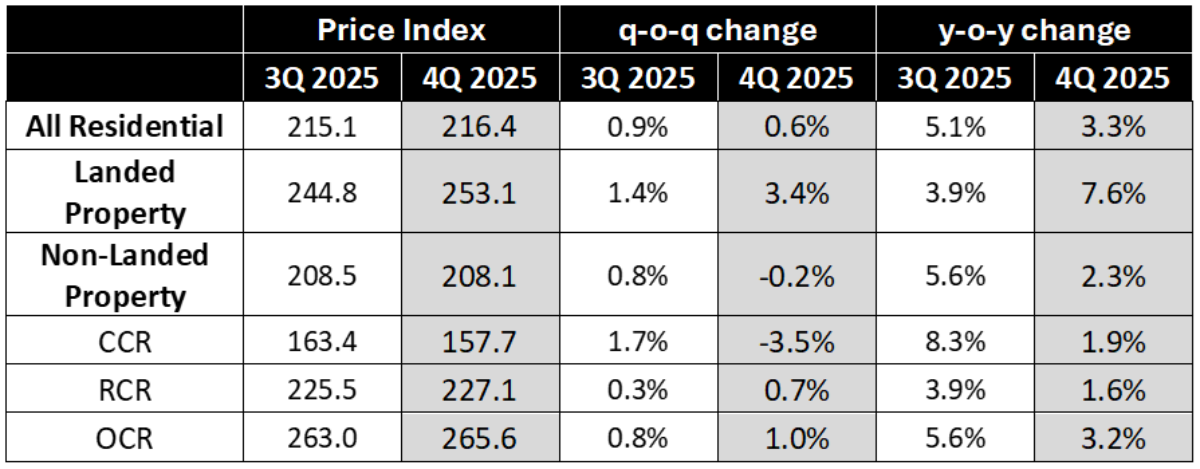
In the fourth quarter of 2025, Singapore’s All-Residential Private Property Price Index rose by 0.6% quarter-on-quarter, extending the growth seen in the previous quarter. While this was slightly slower than the 0.9% increase in 3Q 2025, it still marked the fifth consecutive quarter of price growth, reinforcing the market’s underlying stability.

On a year-on-year basis, private home prices rose 3.3% in 2025, with much of the growth driven by the landed housing segment. This gradual pace of appreciation suggests that the market is expanding in a controlled and sustainable manner, rather than overheating.

For buyers who have been waiting on the sidelines, the data shows that prices are not retreating—but neither are they surging aggressively. This environment tends to favour decisive buyers who are financially ready, rather than those hoping for sharp price corrections.

Transaction Volumes Dip Seasonally, But Full-Year Activity Remains Strong

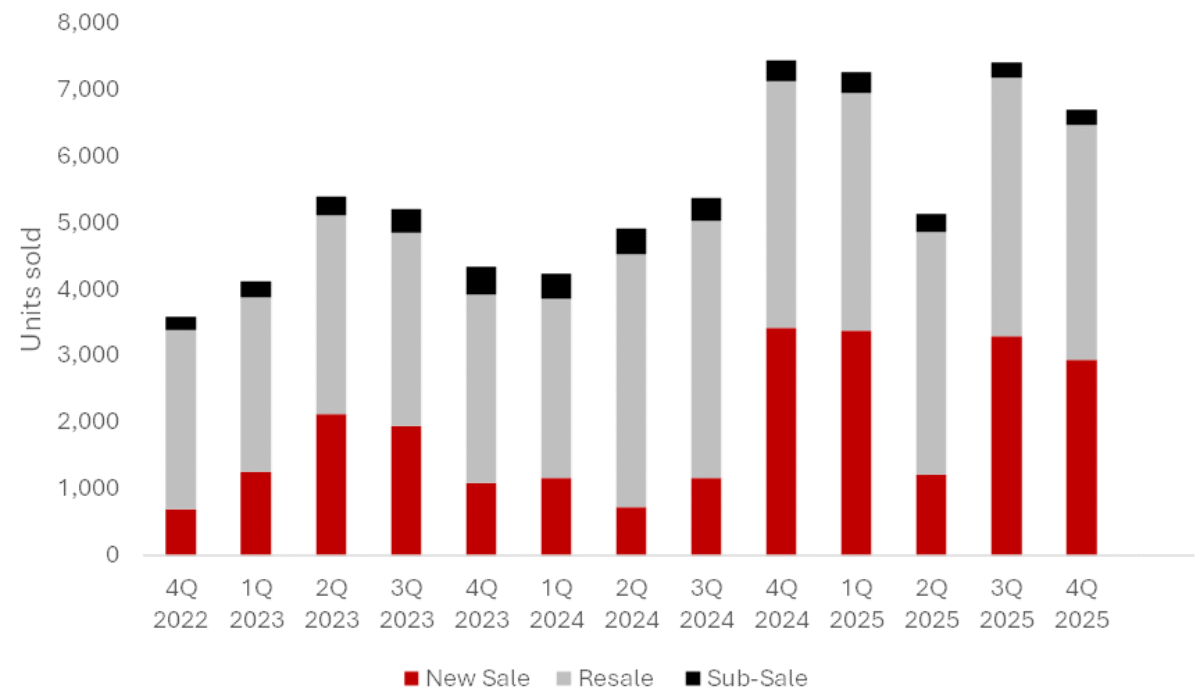
Private Property Transaction Volume after Covid
Private Non-Landed Transaction Volume

A total of 6,699 private home transactions were recorded in 4Q 2025, representing a 9.5% quarter-on-quarter decline. This moderation came after a very strong 3Q 2025, which saw heightened activity driven by eight major project launches.

The softer fourth-quarter performance was largely expected. Developers typically slow down launches toward the end of the year, and buyer activity often dips in December due to school holidays and year-end travel. Importantly, this was a seasonal slowdown rather than a demand-driven pullback.

For the full year, total private home sales reached 26,492 units, highlighting the resilience of Singapore’s housing market even amid global uncertainties earlier in the year.

New Home Sales Remain the Key Demand Driver

Despite fewer launches in 4Q 2025, the primary (new home) market remained robust. Developers sold 2,940 new private homes during the quarter, only a modest decline from the previous quarter’s strong showing.

Across the whole of 2025, 10,815 new homes were sold, making it the best-performing year since 2021. This reflects sustained confidence among buyers, particularly owner-occupiers who are less sensitive to short-term market fluctuations.

A key trend worth noting is the high take-up rates at launch. In 4Q 2025, four out of five new launches achieved over 80% sales on launch day. This mirrors the strong launch-day demand seen in 3Q 2025 and suggests that well-priced, well-located projects continue to attract immediate buyer interest.

For HDB upgraders, this highlights an important reality: desirable new launches do not stay available for long, especially when supply is limited.

Fewer Completions Are Pushing Buyers Toward New Launches

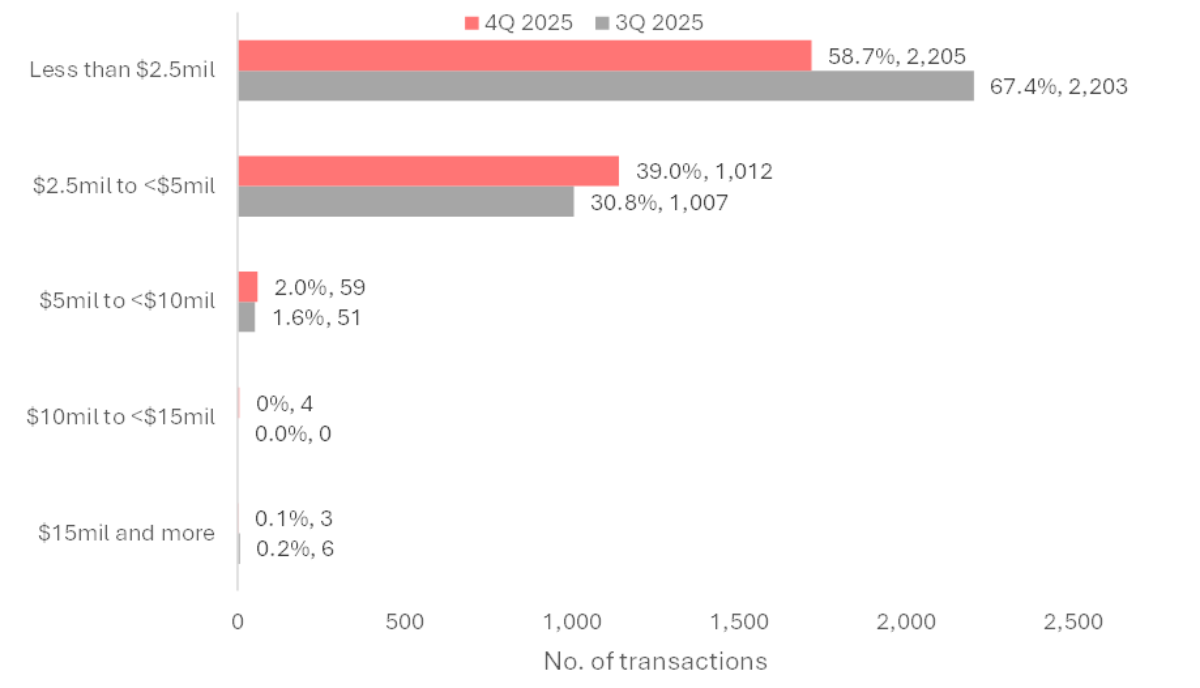
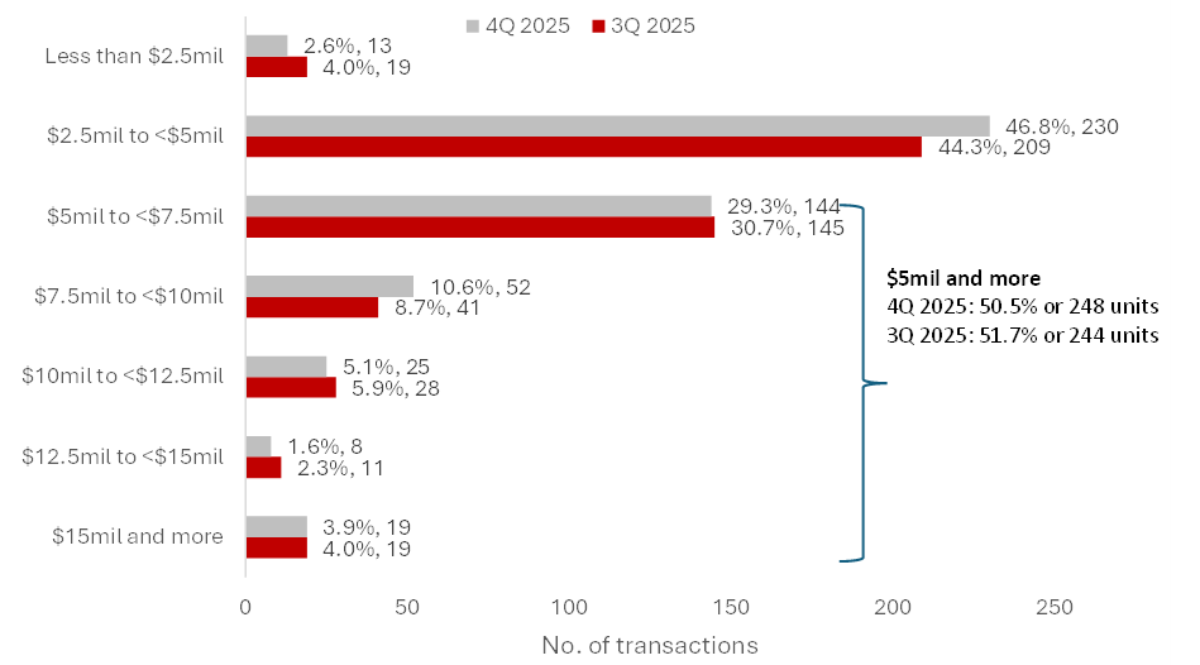
Private Property Transactions by Pricing
New Non-landed Home Transactions by Price Quantum

One structural factor shaping the market is the low number of private home completions. In 2025, only 6,123 private homes (excluding ECs) were completed, significantly lower than the 8,460 units completed in 2024.

This reduced completion pipeline has limited resale and sub-sale supply, pushing more buyers toward the new home market. As a result, developers with ready projects have benefited from spillover demand, especially in popular city-fringe and suburban locations.

This supply dynamic is expected to remain relevant in the near term, which helps explain why developers continue to enjoy strong sales momentum despite fewer launches.

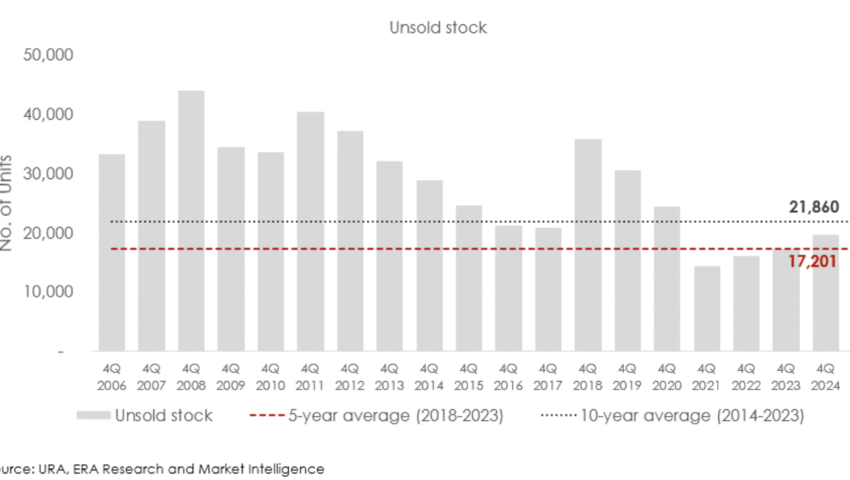
Unsold Inventory Continues to Decline

Unsold Units declining
Declining No of Unsold Private Homes

Unsold private residential stock fell 5.2% quarter-on-quarter to 16,193 units in 4Q 2025. This decline came even after several new projects were launched, reflecting healthy absorption rates across the market.

Lower unsold inventory levels generally support price stability, as developers face less pressure to discount aggressively. It also reinforces the idea that demand is keeping pace with supply, particularly for projects that align well with buyer expectations around pricing, location, and layout.

Non-Landed vs Landed Homes: Diverging Price Performance

Change in URA Private Property Price Indexes for 3Q 2025 and 4Q 2025

Non-Landed Homes See More Moderate Growth

Non-landed private homes recorded slower price growth in 4Q 2025, with prices edging down slightly after stronger gains in the previous quarter. This moderation was largely due to a smaller number of launches compared to 3Q 2025, when eight projects entered the market.

That said, price performance varied significantly by region.

Outside Central Region (OCR) non-landed homes saw the strongest growth, rising 1.0% quarter-on-quarter, supported by the strong performance of Faber Residence, which achieved over 90% sales during the quarter.

Rest of Central Region (RCR) prices rose 0.7% quarter-on-quarter, continuing the upward momentum from earlier launches such as Zyon Grand, Penrith, and The Sen.

Core Central Region (CCR) prices declined 3.5% quarter-on-quarter, ending four consecutive quarters of growth. This was largely due to lower transaction volumes, rather than weak interest, as pricing expectations between buyers and sellers temporarily diverged.

Landed Homes Outperform on the Back of Upgrader Demand

Landed Price Quantum 3Q 2025 versus 4Q 2025

The landed housing segment was a standout performer in 4Q 2025. Prices rose 3.4% quarter-on-quarter, accelerating from the previous quarter and marking the fourth consecutive quarter of growth.

On a year-on-year basis, landed home prices climbed 7.7% in 2025, significantly outpacing non-landed homes. This trend reflects growing interest from condominium owners who were able to upgrade as their property values appreciated.

Transaction volumes for landed homes also increased, with 491 transactions in 4Q 2025, bringing the full-year total to 1,852 transactions, an 11.2% increase over 2024.

Demand was particularly resilient in the OCR and RCR, where buyers found a better balance between space, affordability, and location. In contrast, CCR landed transactions slowed as higher prices led to a temporary standoff between buyers and sellers.

Resale and Sub-Sale Markets Hold Steady

The resale private home market recorded 3,529 transactions in 4Q 2025, a slight moderation from the previous quarter. However, full-year resale transactions totalled 14,622 units, largely in line with 2024 levels.

This consistency highlights the resilience of the resale segment, even as it competes with attractive new launches and faces seasonal slowdowns.

Sub-sale activity remained muted, with only 230 transactions in 4Q 2025. The limited number of new completions in 2025 reduced opportunities for sub-sale transactions, a trend that is likely to persist until completion volumes rise again.

Rental Market Begins to Stabilise

After several years of strong rental growth, the private residential rental market showed signs of stabilisation in 4Q 2025. The All-Residential Rental Price Index dipped 0.5% quarter-on-quarter, reversing the modest increase seen in the previous quarter.

Non-landed rents declined marginally, while landed rents saw a steeper adjustment. Despite this short-term pullback, overall private rents still rose 1.9% for the full year, indicating that rental demand remains structurally supported.

Looking ahead, a growing supply pipeline—combined with policies such as the extended occupancy cap—is expected to keep rental growth in check through 2026 and 2027. For tenants, this could translate into more stable and negotiable rental conditions.

Upcoming Launches in 2026: Supply Remains Managed

The new launch pipeline in 2026 is shaping up to be active but controlled. The year began with the successful launch of Coastal Cabana EC, which sold more than two-thirds of its units shortly after launch.

For the full year, around 19 private residential projects comprising approximately 9,852 units, along with five EC developments offering nearly 2,000 units, are expected to enter the market. These projects span the CCR, RCR, and OCR, catering to a wide range of buyer profiles.

The continued release of land through the GLS programme reflects the government’s commitment to maintaining a stable housing supply and preventing excessive price volatility.

Market Outlook for 2026: Stability with Moderate Growth

The slight pullback in transactions during 4Q 2025 does not signal a weakening market. Instead, it reflects a natural pause following an exceptionally strong third quarter and the usual year-end slowdown.

Heading into 2026, Singapore’s private residential market is expected to remain resilient, supported by:

  • Strong owner-occupier demand
  • Limited unsold inventory
  • Controlled supply from GLS sites
  • Stable employment and income conditions

Barring unexpected global shocks, new home sales in 2026 are projected to range between 9,000 and 10,000 units, while resale transactions are expected to remain in the 13,000 to 14,000 range.

For buyers, this suggests a market that rewards preparation and decisiveness rather than speculation. Prices are likely to trend upward gradually, making well-timed purchases more important than trying to time a market bottom.

Final Thoughts: What This Means for Buyers and Upgraders

The 4Q 2025 URA statistics confirm that Singapore’s private property market remains fundamentally healthy. Demand has proven resilient, supply is being carefully managed, and price growth continues at a sustainable pace.

For HDB upgraders, the ongoing strength in both resale HDB prices and private home demand presents a window of opportunity to transition into private housing with confidence. For first-time private buyers, the coming year offers a diverse range of new launches across different regions and price points.

As always, the key lies in understanding your budget, timing your move strategically, and choosing projects that align with both lifestyle needs and long-term value.