TLDR
- Property tax is annual, no exceptions. Own it, live in it, rent it, or leave it empty — IRAS bills you every year regardless.
- It’s based on Annual Value, not market price. A $3M condo might have an AV of $60,000. That AV — not the market value — is what your tax is calculated on.
- Two rate schedules exist. Owner-occupied rates are much lower. Renting out your property? You pay the non-owner-occupied rate, which starts at 10% from the first dollar.
- Same property, very different bills. A condo with AV $60,000 costs $2,180/year in tax if you live there — and $6,900/year if you rent it out. That’s a $4,720 annual gap.
- Luxury properties hurt more. Rates are progressive. The higher the AV, the steeper the rate — especially for rented-out units, where the top rate hits 20%.
- Owner-occupier rate is not automatic. You have to apply for it through IRAS after moving in. Miss this and you overpay.
- AV can be disputed. If IRAS revises your AV upward and it doesn’t match actual rents nearby, you have 30 days to object. Win the objection and you save money every year going forward.
If you own property in Singapore, property tax is one of those costs you pay every year without fail. Doesn’t matter if you live there, rent it out, or leave it empty — IRAS sends the bill regardless.
A lot of buyers only think about property tax after they’ve already bought. That’s a mistake. At the luxury end of the market especially, your annual tax bill can run into tens of thousands of dollars. Knowing how it works before you buy helps you plan properly and avoids any nasty surprises come January.
This guide breaks it down simply — how it’s calculated, what the current rates look like in 2026, worked examples for different property types, and what to do if you think your bill is wrong.
What Is Property Tax in Singapore?
Property tax in Singapore is an annual tax collected by the Inland Revenue Authority of Singapore (IRAS). Every property owner pays it — HDB flat owners, condo owners, landed homeowners, commercial property owners. No exceptions.
The key thing most people miss: property tax is not based on what you paid for your property or what it’s worth on the market today. It’s based on something called the Annual Value, or AV.
That distinction matters a lot. A condo worth S$3 million on the open market might have an AV of S$60,000. And it’s that S$60,000 figure, not the S$3 million, that determines your tax bill each year.
What Is Annual Value and How Is It Calculated?
Annual Value is the estimated amount your property could fetch in rent over one year if it were rented out unfurnished. IRAS works this out by looking at actual rental transactions for similar properties in the same area.
Furniture, fittings, and maintenance fees are excluded from the calculation. It’s strictly the bare rental value of the unit itself.
A few things to keep in mind about AV:
- IRAS reviews and updates AVs periodically based on market rental movements
- Your AV is not fixed permanently — it can go up if rents in your area have risen
- If your AV is revised upward significantly and you think it’s wrong, you have the right to object within 30 days of receiving the notice
How to check your property’s Annual Value:
If you’re the owner, log in to the IRAS website at iras.gov.sg using Singpass and go to the View Property Dashboard. It’s all there.
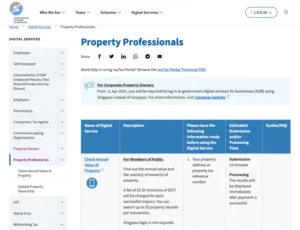
If you’re a buyer looking at a property before purchasing, you can use the IRAS portal for property professionals to check the AV. There’s a S$2.50 fee per enquiry but it gives you the actual figure, not an estimate.
You can also check estimated rental data on property portals like 99.co. This is free but less accurate — most units actually transact above the AV rental figure, so treat it as a rough guide only.
The Two Types of Property Tax Rates
Singapore uses two different rate schedules depending on how you use the property.
Owner-Occupied Rate
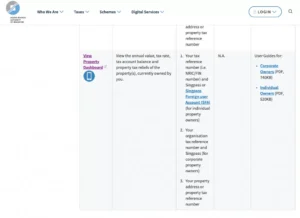 For properties where the owner lives there as their primary residence, or where the property is left vacant.
Non-Owner-Occupied Rate
 For properties that are fully rented out to tenants. These rates are higher across all AV brackets.
This matters practically. If you buy a condo to rent out, you’ll pay the higher non-owner-occupied rates from the start. If you move in yourself, you apply for the owner-occupier rate and pay significantly less.
2026 Property Tax Rates: Owner-Occupied Residential Properties
These are the current rates for properties where the owner lives in the unit:
Annual Value (AV) | Tax Rate | Max Tax for This Band |
First S$8,000 | 0% | S$0 |
Next S$47,000 | 4% | S$1,880 |
Next S$15,000 | 6% | S$900 |
Next S$15,000 | 8% | S$1,200 |
Next S$15,000 | 10% | S$1,500 |
Next S$15,000 | 12% | S$1,800 |
Next S$15,000 | 14% | S$2,100 |
Above S$130,000 | 16% | No limit |
For the majority of owner-occupiers in Singapore, the effective tax rate stays well below 10% because most residential AVs don’t climb into the upper bands. A typical condo with an AV of around S$60,000 would pay a relatively modest annual tax bill under this schedule.
2026 Property Tax Rates: Non-Owner-Occupied Properties
If your property is rented out — or you own it but don’t live there — these are the rates that apply:
Annual Value (AV) | Tax Rate | Max Tax for This Band |
First S$30,000 | 10% | S$3,000 |
Next S$15,000 | 12% | S$1,800 |
Next S$15,000 | 14% | S$2,100 |
Next S$15,000 | 16% | S$2,400 |
Next S$15,000 | 18% | S$2,700 |
Above S$90,000 | 20% | No limit |
You’ll notice the starting rate here is already 10% on the first S$30,000. For investors with multiple properties, the non-owner-occupied schedule adds up quickly, especially when AVs are revised upward after a rental market uptick.
Real Examples: How Much Property Tax Will You Actually Pay?
Let’s make this concrete with a few real-world scenarios.
Example 1: HDB owner living in their flat, AV = S$12,000
Using owner-occupied rates:
- First S$8,000 at 0% = S$0
- Remaining S$4,000 at 4% = S$160
- Total annual property tax = S$160
That’s S$13.30 a month. Not significant for most households.
Example 2: Condo owner living in unit, AV = S$60,000
- First S$8,000 at 0% = S$0
- Next S$47,000 at 4% = S$1,880
- Remaining S$5,000 at 6% = S$300
- Total annual property tax = S$2,180
Around S$182 a month. Still manageable.
Example 3: Condo fully rented out (investor), AV = S$60,000
Using non-owner-occupied rates:
- First S$30,000 at 10% = S$3,000
- Next S$15,000 at 12% = S$1,800
- Remaining S$15,000 at 14% = S$2,100
- Total annual property tax = S$6,900
See the difference? The same property with an AV of S$60,000 costs S$2,180 if you live in it and S$6,900 if you rent it out. That’s a gap of S$4,720 every year — which is a number worth knowing before you commit to an investment strategy.
Example 4: Luxury condo rented out, AV = S$120,000
- First S$30,000 at 10% = S$3,000
- Next S$15,000 at 12% = S$1,800
- Next S$15,000 at 14% = S$2,100
- Next S$15,000 at 16% = S$2,400
- Next S$15,000 at 18% = S$2,700
- Remaining S$30,000 at 20% = S$6,000
- Total annual property tax = S$18,000
For luxury condo for sale investors renting out high-AV properties, property tax is a meaningful cost that needs to sit inside your return calculations from day one. If you’re working through investment numbers, our property investment advisory can help you model the full cost picture including property tax before you commit.
How to Pay Property Tax in Singapore
IRAS issues property tax bills once a year. The full amount is due by 31 January each year. You’ll receive a notice from IRAS in November or December for the following year.
Payment methods accepted:
- GIRO (most common — set it up once and it’s automatic)
- Internet banking
- AXS stations
- SAM (Self-service Automated Machines)
- cheque (sent to IRAS)
GIRO is genuinely the easiest option. You can set up GIRO through the IRAS website, and IRAS will deduct in a single payment on 15 January or up to 12 monthly instalments from January to December. For most property owners, the monthly instalment option through GIRO makes the most sense for cash flow.
What happens if you pay late?
A 5% penalty is added to any unpaid amount after the due date. If it’s still unpaid after 30 days, IRAS can add another 2% per month. Don’t ignore property tax notices. The penalties add up quickly and IRAS takes this seriously.
Owner-Occupier Relief: How to Claim It
If you’ve just moved into your property and haven’t claimed the owner-occupier rate yet, you need to notify IRAS. It doesn’t apply automatically.
You can submit your owner-occupier claim through the IRAS website using Singpass. Once approved, IRAS will reassess your tax at the lower owner-occupied rates and refund any overpayment from the current tax year.
A few situations where this matters:
- You bought a new property and moved in — apply for owner-occupier rate immediately
- You had a tenant and they’ve moved out, and you’re moving in yourself — notify IRAS
- You moved out and rented your place — notify IRAS and your rate will switch to non-owner-occupied
Don’t assume IRAS knows about changes in your occupancy status. You need to tell them. And if you’ve been paying non-owner-occupied rates when you should have been getting owner-occupier rates, you can claim a refund — but only for the current year and one year back.
Can You Dispute Your Annual Value?
Yes. If IRAS revises your AV upward and you believe it doesn’t reflect actual market rents in your area, you can object.
The process:
- You have 30 days from the date of the AV revision notice to file an objection
- Submit the objection through the IRAS digital services portal
- Gather evidence — actual rental transactions for comparable units in the same development or nearby buildings are the strongest support
IRAS will review your objection and either maintain the AV, revise it downward, or ask for more information. If you’re not satisfied with their decision, you can appeal to the Valuation Review Board.
This process is worth going through if the revision is significant, especially for investors where a higher AV directly means a higher annual tax bill. Winning an AV objection on a luxury rental property could save you thousands every year going forward.
Property Tax for Foreign Property Owners in Singapore
Foreigners who own private residential property in Singapore pay property tax at the same rates as citizens and PRs. The tax rates themselves don’t discriminate by nationality — your AV and occupancy status determine your rate, not your passport.
What does differ for foreigners is the buying cost upfront. The 60% Additional Buyer’s Stamp Duty for foreign buyers is a separate one-time charge at purchase. Property tax is the ongoing annual obligation after that. If you’re still working through whether buying in Singapore makes sense for your situation, our guide for foreigners buying property in Singapore covers the full picture including stamp duty, financing, and ownership rules.
Property Tax vs ABSD vs BSD — What’s the Difference?
A lot of buyers mix these up. They’re three completely separate taxes:
Tax | When You Pay | Who Pays |
Buyer’s Stamp Duty (BSD) | Once, at purchase | All buyers |
Additional Buyer’s Stamp Duty (ABSD) | Once, at purchase | Depends on buyer profile |
Property Tax | Every year | All property owners |
BSD and ABSD are one-off transaction costs. Property tax is your ongoing annual obligation as long as you own the property. All three need to be factored into your total cost of ownership calculation — especially when you’re buying at the S$5 million and above range. If you want a detailed breakdown of ABSD rates by buyer type, check our ABSD rate guide.
How Property Tax Affects Your Investment Returns
If you’re buying a condo as an investment to rent out, property tax is a real cost that eats into your net yield. Here’s a rough illustration of why it matters:
Say your condo generates S$72,000 in annual rental income. On paper, your gross yield looks decent. But if your property tax bill at non-owner-occupied rates is S$10,000 a year, that’s nearly 14% of your rental income going straight to IRAS before maintenance fees, mortgage servicing, or agent commissions even come into the picture.
Higher-AV properties — which are common in the luxury segment — pay proportionally more tax under the progressive rate structure. This is exactly why serious investors need to model net yield, not just gross yield, before committing to a purchase.
Our mortgage calculator can help you work through the monthly numbers, and our investment advisory team can help you stress-test the full return profile of any property you’re considering.
Key Dates and Admin Checklist for Property Owners
Here’s a quick reference for staying on top of property tax in Singapore:
- November/December — IRAS sends your annual property tax notice
- 31 January — Full payment due date (or GIRO deduction begins)
- Within 30 days of AV revision notice — Deadline to file an AV objection
- Anytime — Notify IRAS if your occupancy status changes (moving in, renting out, or vacating)
- Immediately after purchase — Apply for owner-occupier rate if you’re moving in
If you’ve recently bought or are in the process of buying, it helps to go through all of this alongside your other financial planning. Our property consultation service covers the full cost-of-ownership picture including property tax — it’s a free 30-minute session and worth doing before you finalise anything.
Summary Table: Owner-Occupied vs Non-Owner-Occupied at a Glance
AV Level | Annual Tax (Owner-Occupied) | Annual Tax (Non-Owner-Occupied) | Difference |
S$30,000 | S$880 | S$3,000 | S$2,120 |
S$60,000 | S$2,180 | S$6,900 | S$4,720 |
S$90,000 | S$5,180 | S$12,900 | S$7,720 |
S$120,000 | S$9,980 | S$18,000 | S$8,020 |
The gap between the two rate schedules only grows as AV increases. For investors buying high-value properties, this is a substantial annual cost difference worth factoring in from day one.