Why Middle East Conflict Benefit Singapore Property
CategoriesGuide News

Why the Middle East Conflict Makes Buying Singapore Property Now a Smart Move

SPECIAL MARKET REPORT — MARCH 2026

Why the Middle East Conflict Makes Buying Singapore Property Now a Smart Move

By SG Luxury Condo Team  ·  March 2026  ·  13 min read

📋 What You Will Learn

  1. How a Faraway Conflict Changes Your Property Decision
  2. Rising Construction Costs Will Drive Future Property Prices Higher
  3. Low Interest Rates Create a Rare Window for Buyers
  4. Singapore Is Asia's Ultimate Safe Haven for Capital and Families
  5. Supply Chain Disruption Is Tightening Future Housing Supply
  6. Singapore's Growing Population Means Demand Is Only Going Up
  7. The Bottom Line: Why Waiting May Cost You More Than Buying

How a Faraway Conflict Changes Your Property Decision

You might be asking: What does a conflict in the Middle East have to do with me buying a condo in Singapore? It is a fair question — and the answer is more direct than you might think.

In late February 2026, the United States and Israel launched joint air strikes against Iran, triggering a region-wide escalation that has effectively shut down the Strait of Hormuz — the narrow waterway through which roughly 20 million barrels of crude oil pass every single day. According to the World Economic Forum, Brent crude oil prices jumped about 15% in the opening days of the conflict, then surged to $120 a barrel as it deepened and the market began pricing in the risk of sustained disruption.

Oil and energy costs are embedded in almost everything used to build a home — steel, cement, aluminium, glass, transport, logistics. When oil prices spike and shipping routes shut down, building things gets more expensive. Developers pay more to construct your future condo. And eventually, they pass that cost to you. But the story does not stop at construction costs. The Middle East conflict is also reshaping where global capital flows, how Singapore is perceived as a home for both people and wealth, and whether the supply of new condos will keep up with the growing number of people who want to live here.

“Global uncertainty is not a reason to stop. For the right Singapore property buyer, it is a reason to think clearly — and act before the window closes.”

Chapter 1: Rising Construction Costs Will Drive Future Property Prices Higher

Construction is one of the most energy-hungry industries in the world. Steel requires enormous amounts of electricity. Cement kilns run on fuel. Aluminium smelters consume vast amounts of power. All of these are powered by the kind of energy that is now being priced with a war premium.

At the centre of the disruption is the Strait of Hormuz, the narrow waterway through which some 20 million barrels of crude oil pass daily. Escalation around the critical waterway has increased logistics risk, lifted war-risk insurance and bunker costs, and added a risk premium to crude oil and liquefied natural gas (LNG). These costs are now filtering through to construction input prices, as noted in a March 2026 report by global construction consultant Linesight.

In the first week of March 2026, crude futures jumped by nearly 22% as markets priced Gulf risk. Aluminium prices reached a four-year high on the London Metal Exchange. According to Baker McKenzie’s Global Disputes Forecast 2026, Asia’s dependency on Middle Eastern energy means disruptions pass through to power and transport costs, which in turn inflate material inputs such as steel, cement and fabricated components.

+22%
Crude futures jump in first week of March 2026 as markets priced Gulf risk
3.45%
Revised tender price inflation forecast for 2026, up from 3.3% (Rider Levett Bucknall)
4-yr high
Aluminium prices on LME — a key construction material — in March 2026 (Linesight)

A condo that a developer prices at $1.8 million today was planned and costed before the current spike in material prices. The next wave of developments — those being designed, tendered, and launched over the next 12 to 24 months — will be costed with today’s elevated energy, steel, and aluminium prices baked in. That means higher launch prices for buyers who wait.

In Malaysia, housing contractors have already warned that the ongoing instability in global supply chains is making it difficult to provide accurate cost estimates during the early stages of a project, adding that this can lead to cost overruns, construction delays, and developers postponing or restructuring the launch of housing projects. What applies in Malaysia applies across the region — including Singapore.

Chapter 2: Low Interest Rates Create a Rare Window for Buyers

💡 What This Means for HDB Upgraders

If you are considering upgrading from your HDB flat to a private condo, the condos you are looking at today — especially new launches already under construction — were priced before the current energy cost spike. Waiting for "better deals" in 2027 may instead mean facing higher launch prices as developers reprice based on today's elevated construction costs. View our latest new launch listings to see current pricing before it changes.

SORA — Singapore’s benchmark home loan interest rate — has been falling steadily since its 2023 peak of over 3.5%. As of early 2026, SORA-linked home loan rates sit at approximately 1.1% to 1.5%. This gives you lower monthly mortgage repayments than at any point since 2021.

📊 What SORA Rate Movement Means for Your Monthly Payment

On a $1.35 million bank loan (75% LTV on a $1.8M condo) over 25 years:

At 3.5% (2023 peak): Monthly repayment ≈ $6,760

At 2.0% (stress test floor): Monthly repayment ≈ $5,720

At 1.3% (current SORA-linked rate, early 2026): Monthly repayment ≈ $5,150

*Illustrative figures only. Actual rates depend on bank package and individual credit profile. Bank stress tests use a floor rate of 4%.

Here is the nuance the Middle East conflict introduces: rising energy costs and potential supply disruptions will place upward pressure on inflation, either pushing it higher or preventing it from falling as quickly as expected. This means the current window of relatively low rates is not guaranteed to stay open indefinitely. If the conflict drives a sustained global inflation resurgence, central banks may have to pause or reverse rate cuts. The window of sub-2% SORA-linked mortgage rates may be shorter than it looks.

History shows that by the time it becomes obvious interest rates are rising, the window has already closed for most buyers. The time to lock in a loan at today’s rates is now, not after the inflation picture becomes clearer. Check out our complete HDB upgrade financing guide for a breakdown of how to structure your loan in today’s rate environment.

Chapter 3: Singapore Is Asia's Ultimate Safe Haven for Capital and Families

The Capital Inflow Is Already Happening

In 2025, Singapore’s three largest banks attracted a combined S$77 billion in net new wealth money. DBS reported S$39 billion in fresh inflows and OCBC added S$27 billion. The source is clear: ultra-high-net-worth individuals across Asia, particularly from China, India, and the Middle East, are moving assets out of perceived hotspots. The Iran-GCC conflict inflicted significant damage on the UAE’s infrastructure and civilian sites, directly undermining the Gulf’s reputation as a safe haven. Firms like JPMorgan and Partners Group have cancelled or relocated major investor gatherings from Dubai. When global wealth moves, it needs somewhere to land — and increasingly, a large portion of that capital is landing in Singapore real estate.

Huttons Asia CEO Mark Yip has said: “It would not be a surprise to see more wealth coming to Singapore and contributing to demand for properties.” This is because ultra-high-net-worth individuals want stability and low taxes.

Why Singapore Keeps Getting Chosen

Singapore AdvantageWhat It Means for Property Owners
Political neutrality and stabilityNo risk of property confiscation or sudden policy reversal
Strong Singapore Dollar (SGD)Your property value is denominated in a currency that holds its global value
English common law legal systemTransparent, enforceable property rights with no legal ambiguity
World-class financial infrastructureLiquid market — you can sell when you need to
Low crime, excellent schools, healthcareConsistent demand from locals and expats — supports rental yield
Consistent MAS regulatory frameworkCooling measures prevent speculative bubbles — no sudden market collapses

ERA Singapore has documented the historical evidence: during the first Gulf War (1990–1991), Singapore’s Private Residential Property Price Index maintained its growth throughout the conflict and rose by roughly 160% over the following five years. During the Iraq War (2003–2011), the PPI rose by around 82.9% throughout the conflict. An upward trend in private property prices has been observed since the outbreak of the Russia–Ukraine conflict in 2022 as well.

The pattern is consistent: Singapore property does not crash during Middle East conflicts. It continues — and often accelerates — its long-term upward trend. Singapore’s stability makes it the natural beneficiary of the capital flight that follows every period of global uncertainty.

“Every major global conflict in the past 30 years has ended with Singapore property prices higher than when it started. That is not coincidence. That is structural advantage.”

💡 Explore Singapore's Top Condos

Browse our curated listings of Singapore's top private condos to see what your budget can unlock in today's market — from OCR family condos to CCR luxury residences that are seeing the strongest safe-haven interest from international buyers.

Chapter 4: Supply Chain Disruption Is Tightening Future Housing Supply

When construction costs rise sharply and supply chains become unpredictable, developers face a difficult choice: launch new projects at higher prices and risk slower sales, or delay launches until they have more cost certainty. Armed escalation across the Middle East has disrupted airspace and critical maritime corridors, notably the Strait of Hormuz and Red Sea/Suez, forcing costly rerouting of vessels and increasing war risk insurance and freight rates. According to Baker McKenzie, construction supply chains in the Gulf are already experiencing delivery delays, price volatility and repricing of non-energy cargo, with knock-on effects for Asia Pacific contractors dependent on these corridors.

1

Delayed New Launches

Developers who cannot accurately price steel, aluminium, and MEP components will delay project launches rather than risk selling at prices that do not cover their final construction cost. Fewer launches = fewer options for buyers = upward pressure on available units.

2

Extended Construction Timelines

When one stage slips — production, supply and delivery — the delay compounds on any project underway. The next wave of supply enters the market later than planned, stretching the gap between demand and available units.

3

Higher Replacement Cost of Existing Stock

When it becomes more expensive to build new properties, the replacement cost of existing ones rises. This puts a floor under resale prices — sellers of existing condos can justifiably ask for more, knowing that rebuilding today would cost significantly more than it did when the property was first constructed.

Singapore is a city-state with a total land area of just 733 square kilometres. There is no equivalent of suburban sprawl here. Every square metre of buildable land is finite, and the government tightly controls what gets released through the Government Land Sales (GLS) programme. Supply chain disruption slowing new completions, combined with tight land supply and rising construction costs that deter new launches, creates a perfect storm for constrained housing supply at exactly the moment when demand is rising.

You can explore currently available new launch condos on our listings page — properties priced and launched before the current cost spike, while supply is still relatively available.

Chapter 5: Singapore's Growing Population Means Demand Is Only Going Up

Population Growth: The Numbers from Singapore's Own Government

Singapore’s total population stood at 6.11 million as at June 2025, a 1.2% increase from June 2024. The annualised population growth rate of 1.5% over the past five years (2020–2025) was higher than the 0.5% over the preceding five-year period (2015–2020). The Non-Resident population stood at 1.91 million, an increase of 2.7% — this growing pool of employment pass holders and skilled professionals directly supports rental demand for private condos.

📌 Singapore's Population in Numbers (2025)

Total population: 6.11 million (record high)

5-year annualised growth rate: 1.5% per year

Non-resident population growth: +2.7% year-on-year

New PRs granted in 2024: ~35,264

New citizenships granted in 2024: ~22,766

Median household income: S$12,446/month — first time crossing $12,000 mark

Source: Singapore Department of Statistics (DOS), Population in Brief 2025; ERA Research, March 2026.

The Middle East Conflict Amplifies This Demand

When the Gulf becomes unstable — when Dubai’s reputation as a safe business hub is damaged by missile strikes on its infrastructure — Singapore is the natural destination for displaced wealth and displaced people. Multinational corporations often centralise operations in politically stable cities during uncertain times. Family offices, financial institutions, and regional headquarters that were based in Dubai are actively reviewing their presence and exploring Singapore as an alternative base. Every new high-income professional relocating from the Gulf to Singapore needs to live somewhere — and most will rent or eventually buy private property.

💡 What This Means for Your Rental Yield

The growing expat and non-resident population is a strong tailwind for rental demand. Current rental yields for OCR condos range from 3.5% to 4.5% per annum. See our guide on Singapore investment properties with strong rental yields to find the best-performing areas for income returns.

Chapter 6: The Bottom Line — Why Waiting May Cost You More Than Buying

FactorCurrent SituationImplication for Buyers
🏗️ Construction costsSteel +22%; aluminium 4-yr high; tender inflation revised upwardFuture condos will be launched at higher prices than today
💰 Interest ratesSORA at ~1.1–1.5%, near multi-year lowsMonthly repayments cheaper now than in 12–18 months
🏙️ Singapore safe havenS$77B in new wealth inflows to SG banks in 2025More capital = more demand = sustained price floor + upward pressure
🔗 Supply chain disruptionStrait of Hormuz effectively closed; shipping costs surgingFuture supply tightening as demand rises
👥 Population growth6.11M (+1.2%); 35K new PRs; $77B wealth migration to SGMore people need homes; rental yields and capital values supported

Put these five forces together and a picture emerges: the cost of building a new condo will be higher in 2027 than in 2026. Supply may be tighter. And demand from both locals and arriving wealth is growing. The result of rising costs, tighter supply, and growing demand is higher prices.

History is the most convincing argument. Singapore property survived the Gulf War, the Asian Financial Crisis, SARS, the Iraq War, the Global Financial Crisis, COVID-19, and the Russia–Ukraine conflict. In every case, those who bought during the uncertainty and held for five or more years were rewarded. The Middle East conflict of 2026 will, in time, be another chapter in that same story.

⚠️ A Word of Balance

Not every scenario is positive. If the Middle East conflict leads to a prolonged global recession, Singapore's open, trade-dependent economy could face headwinds — and property market sentiment could cool in the short term. As always, buy within your means, maintain an emergency fund, and choose properties with strong fundamentals: good location, reputable developer, and the right size for your needs.

If you are ready to take the next step — whether exploring your upgrade options, understanding your CPF and financing position, or finding the right new launch for your budget — we would love to help. Browse our contact page to reach our team.

Find Out If Now Is the Right Time for You

Global market conditions are moving fast. Book a free, no-obligation consultation with our team and we will map out your personal upgrade timeline — your MOP, your finances, and the best options available right now.

Get My Free Property Consultation →
Disclaimer: This article is for general informational and educational purposes only. It does not constitute financial, legal, or property investment advice. All data cited is sourced from publicly available reports as at March 2026, including EdgeProp Singapore, ERA Singapore, Baker McKenzie, World Economic Forum, Linesight, Rider Levett Bucknall, and Singapore Department of Statistics. Market conditions, geopolitical situations, and economic forecasts are subject to rapid change. Please consult a licensed property agent, financial advisor, and lawyer before making any property transaction. SG Luxury Condo is a licensed real estate agency in Singapore.
Private Property Transaction Volume after Covid
CategoriesNews

4Q 2025 URA Property Statistics: Private Home Demand Stays Resilient

2025 URA Property Statistics: Private Home Demand Stays Resilient

Singapore’s private residential property market ended 2025 on a stable and confident note. According to the latest URA Real Estate Statistics for 4Q 2025, private home prices continued to rise, transaction volumes remained healthy, and buyer confidence carried through from the strong momentum seen in the third quarter.

While overall sales volumes moderated slightly due to fewer launches and the typical year-end slowdown, the underlying demand for private homes stayed intact. More importantly, the data points to a firm outlook heading into 2026, supported by controlled supply, stable economic conditions, and sustained owner-occupier demand.

For HDB upgraders, first-time private buyers, and long-term investors, the 4Q 2025 figures provide valuable insight into where the market stands today—and where it may be heading next.

Private Home Prices Continue a Steady Uptrend in 4Q 2025

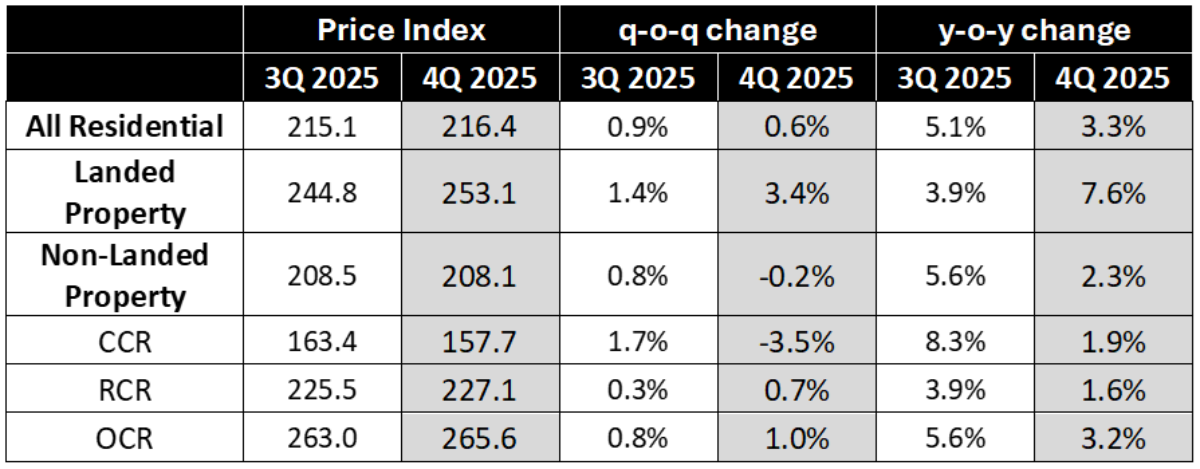
In the fourth quarter of 2025, Singapore’s All-Residential Private Property Price Index rose by 0.6% quarter-on-quarter, extending the growth seen in the previous quarter. While this was slightly slower than the 0.9% increase in 3Q 2025, it still marked the fifth consecutive quarter of price growth, reinforcing the market’s underlying stability.

On a year-on-year basis, private home prices rose 3.3% in 2025, with much of the growth driven by the landed housing segment. This gradual pace of appreciation suggests that the market is expanding in a controlled and sustainable manner, rather than overheating.

For buyers who have been waiting on the sidelines, the data shows that prices are not retreating—but neither are they surging aggressively. This environment tends to favour decisive buyers who are financially ready, rather than those hoping for sharp price corrections.

Transaction Volumes Dip Seasonally, But Full-Year Activity Remains Strong

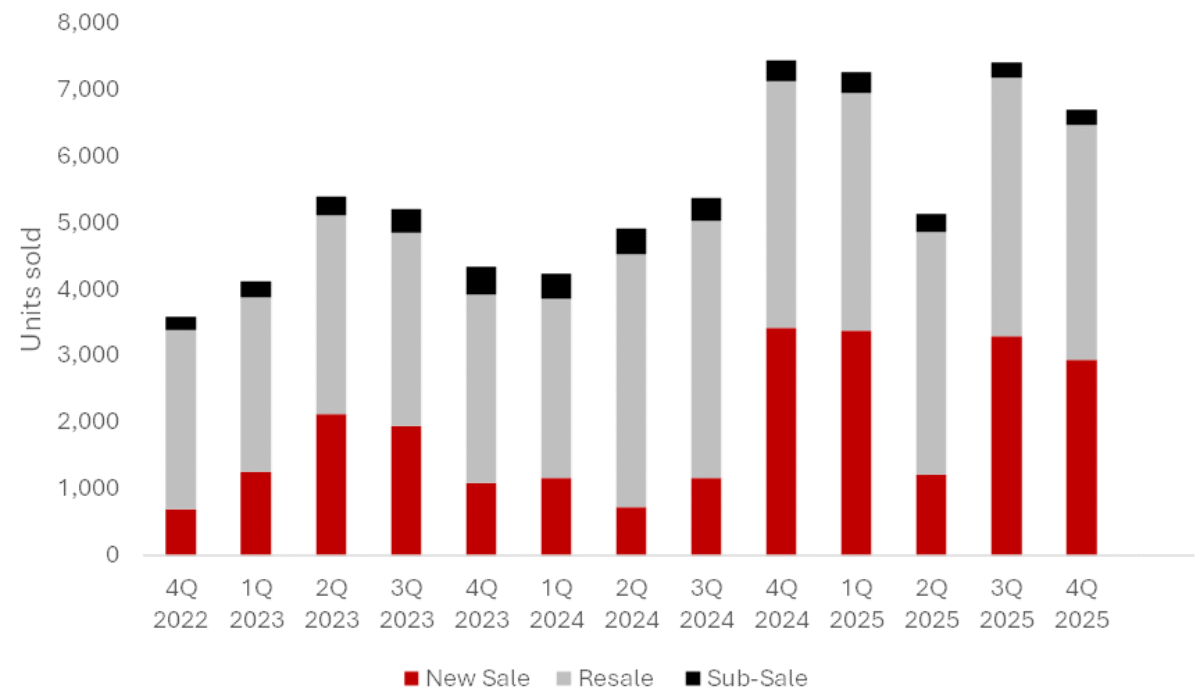
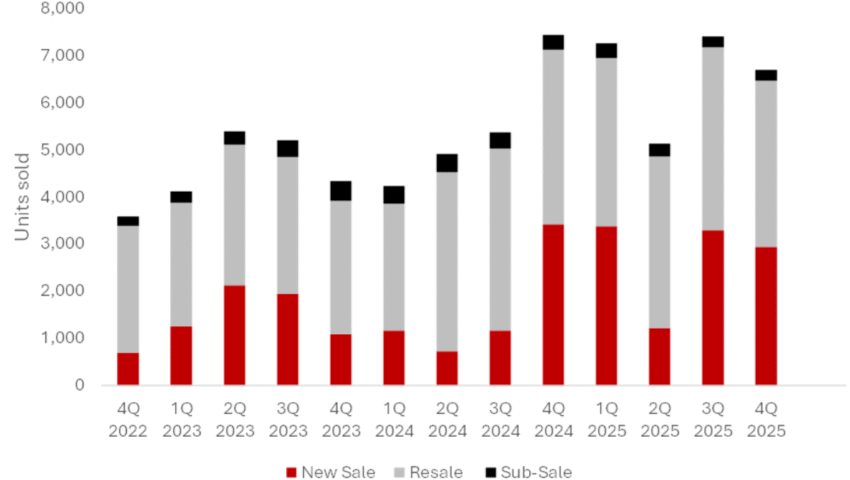
Private Property Transaction Volume after Covid
Private Non-Landed Transaction Volume

A total of 6,699 private home transactions were recorded in 4Q 2025, representing a 9.5% quarter-on-quarter decline. This moderation came after a very strong 3Q 2025, which saw heightened activity driven by eight major project launches.

The softer fourth-quarter performance was largely expected. Developers typically slow down launches toward the end of the year, and buyer activity often dips in December due to school holidays and year-end travel. Importantly, this was a seasonal slowdown rather than a demand-driven pullback.

For the full year, total private home sales reached 26,492 units, highlighting the resilience of Singapore’s housing market even amid global uncertainties earlier in the year.

New Home Sales Remain the Key Demand Driver

Despite fewer launches in 4Q 2025, the primary (new home) market remained robust. Developers sold 2,940 new private homes during the quarter, only a modest decline from the previous quarter’s strong showing.

Across the whole of 2025, 10,815 new homes were sold, making it the best-performing year since 2021. This reflects sustained confidence among buyers, particularly owner-occupiers who are less sensitive to short-term market fluctuations.

A key trend worth noting is the high take-up rates at launch. In 4Q 2025, four out of five new launches achieved over 80% sales on launch day. This mirrors the strong launch-day demand seen in 3Q 2025 and suggests that well-priced, well-located projects continue to attract immediate buyer interest.

For HDB upgraders, this highlights an important reality: desirable new launches do not stay available for long, especially when supply is limited.

Fewer Completions Are Pushing Buyers Toward New Launches

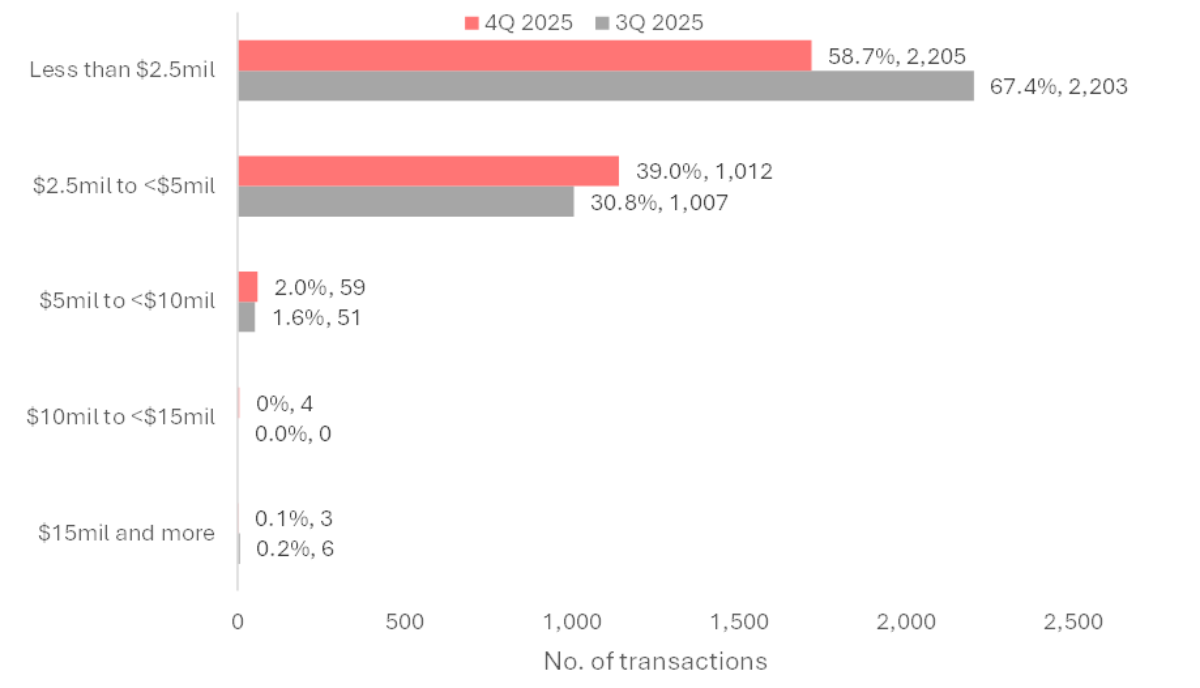
Private Property Transactions by Pricing
New Non-landed Home Transactions by Price Quantum

One structural factor shaping the market is the low number of private home completions. In 2025, only 6,123 private homes (excluding ECs) were completed, significantly lower than the 8,460 units completed in 2024.

This reduced completion pipeline has limited resale and sub-sale supply, pushing more buyers toward the new home market. As a result, developers with ready projects have benefited from spillover demand, especially in popular city-fringe and suburban locations.

This supply dynamic is expected to remain relevant in the near term, which helps explain why developers continue to enjoy strong sales momentum despite fewer launches.

Unsold Inventory Continues to Decline

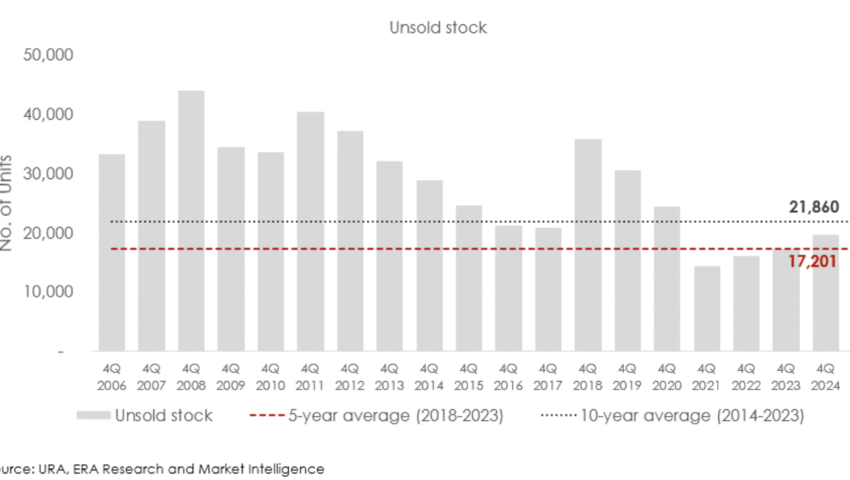
Unsold Units declining
Declining No of Unsold Private Homes

Unsold private residential stock fell 5.2% quarter-on-quarter to 16,193 units in 4Q 2025. This decline came even after several new projects were launched, reflecting healthy absorption rates across the market.

Lower unsold inventory levels generally support price stability, as developers face less pressure to discount aggressively. It also reinforces the idea that demand is keeping pace with supply, particularly for projects that align well with buyer expectations around pricing, location, and layout.

Non-Landed vs Landed Homes: Diverging Price Performance

Change in URA Private Property Price Indexes for 3Q 2025 and 4Q 2025

Non-Landed Homes See More Moderate Growth

Non-landed private homes recorded slower price growth in 4Q 2025, with prices edging down slightly after stronger gains in the previous quarter. This moderation was largely due to a smaller number of launches compared to 3Q 2025, when eight projects entered the market.

That said, price performance varied significantly by region.

Outside Central Region (OCR) non-landed homes saw the strongest growth, rising 1.0% quarter-on-quarter, supported by the strong performance of Faber Residence, which achieved over 90% sales during the quarter.

Rest of Central Region (RCR) prices rose 0.7% quarter-on-quarter, continuing the upward momentum from earlier launches such as Zyon Grand, Penrith, and The Sen.

Core Central Region (CCR) prices declined 3.5% quarter-on-quarter, ending four consecutive quarters of growth. This was largely due to lower transaction volumes, rather than weak interest, as pricing expectations between buyers and sellers temporarily diverged.

Landed Homes Outperform on the Back of Upgrader Demand

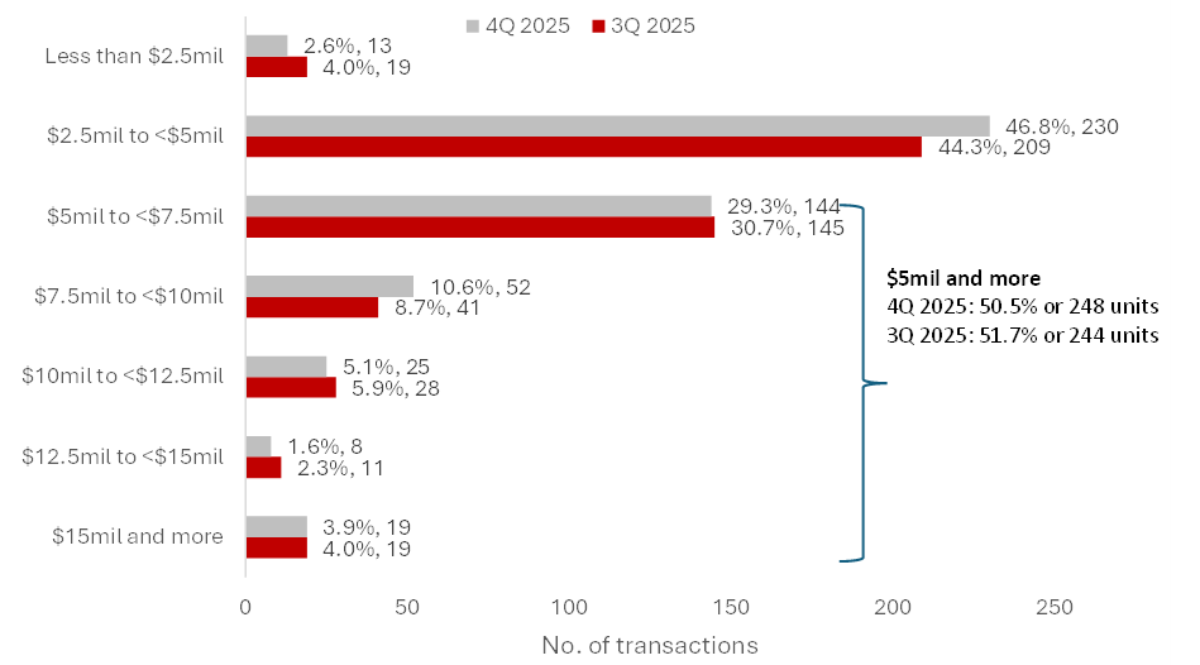
Landed Price Quantum 3Q 2025 versus 4Q 2025

The landed housing segment was a standout performer in 4Q 2025. Prices rose 3.4% quarter-on-quarter, accelerating from the previous quarter and marking the fourth consecutive quarter of growth.

On a year-on-year basis, landed home prices climbed 7.7% in 2025, significantly outpacing non-landed homes. This trend reflects growing interest from condominium owners who were able to upgrade as their property values appreciated.

Transaction volumes for landed homes also increased, with 491 transactions in 4Q 2025, bringing the full-year total to 1,852 transactions, an 11.2% increase over 2024.

Demand was particularly resilient in the OCR and RCR, where buyers found a better balance between space, affordability, and location. In contrast, CCR landed transactions slowed as higher prices led to a temporary standoff between buyers and sellers.

Resale and Sub-Sale Markets Hold Steady

The resale private home market recorded 3,529 transactions in 4Q 2025, a slight moderation from the previous quarter. However, full-year resale transactions totalled 14,622 units, largely in line with 2024 levels.

This consistency highlights the resilience of the resale segment, even as it competes with attractive new launches and faces seasonal slowdowns.

Sub-sale activity remained muted, with only 230 transactions in 4Q 2025. The limited number of new completions in 2025 reduced opportunities for sub-sale transactions, a trend that is likely to persist until completion volumes rise again.

Rental Market Begins to Stabilise

After several years of strong rental growth, the private residential rental market showed signs of stabilisation in 4Q 2025. The All-Residential Rental Price Index dipped 0.5% quarter-on-quarter, reversing the modest increase seen in the previous quarter.

Non-landed rents declined marginally, while landed rents saw a steeper adjustment. Despite this short-term pullback, overall private rents still rose 1.9% for the full year, indicating that rental demand remains structurally supported.

Looking ahead, a growing supply pipeline—combined with policies such as the extended occupancy cap—is expected to keep rental growth in check through 2026 and 2027. For tenants, this could translate into more stable and negotiable rental conditions.

Upcoming Launches in 2026: Supply Remains Managed

The new launch pipeline in 2026 is shaping up to be active but controlled. The year began with the successful launch of Coastal Cabana EC, which sold more than two-thirds of its units shortly after launch.

For the full year, around 19 private residential projects comprising approximately 9,852 units, along with five EC developments offering nearly 2,000 units, are expected to enter the market. These projects span the CCR, RCR, and OCR, catering to a wide range of buyer profiles.

The continued release of land through the GLS programme reflects the government’s commitment to maintaining a stable housing supply and preventing excessive price volatility.

Market Outlook for 2026: Stability with Moderate Growth

The slight pullback in transactions during 4Q 2025 does not signal a weakening market. Instead, it reflects a natural pause following an exceptionally strong third quarter and the usual year-end slowdown.

Heading into 2026, Singapore’s private residential market is expected to remain resilient, supported by:

  • Strong owner-occupier demand
  • Limited unsold inventory
  • Controlled supply from GLS sites
  • Stable employment and income conditions

Barring unexpected global shocks, new home sales in 2026 are projected to range between 9,000 and 10,000 units, while resale transactions are expected to remain in the 13,000 to 14,000 range.

For buyers, this suggests a market that rewards preparation and decisiveness rather than speculation. Prices are likely to trend upward gradually, making well-timed purchases more important than trying to time a market bottom.

Final Thoughts: What This Means for Buyers and Upgraders

The 4Q 2025 URA statistics confirm that Singapore’s private property market remains fundamentally healthy. Demand has proven resilient, supply is being carefully managed, and price growth continues at a sustainable pace.

For HDB upgraders, the ongoing strength in both resale HDB prices and private home demand presents a window of opportunity to transition into private housing with confidence. For first-time private buyers, the coming year offers a diverse range of new launches across different regions and price points.

As always, the key lies in understanding your budget, timing your move strategically, and choosing projects that align with both lifestyle needs and long-term value.

Springleaf New Launch Condo
CategoriesGuide News

Singapore Property Sales Report: What August 2025 Means for First-Home Buyers & HDB Upgraders

Singapore Property Sales Report: What August 2025 Means for First-Home Buyers & HDB Upgraders

Springleaf New Launch Condo

Buying your first home, or upgrading from an HDB flat, is a major decision. You want value, location, timing, future growth—and avoiding pitfalls. The latest developer sales results for August 2025 provide a compelling window into where the Singapore private housing market is headed. Here’s what you need to know, how to interpret the numbers, and what factors matter most for you.

Key Figures: Surge in Sales & What It Signals

In August 2025, developer sales in the private home (non-landed) segment (excluding Executive Condominiums, or ECs) jumped to 2,142 new homes sold. This is the highest monthly total since November 2024.

Compared to July 2025, that’s an increase of approximately 128%, and when measured year-on-year versus August 2024, it is over ten times as many units sold.

Including ECs, total developer sales were even higher (2,338 units) in August, reflecting continued interest in that segment from upgraders and those wanting more space while keeping cost more manageable. 

What’s fueling this surge? It’s largely driven by fresh new launches. Five major projects—Springleaf Residence, River Green, Promenade Peak, Canberra Crescent Residences, Artisan 8—accounted for about 88% of August’s non-EC developer sales. Also, the number of units launched in August rose sharply vs July (49% higher).

For first-home buyers and upgraders, this kind of momentum means more choices, more competitive pricing in some projects, and possibly better negotiating or timing windows—especially in projects that are less premium or slightly further out.

Breakdown by Region: CCR, RCR, OCR

Private New Home Sales Comparison
Private New Home Sales July vs August

When you’re upgrading from an HDB flat, where your new home is matters a lot: proximity to MRT / work / schools, neighbourhood quality, and long-term value. Here’s how things looked by region in August.

  • CCR (Core Central Region): 513 units sold in August—this is a strong rebound. CCR has been quiet in past months, but August saw demand rise significantly. Some of the headline projects here were River Green (451 units sold, ~86% of its total) with a median price around S$3,111 psf. Also, UpperHouse at Orchard Boulevard moved solidly.

  • RCR (Rest of Central Region, city-fringe): RCR had 476 units sold, a slight decrease from July but still showing strength. Projects like Promenade Peak (333 units sold) and Artisan 8 contributed. RCR gives a bit more space for money, often slightly lower quantum per unit but still fairly central. 

  • OCR (Outside Central Region, more mass-market / suburban): This region took the lead in volume in August with 1,153 units sold (non-EC). That’s a major jump from July’s OCR sales (which were very low). Projects like Springleaf Residence (884 of its 941 units sold, almost full take-up) and Canberra Crescent Residences sold well here. OCR is attractive for first-home buyers / HDB upgraders who need more space per dollar.

Pricing & Quantum: What Buyers Paid

One of the biggest concerns for HDB upgraders or first-timers is “How much will this cost me?“ Quantum (total purchase price), psf (price per square foot), and what portion of units in a launch are below certain thresholds, matter a lot.

Here are some of the numbers that stand out in August 2025:

  • A large portion (around 79-80%) of units sold in the major new launches were priced below S$2.5 million. That means most of what people bought were mid-market range, not ultra luxury

  • Median psf in the OCR projects were generally lower. For example, Springleaf Residence had a median price of S$2,166 psf, Canberra Crescent Residences about S$1,991 psf

  • In CCR, median psf is much higher: River Green ~ S$3,111 psf; UpperHouse ~ S$3,353 psf, etc. 

  • For ECs, Otto Place EC continues to see strong demand. In August, 196 EC units were sold, nearly fully sold (Otto Place ~90% sold by end-August). Median price ~ S$1,760 psf. ECs remain attractive as a “step between HDB and private condo” option. 

So for HDB upgraders: if you’re considering private, OCR and RCR launches offer more affordable quantum for space; CCR demands premium, but may offer prestige or future capital appreciation.

Buyer Profile & Foreign Participation

Another key factor: who is buying? And how much foreign/PR participation is there? These affect policies, competition, and sometimes sentiment.

  • Singaporeans dominated buyer volume: in August ~ 90.6% of buyers were citizens. PRs made up about 8%, and foreigners only ~ 1.4%.

  • This means that most of the demand is from local owner-occupiers or upgraders, not foreign investors. For HDB upgraders, this reduces one element of external competition (though competition from other locals is still strong).

  • Price thresholds matter: many bought units under S$2.5M. Very few super-luxury units; even within CCR, a portion of units is priced more “affordably” (relatively) under that threshold. This pricing mix seems deliberate by developers to hit that “sweet spot” which many upgraders / first-homeowners aim for.

Price range ARTISAN 8 CANBERRA CRESCENT RESIDENCES PROMENADE PEAK RIVER GREEN SPRINGLEAF RESIDENCE Total
Below $1 mil6.7%1.4%0.0%0.0%0.9%0.6%
$1 mil to <$1.5 mil6.7%38.4%6.0%17.5%38.2%27.4%
$1.5 mil to <$2 mil53.3%45.5%38.1%44.6%25.3%34.6%
$2 mil to <$2.5 mil13.3%12.8%21.0%14.0%17.4%16.7%
$2.5 mil to <$3 mil20.0%1.9%6.9%18.2%14.3%12.6%
$3 mil to <$3.5 mil0.0%0.0%11.7%5.3%3.8%5.1%
$3.5 mil to <$4 mil0.0%0.0%6.6%0.4%0.0%1.3%
$4 mil to <$5 mil0.0%0.0%4.8%0.0%0.0%0.8%
$5 mil to <$7 mil0.0%0.0%4.8%0.0%0.0%0.8%
Total100%100%100%100%100%100%
Proportion below $2.5 mil80.0%98.1%65.2%76.1%81.9%79.4%

Timing & Launch Strategy: What August Tells Us

Lynderwoods showflat high demand
New Launch balloting

Timing of launches, especially around cultural dates and “quiet months,” is often underappreciated by buyers. August 2025 is illustrative:

  • Developers pushed out multiple launches before the Lunar Seventh Month (starts 23 August in 2025) to avoid the traditional lull. Auctions/launches drop during Ghost Month, typically less demand. 

  • As a result, projects like Springleaf Residence, River Green, etc., launched earlier in the month and captured buyer interest before the expected slowdown. That means timing your decision (and being ready when showrooms open) can make a difference.

  • The number of new units launched in August (for sale) was 2,496 (excluding ECs), significantly more than in July. That means more fresh inventory, more choice. 

So, if you’re a buyer, observing launch calendars, showflat previews, and being ready to act early matters a lot. Waiting for discounts may or may not work, depending on supply and demand.

What This Means for HDB Upgraders & First-Home Buyers

Putting together all the data above, what are the takeaways for people in your situation?

  1. Budgeting & Quantum Expectations
    If you’re upgrading from an HDB flat, expect that a private 2- to 3-bedroom in OCR or RCR may cost in the range of S$1.5M to S$2.5M (depending on location, amenities, psf). CCR options will generally cost more (often S$2.5M+). Make sure you include all additional costs (stamp duties, legal fees, renovations).

  2. Location vs Price Trade-Off

    • Want to stay close to the city, shorter commute? CCR or near MRT RCR homes are appealing but come at higher psf.

    • If you can compromise somewhat on location, OCR releases like Springleaf / Canberra Crescent offer much more space per dollar. For many upgraders, this is a sweet compromise.

  3. New Launch vs Waiting
    New launches in “good” projects are selling fast. If you find a project that matches your criteria, acting early helps. Missed launch may mean higher prices later or less favourable unit choices (higher floors, odd facing). But rushing without due diligence (on developer reputation, contract terms, connectivity etc.) could lead to regrets.

  4. Financing & Affordability
    Lower mortgage rates (or expectations thereof), stable income, and healthy loan-to-value (LTV) ratios are encouraging. But don’t overextend. Make sure monthly repayment fits comfortably with your other expenses. Also be aware of future maintenance, property tax, and renovation costs.

  5. Consider ECs (Executive Condominiums)
    ECs like Otto Place are appealing for upgraders who want private lifestyle features but at lower quantum. They offer a middle ground. Keep an eye on upcoming ECs (e.g. Coastal Cabana, Tampines Street 95) as they may offer good value.

  6. Policy Risks & Resale Potential
    Policies (like Additional Buyer’s Stamp Duty (ABSD), Loan-to-Value limits, cooling measures) can shift, especially for CCR and higher-quantum properties. Always leave room in your planning. Also, consider resale potential: homes nearer MRTs, good schools, good connectivity & amenities tend to retain or increase value better.

  7. Emotional & Lifestyle Factors
    First-home buyers often look for functionality: size, layout, amenities, travel time, schools. Upgraders may also value prestige, view, brand, or future resale. Be clear what’s your priority: are you buying to live or partly to invest? Does prestige matter, or maximizing usable space?

Risks & What to Watch Out For

While numbers are encouraging, not everything is perfect. Here are the risks:

  • Seasonality Slowdowns: After a strong August, slowing in September is expected, because of Ghost Month and fewer launches. That may temporarily relieve pressure, but could also mean fewer options.

  • Rising Costs: Land prices, construction costs, labour, materials—all continue to rise. That may force developers to raise asking prices or reduce “sweet-spot” units. If you wait too long, you may pay more.

  • Financing Headwinds: If interest rates rise, or bank policy becomes more conservative, your mortgage costs could go up. This impacts monthly cashflow.

  • Competition: Good projects (location + developer + pricing) are attracting many buyers. Getting in early helps, but you need to be ready with financing, decision-making, and possibly some flexibility.

What First-Home Buyers & Upgraders Should Do Now

To make the most of this market while minimizing risk, here are practical steps:

  1. Define Your Priorities Clearly
    Decide what matters most: commute time, school proximity, size vs prestige, view vs cost. Make a checklist.

  2. Set a Firm Budget
    Including not just purchase price, but stamp duty, legal costs, maintenance, renovations. Use mortgage calculators. Talk to lenders — get in-principle approvals so you know how much you can borrow.

  3. Monitor New Launch Calendars
    Keep an eye on upcoming projects: in August the launches drove most of the sales. Look at upcoming ones: Penrith, Zyon Grand, The Sen etc. These may offer units in your preferred region / price bracket.

  4. Be At Showflats Early
    Project showflats open, or preview, often before formal sales. Attending early lets you see unit facing, layout, offer schemes etc. Also, early applications sometimes get better units (lower storeys, better view).

  5. Understand the Lease & Tenure Differences
    Especially in CCR vs RCR vs OCR, lease tenure, freehold vs leasehold, and remaining lease life can affect value/resale. Also check developer reputation and track record.

  6. Negotiate & Compare
    Don’t accept the first offer without comparing similar projects (location, psf, amenities). Sometimes developers throw in perks (fitting, furniture, rebates). These can ease the burden.

  7. Plan for the Long Term
    Even if you buy to live, think about resale or rental potential, in case life changes. Proximity to future MRTs, master plan enhancements, or upcoming infrastructure will matter.

Looking Ahead: What to Expect in 2H & Into 2026

With the strong performance in August, what might the rest of 2025 and early 2026 look like for private new home launches and sales?

  • Experts now expect total new home sales (excluding ECs) for the full year 2025 to reach between 9,000-10,000 units, up from earlier forecasts of 8,000-9,000.

  • Several projects are expected to launch in Q4 2025: Penrith, The Sen, Zyon Grand, Faber Residence, Skye at Holland etc. Buyers should watch these closely.

  • Pricing pressure may increase, especially in CCR, as demand returns and land/construction cost increases persist. Developers will likely try to balance “quantum” appeal vs profit margin.

  • More units in OCR may be introduced to meet demand from upgraders and first-home buyers who want space/value. EC launches may be fewer; many upcoming EC projects are further ahead (Q1 2026 etc).

  • Policy environment is likely to remain stable but could be adjusted (e.g. ABSD, loan-to-value) if markets overheat. Buyers should monitor policy announcements.

Real-Life Examples: Projects That Could Be Good Fits

Here are some actual projects from August 2025 that may suit upgraders / first-home buyers. I’m selecting ones that combine good value, location, and realistic quantum.

ProjectRegionUnits & Take-UpMedian / Typical Price PSFWhat Makes It Attractive
Springleaf ResidenceOCR (Upper Thomson)~884 of 941 units sold (≈94%)~ S$2,166 psfLarge launch, strong take-up, fairly central, but more affordable than CCR; good if you want balance of space + accessibility.
Canberra Crescent ResidencesOCRSold ~211 units in month (56%)~ S$1,991 psfLower psf, decent project; good for upgraders who want lower quantum but modern amenities.
River GreenCCR (River Valley / Great World area)~451 units sold (≈86% of launch over time)~ S$3,111 psfVery premium; iconic location; great if you can stretch budget and want prestige.
Promenade PeakRCR~333 units sold (≈56% of units)~ S$2,919 psfCity-fringe option with RCR location; good middle ground if CCR quantum is too steep.
Otto Place ECEC segment~191 units sold in August; nearly sold out~ S$1,760 psfEC often has lower entry quantum; good stepping stone from HDB to private.

These help show what you can expect in real terms: where price per square foot will likely be, and how fast units sell in good projects.

Conclusion

August 2025 was a landmark month for Singapore private developer sales. For first-home buyers and those upgrading from an HDB flat, it brings renewed optimism: more launches, more units below S$2.5 million, and better options in OCR and RCR. CCR is also waking up again, though you pay a premium.

If you’re planning to buy soon, now is a strong moment: with good launches, competitive pricing, and healthy market activity. But don’t rush blindly. Clarify your budget, location priorities, unit type, and factor in all costs. Be ready for sales spikes, but also for quieter months ahead. With careful planning, you can pick a home that fits your needs, lifestyle, and financial comfort—both now and in the long-term.

Bayshore Road GLS Site
CategoriesGuide News

Vela Bay: A Landmark Breakthrough in East Coast Living

Vela Bay: A Landmark Breakthrough in East Coast Living

Bayshore Road GLS Site
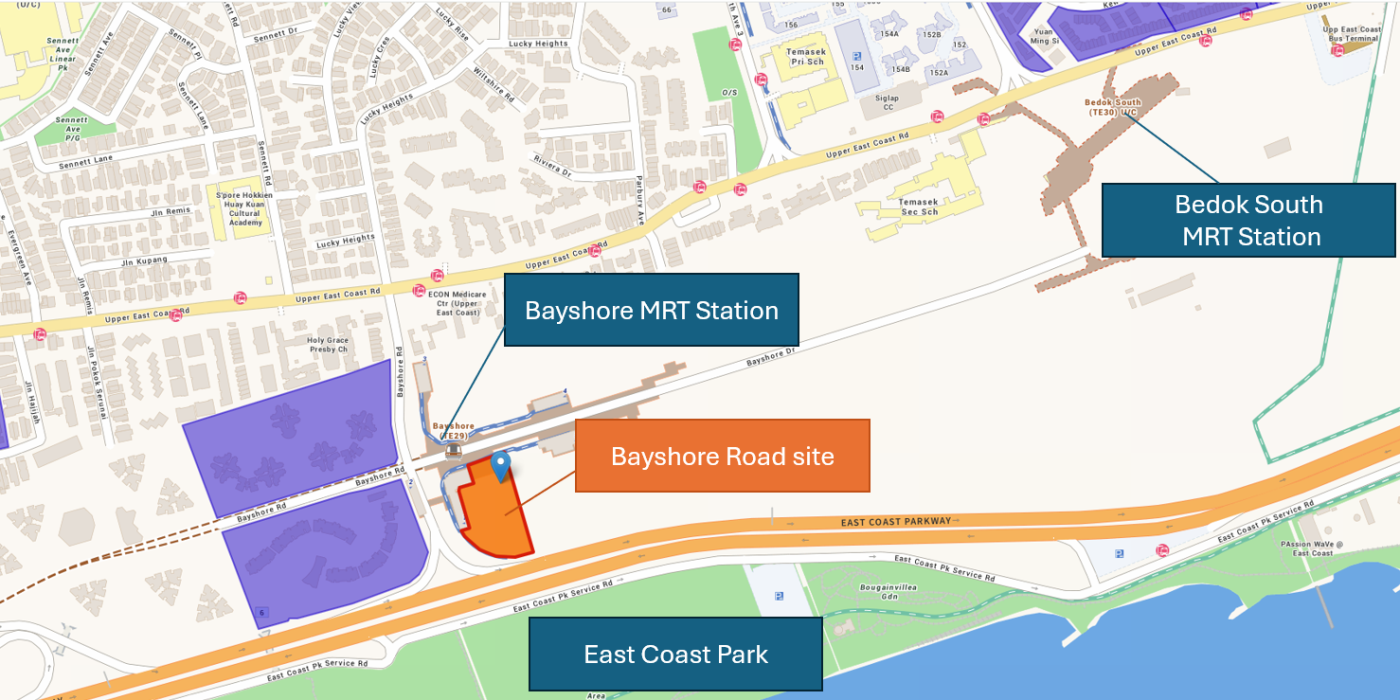
Bayshore Residences Location map

<TLDR>

The Bayshore Road GLS site which will be called Vela Bay, launched by URA in November 2024 and closed in March 2025, drew eight bids, with Sing-Haiyi Garnet winning at S$658.9 million or S$1,388 psf ppr—setting a new suburban record. Boasting prime MRT access, sea-views, and located at the heart of the 60 ha Bayshore Master-Planned precinct, the site exemplifies strong developer confidence and pent-up homebuyer demand in a rejuvenating East Coast district.

1. The Site in Context: Location, Launch, and Scale

Launch and Tender Timeline
URA launched the Bayshore Road GLS site on 26 November 2024, with the tender closing on 18 March 2025.

Parcel Details and Yield

  • Land Size: Approximately 10,497.3 m² (or ~112,992 sq ft).

  • Gross Floor Area (GFA): Maximum of 44,089 m² (~474,570 sq ft), projected to yield around 515 private housing units.

This makes it a medium-scale, highly strategic GLS site, ideal for both major and mid-tier developers.

Location Bayshore
Region Outside Central Region (OCR)
Planning Area Bedok
Site Area 1.05 HA / 10,500 sqm (113,021 sqft)
Gross Plot Ratio 4.2
Land Use Zoning Residential (non-landed)
Maximum Gross Floor Area (GFA) 44,100 sqm (474,688 sqft)
Estimated Housing Units 515

2. Developer Competition and Record Bid

Intensity of Bidding
The tender attracted eight bids, marking the highest turnout for a private residential GLS since Jalan Tembusu in 2022.

Winning Bid Details

  • Winner: Sing-Haiyi Garnet (a JV between SingHaiyi Group and Haiyi Holdings) – S$658.9 million.

  • Land Rate: S$1,388 psf ppr.

Competitive Margin and Market Sentiment

  • The winning bid exceeded the next highest offer by a mere 0.8%, reflecting closely matched valuations.

  • Notably, business analysts also interpret the ~20% premium over some expectations as an indicator of developer confidence in this site’s potential.

3. Record-Breaking Suburban GLS Benchmark

New Highest Suburban GLS Land Rate
At S$1,388 psf ppr, this surpasses the previous OCR (Outside Central Region) record held by Clementi Avenue 1 (S$1,250 psf ppr) and slightly exceeds Lorong 1 Toa Payoh (S$1,360 psf ppr).

Blurring of Market Segments
The land rate even rivals those seen in RCR and CCR GLS plots—such as Zion Road (RCR) at S$1,202–1,304 psf ppr and Holland Drive (CCR) at S$1,285 psf ppr—indicating developers are increasingly valuing site merit over zoning labels.

4. Why the Fierce Developer Interest?

4.1 First Movers in a New Waterfront Precinct

Located in the 60 ha Bayshore precinct, this is the first private residential site released under a master plan aiming to deliver 3,000 private and 7,000 HDB flats (~10,000 new homes). Developers coveted the first-mover advantage in shaping this new East Coast estate.

4.2 Excellent Connectivity

  • Bayshore MRT Station, at the doorstep and part of TEL Stage 4, opened 23 June 2024, providing seamless access to Downtown and beyond.

  • Proximity to East Coast Parkway (ECP) ensures fast private-vehicle access to city center and Changi Airport (approx. 15-minute drive).

4.3 Lifestyle and Scenic Appeal

Some future units are expected to offer unobstructed sea views and direct access to East Coast Park, elevating their desirability.

4.4 Pent-up Demand from Upgraders and Investors

  • No significant private condo launch in Bayshore since Costa Del Sol (2000) or The Bayshore (~1990s), creating pent-up demand.

  • Potential buyers include:

    • HDB upgraders from Marine Parade and Bedok; around 2,012 flats will fulfill their MOP within two years, offering financial flexibility for condo upgrades.

    • Landed homeowners from enclaves like Kew and Sennett estates seeking modern, low-maintenance living.

    • Investors drawn by rental prospects and strong locational attributes.

4.5 Developer-Friendly Scale

The site’s modest yet substantial scale appealed to mid-tier developers with lower risk appetites, allowing for aggressive, yet manageable bids.

5. Site’s Value Drivers and Visionary Planning

5.1 Masterplan

Bayshore will be a new housing estate, planned as an extension of Bedok town. It is located along East Coast Park, with two MRT Stations (Bayshore and Bedok South) within the estate. Designated as a car-lite district, there will be a transit proximity corridor that acts as a community spine with sheltered walkways and cycling paths. The entire estate will inject approximately 10,000 new homes, of which around 30% is meant for private housing.  Bayshore is zoned as a car-lite precinct.

The Masterplan for Bayshore area is set to enhance overall connectivity and increase the availability of amenities in the area for residents, both existing and new. As a new estate, there will be smart and sustainable features, while the living environment will encourage active lifestyles and healthy living.

The plot is the first private residential site in the up-and-coming Bayshore precinct and an inaugural project under the Bayshore Master Plan.

5.2 Car-Lite, Sustainable Urban Design

The Bayshore MRT Station will serve residents, located just across the road. Being on the Thomson-East Coast Line (TEL), commuters can travel directly to Marina Bay, Orchard, Upper Thomson and Woodlands.

For drivers, there is direct access to major roads such as the East Coast Parkway (ECP) Expressway which directly connects to central Singapore within a 15-minute commute time and Changi Airport.

Additional cycling networks will be developed in-line with the government’s vision to develop a car-lite neighbourhood, while connecting Bayshore with Round Island Route and the upcoming corridor from East Coast Park to Changi Beach.

The Bayshore precinct has been designated as a car-lite development, featuring dedicated walking and cycling networks, wider pavements, and proximity to public transportation.

5.3 Green and Transit-Oriented Design

Plans include a 1 km public transit street, green corridors, and integration with Cycle Round Island Route, linking Bayshore to East Coast Park and Changi Beach.

5.4 Infrastructure Enhancements

LTA plans include a new flyover to ECP by 2030, a bus-priority transit corridor, cycling paths along the flyover, and improved connectivity to Bedok South MRT station (opening 2H 2026).

5.5 Community Amenities and Planning Synergies

SchoolDistance to site
Temasek Primary SchoolWithin 1km
Temasek Secondary SchoolWithin 1km
Bedok Green Primary SchoolBetween 1km to 2km
Bedok View Secondary SchoolBetween 1km to 2km
Victoria School (Secondary)Between 1km to 2km
Bedok South Secondary SchoolBetween 1km to 2km

Within a 1–2 km radius are educational institutions such as Temasek Primary, Secondary, and Junior College, and upcoming mixed-use developments above Bedok South MRT.

By 2026, another three stations (Bedok South, Sungei Bedok and Xilin) will be completed. This will provide residents with rail access to the Singapore University of Technology and Design (SUTD), the only university in the east.

6. Launch Price Forecasts & Market Impact

Expected Selling Prices
Analysts project launch prices from S$2,500–2,700 psf, with averages above S$2,800 psf depending on design and fit-out quality.

Broader Market Significance

  • The top bid surpassing recent RCR/CCR rates signals that location quality now trumps regional classification in developer assessment.

  • The sale reaffirms strong market resilience and renewed buyer sentiment since late 2024’s buoyant new home launches in Singapore.

  • From 2020 to 2024 September, the median price psf of non-landed homes in Bayshore, District 16 and OCR have increased by 29.7%, 30.5% and 24.7% respectively. The growth in all areas are relatively paced at the same rate, with District 16 leading the increase in prices.
Planning Area/DistrictMedian Prices of Properties in 3Q 2020Median Prices of Properties in 3Q 2024% Change in Median Price
Bayshore$1,161$1,50629.7%
District 16$1,161$1,51530.5%
Outside Central Region$1,318$1,64324.7%

However, prices in District 16 could have been propped up by new launches in the area, whereas median prices in Bayshore are based on recorded resale transactions given the lack of new projects.

7. Potential Demand/Buyer Profile

With the Bayshore area being largely undeveloped since existing projects launched more than two decades ago, the addition of 515 out of an estimated 3,000 new private homes leads major initiatives in rejuvenating the area.

The site could also potentially attract HDB upgraders given that an estimated 2,012 flats will also fulfil their MOP within the next two years. The median price of 5-room and 4-room flats of less than 15 years transacted in Bedok at $976,500 and $815,000 respectively from January 2024, which could contribute to the down payment for a new home in Bayshore.

The Bayshore area is located in proximity to numerous private landed housing enclaves, such as the Kew and Sennett Estates. Demand could come from the sizable population of landed home owners, with older owners seeking to right-size their homes, or from larger families who want to live in the same project.

The last new launch at Siglap Road (Seaside Residences) in April 2017 saw 70% of  released units sold at launch. With 60% of the buyers identified from the East, the new launch with an attractive location and pricing highlights the pent-up demand in the area.

Buyers who see owning a private property as a long-term investment may see this Bayshore development as a viable option. Although future HDB estates nearby in Bayshore are likely to be classified as Plus, they could still generate upgrader demand. This provides a potential exit strategy in the future, as they could then right-size if they choose to.

While we can expect strong demand for this estate, developers having a strategic unit mix will be crucial for Bayshore Road’s eventual developer to address the diverse needs of different buyer segments. This includes catering to investors seeking rental opportunities, landed property owners right-sizing from nearby enclaves like the Kew and Sennett estates, and families (including HDB upgraders) relocating from nearby Tampines and Bedok.

With the right unit mix and pricing, we can expect the future development to be poised to draw significant buyer interest from aspiring first-movers, as well as upgraders. Homeowners from the many nearby projects, which are at least 20 years old, may consider moving to a brand-new development with the same locational attributes and a refreshed lease.

8. Multitude of Opportunities to be Leveraged on by Developers

Older condos along East Coast Parkway have significant en bloc potential, however, they could be unsuccessful due to the development’s large size. Previous en-bloc efforts of Laguna Park have failed, with the most recent tender in 2019 at $1.48 billion closing with no applicants. Mandarin Gardens had also failed to secure the required 80% threshold. A successful en bloc launch of the development could have seen reserve price of $2.88 billion ($953 psf ppr).

The last GLS site along East Coast Parkway at Siglap Road (Seaside Residences) was awarded at $624 mil ($858 psf ppr) to the highest of eight bids in 2017. The site’s premium location boasting the unique characteristic of sea views could have attracted developers to contend for the site.

Bayshore Road site is one of the more attractive sites on the 2024 GLS Confirmed List. Having observed lukewarm responses for previous sites, developers could have withheld bids to attempt competing for Bayshore.

The palatable size of the development could also be an attractive attribute for smaller developers, which they can leverage on to place competitive bids with lower risks.

9. Developer Sentiment & Market Interpretation

Analyst Commentary on Bidding Behavior

  • ERA’s Marcus Chu noted strong developer interest due to site appeal and manageable size, leading to aggressive bids.

  • Knight Frank (Leonard Tay) emphasized that developers held back on other tenders to focus on Bayshore, given its attractive positioning.

  • PropNex’s Wong Siew Ying described the result as bullish, pointing to pent-up demand and first-mover advantage as key motivators.

Individual comments:

“With no new private homes in Bayshore for over 20 years… we may expect keen demand for the future project here when it is launched.” — Justin Quek, OrangeTee & Tie Singapore Business Review.

10. Developers Could Compete for First-Mover Advantage in New Township

The Bayshore Road site marks the first GLS site in Bedok since 2020 and Bayshore area since 1997, highlighting the scarcity of new private residential homes. Given its prime location next to an MRT station, developers are more willing to fork out a premium to secure the attractive site.

The upcoming Bayshore estate also draws similarities to the township development in Lentor whereby new launches in the area consecutively set the bar for future launch prices. It will be in the developers’ best interest to leverage on first-mover advantage in penetrating the market for private residential homes in Bayshore.

The wave of new launches in November garnered overwhelming response. Emerald of Katong achieved a record-high with 99% of the development sold, along with Chuan Park with 76% sales during its launch weekend. This strong indication of homebuyer optimism could translate to strong developer confidence in future GLS performance.

11. Future Outlook and Strategic Considerations for Developers

11.1 Importance of Unit Mix

To satisfy diverse buyer segments—investors, HDB upgraders, and right-sizers—developers must craft a strategic mix of unit types (e.g., compact 1-bedroom through family-oriented 4-bedroom units) and price points.

11.2 Phased Construction and Launch Timeline

Given land tender in March 2025, planning, permits, and construction suggest launches likely from late 2026 onwards, with completion over the early 2030s.
In parallel, HDB’s Bayshore Vista and Bayshore Palms (BTO) were launched in October 2024, and future precinct development will follow incrementally.

11.3 Positioning as a Signature East Coast Coastal Development

With its core attributes—sea views, seamless connectivity, and sustainable precinct design—the project has the potential to become a flagship in East Coast living.

12. Frequently Asked Questions

Q1: Why did the Bayshore GLS attract so many bids?
A: It combined a strategic location (MRT and ECP), sea-views, pent-up demand due to no major launches since 2000, and manageable parcel size—boosting developer confidence.

Q2: What are expected selling prices for new units?
A: Industry analysts estimate S$2,500–2,700 psf entry-level prices, with averages above S$2,800 psf, depending on design and finishes.

Q3: What infrastructure will support resident lifestyle?
A: Features include Bayshore MRT (TEL), ECP access, upcoming flyover and transit corridor, educational amenities, green pedestrian/cycling paths, and future mixed-use nodes.

Conclusion

The Bayshore Road GLS site attracted strong developer interest, with eight bidders competing in a highly competitive round. Sing-Haiyi Garnet had the highest bid of $658.8 million ($1,388 psf ppr), narrowly edging out the next highest bidder by 0.8%.

Despite headwinds faced by developers in the market, the Bayshore site is one of the land parcels many developers have been waiting for this year. The site’s allure and expected pent-up demand from buyers could give them confidence and provide the impetus for the aggressive bidding. Moreover, the plot’s palatable size could be draw for smaller-scale developers which resulted in the strong interest.

While bids amongst the top four bidders were aggressive, with a difference of 8%, there was a significant 35.9% gap between the lowest and highest bids. This reflects mixed market sentiments and the buying appetite of future buyers. Nonetheless, this site sets a new OCR land price benchmark, surpassing previous records in Clementi (now Elta) while being similar to Toa Payoh (now The Orie) in the RCR.

CategoriesNews

July–August 2025 New Launch Surge: What It Means for Buyers

July–August 2025 New Launch Surge: What It Means for Condo Buyers in Singapore

If you’re eyeing a new condo upgrade this year, things just got interesting. July 2025 saw a massive rebound in new private home sales. And if early August is anything to go by—you’re going to want to sit up and pay attention. More launches, strong take-up, and cooling price gaps between core and fringe zones are shaking up what buyers can expect. Here’s what’s really going on—without the fluff.

Lynderwoods showflat high demand
New Launch balloting

1. Sales Spiked—Why It Matters

High Transaction Volume in Aug 2025
Spike in Price and Volume in Aug 2025

In July, developers moved 940 new private homes (excluding executive condos)—a 245.6% jump from June and 63.2% higher year-on-year. That means buyers are back. Property demand is turning up the heat again.

And the action didn’t stop there. Early August saw three big launches—River Green, Promenade Peak, and Canberra Crescent Residences—sell over 900 units in just the first two weeks. We could see more than 1,500 total new home sales by end of August, the strongest monthly tally since late 2024.

2. Where the Buyers Are Coming In

Rest of Central Region (RCR) continued to shine, owning over half of July’s sales. LyndenWoods sold out 331 units at a median of S$2,463 psf with a stunning 97% take-up.

Meanwhile, Core Central Region (CCR) came roaring back. Projects like The Robertson Opus and UpperHouse at Orchard Boulevard together accounted for 357 units—CCR’s best monthly showing in over four years. Their median prices clocked above S$3,250 psf.

OCR demand was quieter—but that’s about to change as new launches like Canberra Crescent and Springleaf pick up steam.

3. What Drove the Buying Boom?

Declining New Home
Limited Supply in Singapore Property Market
  • Sweet-spot pricing: Many units were priced under S$2.5m, keeping them attractive even in CCR. About 73% of LyndenWoods units fell under that threshold.

  • Local buyer dominance: Singaporeans made up 86% of purchases, PRs about 12%. Foreign demand remains modest.

  • Luxury segment recovery: A handful of S$5m+ deals, including a duplex penthouse at 21 Anderson for S$52m, show high-end demand remains resilient.

  • Limited Supply: Declining New Home Supply with lower than average unsold units in the market.

4. What It Means for You (If You’re Upgrading)

SignalMeaning for Buyers
RCR launching strongJump early into fringe projects for better value
CCR comebackPrime luxury returns—value narrowing vs RCR
Strong local uptakeBe ready to move fast; months-long decision windows may be gone
August supply boostMore choices—but competition will be fierce

5. August Outlook and Beyond

Up and Down of Singapore's Private Housing Market
Price trend of Singapore Housing Market

Experts expect Q3 2025 to finish with 4,500 new units launched, and full-year developer sales (excluding ECs) could hit 8,000 to 9,000—way ahead of 2023 and 2024. That means more options and potentially more value—but prices are likely to hold firm.

Conclusion

July’s rebound tells us buyers are confident again. Whether you’re upgrading soon or planning ahead, the window is opening—but it won’t stay open forever. If you’ve been waiting on the sidelines hoping for prices to soften, you might be too late.

Pro tip: Start watching upcoming projects now, especially in RCR. Check developer pricing, sales pace, and compare PSF before making your move. Competitive launches are returning—and early buyers stand to gain.

HDB Price Trend and Number of Transactions
CategoriesNews

2Q 2025 Private & HDB Report: What Upgraders Must Know 🏡

Q2 2025 Private Residential & HDB Resale Report: What Upgraders Must Know

Singapore’s property market in 2Q 2025 remained remarkably resilient, even as transaction volumes softened. For upgraders planning the leap from HDB to private homes, these insights are essential in shaping your timing and strategy.

🔹 Private Residential Market: Prices Gain, Volumes Dip

Singapore Private Condominium Price Index Q2 2025
Private Condo Price Index 2012-2025

URA’s flash data shows private home prices up 0.5% quarter-on-quarter, reflecting steady demand despite 40.2% fewer transactions (4,340 units) compared to Q1 2025 

  • CCR units (Central Core Region) saw the strongest price rise at +2.3% q-o-q

  • OCR segment (Outside Central Region) grew 0.9% q-o-q

  • RCR region (Rest of Central Region) saw a mild 1.1% decline 

What’s behind it?

  • Calendar factors like elections and June school holidays slowed new project launches

  • Recent CCR projects—such as Bloomsbury Residences, One Marina Gardens, 21 Anderson, and Arina East—offered boutique, freehold options that drew discerning buyers 

On resale and sub-sale private properties:

  • Resale transactions fell 18.6% to 2,547 units

  • Sub-sale dipped 37.9% to 187 units

  • But resale prices still climbed 1.8% (median $1,749 psf), and sub-sale remained elevated (~$2,059 psf)

What this means for upgraders:

  1. Fewer new launches mean strong pricing on proven private homes.

  2. CCR remains the standout growth potential, especially boutique freehold offerings.

  3. Secondary market still offers attractive pricing if you’re ready to move fast.

🔹 HDB Resale: Record Prices, Tight Supply

HDB Price Trend and Number of Transactions
HDB Price Index & Transaction Volume 2022-2025

Meanwhile, HDB resale prices continue their steady climb, reaching an RPI of 202.8 (+0.9% q-o-q) in Q2 2025—marking 21 straight quarters of growth.

However, transaction numbers slid to 6,981 units (−5% y-o-y)—a seasonal lull amid holiday calm and the upcoming July BTO/SBF launches.

Key trends:

  • MOP supply hit a decade low, with only 6,974 flats eligible—an 11-year low—tightening central estate resale options.

  • A record 408 flats – mostly 4-room units in mature estates – crossed the $1 million mark.

  • Yet ~73% of flats remain within affordability range:

    • 50% priced S$500k–750k

    • 23% at S$250k–500k

Why it matters for upgraders:

  • Higher resale prices mean your HDB can generate more cashflow toward your private property deposit.

  • Low supply plus BTO/SBF delays makes timely resale action critical.

Why Fewer Transactions Didn’t Sink Prices

While overall demand eased slightly, steadfast demand in mature estates and a strong labour market helped support prices. Despite weaker economic forecasts, including Singapore’s 2025 GDP growth being revised down to 0–2%, unemployment remains low—providing stability for housing demand ERA.

Additionally, the upcoming July BTO and SBF exercises—which will add around 8,500 units across popular estates like Bukit Merah, Clementi, Toa Payoh, Tampines, and Simei—led some buyers to pause resale purchases, with many expected to return if they miss out on these flats.

MOP Supply Hits Decade-Low; Million-Dollar Flats on the Rise

Total Number of MOP Flats Upcoming
No of MOP Flats

Only 6,974 HDB flats will reach Minimum Occupation Period (MOP) in 2025—the fewest since 2014—limiting fresh resale supply, particularly in central estates. As a result, pricier homes stayed resilient: 408 flats sold for S$1 million or more in Q2 (4.4% of all transactions), up from 384 in Q1 and 236 a year ago. Notably, many were 4-room flats in mature areas, underscoring strong demand among home-upgraders and private-property right-sizers.

Despite luxury activity, three-quarters of resale flats remained within reach: 50% between S$500k–750k, and 23% between S$250k–500k, making them attractive to average-income buyers.

Policy Shifts Could Benefit Private Upgraders

Discussions are underway to abolish the 15-month wait-out period that requires private-home owners to wait before buying a resale flat. With MOP-supply set to surge in 2026–27, removing this rule could offer private-home owners greater flexibility to right-size

🔹 Market Outlook: Timing Is Everything

Private market:

  • 4,154 units expected in Q3 2025 (15 total launches in 2H), with CCR leading the recovery.

  • Expect steady sales momentum in RCR and OCR.

HDB resale:

  • BTO/SBF in July may temporarily relieve demand—but unsuccessful applicants may return to resale in 2H.

  • The 15-month wait-out period for downgrading private property owners may be scrapped soon—boosting flexibility for right-sizers.

What This Means for Home-Upgraders in 2025

  • Stable Price Growth: Expect HDB prices to rise around 3–6% annually, supported by low supply and steady demand.

  • Smart Entry Strategy: With fewer flats hitting MOP this year, competition for resale flats—especially in mature estates—is strong.

  • Watch July BTO/SBF Results: If unsuccessful, many buyers will re-enter the resale market, adding momentum.

  • Policy Relief Soon?: Removing the wait-out rule could ease private-home planners transitioning back to resale flats.

✅ Strategy Tips for Singapore Upgraders

ConsiderationWhat It Means
HDB resale pricingHigher sale value funds bigger deposits
Private launch timingGuard against supply dips in Q2, H2 recovery in Q3
CCR launchesIdeal for long-term private buyers
Policy tweaksWatch for wait-out period removal

🔹 Final Word

In Q2 2025, both private and HDB resale sectors showed strength—prices holding firm even as volumes softened. For home-upgraders, this offers clarity: leverage strong resale prices, time your purchase around launch cycles, and prepare to move decisively once supply picks up.

For upgraders eyeing a private property purchase, Q2 2025 was proof that HDB resale remains a resilient stepping stone. Whether waiting out BTO cycles, strategising timing, or preparing for policy loosening, the market today favors those who stay informed and act purposefully.

Ready to map your upgrade journey? Book a tailored strategy session at sgluxurycondo.com today.

Property Price Index Trend
CategoriesNews

New SSD Rates – Impact on Singapore Property Market

4-Year SSD Returns in 2025—What It Means for Property Prices

On 4 July 2025, the Singapore government officially reinstated the 4-year Seller’s Stamp Duty (SSD) holding period, a move aimed squarely at cooling speculative activity in the property market. The change applies to residential properties purchased from 12:00 am on 4 July 2025, and marks a significant policy reversal from the SSD relaxation in 2017.

But what does this mean for homebuyers, investors, and developers in 2025 and beyond?

Why the Government Reinstated 4-Year SSD

Over the past year, Singapore has seen a surge in short-term speculative activity, especially sub-sales in the new launch market. In fact, 2024 recorded over 1,300 sub-sale transactions, the highest level in more than a decade. This uptick raised concerns of a frothy market driven more by flipping than fundamentals.

To address this, the government:

  • Extended the SSD holding period from 3 to 4 years

  • Reverted the SSD rates to the pre-2017 levels (up to 16% if sold within the first year)

This is a clear signal: flipping properties for quick gains is no longer welcome.

Impact on Property Prices and Market Activity

URA Property Price Index vs Volume transacted
URA private home price index & private home sales volume

1. Sub-sale Activity Expected to Drop

Looking back at Jan 2011 when SSD kicks in, the total sub-sale units reduced to less than 500  sub-sale transactions in 2014. That shows the effectiveness of the SSD policy.

2. Price Growth Likely to Slow

With reduced demand from speculators, price escalation is expected to moderate, especially in previously hot zones like OCR new launches and RCR fringe projects. Developers may be forced to adjust their pricing and launch strategy to target long-term owner-occupiers.

3. Market May Become More Stable

By encouraging longer holding periods, the revised SSD discourages “musical chairs” investment behaviour. Over time, this can help build a healthier, more sustainable property market grounded in real demand.

A Brief History of SSD in Singapore

YearSSD Holding PeriodMaximum SSD Rate (Year 1)
20114 years16%
20173 years12%
20254 years16%

The SSD was originally introduced in 2010 to curb property flipping during a red-hot market. After being relaxed in 2017, speculative buying gradually returned, culminating in today’s policy reset.

What It Means for Buyers & Investors in 2025

If you’re considering buying a new launch condo, this policy shift should factor into your decision. You’ll need to:

  • Hold the property for at least 4 years to avoid SSD

  • Be more selective—layouts, location, and growth potential matter more now. Look for properties in areas with URA transformation in the 5-7 years horizon rather than the 3 years horizon. Also, look for locations with strong tenancy pool.

  • Think long-term: this is a market geared toward owner-occupiers and investors with a 5–10 year horizon

Final Thoughts: Stability Over Speculation

The return of the 4-year SSD is a cooling measure meant to reset the tone of the property market. While it may create short-term uncertainty—particularly in sub-sale and new launch volumes—it lays the groundwork for a more balanced and sustainable market in the long run.

For savvy homebuyers and long-term investors, this could mean more realistic pricing, less competition from flippers, and better opportunities for capital appreciation.

Orange-And-Red-Modern-Minimalist-The-Most-Attractive-YouTube-Baner
CategoriesGuide News

H2 2025 Singapore Property Outlook: Key Trends & Opportunities

H2 2025 Singapore Property Outlook: Key Trends and Opportunities

I will be looking understanding where and why these developments are trending can help you make a smarter decision.

Here’s a breakdown of what to expect—and where the best opportunities lie.

Luxury Redefined: Core Central Region (CCR) Leads the Way

The CCR has always been synonymous with prestige, but as the saying goes: “Luxury is not a price, it is an experience.” This rings true for upcoming high-end projects like:

  • UpperHouse (Orchard Boulevard)

  • River Green (River Valley Green)

Why CCR?

  • Demand Shift: Investors and high-net-worth individuals are eyeing CCR for its stability and long-term value.

  • Undervalue: price of CCR is very close to RCR making CCR more of a value buy.

Tip for Investors: If you’re looking for a value buy, now might be the time to enter the CCR market before the next upswing.

RCR (Rest of Central Region): Balanced Growth & Accessibility

The RCR strikes a perfect balance between affordability and prime location. Key launches include:

  • Lyndenwoods (Science Park)

  • Magaret Drive GLS (Margaret Drive)

Why RCR?

  • Cheaper Land Prices: Compared to CCR, RCR offers more competitive pricing with good amenities.

  • Strong Location & Amenities: Located in high demand location near amenities and MRT.

Tip for First-Time Buyers: RCR provides a sweet spot—close to the city without the CCR price tag.

OCR (Outside Central Region): Affordable & High Growth Potential

For budget-conscious buyers, the OCR remains a strong contender with projects like:

  • Canberra Crescent Residences (Canberra Crescent)

  • Springleaf Residences (Springleaf)

Why OCR?

  • Price Increases Expected: OCR is poised for growth due to rising demand from families and upgraders.

  • Great Amenities: These areas often offer larger spaces, greenery, and excellent schools.

Tip for Investors & Buyers: OCR’s affordability and growth potential make it ideal for long-term gains.

Final Thoughts: Where Should You Buy?

  • CCR: Best for investors seeking stability and luxury.

  • RCR: Ideal for first-time buyers who want a balance of location and price.

  • OCR: Perfect for those prioritizing affordability and future appreciation.

Of the 15 project launches in second half of 2025, I have curated the top 2 of each sector. These 6 will be highly in demand.

With 6,574 new units launching, H2 2025 presents a golden opportunity—whether you’re stepping into the market for the first time or expanding your portfolio. Stay informed, act wisely, and remember: in real estate, the best decisions are made with both data and foresight.

Ready to explore these opportunities? Contact me today for personalized advice!

PPI on CCR
CategoriesGuide News

Finding Undervalue Properties in 2025

Finding Under-Value Properties in 2025

In my previous article, I was doing a property market review for Q1 2025 and in 1 of my slides, I talk about the property price index for the different regions of Singapore. Some clients as me for more information and details and in today’s view, I will be sharing which district in Core Central Region (CCR) where you can find the most value.

Finding undervalued properties in Singapore can be a strategic way to maximize your investment returns. By identifying properties priced below their market value, you can capitalize on potential appreciation and rental income. Here is how I use the Property Price Index by Region and District to determine which District is best to invest into.

Property Price index via Region

Property Price Index by Region of Singapore
Property Price Index by Region of Singapore (CCR,RCR,OCR)

The above is the Property Price Index (PPI) for the different region of Singapore primary the Core Central Region (CCR), Rest of Central Region (RCR) and the Outside of Central Region (OCR).

Base on my previous news article, I mention that the most undervalue is the CCR. I will be studying the PPI of the different district of CCR to find which gives the most value.

I will be using data from 2018 onwards as 2018 has the smallest price difference as compared to RCR.

PPI on Core Central Region

PPI on CCR
Property Price Index on Core Central Region

Between 2018 and early 2025, Singapore’s private residential property market experienced notable fluctuations influenced by economic conditions, policy interventions, and global events. Here’s a concise overview of the key trends during this period:

📈 2018–2019: Stable Growth Amid Cooling Measures

In 2018, the market saw moderate growth, which was tempered by the government’s in troduction of cooling measures in July, including increased Additional Buyer’s Stamp Duty (ABSD) rates and tightened Loan-to-Value (LTV) limits. These policies aimed to curb speculative buying and ensure sustainable price growth. Consequently, property prices stabilized, maintaining a steady trajectory into 2019.


🌐 2020: COVID-19 Induced Slowdown

The onset of the COVID-19 pandemic in early 2020 led to economic uncertainty and a temporary slowdown in the property market. Circuit breaker measures and travel restrictions affected transaction volume. However, the market demonstrated resilience, with prices experiencing only a slight dip before rebounding in the latter half of the year as restrictions eased and buyer confidence returned.


🚀 2021–2022: Robust Recovery and Price Surge

The years 2021 and 2022 marked a period of strong recovery and significant price appreciation. Factors contributing to this surge included low-interest rates, pent-up demand, and limited new supply. According to the Urban Redevelopment Authority (URA), private home prices increased by 8.6% in 2022, following a 6.8% rise in 2021.


📉 2023: Market Stabilization

In 2023, the market began to stabilize as the effects of earlier cooling measures took hold. The URA’s data indicated a moderation in price growth, with the private residential property price index showing a more tempered increase compared to the previous two years. This period was characterized by cautious optimism, with buyers and developers adjusting to the new regulatory environment.


🔄 2024–Early 2025: Fluctuations and Moderation

  • Q1 202: The market experienced a rebound, with private home prices rising by 2.3% quarter-on-quarter, driven by strong demand in various segments.

  • Q3 202: Prices declined by 0.7% quarter-on-quarter, marking the first drop in five quarters, attributed to high interest rates and property curbs.

  • Q4 202: A recovery ensued, with prices increasing by 2.3% quarter-on-quarter, the fastest pace since Q3 2023, fueled by a surge in year-end sales.

  • Q1 202: The growth moderated to a 0.6% quarter-on-quarter increase, reflecting a cooling in price momentum across all market segments.

As of Q4 2024, the URA’s private residential property price index reached an all-time high of 209.4 points, indicating a significant appreciation from previous years.

Property Price Index for District 1

Property Price Index of District 1

Although prices grew by 6% from 2018 to 2025, however, the overall trend is still negative downwards. Q4 2024 has a huge spike and is held by Q1 2025. Perhaps we should see Q2 2025 pricing to make a more informed decision. However, this type of negative trend data shows very promising prices of undervalue properties. If you are such person to buy investments that are negative in trend, District 1 properties is for you.

Property Price Index for District 2

Property Price Index of District 2

District 2, primary in Tanjong Pagar shows a flat trend line. Is neither good nor bad. Very suitable for people who are looking to buy just to rent out their properties as it is very stable.

Property Price Index for District 9

Property Price Index of District 9

Although prices increase from 2018 to 2025 is only at a 2% increase, I see there is a lot of potential in this location. The trend line is increasing but not steep. Personally for me, this is the best form of investment to go as it has an upward trend and we are just waiting for it to spike to catch up with the rest of the Singapore market. I would strongly recommend this type of trend line.

Property Price Index for District 10-11

Property Price Index of District 10

The trend line of both district 10 and 11 are very similar, increasing growth of 25 and 33% respectively. This growth rate is very similar to RCR and OCR so there is not much difference. I would ask to avoid this areas as buying here does not give you much undervalue.

Why the Behaviour of District 1 and 9?

District 1 and 9 are primary bought either by investors or foreigners (who are investors themselves). Due to the high ABSD rate of 60%, foreigners can’t enter into this market. As such, it became more open to local Singaporeans who can find more value in these districts.

Moreover, property prices here are not consider cheap as compared to OCR. However, if RCR prices do catch up to close to CCR prices, homebuyers and investors will start to shift their focus to CCR as just by paying a bit more, they will be able to afford a better location property.

Do not be surprise, if Singapore were to be in a recession or greatly affect by the Trump’s Tariffs, the Singapore Government may reduce the ABSD for foreigners purchasing properties and this will cause a huge floodgate for foreign buyers which will cause district 1 and 9 to spike!

The golden question is when will this happen. No one knows but it’s a huge gamble I am willing to take if I am an investor looking for undervalue properties. 

Non Landed Units sold and URA Property Price index for Non-Landed Properties
CategoriesNews

Q1 2025 Property Market Analysis & Research

Singapore Residential Property Market Update: Q1 2025

Price and Sales Trends

Non Landed Units sold and URA Property Price index for Non-Landed Properties
PPI & Volume Transacted from 2020 to 2025 Post-Covid

According to preliminary data from the Urban Redevelopment Authority (URA), the private non-landed residential market (excluding Executive Condominiums) recorded a modest quarter-on-quarter price growth of 0.6% and an annual increase of 4.3% in Q1 2025. These gains were primarily driven by new project launches in fringe and suburban districts. Despite ongoing momentum from late 2024, the pace of price growth appears to be moderating, signaling a potential stabilization in market conditions.

Sales activity remained resilient, with 3,310 new units sold during the quarter—marginally lower than the 3,368 units in Q4 2024. The strong performance was supported by more favorable interest rate conditions, which encouraged previously cautious buyers to enter the market. Purchasers were particularly drawn to new launches due to phased payment structures and the appeal of modern developments with full amenities.

Secondary market activity, however, declined. The number of resale transactions fell by 20.3% quarter-on-quarter to 2,775 units. Overall, the non-landed residential market recorded a total of 6,085 transactions, down 11.2% from the previous quarter but 54.0% higher than the same period in 2024.

Regional Market Insights

Core Central Region (CCR)

The CCR saw a 41.2% rise in new home sales, reaching 185 units in Q1 2025. This increase was bolstered by promotional activity at developments like One Bernam and Aurea. However, secondary sales in the region declined by 14.9%, resulting in a total transaction volume of 681 units—4.6% lower than Q4 2024. With foreign buyer interest still muted due to elevated Additional Buyer’s Stamp Duty (ABSD) rates, prices in CCR grew only modestly at 0.6% q-o-q and 1.7% y-o-y.

Rest of Central Region (RCR)

In the RCR, prices grew by 1.0% q-o-q and 6.5% y-o-y. These increases were largely supported by the launch of The Orie, which sold approximately 86% of its 668 units at an average of S$2,704 psf. However, overall sales volume declined significantly. New transactions fell by nearly half (49.7% q-o-q), and total regional transactions were down 38.9% to 1,836 units.

Outside Central Region (OCR)

The OCR emerged as the most active submarket during the quarter. Prices rose by 0.3% q-o-q and 3.8% y-o-y. New launches such as Lentor Central Residences, Parktown Residence, Elta, and Bagnall Haus reported strong take-up rates ranging from 61% to 93%. New sales surged by 57.4% to 2,199 units, although resale activity declined by 21.1%. On balance, the OCR experienced a 13.9% increase in overall sales to 3,568 units.

Rental Market Developments

Rental Price and Volume from 2020 to 2025
Rental Transaction over 5 years 2020 to 2025

Leasing activity for non-landed private homes totaled 12,576 contracts in the first two months of 2025—a 4.7% rise from the previous two-month period and 1.7% higher year-on-year. Rents edged up by 1–2% across most market segments, with the exception of the ultra-luxury tier, which saw a 3% decline. Vacancy levels were higher for one- and two-bedroom units, suggesting that landlords in these categories may need to recalibrate rental expectations.

Market Outlook

The pricing gap between prime and non-prime residential regions continues to narrow, as new projects in the RCR and OCR command prices approaching those in the CCR. Limited new launches in the CCR have meant that sales largely comprise residual units, with interest from local high-net-worth individuals and permanent residents replacing foreign demand.

Looking ahead, Knight Frank forecasts that new home sales in 2025 could range between 7,000 and 9,000 units, assuming no introduction of additional cooling measures. Overall, the market is expected to transact between 19,000 and 23,000 non-landed units for the year, with prices projected to rise by 3% to 5%.

SG Luxury Condo | Singapore Luxury Apartment for Sale
CategoriesNews

5 Most Common Questions I Get Asked as a Realtor

5 Most Common Questions I Get Asked as a Realtor

In my time as a realtor, I have had my fair share of clients coming to me with dozens of questions regarding property. More often than not, questions are similar among most of my clients. In a way, these questions can form a Frequently Asked Questions section in my mind!

Today, I have decided to write about the 5 most common questions that I get asked as a real estate agent. Think of this as an FAQ section that will come in handy on your property journey and you might one day want to be me yourself! Let’s go.

Question 1: “How is the market, James?”

Let me walk you through my thought processes when someone asks me this question. Firstly, I will begin to break the market down into different sub-segments: premium/high-end, middle end, and mass market.

All of these will behave in a completely distinct way because the market will never be up or down all at the same time! For example, the middle rung of the market can remain quiet while the mass market segment might underperform or overperform.

In the same way, a particular segment will perform differently at different points of the year. For example, the mass market segment can be relatively quiet in a whole year and suddenly pick up in Q1 and Q2 of the next year!

This information can easily be found on my website! Just head over to Singapore Property Price Index (PPI) and all information is available to you! Besides the PPI, you can also find the price trend of different region of Singapore, HDB vs Resale, landed property price trend and even Commercial and Industrial trends.

Question 2: “Do you think now is a good time to buy?”

If you look at the real estate market and its many sub-segments objectively, you’ll see that not all of them are down (or up) at the same moment. For example, many great properties have changed hands in the luxury end of the market during the last three quarters, and while prices in the middle-upper tiers have fallen slightly in recent quarters, the equivalent volume of sales has grown proportionally more. These are among numerous signs that, in my opinion, point to a market sense of price rationalization and sensitivity.

purelyThe truth is, it is extremely difficult to plan the perfect time to buy a property. There will be new factors and challenges to contend with at different points in time. If purchasers wait for prices to drop or for the market to adjust, they may face higher borrowing rates. So, if you need housing or want to invest in one, don’t get stuck in Analysis Paralysis—consult a real estate agent, do your due diligence, and go ahead with your decision!

Of coz what I can provide is a slightly more in-depth research. Few years back, I developed a Property P.L.U.S. System which is not only data-driven. Lot’s of my client’s have great success using my system! (Check out my track record here!) My Property P.L.U.S. System which I developed is a systematic and algorithmic way is analysing the property  market after looking through hundreds of local properties.

Question 3: “When will ABSD and TDSR be done away with?”

For the uninitiated, ABSD, or Additional Buyers Stamp Duty, was introduced to make sure that people who were buying property truly saw value in the investment. On the other hand, TDSR, or Total Debt Servicing Ratio was put in place to make sure that people are buying within their limits and capabilities without having to fall into debt.

Here in Singapore, most policies are put in place for a good rhyme and reason. For that reason, even if authorities were to ease property cooling measures like ABSD and TDSR, it is most likely wishful thinking to hope that they will be totally lifted and done away with.

In fact, there has already been some easing—certain TDSR requirements were eased to allow the property to be used as equity. In other words, banks will lend you money if the property is considered equity. This made it simpler for Singaporeans to finance their homes, but it didn’t make it any easier for them to purchase three or four more properties.

In short, as a Singaporean, I truly believe that the ABSD is here to stay and it’s very good for the country. It provides a cushion if ever we do meet with the next economic crisis. Just by removing the ABSD, the government can attract more foreign monies into the local economy, thus boosting out economy. Moreover, the ABSD also helps property pricing from collapsing which we have not seen it since the introduction fo ABSD.

However, if you want to minimise the ABSD, head over to our article on “How to Legally avoid ABSD for Properties in Singapore.”

Question 4: “Should I diversify my portfolio to look at commercial and/or foreign properties?”

James helping another client to purchase their dream home

Before you ask any property agent this question, you should ask yourself “What is the motivation behind my property purchase?” On top of asking my clients this question, I will definitely take a comprehensive look at the client’s portfolio.

When the acquisition is part of estate planning (for their children) or a planned investment with a very defined exit horizon, motive is clear. But sometimes, a client’s motive isn’t always evident.

After laying all of this groundwork and making sure that all of these issues are taken into account as a whole, I will be better able to provide advice based on what I believe is best.

When deemed fit, I occasionally refer them to other types of real estate, such as commercial, industrial, or international properties. At other situations, when the client’s portfolio isn’t suitable to do so, I will tell them not to buy the property at all. Honesty is the best policy, right? And I take that really seriously! That’s how I have many client-turned friends who can vouch for me on that!

In addition, know the data and taxation for commercial or foreign properties. Know the risk and especially the saleability and the pros and cons.

Question 5: “I am a foreigner/PR, how can I avoid paying so much taxes?!”

Here’s the short answer 99% of the time: You can’t! But before I even go into that, I will usually examine the client’s portfolio. If his or her ONLY goal is to reduce risk by transferring money out of their home country, perhaps banking on property investment and avoiding taxes isn’t the way to go. However, there are certain complex strategies you can employ in the right situation. One example is you are holding on to certain passports like the US or Switzerland with free trade agreement with Singapore, you will not have to pay any ABSD at all!

He or she may even choose to invest their money in a REIT – an indirect real estate investment that does not need the ownership of a physical asset – on the Singapore Stock Exchange. Of course, the benefits that you will get from REIT will be different from property investment! Sometimes, paying taxes is a small sacrifice for larger returns!

CategoriesNews

Six Major Impacts on Singapore Property Market

Six Major Impacts on Singapore Property Market

In current times, many of us are facing uncertainties and fear brought about by the Russian- Ukraine conflict, and the on-going response to the COVID-19 pandemic. The situation has resulted in hyperinflation, rising oil prices and interest rate. And some of you have asked if the stock market will crash in 2022. Here are some of these insights on how the Singapore property market will be affected.

How war affect Singapore Property Price Index

1. RUSSIAN-UKRAINE WAR

External events such as wars exert pressure on asset value such as stocks and shares, as well as property prices for a short period of time. It creates a window of opportunity where the market reacts, but the property market will soon recover in spite of the prevailing war. Historically, events such as the Iraq and Afghanistan war, it has shown that wars do not have direct impact on the Singapore property market. However, data has shown that the property market was more affected by 2008 GFC and 2013 cooling measures. War time seems to attract more savvy home buyers and investors, resulting in an increase in property transaction volume. Private Property Volume also surged 17% a year on average after the start of each war.

Historical Market Crashes & Recovery with the Singapore Private Property Price Index

2. STOCK MARKET CRASH

Many people ask if our home stock market will crash if the Stock Markets crash around the world, due to the recent Russian-Ukraine War. Historically the world event that caused a high impact was the 9-11 terrorist attack, which crashed the US stock market, causing a $1.4 trillion loss in market value. Market crashes are temporary and the Market is likely to recover and do better than previous crashes.

What does this mean? Every crash is proven a golden opportunity to multiple your wealth. The COVID-19 pandemic and the Russia-Ukraine War have both shocked the stock market, the Straits Times Index (STI) had reacted as well. While the stock market is volatile, the Singapore residential property is more resilience to market crashes than stocks.

Residential real estate is deemed as non-speculative, non-volatile and “safe haven” asset class, and the preferred choice for investors. Overall, property is a more stable asset and the preferred choice during uncertain times. The stock market has recovered some losses from the initial shock caused by the Russian-Ukraine War which started on 24 Feb 2022. Data has shown that the prices for non-landed property prices was not affected in Feb 2022.

Effects of Oil Price on Private Property Price Index

3. RISING OIL PRICE

The effects of rising oil price will drive transportation costs up, in turn increasing the construction costs, and Home prices. Home buyers are used to the new price level and prices are unlikely to be lower drastically as compare to oil prices. Hence, drop in oil prices might not lead to a drop in property prices.

The effects of rising oil price will cause a snowball effect and result in

  • Higher transport cost
  • higher construction cost
  • higher future home prices

Homebuyers will eventually be used to the new price level and prices are unlikely to be lowered drastically as compare to oil prices in future.

Property Performs well in Inflationary Environments

4. HYPER INFLATION

We are currently facing hyperinflation, a near 9-year high. What does this mean? Things become more expensive over time, and Cash loses its purchasing power over time due to inflation. Is it wiser to keep cash in bank or invest cash in asset that is good hedge against inflation? Data has shown that Home price grew faster than inflation over the last 15 years. Private property price index has grown faster than consumer price index (inflation) over the last 15 years. Home price growth will continue with more inflationary pressure due to increasing costs in land, construction material, construction, labour, and transportation.

What you consider ‘high’ now is low in the future. Will you rather buy high now than buy even higher in the near future? Gone are the days of “Buy Low, Sell High”, the New Normal Is “Buy High, Sell Higher”. For all new buyers and investors, do not wait and invest today.

Rising Interest Rate does not affect Home Price Growth

5. RISING INTEREST RATES

When interest rate rises, home prices do not necessarily fall. Interest rates and price index moved in opposite direction – only 35 out of 64 times (54%) in the last 25 years, and may also be due to other factors. Currently, home prices are well supported fundamentally by positive economic growth, good job market, strong affordability of consumer, low supply and high demand, and high liquidity in market due to low bank interest rates.

When SORA rose from 2017 – 2019, home prices continued rising. SORA was still well below the previous high (3.3%). Most upgrading home buyers who previously own HDB flats are adapted to the HDB interest rate of 2.6%. In the past years with rising interest rates, property transaction volume rose in tandem. Rising interest rates do not affect buying demand as people still consider real estate as a good asset class. Investors are confident that capital gain of residential properties outgrows the borrowing cost.

Effect of Past Pandemics on Singapore Home Prices

6. ONGOING COVID-19 PANDEMIC

The past two years has been challenging for Singapore and globally due to the COVID-19 pandemic but it has no adverse impact on home prices, showing that affluent individuals are still able to invest in property.

Year 2003-2004: Only SARS period observed dampening effects.
Year 2009- 2010: Home prices grew during Swine Flu as people were no longer worried (low death rate).
Year 2020- 2022: Home price continue its upward climb as demand grew stronger from upgraders for bigger home size during prolonged COVID-19.

Major outbreaks had a slight impact on private home transaction volume. Historically, transaction volume fell by 32% during SARS period, but the Home prices continue to grow during Swine Flu as people were no longer worried (low death rate). There was demand to upgrade to larger homes due to work from home during COVID-19. Hence the pandemic has little or no adverse impact on home prices.

IN CONCLUSION

It is good news for our property market and homebuyers. In 2021, the highest transacted value came from Resale Condo, followed by New Sales condo and HDB Resale. Overall totaling $1.7 billion in transaction! This shows that there are many opportunities for Singaporeans, as property performs well in inflationary environment, and consistent price growth across all residential property segments.

CategoriesNews

Comprehensive Guide on Luxury Condo Hunting

Comprehensive Guide on Luxury Condo Hunting

In our previous article, we talked about what makes a luxury condo and proceeded to list down the top 8 most luxurious condominiums available for sale in Singapore.

If you’ve decided to hunt for your dream luxury condo, you’ll want to know how to pick the best luxury condo for you before you go out and start the hunting. There are various factors to consider, all of which we’ll go over in detail in this article. Therefore, without further ado, here are the essential factors to consider while selecting a luxury condo:

1. Decide on the size you require

Luxury condos are available in a variety of sizes. Some units are 300 square feet in size, while others are 3,000 square feet. Before you begin your search, you must first determine how much space is required and then set a minimum size restriction for yourself.

You can probably get by with any size residence if you’re living alone. However, if you share a space with others, you’ll want something at least 600 square feet.

Consider your comfort levels when deciding on the size of a condo. Do you prefer to rub elbows with others or prefer to have a lot of breathing room? This will have an impact on how low you may set your minimum space need.

2. Decide on how many rooms you need

After figuring out your space requirement, you’ll need to figure out how many rooms you’ll need in the condo. Of course, this is entirely contingent on your specific circumstances.

A studio or 1-bedroom condo will fit you just fine if you’re a minimalist living alone. On the other hand, if you want to set up a recording studio in your home, you’ll probably need something with two or more bedrooms.

The majority of condos feature one to three bedrooms. Therefore, if you want something with more than three bedrooms, your options may be limited.

3. Pick an area you’d like to live in

The location of the condo is just as significant as the condo itself. After all, you could be able to afford a 5-bedroom apartment, but it’s probably not going to fit you well if it’s in a secluded location.

Perhaps you’d want to be near the local university? Perhaps there’s a strip of bars you’d like to be close to? Or maybe you wish to be close to friends? In any case, you must evaluate several neighbourhoods. If you rent a condo in a dangerous or unappealing area, your quality of life is likely to suffer.

4. Consider the amenities you need

Another factor to consider is the amenities you’ll need. There are a variety of amenities available in luxury condos, including in-unit washers and dryers, in-unit hot tubs, communal swimming pools, community tennis courts, and more.

These features may or not be necessary to you. First, you must determine which amenities are must-haves for you and look for a condo that fits your needs. Generally, you can learn about luxury condo facilities by visiting the condo complex’s website.

5. Set a budget

You probably don’t have limitless cash to throw at a rental. As a result, you’ll need to create a budget and keep to it.

Setting a maximum monthly rent price can help you narrow down your possibilities. After that, you’ll be able to focus on condos that are specifically matched to your budget. It’s worth noting that the cost of your rent should not exceed 30 per cent of your monthly income. There is some leeway here, but you don’t want to spend too much money on living expenses.

6. Read reviews on the condo

Reading online reviews is also a crucial element of evaluating condo-buying possibilities. You can get many evaluations from previous tenants by putting in the condo’s name. These reviews will give you an idea of the apartment complex’s quality and address any queries you may have.

Reviews are beneficial when comparing condo sizes. These reviews can be used to compare two or more condos, assisting you in making the best decision possible.

However, you should keep in mind that reviews alone should not be used to make your final decision. It’s crucial to realise that reviewers have their own prejudices, contributing to favourable and unfavourable evaluations.

7. Visit the condo before signing the lease

Our final advice is to inspect your potential condo before signing the contract. Pictures alone aren’t enough to give you a sense of the space. You can only wholly grasp what you’re getting into if you see it in person.

Ensure the condo unit has all of the features you’re looking for when you see it. Take a thorough look at the various components throughout the unit if aesthetics are important to you.

You’ll also want to double-check that all of the appliances are operational. Make sure that everything is working properly by flushing the toilet, turning on the faucets, and flipping the light switches. You don’t want to spend a lot of money on an apartment that isn’t entirely functional.

IN CONCLUSION

At the end of the day, choosing a luxury condo is all about making the correct decisions. First, you should be able to limit your alternatives if you consider the variables mentioned above. Then, once you’ve narrowed down your options, choose the one that best meets your requirements.

Do you need more help in finding the luxury condo of your dreams? Then, get in touch with us at SG Luxury Condo, and we’ll make your hunt for a luxury condo easier!

CategoriesNews

Why People are Buying Singapore Properties Despite Rising Prices and Interest Rates

Why People are Buying Singapore Properties Despite Rising Prices and Interest Rates

Did you know that Singapore Property Price Index has risen by 18% since 2020? That’s right. Property prices and interest rates are rapidly growing in Singapore. In fact, since June 2020, HDB has grown by 23% while non-landed private condominiums grew by 18%. And the worst part? There are no signs of it slowing down.

And yet, people still continue to flock to the property market scene in Singapore. To some of you, it might seem like a strange phenomenon to purchase properties when the prices are growing, but I assure you there is a very good reason (or many reasons in fact) for it! So, if you are curious as to why people do so, continue reading this article!

Why are HDB prices consistently increasing?

Property Price Index of HDB Resale Flats

Before we dive further into the various reasons, let us first understand why is HDB prices are consistently increasing. Unfortunately, the rapid rate of price growth of HDB resale flats is due to a combination of a few factors.

Firstly, who could leave out the COVID-19 pandemic? Not only has it caused supply chain disruption and lock-downs, but it also led to shortages of materials and manpower in the local construction industry. All these contributed to the higher HDB prices. 

In fact, the COVID-19 pandemic has also caused the construction of HDB flats to be disrupted and delayed. Previously, most applicants of HDB (BTO) flats would expect to receive the keys to their new flats about three to four years after they applied for their flats. Now, the pandemic has extended the wait for BTO flats to beyond 4-5 years! With this increase in the wait time for BTO flats, it’s no wonder HDB homebuyers (especially those who can’t afford to wait) are turning to the resale market for completed HDB flats instead.

Essentially, the demand for resale flats has greatly increased during this pandemic. In fact, about 31,000 HDB resale flats exchanged hands last year, which was 25.3% more than the number of resale flats transacted in 2020. But why exactly do prices increase with the rising demand for resale HDB flats? It is because the stock of available resale HDB flats is limited in the short term, thus, prices will increase.

Why are condo prices consistently increasing?

Property Price Index Over Last 3 Years Since 2019

What about condominiums then? Why are their prices increasing over the years? Apart from the increasing cost of materials and manpower, it is mainly due to the “spillover effect”. This “spillover effect” happens when sellers who sell their HDB need to buy a property, but due to the delayed HDB construction and limited resale HDB flats, they turn to the private condominium market instead. What that means is the “spillover effect” causes the demand for private properties to greatly increase. 

In fact, the increase in pricing since the pandemic culminated to an 18% growth from April 2020 to July 2022, a continuous 23 months consistent increase. HDB, on the other hand, grew by 23% over the same period.

Increasing interest rates

Rising Interest Rate does not affect Home Price Growth

In addition to rising property prices, interest rates for properties are also growing in Singapore. To understand this phenomenon in Singapore’s property market, let’s put things in perspective by identifying what happens during an economic crisis.

During a recession, businesses and consumers stop spending, hence money also stops flowing. In order to encourage businesses to spend more and get the money flowing again, the federal bank will decrease the interest rate to near zero – i.e., a low-interest rate.

At the same time, the government will also spend more on construction projects so as to stimulate the economy. This is called the multiplier effect which will cause other businesses to spend like the construction and banking industry.

What about right now? Currently, we are not going through an economic crisis, rather, we are experiencing inflation in prices (due to insufficient supplies). As such, the federal bank, in order to curb inflation, has increased interest rates to encourage businesses, banks and concomitantly, consumers to spend less.

Moreover, the US Federal Reserve has increased interest rate this year by 2.25% (27th July 2023) yet 3-month SORA rate (used by Singapore banks) has only increase from 0.194% to 0.995%.

So, why buy property? Reason 1 – Hedge against inflation

Now that we understand why rising property prices and interest rates are increasing in Singapore,  here’s the first reason why people are still purchasing properties in Singapore. It is because they want to hedge against inflation.

In fact, more and more Singaporeans know that it is much better to put your cash in assets (properties) rather than holding on to it during the inflation period. After all, your cash will only be worth less over time during inflation. At the same time, Singaporeans turn to properties rather than stocks and funds to hedge against inflation. This is because with the supply chain disruption, China’s frequent lock-downs and the Russian-Ukraine war, Singaporeans know that it is dangerous to put their money in international stocks and funds. In fact, The New York Stock Exchange has fallen more than 16% this year and bitcoin 250% (from the peak of $70,000 to $20,000 now).

Singaporeans are turning instead to the local property market scene because they know Singapore has a politically stable environment, and there is potential for growth as well. In fact, with Singapore’s limited land size, growing demand for properties in Singapore, and limited release of new lands for sale by the government, these all ensure that property prices in Singapore will continue to grow. Not to mention, the increasing manpower and rising material cost and also demand far outstripping supply will also cause property prices to grow.

So, why buy property? Reason 2 – Unaffected by rising interest rates

Although interest rates are rising in Singapore, it does not affect property buyers. And this is why people are still willing to purchase a new property in Singapore.

Singapore Housing Interest Rate

Firstly, although interest rates may be on the rise, we are currently at a relatively low interest rate level. After all, the interest rate has been very low below 2% over the last 10 years. Even at our peak 7% interest rate in the past, it is still comparatively lower than other countries with an average interest rate of 8%. Therefore making the local property market so attractive to Singaporeans.

Singapore Rental vs Property Pricing

Secondly, property buyers are not affected by interest rates because they pass the cost to the tenants directly. As such, even if interest rates continue to rise, property buyers need not be worried about it because they have passed on the cost to others.

Taken together, the ability to hedge against inflation and the lack of the need to be worried by rising interest rates make people want to purchase properties in Singapore, despite rising property prices and interest rates.

CategoriesNews

Why are foreigners buying Singapore property Despite Cooling Measures?

Why are foreigners buying Singapore property Despite Cooling Measures?

Do you know that foreigners from China, Malaysia, USA, Indonesia and several others are buying Singapore Luxury properties? This is because Singapore is the third most attractive real estate markets, just behind London and Hong Kong according to Heitman LLC, one of the world’s top investment firm.

There is a reason why foreigners love buying properties in Singapore. It’s simple, it’s because the property market in Singapore is just that attractive. In fact, Singapore’s property market has long been regarded as a “safe haven” because of how lucrative and secure it is. Even during the COVID-19 pandemic, the property market scene in Singapore continued to grow stronger. Specifically, the private property price grew by almost 23% in the past 2 years.

Singapore Property Growth as Compared to other Major Cities

Despite Singapore has several regulations and cooling measures put in place by the authorities, foreigners are still coming into Singapore. In fact, the housing market in Singapore is one of the most regulated compared to other major cities. If such cooling measures had not been implemented, Singapore would likely garner more interest and capital, and a more pronounced appreciation in private property prices. But the issue is, is the property market in Singapore still attractive despite these implemented cooling measures?

Our answer to that question is yes. Singapore will continue to be one of the most attractive cities for investors and businesses alike, even in the post-pandemic world. Consequently, the housing market in Singapore will continue to grow in the medium and long run due to the increase in demand. In fact, Singapore’s prime geographical location and long-term planning put Singapore at an advantage, especially with the current COVID-19 epidemic exacerbating geopolitical concerns. For instance, the US-China competition disrupted global supply lines and fuelled trade protectionism among nations that are primarily concerned with the short term.

The Rise of Singapore

The ever-evolving epidemic has re-defined risk attitudes, especially among individuals with extremely high net worth. What this means is affluent entrepreneurs, and worldwide talent will flock to Singapore. In fact, the ongoing promotion by the variable capital company (VCC) has also raised Singapore’s status to be a wealth and management powerhouse. As such, making Singapore become a default go-to city for global funds and many alike to establish themselves. Singapore is also a regional manufacturing powerhouse despite its modest size. Specifically, manufacturing accounts for over 20% of Singapore’s GDP, in contrast to other global financial centres, which are predominantly service-oriented.

Singapore’s attractiveness on a global stage does not just end there. On the global supply chain aspect, Singapore plays a key role in a wide range of products, from storage and memory to microelectromechanical systems. Specifically, Singapore produces four of the world’s top ten pharmaceutical drugs and is also the world’s seventh largest supplier of petrochemicals. In terms of biomedical activities and innovations, it is also expected to acquire significant impetus in Singapore from 2022. With such a wide range, it helps to diversify Singapore’s economical context and has even benefited Singapore during the COVID-19 epidemic. 

Apart from being attractive on a global scale, Singapore also manages to distinguish itself from other countries. This is because of its distinctive services as worldwide wealth management and financial centre founded on low corruption rates, transparent public institutions, and strong political stability. As such, Singapore will continue to be an ideal site for investors and enterprises that are looking to capitalize on Asia’s massive development potential in the future decade.

Although the cooling measures in place may have caused Singapore a slower property market growth as compared to some other cities, it has stopped private house values from spiralling out of control. This is especially beneficial with the COVID-19 pandemic affecting the economy. As such, local and foreign property purchasers are likely to invest in properties in Singapore. This is even despite the increased additional buyer’s stamp duty (ABSD) rates, where we predict that luxury residences in Singapore will continue to attract strong interest from overseas investors. This is especially so with the recent declaration of easing border curbs. Consequentially, Singapore will attract some of the internationally mobile rich who are still willing to pay the 30% ABSD for admission into Singapore’s steady prime property market. 

Consumer Perceptions

Taken together, property purchasers, both domestic and international, are likely to keep a keen eye on Singapore as a home investment destination.
CategoriesNews

Addressing 5 Major Concerns Singapore Homebuyers have in 2023

Addressing 5 Major Concerns Singapore Homebuyers have in 2023

As we approach 2023, we do know that many Singaporeans are conflicted. On one hand they need to buy a property to stay or to invest in order to hedge against inflation and yet  they are concern with the all-time high property prices, high inflation and a likelihood of recession in 2023.

In this article, I shall be looking at past historical trend and give my own personal opinion on the market outlook for Singapore property in year 2023 and share the 5 major concerns that homebuyers have.

1. Recession

1.1 What is a Recession and What causes them?

A recession is when there are two consecutive quarters of economic negative growth in an economy, measured by Gross Domestic Product (GDP). GDP is the measure for the total output of an economy. It is usually synonymous with retrenchment and unemployment. This is because businesses aren’t making as much money as they need to, so naturally they have to “reduce headcount” to lower their costs of operation.

Recessions are not uncommon but can vary widely in how substantial they can be. Singapore last experienced a recession in early 2020 due to the Covid-19 pandemic and GDP fell by 5.4%.

A recession can be caused by numerous factors. Before the COVID-19 pandemic, the 2008 Lehmann Brothers Financial Crisis caused by the subprime mortgage crisis in the USA led to four quarters of economic decline in Singapore. Prior to that was the dotcom bubble & 9/11 recession, which was triggered in-part by increasing interest rates to combat high inflation. Since the great depression of 1930, a recession has not lasted more than 5 consecutive quarters.

1. 2 Is SG Government Doing Anything to Prepare for a Recession?

ST Article: Singapore does not expect recession in 2023

Although the Singapore Government does not expect a recession, they are still taking several precautions. 

Firstly, Singapore is building up its reserve through increase in Goods & Service Tax (GST) and also Property Tax in 2023. With a greater reserve, Singapore are prepared to spend more during recession. This is call the Multiplier Effect to stimulate the economy and help Singapore to recover faster.

1.3 Past Historical Spending

The Singapore Government will be spending on:

  • Funding of Skills Training, Upgrading and Development
  • Rebates of HDB charges
  • Expanding Public Sector Recruitment
  • Workfare Income Supplement
  • Tax Concessions for Businesses
  • Spending on Public Sector, eg Education, Healthcare, Construction & Transport Infrastructure like the Cross Island MRT Line
  • Enhanced Sustainable Development Programmes
  • Rejuvenating Public Housing Estates

Moreover, other tactics the Government can do is to reduce personal income tax, rebates for property and corporate taxes and reducing cooling measures for more foreign investors.

1.4 Does a Recession Means a Collapse in Property Prices?

RecessionDateDuration (months)GDP Growth (%)
Gulf War RecessionJuly 1990 – March 19918+6.7
Asian Financial CrisisJuly 1997 – Dec 199818-2.2
dot-com/ 9-11March 2001 – Nov 20018-1.1
2008 Global Financial CrisisDec 2007 – June 200918+0.1
COVID-19 RecessionFeb 2020-July 20206-12.6

If you study the table above on past recession, there is no clear result on how long a recession can be (as recession is just a technical term of 2 consecutive negative GDP growth). Furthermore, GDP growth can also bounce back extremely fast

Singapore Property Growth vs GDP
Singapore Past Recession vs Property Price

Comparing with the Singapore Property Price Index, the 2 major drops of more than 10% are the Asia Financial Crisis in 1997 and the Lehmann Brothers Global Financial Crisis in 2008.

Typical market crashes, where house prices fall by more than 10%, have generally been in tandem with deeper economic recessions, having only occurred twice in the last 70 years.

Conclusion: Not all recession causes property prices to fall. Other factors have to be study.

2 Unemployment Rate

Singapore Tight Labour Market
Singapore Unemployment Rate

2.1 Unemployment from Past Recessions

RecessionDateSG Unemployment Rate
Asia Financial CrisisJuly 97 – Dec 982.5%
Dot-com / 9-11March 01 – Nov 012.7%
Lehmann Brother CrisisDec 07 – June 092.2%
COVID-19Feb 20203.4%

The 2 market crashes (Asia Financial Crisis ’97, Lehmann Brothers Crisis ’08) are triggered by high unemployment rate of 2.5% and above which in turns causes the economic slow-down. In 2020, Singapore unemployment rate released for Q3 2022 is 3.4%, a decrease of 0.3% from the 3 months prior which saw the lowest rate over three months since 1974.

Hence, an economic crisis is more impactful to the Singapore property market then just a recession.

However, if you look into 2022 Singapore unemployment data, our unemployment rate has fallen to pre-pandemic level of 2%. This is also align with the tight labour market and rising labour cost.

The current market environment is very different to that of past years where parts of the economy are struggling with growth. Singapore is still enjoying low unemployment levels of 2%. Having low unemployment reduces the risk of distress.

In fact, since the COVID-19 pandemic in 2020, there has been 3 cooling measures (16/12/21, 8/5/22, 30/9/22)  to cool the hot property market.

2.2 Post TDSR Era

Home Prices vs Unemployment

One interesting thing to point out is in 2018, even though unemployment rose, home prices rose as well. This is due to Total Debt Servicing Ratio (TDSR), where the Monetary Association of Singapore (MAS) ensure that anyone who bought a property in Singapore has prudent borrowing and can service their mortgage. 

*Check out how much you can borrow with the new interest rate here with our Mortgage Affordability Calculator.

Hence in 2022 with the high interest rate environment, people are still able to finance their property with ease and you do not see any foreclosure. 

3. Rising Interest Rates

Singapore Historical Interest Rates

Following the GFC in 2008, Singapore has enjoyed an era of historically low interest rates which has both positives and negatives. Between 1971 and 2022 the average interest rate (base rate) in Singapore has been 4.1% so in context the current rate of 3% is still attractive. Despite seeing several rises in 2022, Singapore’s base rate is still lower than that of Canada and the U.S at 3.75% and 4% respectively.

Low Risk Level

Furthermore, the number of highly leveraged households in Singapore  is now very low following the mortgage review that was undertaken in 2013. The Cap Rate of 3.5% has ensured that every citizen taking a loan will be able to absorb an increase of interest rate to 3.5%. Moreover, banks in 2022 take an additional precaution to increase the Cap Rate to 4.5% to ensure even more prudent borrowing and to prepare for any further cooling measures by the government.

What it means is MAS and banks has ensured that if you take a loan and interest rate were to go up to 4.5% one day, you will still be able to take home 45% of your gross income.

4. Increase in Construction Cost Due to Building & Supply Chain Issues

As the war continues between Ukraine and Russia, energy prices have continued to rise. The increased cost of powering machinery coupled with a shortage of labour and raw materials (such as steel) experiencing significant inflation, has put enormous pressure on construction activities. Cost inflation has reach 7.5% by the end of 2022 (although it was predicted to hit 9.5%).

This has seen many contractors scale back on their development plans resulting in a tightening of the housing supply pipeline. Houses are no longer able to be built for what they were even a mere year prior to today, a strong mitigating factor for significant house price changes.

5. Increase in Property Prices

Unfortunately, I still believe that property prices will still continue to grow in the near future. This is mainly due to a over demand for residential properties.

5.1 More Marriages

Number of Marriages after COVID 19

After the easing of COVID-19 Pandemic in 2020, total number of marriages grew by 25.1% to 28,329 marriages!

With a waiting period of over 5 years construction timeline for new BTO, newly weds will likely look into the resale market.

5.2 Oversubscription of BTO flats & Delays in Completion

LocationBTO DateOverall Application Rate of 4rm
Jurong WestMay 20227.4
YishunMay 202212.2
Bukit MerahMay 20225.4
Toa PayohMay 202210.9
WoodlandsAugust 202211.7
Ang Mo KioAugust 202212.6
TampinesAugust 202222.3

Not only for new affordable BTO has long wait time of >5 years, the number of subscription rate is extremely high.

Even in non-mature estates like Yishun or Woodlands, the number of people apply for a BTO is over 10 times! Which means for every 1,000 BTO flats, we got over 11,000 couples applying for the flats. You chance of getting a BTO that you have to wait for > 5 years for construction is less than 10%!

Hence, most people would go for resale instead.

5.3 Fewer MOP Flats Reaching MOP

Number of newly MOP flats
Drop in MOP flats in 2023

The total number of HDB flats that will reach the 5 year maturity or MOP will decrease from 30,197 to 15,363 in 2023.

With over 30,000 newly flats entering into the resale market in 2022, we expect prices to stabilise. However, prices shot up over 12% instead which prompted the government to come in with a cooling measure targeting HDB for the very first timing over 10 years.

With fewer supply out there in 2023 and yet currently strong demand from those who can’t get BTOs, there can only be 1 way moving forward; price is going to continue to go up.


These are the 5 major concerns that current Singaporeans have that are worried for 2023, especially those who NEED to buy a house for a roof over their head. Their dilemma is whether  to buy a resale HDB or condo or to continue waiting out.

My general advise is to wait and see for the next 3-6 months on the direction where the market is heading. Personally I would NOT recommend you to buy a property for short term of 3-5 years horizon. Currently a property should be more for own stay or to hedge against inflation with a holding period of 5-10 years. At the current high interest rate, it is better to put your investments in other short-term investments like stocks or Treasury Bills where the payout of the interest rate is high.

For a more personalise plan, I have to understand your situation first then I can give a better advise. It is best and most recommended (and possible) to:

  1. Take a deferred payment scheme – take loan only 4 years later when interest rate is lower
  2. Buy under-price properties or properties with “Old Price-Tag” of Pre-Pandemic Pricing
  3. Search for properties with high growth potential or in location with future growth.
  4. Don’t waste time searching for under-value or foreclosure properties. There isn’t any out there.
Drop me a WhatsApp from the link below if you are keen to find out more!
CategoriesNews

Best Luxury Condos That You Should Invest In Singapore

Best Luxury Condos That You Should Invest In Singapore

Investing in luxury condos is an excellent idea not only to get profits in the future but as a way to extend the functionalities and the status that comes with it. And if you are an individual or an investor who wishes to do so, then the list of best luxury condos mentioned in the coming sessions will greatly help you begin this journey. Singapore luxury condo is the ultimate investment approach because it is a prime location with developing properties and world-class amenities that will get enhanced in the coming years. Therefore, buying a condo in Singapore is the best decision.

Best Singapore Luxury Condos To Invest Your Time And Money

Investing in a condo that will be profitable without any financial difficulties and with the best amenities one can get is crucial. The following are a few of the best luxury condos in Singapore that are worth your investment.

Wallich Residence

Address: 3 Wallich Street

District: 2

Tenure: 99 years

Types of Units Available: 1-4 Bedrooms, Penthouse and Super Penthouse

Wallich Residence is Singapore’s tallest residential development, with 181 luxury units in the heart of the bustling city. What is attractive about Wallich Residence can be quickly answered with the spectacular views of the city’s iconic spots. In addition, the place has exquisite homes finished with top-notch materials and aesthetics.

The super penthouse of this Singapore luxury condo comes with a private lift, four other penthouse units, and a collection of 1-4 bedroom apartment units. This choice is one of the best in Singapore that defines luxury and refinement most incredibly.

Marina One Residences

Address: 21 Marina Way

District: 1

Tenure: 99 years

Types of Units Available: 1-4 Bedrooms, 2 Bedroom + Study and Penthouses

If getting a serene feel is one of the factors while hunting to buy a luxurious condo, then Marina One is the solution for you. With the prime location in the heart of the Marina Bay district, this residence is surrounded by luxury residences and Grade A offices.

It has a 65,000 sq ft garden and two nearby parks, Marina Station Square and Central Linear Park. It is connected to 4 MRT lines and offers terrific city and sea views.

21 Angullia Park

Address: 21 Angullia Park

District: 9

Tenure: Freehold

Types of Units Available: 2-4 Bedrooms

Completed in 2014, this Singapore luxury condo consists of 54 total units. It is located in the neighborhood of Orchard View and The Paterson Edge. This development property is an excellent investment because it is located in the main shopping street of Singapore; therefore, connectivity and accessibility are more effortless.

Fine dining, local cafes, designer stores, Camden Medical hubs, and Mount Elizabeth are all near the development. It is also closer to the embassy belt and has an international school across Paterson Road. Indeed an excellent option for families and individuals alike to be in the city’s centre enjoying the luxury of everything within reach.

Get The Best Services And Offers While Purchasing The Condo Of Your Dreams

Buying a condo is a lifelong investment that comes with checking off a list of factors. The location, facilities, and budget are essential points to consider. However, it is still a tricky thing to do in real life.

Relax because SG Luxury Condo is here to guide you properly and efficiently assist you with everything required. Our real estate agency provides consulting services and practical solutions if you plan to buy, sell, rent or invest in luxury condos in Singapore. So, get ready to meet the condos of your dreams soon and have life’s best moments!

Singapore Luxury Condo
CategoriesNews

Singapore Luxury Condo: A Look Inside Singapore’s Most Expensive Apartments

Singapore Luxury Condo: A Look Inside Singapore's Most Expensive Apartments

Luxury condos are an excellent investment for various reasons. It is advisable to invest in such properties as it is four times more profitable than any other investment due to the property value and their demand that will never fade back.  

Singapore has become one of the best destinations to buy luxury condos in recent years. This is the result of the recent increase in the purchase of properties by foreigners, even with the high prices. No wonder the Singapore luxury condo is in high demand and an excellent decision for investors and buyers looking for luxury homes. 

Finding The Best Luxury Condos For You

The first step is deciding whether to invest your money and savings in a luxury condo. In short, it is an excellent investment; however, buying a property is challenging. Many factors must be analyzed and checked to make a smart final decision. 

Apart from location and aesthetics, other things like property taxes, insurance costs, and maintenance charges should be considered to invest in a luxurious condo. In addition, resale values are essential for future profits, so make a decision that will be both beneficial and profitable for the present and future. 

Most Expensive Apartments In Singapore

Day by day, Singapore is witnessing the introduction of newly developed properties that provide iconic views with luxurious facilities. Below mentioned are a few of the expensive apartments that are popular and in high demand among buyers: 

The Marq

This Singapore luxury condo is a luxurious experience to celebrate on floor levels 23 to 25 in the Signature Tower of The Marq on Paterson Hill. SC Global Developments developed this property with 17,500 sq ft penthouses that you can buy for approximately $95.7 million. 

The penthouses have a private lift and private spaces for four car park lots and a lift lobby in the car park. This expensive apartment is available with complete furniture, carpets, tableware and wallpaper. 

Sculptura Ardmore

With a stunning view, Sculptura Ardmore is situated in Ardmore Park and was completed in 2014. The design of this property is eye-catching, with a curving facade covered entirely with glass on the exterior of the building. It is truly a unique architectural experience, and the name of the property suits the overall exterior elevations of the building. 

This property is also a project by SC Global Developments and consists of penthouses with almost 10,300 sq ft worth $44.9 million. 

Scotts Square

This Singapore luxury condo stands on Orchard Road and stands out for various reasons. It has a prime location with CBD just 10 minutes away and near to not one but three MRT stations. This property is also near esteemed schools and popular shopping malls in Singapore. Therefore going out for dinner or other activities is more accessible than ever. 

With lots of greenery and a fantastic rooftop pool that gives a splendid view of the city, this freehold property is available in 1-3 bedroom units starting from $2 million. 

Le Nouvel Ardmore

With a low population density and ultra-luxurious living, Le Nouvel Ardmore has two types of residences that are incredibly spacious. There are only two units per floor except for penthouses which fill one entire floor. 

The property has amenities such as a clubhouse, sculpture wall, swimming pools, tennis courts, and play courts surrounded with lots of greenery with a starting price of $25 million. 

Buy Luxurious Apartments In Singapore

At SG Luxury Condo, you will get exceptional choices and offers with solutions to get the best out of your final decision. Buy these luxury properties with confidence and convenience with our service! 

CategoriesNews

Analysis: The Future of Luxury Property Prices in Singapore in 2030

Analysis: The Future of Luxury Property Prices in Singapore in 2030

The real estate market in Singapore has been stable and resilient despite economic and geopolitical challenges in recent years. The luxury property market has been particularly strong, with high demand from both local and foreign buyers. However, with changing market conditions and global uncertainties, it is important to examine the outlook for luxury property prices in Singapore in 2030.

Economic Outlook

The economic outlook for Singapore in 2030 is generally positive. The government has set ambitious targets for economic growth and is investing heavily in infrastructure development. With a growing population and increasing affluence, the demand for luxury properties is expected to continue to rise.

Trends in the Luxury Property Market

In recent years, the luxury property market in Singapore has seen a shift towards smaller, more affordable units. This trend is likely to continue as developers seek to cater to a wider range of buyers, including young professionals and families. However, there will still be a demand for larger, more luxurious properties in prime locations.

Supply and Demand

One of the key factors influencing property prices is the balance between supply and demand. With a limited amount of land available for development, supply is likely to be constrained. However, demand is expected to remain strong, particularly from foreign buyers who are attracted to Singapore’s stable political and economic environment.

Government Policies

The Singapore government has implemented a range of policies aimed at ensuring a stable and sustainable property market. These include restrictions on foreign ownership, stamp duties, and loan-to-value ratios. While these policies may have a short-term impact on property prices, they are necessary to prevent a property bubble and ensure long-term stability.

Impact of Global Events

The global economic and political landscape can also have a significant impact on property prices in Singapore. For example, the ongoing US-China trade tensions could affect Singapore’s economy and property market. However, Singapore’s strong fundamentals and diversified economy should help to mitigate any negative impacts.

In conclusion, luxury property prices in Singapore are expected to continue to rise in 2030, driven by strong demand from both local and foreign buyers. While there may be some short-term fluctuations due to government policies and global events, the overall outlook for the luxury property market in Singapore is positive. To know more visit our website sgluxurycondo or Call/Whatsapp us: +6591385008

CategoriesNews

The Hidden Gems:Unique Apartments for Sale in Singapore

The Hidden Gems:Unique Apartments for Sale in Singapore

Buyers often like to choose unique luxury apartments. This is especially true for those who consider property as an asset that will be handed down to the forthcoming generations.
But sometimes there are not many significant differences between one apartment and another.
Here we will talk about unique apartments for sale in Singapore that deserve a second look. There is something that suits every taste.

1. 3 Orchard By The Park

Located at the center of the cosmopolitan Singapore, 3 Orchard by the park lets you to live within the ultra-luxury residential enclave where the reputable Embassy row is located. You can reach the Orchard Boulevard MRT Station by a walk of a few minutes. The Singapore Botanic Gardens is also at a stone throw distance from the luxury condo. There are flagship stores, medical centers, restaurants, international hotels, and cafes around the property. It is a 77-unit luxury condo designed by Italian architect and designer Antonio Citterio. The property has three 25-storey towers with two, three and four bedroom apartments and two five bedroom penthouses.

2. Marina One Residences

Situated at the center of the Financial Center and Singapore Central Business District, Marina One residences have the most prestigious location among the apartments for sale in Singapore. The location also boasts unmatched conveniences. Offering a distinct lifestyle, this residency has an integrated work-live-play that is magnified by open spaces and abundant lush parks. It is the only residency within Singapore that has a 65,000 square feet garden within the premises.

3. Ritz Carlton Residences

Strategically situated at 5 minutes distance from Orchard road, this luxury residence property has 56 residences and 2 penthouses. Designed to create a new standard of luxury living in Singapore, these homes have exceptional finishes, useful amenities, and excellent service by Ritz-Carlton. There are designer appliances and fittings in each residence. There are three beautiful sky terraces that include a lap pool, fitness center, barbecue area, morning coffee bar, entertainment area, a resort-style swimming pool, tennis courts, maze garden, library, and open gourmet kitchen managed by The Ritz-Carlton.

4. Newport Residences

These luxury apartments for sale in Singapore are situated at Anson Road in District 2. The former Fuji xerox towers will be redeveloped into a mixed-use development, including retail spaces, offices, services apartments, and residences. The Tanjong Pogar MRT station is in close proximity to the residences, and there are several bus stops near the building. It has a dynamic roof garden with distinct stepped architecture, thriving landscaping, and recreational elements. You can enjoy a unique panoramic view of the city and relax significantly in the garden. The hydrotherapy pool offers rejuvenation of the body and mind. The residence has smart homes that help you go about your daily life easily.

5. Wallich Residence

This one is a luxury condo in the Central business district’s center. It is one of the tallest luxury buildings in Singapore. They have 181 units with one super penthouse, four penthouses, and one to four-bedroom units. The residence condo is surrounded by amenities such as healthcare, grocery stores, ATMs, schools, post offices, and personal care. This one is just 8 min train ride and is situated directly above the Tanjong Pagar MRT station.

There are many luxury apartments for sale in Singapore that you can choose from. Each offers unique conveniences that are sure to deliver a unique lifestyle during your stay in the apartment. All of them are at convenient locations close to MRT stations. Choose from the hidden gems and move into your dream luxury apartment today.

CategoriesNews

Luxury Living: Discover the Ultimate Freehold Condo on Orchard Road

Luxury Living: Discover the Ultimate Freehold Condo on Orchard Road

In the vibrant city of Singapore, there is no better place to experience the epitome of luxury living than in a freehold condo on Orchard Road. This iconic street, known for its upscale shopping, fine dining, and entertainment options, offers an unrivalled lifestyle that attracts discerning individuals seeking the very best. In this blog, we will delve into the allure of luxury freehold condos on Orchard Road and why they are considered the pinnacle of sophisticated living. Join us as we explore the features, benefits, and overall appeal of these exclusive properties.

Prime Location:

Situated in the heart of Singapore, Orchard Road is the epitome of a prime location. Living in a luxury freehold condo on Orchard Road means having access to a plethora of amenities, including world-class shopping malls, renowned restaurants, vibrant nightlife, and cultural attractions. The convenience and prestige associated with this address make it highly desirable among residents and investors alike.

Exclusive Lifestyle:

Luxury freehold condos on Orchard Road offer an exclusive lifestyle characterized by opulence, comfort, and convenience. These meticulously designed residences boast lavish interiors, state-of-the-art facilities, and breath-taking views of the city skyline. From spacious living areas to high-end finishes, every detail is carefully curated to provide residents with the utmost luxury and comfort.

Unparalleled Amenities:

One of the highlights of living in a luxury freehold condo on Orchard Road is the abundance of world-class amenities available at your doorstep. From infinity pools and fitness centers to private spas and lush gardens, these condos offer an array of facilities designed to cater to every aspect of your well-being. Enjoy indulgent relaxation, invigorating workouts, and socializing in exclusive lounges, all within the confines of your own residential enclave.

Prestigious Address:

Owning a luxury freehold condo on Orchard Road signifies status and prestige. The address alone carries a sense of sophistication and success, making it a statement of achievement for homeowners. Additionally, the presence of renowned international brands, upscale hotels, and high-end residences in the vicinity further enhances the desirability and exclusivity of this coveted location.

Excellent Investment Potential:

Investing in a luxury freehold condo on Orchard Road is not only a testament to your refined taste but also a smart financial decision. The demand for properties in this prime location remains consistently high, making it a sound investment opportunity. The potential for capital appreciation and attractive rental yields further solidify the appeal of owning a property on Orchard Road.

In conclusion, luxury freehold condos on Orchard Road represent the ultimate in sophisticated living. With their prime location, exclusive lifestyle, unparalleled amenities, prestigious address, and excellent investment potential, these properties are highly sought-after by those who desire the finest that Singapore has to offer. Whether you are looking for a luxurious residence or a lucrative investment opportunity, a freehold condo on Orchard Road is sure to exceed your expectations.

Embrace the allure of luxury living and experience the epitome of refinement by owning a freehold condo on Orchard Road. Indulge in the vibrant city lifestyle, revel in the opulence of your surroundings, and enjoy the privileges that come with residing in one of Singapore’s most prestigious locations.

CategoriesNews

Investing in Real Estate: Condominiums for Sale in Singapore

Investing in Real Estate: Condominiums for Sale in Singapore

Investing in real estate can be a lucrative venture, providing individuals with a stable and potentially profitable asset. Singapore, known for its thriving economy and robust property market, offers a range of investment opportunities, particularly in the apartment sector. This article explores the benefits of investing in condominiums for sale in Singapore and provides valuable insights for potential investors.

Singapore's Thriving Real Estate Market:

Singapore’s real estate market has consistently demonstrated resilience and growth over the years. The city-state’s strategic location, strong infrastructure, political stability, and business-friendly environment make it an attractive destination for investors. The government’s effective urban planning has resulted in a well-designed cityscape with modern amenities, enhancing the appeal of the property market.

Advantages of Investing in condominiums:

Investing in condominiums in Singapore offers several advantages for potential investors. Firstly, condominiums are highly sought after due to their convenient locations, modern amenities, and lifestyle appeal. They cater to a diverse range of tenants, including working professionals, expatriates, and families, ensuring a steady demand for rental properties.

Additionally, condominiums often provide attractive rental yields and capital appreciation potential. The limited land supply in Singapore, coupled with the growing population and strong economy, contributes to the appreciation of property values over time. This makes condominiums a viable long-term investment option.

Prime Locations for Apartment Investments:

When considering apartment investments in Singapore, certain locations stand out as prime areas for potential investors. Districts such as Orchard Road, Marina Bay, and Sentosa offer prestigious addresses and high-end condominiums that appeal to affluent tenants. These areas are renowned for their vibrant lifestyle, proximity to business hubs, and world-class amenities.

For investors seeking more affordable options, emerging neighbourhoods like Jurong Lake District and Punggol present promising opportunities. These areas are undergoing significant development, with improved connectivity and upcoming infrastructure projects, making them attractive for long-term investments.

Factors to Consider Before Investing:

Before investing in condominiums for sale in Singapore, it is crucial to consider various factors to make informed decisions. Conduct thorough market research to understand current property trends, rental yields, and vacancy rates. Analyse the historical price performance and growth potential of the location to assess its investment viability.

Furthermore, evaluate the apartment’s condition, including its age, maintenance, and potential for renovation or refurbishment. Assess the surrounding amenities, such as schools, hospitals, transportation, and shopping centers, as these factors influence the property’s desirability and rental demand.

Financing Options for Apartment Investments:

It takes a lot of money to buy a condo, but there are options for financing that can help buyers. Singapore’s financial institutions and banks offer mortgage loans with flexible repayment terms and competitive interest rates. Find reputable mortgage specialists to discuss your investment objectives and financial capabilities in order to select financing options.

It is prudent to look for pre-endorsement for a home loan before effectively looking for condos. This will enable a more focused property search and will clarify the budget.

Tips for Successful Apartment Investment:

To ensure a successful apartment investment, consider the following tips:

• ENGAGE A RELIABLE REAL ESTATE AGENT : Work with an experienced real estate agent who possesses in-depth knowledge of the local market and can guide you through the investment process.

• DUE DILIGENCE : Conduct thorough inspections, review legal documents, and seek professional advice to mitigate risks and make informed decisions.

• LONG – TERM PERSPECTIVE : View apartment investments as long-term assets that provide consistent returns over time, rather than short-term speculative investments.

• PROPERTY MANAGEMENT : Consider engaging a professional property management company to handle tenant screening, rent collection, and maintenance, ensuring a hassle-free investment experience.

• DIVERSIFICATION : Consider diversifying your investment portfolio by investing in multiple condominiums across different locations to spread risk and optimize returns.

Tax Implications and Regulations:

Investing in condominiums in Singapore entails certain tax implications and regulations. As an investor, you must be aware of the applicable stamp duties, property tax, and goods. Additionally, the Singapore government periodically introduces property cooling measures to manage the property market. Stay updated with the latest regulations to comply with legal requirements and avoid any penalties.

Risks and Challenges:

While there are many benefits to investing in condominiums for sale in Singapore, it is important to be aware of the risks and challenges. Property prices and rental demand can be affected by changes in economic policies, global market conditions, and other factors. To successfully navigate potential obstacles, conduct thorough risk assessments and consider consulting with financial advisors.

Investing in condominiums for sale in Singapore can be a rewarding venture for individuals seeking stable long-term returns. However, it is crucial to conduct thorough research, assess various factors, and stay updated with regulations to make informed investment decisions. Contact us today to know more luxurious condominiums in Singapore.

CategoriesNews

Luxury Living: Apartments for Sale in Singapore’s Prime Locations

Luxury Living: Apartments for Sale in Singapore's Prime Locations

Are you seeking for the best luxury apartment for sale in Singapore? Your adventure has come to an end. Singapore’s real estate market offers a diverse range of outstanding condominiums that combine world-class amenities, breath-taking architecture, and unrivalled convenience.

In Singapore’s best locations, luxury living has reached new heights, with every square foot designed to deliver the highest degree of elegance, convenience, and exclusivity. I’m sure you’re interested, aren’t you?

So, in this post, we’ll walk you through the worlds of luxury living and assist you in find the hidden jewels that are just waiting for you to make your new home

Unveiling Exquisite Architecture and Design: Luxury Apartments

UNDERSTATED-ELEGANCE-REFINED-LUXURY-5

These luxury condominiums have radically altered our perceptions of magnificent architecture. When we evaluate the nicest places in Singapore, we see a diverse spectrum of architectural styles to satisfy various interests.

These designs vary from ultra-modern and exquisite to timeless and traditional. Whether you favour the crisp lines of modern design or the exquisite beauty of historic designs, you’ll discover a beautiful apartment that meets your needs.

Unrivalled Amenities for Unparalleled Comfort

When we discuss luxury living, it always extends beyond the confines of our flats or condominiums. Since these luxurious residences provide an abundance of facilities that make them like a dream fulfilled, we may see ourselves resting in pools of infinity with breath-taking views.

Seamless Integration of Technology

It’s time to enter a world where modern technology improves your everyday existence. Smart home technologies integrate seamlessly with your lifestyle, enabling you to control lighting, climate, security, and entertainment systems with the touch of a button. Live in the future with simple automation that predicts your requirements.

The location is in the heart of city elegance.

Location: The Heart of Urban Elegance

Convenient Access to Vibrant shopping malls at Newport Residences

In general, these flats are in the best spots in Singapore, placing you in the center of the city. It’s time to discover renowned cultural treasures, bask in the liveliness of entertainment districts, and indulge in excellent shopping events, all within a short distance of your beautiful property.

Investment Potential and Future Prospects

Aside from their obvious appeal, these flats have great financial potential. Singapore’s thriving real estate market and consistent economic growth offer an enticing setting for property appreciation. Owning a luxury apartment in Singapore is a smart investment as well as an enjoyable one.

Luxury living is a style of life that embraces the unusual, rather than just opulent facilities and perfect locations. The acquisition of a luxury condominium indicates your appreciation for the finer things in life. It’s a chance to personalize your surroundings to represent your aims and aspirations, to celebrate your achievements, and to indulge oneself in a world of beauty and comfort. Contact Sg Luxury Condo if you are seeking for luxury condo for sale in Singapore.

CategoriesNews

Sustainability and Eco-friendly Features in Ultra-Luxury Real Estate: Green Mark Certification and Green Building Practices

Sustainability and Eco-friendly Features in Ultra-Luxury Real Estate: Green Mark Certification and Green Building Practices

In recent years in the world of ultra-luxury real estate, where extravagance meets innovation, a new trend is emerging: sustainability and eco-friendly features. The desire for luxurious residences increasingly goes alongside with a heightened environmental concern. With increasing concerns about environmental conservation and climate change, the luxury real estate sector has recognized the need to adopt sustainable practices. We will look at how GREEN MARK certification and green construction methods are changing the landscape of ultra-luxury real estate as we dig into this fascinating issue.

The Importance of Sustainable Real Estate Properties

Sustainable real estate is the development, construction, and operation of the buildings with a low environmental effect while increasing efficiency of resources and resident well-being. This strategy stresses long-term structural sustainability, ensuring that they are ecologically responsible, commercially viable, and socially favorable. Real estate developers may design environmentally friendly structures that minimize energy usage and promote a better living environment by incorporating sustainability concepts into real estate properties.

The Transition Towards Sustainable Luxury

1. Embracing Sustainable Luxury Living

In recent years, there has been a discernible shift in the preferences of affluent individuals in their quest for the perfect homes. This discerning clientele now gravitates towards sustainable living rather than opulent dwellings adorned with marble and gilded extravagance. This transformation is propelled by a heightened awareness of environmental issues and a shared commitment to reducing carbon footprints.

2. The Ascendancy of GREEN MARK Certification

At the forefront of the sustainable luxury movement stands the GREEN MARK certification, launched in January 2005. Developed by Singapore’s Building and Construction Authority (BCA), GREEN MARK has emerged as a globally recognised rating system for environmentally conscious buildings. It meticulously assesses a building’s ecological performance, awarding points based on a range of sustainability criteria.

3. Attaining the Coveted GREEN MARK Platinum Distinction

In the realm of ultra-luxury real estate, attaining GREEN MARK Platinum(score above 90) status stands as the pinnacle of accomplishment. This prestigious certification serves as an unequivocal testament to a property’s unwavering commitment to sustainability, energy efficiency, and environmental stewardship. Noteworthy features such as solar panels, energy-efficient HVAC systems, and the use of eco-friendly building materials are among the factors contributing to the coveted GREEN MARK Platinum accolade.

UNDERSTATED-ELEGANCE-REFINED-LUXURY-2

Environmentally Friendly Building Practices

Beyond the confines of GREEN MARK certification, eco-conscious construction practices have solidified their position as a fundamental element within the realm of high-end real estate. These methodologies encompass a diverse array of environmentally friendly attributes, such as:

1. Sustainable Building Components

Ultra-luxurious properties now incorporate sustainable building materials, ranging from reclaimed timber flooring to countertops crafted from recycled glass. These elements not only imbue a distinctive aesthetic but also curtail the ecological footprint of the construction process.

2. Energy Optimization

Cutting-edge technology takes center stage to maximize energy efficiency. Intelligent home systems seamlessly manage illumination, temperature control, and climate regulation, thereby ensuring judicious energy consumption and substantial reductions in utility expenditures.

3. Water Preservation

Prioritizing water conservation has become a hallmark of these prestigious residences. Advanced plumbing fixtures, greywater recycling systems, and xeriscaping techniques have become commonplace features.

4. Verdant Enclaves

The world of luxury real estate now seamlessly integrates luxuriant green spaces within its confines. Rooftop gardens, secluded parks, and artfully landscaped terraces not only augment the aesthetic appeal but also foster biodiversity.

Luxury Apartments for sale

Benefits of Investing in Eco-Conscious Residences and Their Positive Ecological Influence

Investing in eco-conscious residences not only confers numerous advantages upon property owners but also wields a constructive influence on the environment. These dwellings, alternately referred to as verdant or sustainable abodes, are meticulously crafted with a central emphasis on energy efficiency, judicious resource employment, and eco-friendly methodologies. In the ensuing narrative, we shall deliberate upon the merits of allocating resources to eco-conscious homes and their affirmative ecological impact.

1. Energy Efficiency :

Eco-conscious residences are meticulously designed to curtail energy utilization and minimize reliance on finite energy resources. They deploy an assortment of energy-conserving technologies including photovoltaic cells, energy-frugal appliances, LED illumination, and intelligent domicile systems that optimize energy utilization. Consequently, homeowners reap the dividends of diminished energy expenditures and a diminished carbon footprint, thereby contributing substantively to a more sustainable future.

2. Resource Prudence :

Sustainable residences accord precedence to the judicious utilization of natural resources. Water-saving fixtures, rainwater harvesting systems, and greywater reclamation mechanisms curtail water consumption, thus safeguarding this invaluable resource. Additionally, eco-conscious abodes frequently incorporate upcycled or sustainable construction materials, thus curtailing the requisition for pristine resources and minimizing waste generation.

3. Enhanced Indoor Air Quality :

Sustainable residences accord paramount importance to the health and well-being of occupants. They deploy ventilation systems that facilitate the circulation of fresh air and its purification, thereby diminishing the presence of indoor pollutants and allergens. Furthermore, they employ materials and finishes of low toxicity, thereby minimizing the emission of detrimental volatile organic compounds (VOCs) and fostering a more salubrious habitation milieu.

4. Augmented Comfort :

Eco-conscious residences are architected to proffer superlative comfort to their inhabitants. Superb insulation, efficient fenestration, and hermetically sealed building envelopes perpetuate uniform indoor temperatures, ergo mitigating the exigency for excessive thermal regulation. This culminates in augmented thermal contentment and an ameliorated residential experience for homeowners.

5. Elevated Property Worth :

Investments in eco-conscious residences can engender an upswing in property worth over the long haul. As sustainability accrues augmented significance for prospective property purchasers, the demand for green residences continues its ascendant trajectory. The integration of green attributes and certifications like GREEN MARK or Energy Star ratings can render a property all the more alluring to potential buyers and, correspondingly, appreciate its market value.

6. Attenuated Environmental Footprint :

Arguably, the most conspicuous boon of venturing into eco-conscious residences is the salutary impact on the environment. By curbing energy consumption, harnessing renewable energy resources, preserving water, and espousing sustainable construction methodologies, these residences contribute substantively to the mitigation of climate fluctuations, the safeguarding of natural resources, and the preservation of ecosystems. This collective endeavour contributes to a reduction in carbon emissions, a diminution in waste generation, and the safeguarding of biodiversity.

7. Long-Term Fiscal Prudence :

While the initial outlay for the construction or acquisition of an eco-conscious domicile may surpass that of a conventional dwelling, the long-term financial savings far outbalance the preliminary investment. Energy-efficient attributes and technologies substantially diminish energy outlays, thereby accruing financial savings for property holders over time. Furthermore, measures for water conservation and low-maintenance construction materials attenuate continuous expenses, rendering eco-conscious homes fiscally advantageous in the protracted term.

The Future of Extravagant Real Estate

As sustainability and eco-conscious attributes entrench themselves as standard requisites within the sphere of ultra-luxury real estate properties, it becomes evident that this paradigm shift is not transitory. Buyers are not merely investing in opulent abodes; they are also investing in a more sustainable, ecologically responsible future. The amalgamation of GREEN MARK certification and eco-friendly construction practices is reshaping the landscape of high-end real estate, ensuring that opulence and environmental conscientiousness coexist harmoniously.

In summation, the universe of ultra-luxury real estate is in the throes of a profound metamorphosis. Sustainability and eco-friendly characteristics are no longer peripheral but obligatory. GREEN MARK certification and eco-conscious construction practices occupy the vanguard of this evolution, defining novel standards for luxurious living that not only cater to the preferences of the elite but also align with our obligations to the planet.

CategoriesNews

Eminence of Lavish Living in Singapore

Eminence of Lavish Living in Singapore

For those seeking the pinnacle of luxurious living in Singapore, you have arrived at the perfect destination. Our unwavering dedication to offering the most exquisite luxury apartments and condominiums for sale or investment in Singapore is unmatched. Singapore is globally renowned for its opulent real estate options, and we take immense pride in presenting to you the crème de la crème of high-end Luxury Apartments and Condos. In this comprehensive guide, we shall walk you through the distinctive qualities that set our real estate properties apart, the profound wisdom of investing in Singapore’s luxurious real estate sector, and the art of navigating this process seamlessly.

Why Opt for Our Extravagant Luxury Apartments and Condos?

Peerless Elegance

Our collection of extravagant luxury apartments and condominiums epitomizes sophistication and finesse. Each property undergoes meticulous selection to ensure the highest levels of lavishness and convenience. From the exquisite interiors to the awe-inspiring views, you will indulge in the zenith of luxury living.

Prime Locations

Location is of paramount significance, and we have handpicked the most coveted locales in Singapore for our properties. Whether you yearn for the bustling cityscape, tranquil waterfront panoramas, or verdant natural surroundings, our portfolio offers a plethora of choices that cater to your discerning preferences.

World-Class Amenities

Our extravagant luxury apartments and condominiums are impeccably designed to cater to your every whim. Expect an array of world-class amenities, including private swimming pools, fitness centres, and concierge services, providing a lifestyle that surpasses all expectations.

Fortified Security and Utmost Privacy

We recognize the paramount importance of security and privacy in the realm of high-end living. Rest assured, our properties are fortified with state-of-the-art security measures, offering an unparalleled level of seclusion.

The Advantages of Investing in Singapore's Opulent Real Estate

Stability and Prosperity

Singapore’s real estate market has consistently demonstrated its resilience over the years. It serves as a safe haven for investors, promising steady growth and lucrative returns. The demand for luxury properties in Singapore remains robust, making it a judicious investment. Check out our Top 5 Recommended New Launch Condo for 2023.

Economic Affluence

Singapore’s thriving economy exerts a magnetic pull on high-net-worth individuals and expatriates. Possessing a luxury property in the heart of this vibrant metropolis opens doors to a plethora of opportunities.

Cultural Diversity

Singapore is a melting pot of cultures, and its real estate landscape mirrors this diversity. You can discover properties that cater to a myriad of cultural inclinations, spanning from contemporary designs to traditional aesthetics.

International Educational Institutions

For families, the presence of top-tier international schools is a significant draw. Proximity to these institutions can substantially enhance the allure of your opulent property.

The Art of Acquiring Extravagant Luxury Apartments and Condos

Delineate Your Prerequisites

Before embarking on your opulent real estate journey, it is imperative to delineate your prerequisites. Consider factors such as location, property dimensions, budget, and lifestyle predilections. Our adept advisors are at your service to aid you in this process.

Property Selection

Peruse our expansive portfolio of Best High End Luxurious Condominium Property for sale in Singapore. We provide virtual tours and comprehensive property descriptions, affording you the opportunity to explore our listings from the comfort of your own abode.

Legal Formalities

Procuring luxury real estate in Singapore involves legal procedures and documentation. Our team of legal experts will escort you through each phase, guaranteeing a smooth and stress-free transaction.

Financial Alternatives

We understand that opulent luxury properties entail a substantial investment. We present an array of financial alternatives and can connect you with financial institutions that specialize in luxury real estate. We also provide property price index for Singapore Luxury properties so that you can invest in correct real estate property. To work out the best scenario for the purchase of next property with minimum overall stamp duties payable, we have DECOUPLING CALCULATOR.

Inspection and Observation

Once you have shortlisted properties, schedule appointments for firsthand encounters. Our agents will accompany you and furnish insights into the minutiae of each property.

Finalization of the Transaction

Upon discovering the perfect opulent luxury apartment or condominium, we shall aid you in finalizing the transaction. Our negotiation experts will ensure you secure the optimal value for your investment.

In Conclusion

Investing in Best High End Luxury Apartments and Condos for Sale in Singapore transcends a mere acquisition; it embodies an experience that defines your way of life. Our portfolio proffers the most exquisite properties in prime locales, replete with world-class amenities and a profound commitment to security and privacy. Furthermore, Singapore’s flourishing economy and cultural kaleidoscope render it an idyllic haven for lavish living.

If you are poised to embrace the zenith of luxury in Singapore, look no further. Our team stands ready to accompany you every step of the way, assuring that your investment in opulent luxury real estate is a seamless and gratifying odyssey.

CategoriesNews

Living the Condo Lifestyle: Benefits and Perks in Singapore

Living the Condo Lifestyle: Benefits and Perks in Singapore

Welcome to SGLuxuryCondo, where we advise you to take a luxurious trip into the exquisite world of condominium everyday life in Singapore. As seasoned Singapore property specialists, we take great delight in not just providing properties but also creating places that redefine luxury and comfort above all. Join us as we reveal the amazing privileges and unique amenities that await those who are distinguishing enough themselves to call one of our magnificent condominiums home.

Introduction

Welcome to SGLuxuryCondo, where we advise you to take a luxurious trip into the exquisite world of condominium everyday life in Singapore. As seasoned Singapore property specialists, we take great delight in not just providing properties but also creating places that redefine luxury and comfort above all. Join us as we reveal the amazing privileges and unique amenities that await those who are distinguishing enough themselves to call one of our magnificent condominiums home.

Revealing the Charm of Condo Residing

Indulge yourself in the fascination of Singapore condominium living—a way of life that exceeds the ordinary living and drives you into a realm of incomparable luxury and comfort. Our devotion at SGLuxuryCondo goes beyond simply offering apartment buildings; we carefully design and select places that redefine the very meaning of luxurious living, ensuring that every moment is a gateway to the extraordinary.

1. Unrivaled Accessibility: A Portal for Urban Exploring

Deciding to live in a condominium with us means having unrestricted access to Singapore’s lively urban scenery, where every crucial area of the city is within walking distance from you. Enjoy a 20% decrease in commuting times, giving you the opportunity to explore and immerse yourself in Singapore’s cultural richness and entertainment options—a portal to urban adventure unlike any other.

2. Exorbitant Amenities: Indulging Activity Centers

Indulge in splendor with our thoughtfully crafted amenities—an extravagant playground where every day is a luxurious celebration. Our condominiums go beyond traditional houses, with special spa facilities that wrap you in solitude, private movie experiences, and personal concierges that attend to your every need. According to resident surveys, they are a witness to a 30% improvement in total happiness throughout their lives.

3. Enriched Community Living: Where Connections Expand

We at SGLuxuryCondo recognize that the pulse of condominium living is community. Our projects are intended to be hotspots of contact and bonding, promoting relationships that strengthen your social life in addition to your living environment. Get involved in customized events, special occasions for connecting, and handpicked festivities, and enjoy a 25% boost in social interactions over typical accommodations.

4. Improved Security: Your Peaceful Haven

As security now-a-days is more than a feature; it is a promise, so our condominiums feature modern security and surveillance systems, such as facial recognition technology, biometric access, and a dedicated team of security professionals, ensuring your home is a safe haven protected by the most advanced safety precautions. Enjoy the peace and quiet that comes with a 15% decrease in crime-related incidents when compared to surrounding areas.

5. Investment Genius: Raising Your Wealth with Every Brick

Aside from the instant satisfaction, purchasing a SG condominium is a strategic move, wise and long-term investment. Singapore’s real estate market has consistently demonstrated resilience and growth, transforming your condominium into more than just a home but also a profitable asset. As you enjoy the privileged advantages associated with high-value property ownership, your financial standing will grow, with past statistics indicating an average annual property value increase of 8% in our developments.

6. Customized Luxury Living: Made to Measure Perfection

Enter a world where your place of residence is a reflection of your personality as our condominiums and apartment buildings are very thoughtfully designed, blending modern architecture you’re your personalized embellishments. Indulge yourself in a living experience where every aspect is adapted to your tastes, resulting in a house that is clearly and truly yours. Residents report a 20% boost in overall happiness while living in personalized environments.

7. Eco-Luxury: Living Green for a Better Tomorrow

SGLuxuryCondo provides eco-luxury condos i.e. our properties are more than just beautiful; they are also environmentally friendly. Immerse yourself in green landscapes, energy-efficient design, and an eco-friendly lifestyle with our recommended residences and apartments, and enjoy each moment with nature itself. Choose a house where luxury and environmental responsibility live together, as our constructions have achieved a noteworthy 30% decrease in carbon footprint compared to typical homes.

Conclusion: Your Doorway to Unparalleled Living

To summarize, when you pick a condominium with SGLuxuryCondo, you are not only choosing a property to live, you are actually choosing a lifestyle that is unsurpassed in its luxury, refinement and exclusivity. With us, you may raise your living standards and go on a journey where every moment is a witness to the remarkable, be it amenities, social life or wealth. SGLuxuryCondo not only provides the finest condos for sale in Singapore, but also provides market insights, financial planning, property price index, consultation and much more. Your door to unparalleled luxury life awaits.

CategoriesNews

Singapore Property Market Outlook 2024

Singapore Property Market Outlook 2024

Increased costs and higher interest rates in 2023 have tempered the overall demand for residential properties. The Additional Buyer Stamp Duty (ABSD) hike in April further dampened demand from investors and foreign buyers, contributing to the moderation of residential demand. Additionally, a series of money laundering cases in August involving high-value residential property transactions has prompted stricter anti-money laundering checks.

However, recent sales performance tells a contrasting story. J’den and Watten House, introduced in November, have not only achieved benchmark prices but also reported outstanding sales. This suggests a positive shift in the residential market, with returning buyers expressing renewed confidence.

Despite the global economic slowdown, Singapore stands out as a beacon of resilience in the Asia Pacific region. The country’s economic growth is anticipated to expand by 2.3% in 2023. The labor force remains largely stable, and the overall unemployment rate is expected to remain low, despite an increase in retrenchment. Projections indicate a potential easing of both headline and core inflation, averaging 3.0%-4.0% and 2.5%-3.5%, respectively, in 2024. Currently, Singapore’s household balance sheet remains robust, providing a solid foundation for homebuying activities.

Analysts express optimism that the Federal Reserve of the United States might implement an interest rate cut of up to 75 basis points in 2024. Such a move could inject momentum into the residential market, fostering increased transaction volume throughout the year.

Residential Home Prices

Singapore Residential Price
Singapore Residential Price Index 2014-2023

The overall residential property price index recorded a modest increase in 2023, showing a growth of 3.9% in 3Q 2023 compared to the beginning of the year. Among the regions, the Core Central Region (CCR) witnessed a decline in non-landed home prices, falling by 2.0% over the first nine months of 2023. Conversely, new home prices contributed to the rise in Rest of Central Region (RCR) and Outside Central Region (OCR) non-landed home prices, increasing by 4.0% and 8.8%, respectively, during the same period.

Landed home prices remained relatively stable, experiencing a modest 3.2% increase over the last nine months of 2023. This contrasts with the previous two years when the COVID-induced surge led to significant year-on-year increases of 13.3% in 2021 and 9.6% in 2022.

The forecast for the overall residential property price index indicates a year-on-year growth of 4%-5% in 2023, with an additional projection of 5%-6% in 2024. Meanwhile, landed home prices are expected to maintain relative stability, with a potential growth of up to 2% by the end of 2024.

Non-Landed New Homes

Best 2023 New Project Homes
Top 5 Best Selling Properties for 2023

As of December 15, 2023, data from caveats reveals that the islandwide average price for new homes in the fourth quarter reached $2,541 per square foot (psf), marking a year-on-year growth of 8.9%. Following a period of limited new home launches since August, November introduced projects like J’den and Watten House, both achieving exceptional sales and setting benchmark prices. J’den secured a median price of $2,475 psf, while Watten House reached a median price of $3,198 psf.

Despite an increase in new property launches throughout the year, sales volume has shown moderation. In 2023, the new home market witnessed 22 new launches and one Executive Condominium (EC) launch. It is estimated that around 7,600 newly TOP homes (excluding EC) could be introduced in 2023, reflecting a 52% increase from the 2022 figure of 4,987 units.

The top five best-selling projects by units in 2023 are The Reserve Residences, Grand Dunman, Lentor Hills Residences, Tembusu Grand, and J’den. We anticipate a total new home sale ranging between 6,500 and 7,000 in 2023, slightly below the 2022 figure of 7,099 new homes sold.

Buyer Profile for New Homes

Marina Bay View of Singapore

The increase in Additional Buyer Stamp Duty (ABSD) in April 2023, which involved a doubling of ABSD for foreign buyers, has significantly reduced demand from foreign buyers across various market segments. Among these segments, the Core Central Region (CCR) experienced the most pronounced impact. Before the pandemic, foreign buyers comprised nearly a quarter of home buyers in CCR, but since 2020, this proportion has consistently hovered between 12% and 14%. Both the Rest of Central Region (RCR) and Outside Central Region (OCR) have also witnessed declines, albeit marginal, in the proportion of foreign buyers.

Government Land Sales (GLS) Exercise

Top 3 Launches for 2024
Top 3 Most Popular Residential Property Launches for 2024

In 2023, a total of eight residential and two Executive Condominium (EC) sites were successfully awarded. Several Government Land Sale (GLS) sites have garnered as many as six bids this year, indicating heightened competition among developers. Additionally, there has been a noticeable trend of developers forming partnerships and submitting joint bids. Both of the EC sites received significant attention, attracting a total of nine bids.

In response to the decreasing unsold residential stock, which stood at only 17,576 units (including ECs) in 3Q 2023, developers have shown eagerness to replenish their land bank. The escalating land costs are expected to contribute to higher new home prices in the short term. For example, the Toa Payoh Lor 1 site, which concluded in November, secured a bid of $968 million, translating to a land rate of $1,360 per square foot per plot ratio (psf ppr). Similarly, the Pine Grove (Parcel B) site received a bid of $692 million ($1,223 psf ppr), and the Clementi Avenue 1 site garnered a bid of $633 million ($1,250 psf ppr).

New Home Outlook

All New Property Launches for 2024

This year in 2024, there could be as many as 32 new home launches and one EC launch scheduled in the pipeline. This could contribute to a total of more than 11,000 new homes. The 2023 land sale performance suggests prices of new homes in 2024 will continue to grow at a more measured pace. We forecast prices of new homes to grow between 3%-6% by end-2024 while demand for new homes in 2024 will remain largely similar to 2023, falling in the range of 7,000 to 8,000 units.

Non-Landed Resale & Sub-Sale Market

Prices of Singapore Residential Property Transaction
Resale and Sub-Sale Transactions and Average Pricing

As of December 15, 2023, data from lodged caveats reveals that the islandwide average for non-landed resale prices experienced a growth of 5.7% in 2023, while the average non-landed sub-sale prices grew by 1.5% year-on-year (y-o-y).

A total of 9,455 resale units were sold, marking the lowest transaction volume since 2020, with an additional 1,095 sub-sale units sold in 2023. Compared to 2022, resale transactions have moderated, declining by 22.0% y-o-y. Conversely, sub-sale transactions have surged significantly by 56.7% y-o-y, driven by the approaching completion of more new homes.

The increasing price gap between new homes and resale homes has prompted some buyers to shift their focus towards the sub-sale and resale market. Notably, the Rest of Central Region (RCR) and Outside Central Region (OCR) have witnessed a higher number of newly completed homes transacted in recent months, a trend expected to persist into 2024. Newly completed homes have gained popularity among buyers due to their brand-new condition and immediate readiness for occupancy.

New Homes Completions

In 2023, a total of approximately 19,000 private residential units (excluding Executive Condominiums or ECs) are anticipated to be completed, marking the highest annual supply completion since 2016. Additionally, another 10,000 units are scheduled to be completed in 2024.

Resale and Sub Sale Outlook

The increase in new home completions is expected to influence the trajectory of resale price growth and contribute to transaction volume in 2024. ERA projects that for the entirety of 2023, the average non-landed resale and sub-sale prices could see a year-on-year increase of 6% in 2024. The total number of non-landed resale and sub-sale transactions is estimated to range between 11,000 and 11,500 units in 2023, with an anticipated increase to a range of 12,000 to 13,000 units in 2024.

Landed Homes

In 2023, the landed property segment experienced sluggish sales, primarily attributed to elevated home prices and a limited inventory. Landed homeowners, possessing stronger holding power and facing increased replacement home costs, tended to set higher prices and displayed limited urgency to sell. Despite stable demand, more landed deals fell through as buyers and sellers reached an impasse regarding home prices.

Landed home prices remained steady, registering a modest 3.2% increase over the last nine months of 2023. This contrasts with the preceding two years, where the COVID-induced boom propelled landed prices to surge by 13.3% and 9.6% year-on-year in 2021 and 2022, respectively.

The overall volume of landed property transactions declined to 1,198 units, with the total transaction value reaching $6.9 billion. In comparison to the previous year, both transaction volume and value decreased by 28.8% and 27.4%, respectively. For the entire year of 2023, the total volume of landed property transactions is projected to reach 1,200–1,300 units, with the total transaction value expected to exceed $7 billion.

Looking forward to 2024, the landed property segment is anticipated to witness subdued activities, primarily due to rising costs. We predict that the total landed transaction volume could moderate to a range between 1,100 and 1,200 units, with the total transaction value ranging between $6.0 billion and $6.5 billion. Landed home prices are expected to remain relatively stable, with a potential growth of up to 2% by the end of 2024.

Conclusion

Looking into 2024, the new home segment may witness up to 32 new home launches and one Executive Condominium (EC) launch already scheduled in the pipeline. We predict that the prices of new homes could experience growth ranging between 3% and 6% by the end of 2024, primarily influenced by higher land prices. The anticipated demand for new homes in 2024 is expected to moderate within the range of 7,000 to 8,000 units.

The increased number of new home completions in 2024 is likely to regulate the pace of non-landed resale price growth and drive transaction volume. We project that non-landed resale prices could potentially increase by up to 6% year-on-year in 2024, with the total resale and sub-sale transactions ranging between 12,000 and 13,000 units.

Contrastingly, the landed property segment is anticipated to experience subdued activities with stable price growth in 2023. We foresee the total landed transaction volume could moderate to a range between 1,100 and 1,200 units, with the total transaction value expected to fall between $6.0 billion and $6.5 billion. Landed home prices are projected to remain relatively stable, with a potential growth of up to 2% by the end of 2024.

In conclusion, the private residential market seems to have taken a positive turn. Macroeconomic indicators are showing signs of cautious optimism in 2024, instilling quiet confidence that the residential market will recover during the year. The second half of 2024 is projected to bring about more positive economic developments that could propel the Singapore private residential market further.

Historical Trend of Bank Interest Rate
CategoriesNews

5 Property Trend to Look Out for in 2024

5 Property Trend to Look Out for in 2024

At a time marked by increasing interest rates and inflation, navigating the promising landscape of Singapore’s ever-growing property market may look daunting to the uninitiated. For prospective homeowners or potential investors, it is an opportune time to act and seize this opportunity and reap the rewards. However, it’s important to exercise caution and assess the situation before diving right in.

Here are five trends to take note of before you make your first move.

Trend 1: Lower Interest Rates Catalyst For Homebuyer Demand

Historical Trend of Bank Interest Rate

While it’s a common belief that there’s a direct relationship between interest rats and property prices, its effect can actually be dismissed as there are several factors to also consider, such as affordability and demand or government policies. The fluctuations in interest rates will have an impact on the average transaction volume in Singapore.

Our first prediction is that interest rates will be dropping steadily over the course of the year. January is marked by subdued market activity as the market contributors are eagerly waiting for the release of job reports and company profit disclosures. These economic indicators when positive will boost consumer confidence, influence investment decisions, and offer an indicator of whether or not it is the right time to contribute.

With the US FED announcing that they are potentially cutting interest rates, market consensus expecting two to three times from 2024 onwards, and inflation rates stabilizing in the US, it is only natural to expect that these positive signs would trickle down to what we would see here in Singapore. In fact, the bank statements can also be an indicator of these changes. UOB at the end of last year, predicted interest rates would plateau and start to decrease. Though they still have to consider the actual results of the economic activity in the US, I can still give a confident estimation that interest rates will be dropping.

Trend 2: More Upcoming Mega Developments New Launches

Properties with huge number of units for 2024
Mega Developments Launches for 2024

It’s important to stay on top of what properties are coming onto the market. Here are four new launches for you to compare and analyze. With locations in Toa Payoh, Jalan Tembusu, Lorong Chuan, and Tampines.

The Tampines area, with its reasonable pricing, is one that I would recommend to you. However, also take special consideration of the properties in Toa Payoh, Jalan Tembusu, and Lorong Chuan, as I feel these sites offer the best investment return in the long run. With these developments raking in up to 800 or more units each, it provides a sustainable avenue to profit.You can check out my opinion in mega developments in the link provided here.

Trend 3: Influx of Completed Homes Prompt Resale Resurgence

Incoming New Housing Supply for 2024

With COVID delaying construction and postponing projects, 2023 is signaled by a period of chasing these missed deadlines and the rejuvenation of developments. 2023 saw the highest-ever completion of units amassing up to 19000 units and 2024 closely followed with a projected estimate of another 10000 units.

For potential investors, the qualm is whether or not this increased supply results in deductions in transaction prices and buyers expecting lower deals. Let us put your doubts at ease, as the simple answer is no. This is because while we see a shift in supply, this is sustained by an increased demand in the buyer sector. 

Singapore Need for More Housing with Increase Population Growth

Previous research highlighted by Singstats, ERA research, and Market Intelligence showed that Singapore is approaching a 6.9 million population, and market trends indicate that we need up to 700,000 new homes, it’s safe to assume that there will indeed be a high demand for new homes.

This change does affect how homeowners will navigate real-estate investments by opting for the resale market instead of turning to the new launch market.

Our national development minister, Desmond Lee, says that he doesn’t expect prices to increase very heavily. If we look at market trends and history in 2020, we’ll notice that prices have been increasing with 2022 marking moderate changes and subtle decreases. This is why I expect it to grow at a sustainable rate of 4% to 6% increase in 2024.

Trend 4: Navigating a Tenant-Friendly Market

Falling Rental Rates for 2024

These changes do offer an advantage for tenants. Why? Well, as new properties enter the market, there will be more choices for buyers. Additionally, this means that such properties could act as leverage for better deals. Research has shown that there has been a gradual recession since the start of 2023 for rental demand due to the clearing of construction backlog.

If you’re a homeowner or a potential buyer, do take note of two factors which are interest rates and the advantage held by tenants. While an increased interest rate will prompt a higher asking rental price, the tenant will have a huge selection to choose from if your asking price is inflated. Moreover, if the rates were to drop, this would benefit both parties and lower prices can be easily negotiated. For this, we advise you and our clients not to buy a property that you intend to rent out over the next 10 years especially if the property is not close to an MRT station or near amenities—the profit margin to buy and flip in 3 years is higher!

Trend 5: Subdued HDB Price Growth

HDB Prices since 2008
Falling Rental Rates for 2024

Back in 2020 in order to curb HDB resale prices growth, our  National Development Minister Desmond Lee stated that up to 100,000 homes would be entering the market in 2015. With close to 20,000 properties entering the market in 2024, the government is attempting to subdue the growth of HDB prices in Singapore.

It’s integral to take note of the MOP periods before MOP properties become available. If you’re looking to cash in on your investment, 2024 is the perfect time to do so as the prices will hit their peak. If you delay this and wait another year, you’ll be met with the booming influx of new properties and developments and miss out on potentially your largest price tag.

Prices will slow down as a result and this recommendation is backed up by trends starting in 2008. Over three years in 2011 and 2014, an influx of 100,000 new HDBs entering the market resulted in a price drop of up to 12%. With history repeating itself with another 100,000 homes being completed in 2024, the time to sell is now. The market, when assessed carefully, becomes a cycle of recession and inflation and it’s important to seize opportunities and strike while the iron is hot.

Conclusion

As for my forecast for 2024, let me put this simply. Private new properties and the amount of sales transactions will not have much of a difference compared to previous years. This stability does provide opportunities to those with stable budgets to invest in the sites I mentioned above such as the Tampines, Lor Chaun, or the Toa Payoh sites. If we’re talking in terms of pricing, I predict them to go up roughly 4% to 6% for the private market.

What do these trends mean? How can I compare one area to another so I can really understand an area and feel confident to invest? Still have these burning questions? Arrange a consultation call with me, understand how I use my Property P.L.U.S System, and with all the key data points, show you exactly how I analyze that data.

As for resale prices, the volume translation will also remain more or less the same. Yes, more people will be looking at houses, but the supply will meet this demand. Again, prices will increase sustainability at 4% to 6%.

Finally. for HDB trends, there are three rules to consider. Firstly, volume translation will remain the same with more MOP units entering the market. Price-wise, there will be a slightly muted decrease of 3% to 5% and I predict it will be 3%. This is a result of property prices being moderated.

In conclusion, these are the five trends you should look out for as prospective investors and eager homebuyers in the Singapore market. I’ve given you my own predictions and expectations for the future.

Also check out our testimonials and what other clients have to say about us!

Free 30 min Consultation Call
IT'S TIME TO DISCOVER
Your Dream Luxury Condo Home

CONTACT AGENT

Senior Realtor

JAMES LIM

Property Consultant & Analyst

Contact Us

FORM-ONE (footer and popup)

© 2025
SGLUXURYCONDO
ALL RIGHTS RESERVED.

USE OF THIS SITE CONSTITUTES ACCEPTANCE OF OUR TERMS OF USE AND PRIVACY POLICY